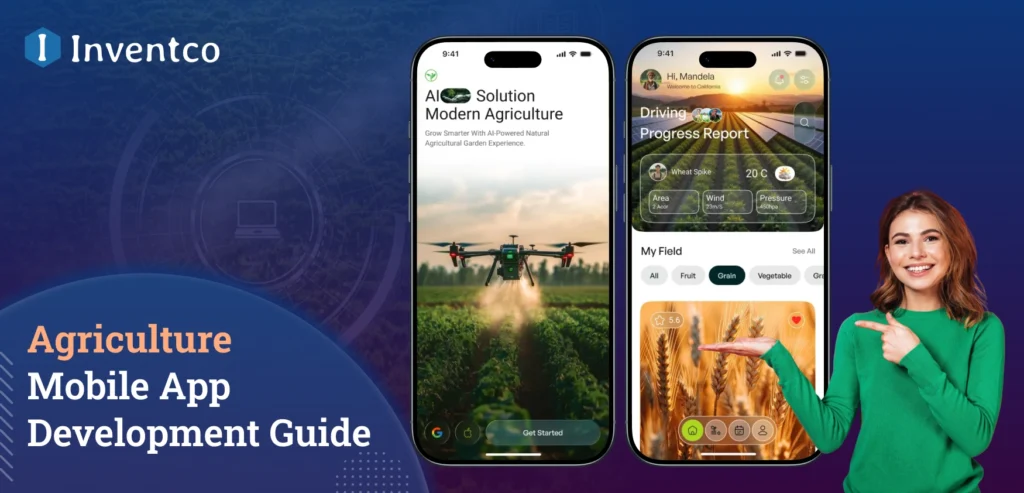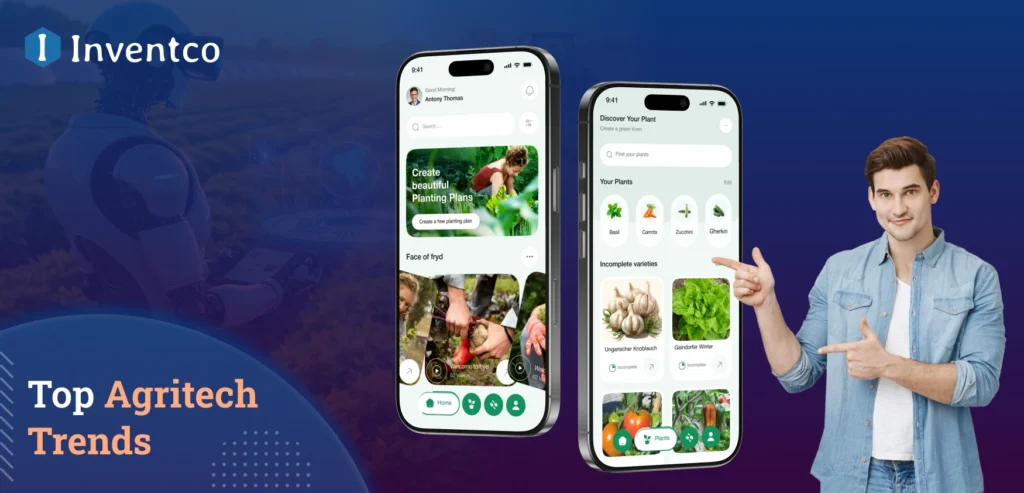
The evolving agribusiness sector is undeniably positive, having been influenced by the digital revolution, increased sustainability, and more data-driven decision-making. These transformations in the agribusiness sector have been positively impacted by the demand for food and the unpredictability of the climate. The agritech trends for 2026 have moved beyond the experimental stage and are becoming the ‘new normal’ for contemporary agribusiness.
The agriculture business sector transformed from one considered very manual and heavily reliant on workers’ experience to one that relies heavily on intelligent systems, connected technologies, and predictive analytics. The agritech trends that redefine how agribusiness operates and stays competitive span from smart agricultural applications to predictive crop planning enabled by artificial intelligence.
In this guide, we explore the key agricultural technologies shaping modern farming, the challenges to adoption, and why investors and founders should focus closely on agriculture mobile app development to build the next generation of digital agricultural solutions.
Overview of the Agriculture Industry and Market Stats
The rapid development of the global agribusiness technological sector is driven by increased digital adoption in the supply chain, farm operations, and agricultural finance. The rapid development of the agribusiness technology sector is driven by increased digital adoption across the supply chain, farm operations, and agricultural finance. From AI-based agribusiness finance to IoT-based farm management systems, digitalized agriculture technologies are becoming ubiquitous on every farm.
- The global agritech market is forecast to grow from approximately USD 34.58 billion in 2025 to about USD 38.56 billion in 2026, reflecting strong momentum in the adoption of technology-led farming worldwide.
- Over the longer term, the agritech market is projected to expand to around USD 58.79 billion by 2030, driven by precision farming, IoT devices, and AI-enabled analytics.
- The global smart agriculture market (a key component of agritech) was valued at about USD 25.36 billion in 2024 and is expected to reach USD 83.72 billion by 2033, with a strong CAGR of 14.6 % from 2025 to 2033.
- The global agriculture analytics market is estimated to grow from around USD 8.63 billion in 2026 to nearly USD 25.76 billion by 2034, indicating rising demand for data-driven farming insights.
Top Agritech Trends Transforming Agriculture in 2026
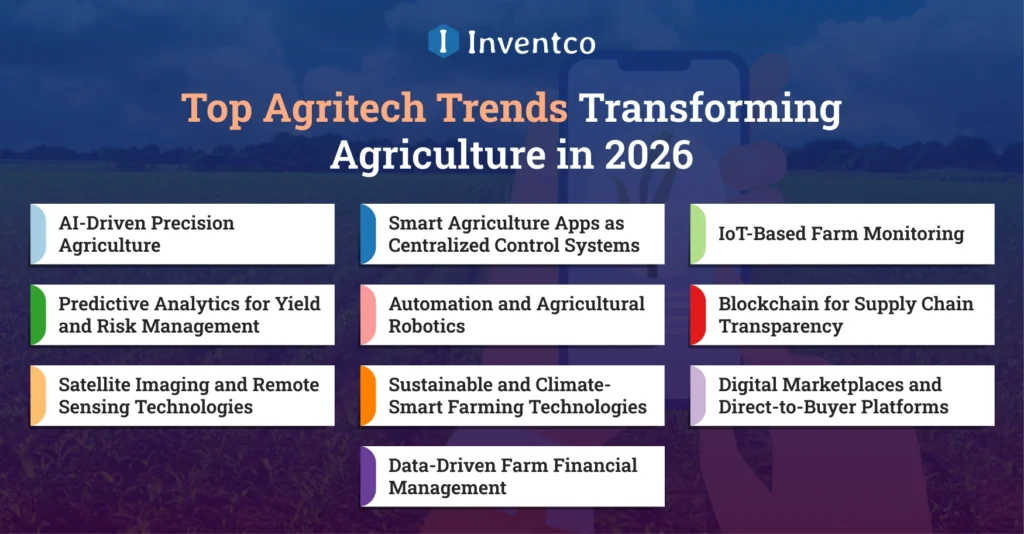
Transformative Agritech Trends in 2026, the year transforming agriculture into a data driven and tech-led industry, provides smarter farming, scalable operations and new opportunities for investors and founders developing new agricultural applications.
1. AI-Driven Precision Agriculture
Commercial farming operations are rapidly adopting AI-driven farming technology. AI-powered farming technology uses advanced algorithms to analyze and synthesize multiple data points, including soil quality, weather conditions, crop health and irrigation level, in order to provide actionable recommendations in real-time.
This technology empowers farmers to increase operational efficiency, reduce resource use, and improve the predictability of crop yields. Moreover, data-driven farming applications facilitate a shift in decision-making from the realm of guess work to the sphere of reason, making precision farming a scalable investment opportunity within the emerging technology trends in agriculture.
Key Use Case: Construct a predictive analytics agriculture app powered by AI and machine learning, which provides crop recommendations, optimized irrigation schedules, and nutrient management strategies, including fertilizer recommendations, based on real-time data from sensor networks within the commercial farming fields substrate. Monetize your app through subscription services or charge on a per-acre basis for large-scale commercial farming operations.
2. Smart Agriculture Apps as Centralized Control Systems
Smart farming applications are expanding their role from basic monitoring technologies to integrated platforms. These systems can consolidate crop planning, equipment tracking, labor management, inventory management, and performance analytics into a single interface. By providing farmers with real-time visibility over their operations, smart agriculture applications can eliminate workflow bottlenecks, reducing operational complexity.
Mobile-first applications are among the top technology trends in agriculture, and they are vital to scalable management in agribusiness. They are effective in improving the pace of decision-making and productivity for farming operations of all sizes.
Key Use Case: Build a comprehensive farm management platform that integrates all operations, labor, equipment, and analytics. This is particularly suited to SaaS models for mid to large agribusinesses and cooperatives.
3. IoT-Based Farm Monitoring
IoT-based monitoring technologies provide real-time tracking of key soil properties and will remain a key trend in agritech. Sensors connected to a network collect and transmit a continuous stream of data to smart agriculture applications, allowing farmers to track and monitor their crops from a distance.
By 2026, this technology will help agricultural stakeholders respond to current environmental conditions and eliminate wasted resources by creating ideal growing conditions. As agricultural technology continues to advance, the insights generated by IoT will be key to improving crop quality and operational efficiency.
Key Use Case: Develop a predictive analytics model to forecast yields, pest risk, and climate impacts for agribusiness. This will provide significant value to investors, insurers, agribusinesses, and enterprises focused on risk management and strategic planning.
4. Predictive Analytics for Yield and Risk Management
Predictive analytics is one of the most important trends in tech for agriculture in 2026. Predictive analytics apply to almost all areas of agriculture, including risk management and productivity management.
Predictive analytics works by using historical datasets and real-time environmental variables to forecast the output of a specific crop, potential pest issues, and any climate changes that could negatively affect that crop’s output. This type of planning is significant, as it allows for a more active planning process rather than waiting to implement solutions as issues arise.
Key Use Case: Predictive analytics for risk, finance, and forecasting provides agribusinesses and investors with greater flexibility in strategic planning and greater value in long-term planning for businesses operating in agriculture.
5. Automation and Agricultural Robotics
The rapid advancement in automation is transforming modern farming practices. Automation in farming is considered to be of great importance in agritech for the year 2026 and beyond. Now that farming is aided by autonomous tractors, robotic harvesters, and AI-driven machinery, operational consistency is better and the problem of labor shortages is becoming a thing of the past. These systems eliminate the need for human workers on repetitive tasks like planting, spraying, and harvesting.
As agricultural technology trends evolve, robotics-driven automation enables faster execution, lower long-term costs, and better scalability, making it a valuable domain for investors and founders of next-gen agricultural applications.
Key Use Case: Develop companion applications to control, monitor, or analyse robotic farming equipment. These platforms can offer systems for automated farming that help plan, maintain, and optimize farming practices.
6. Blockchain for Supply Chain Transparency
Understanding the development of trends in the agricultural technology sector reveals the driving force behind the adoption of blockchain technology for supply chain transparency and traceability improvements. Blockchain technology can enable agriculture apps to record unchangeable data. This data can be recorded at each step, from production to distribution. Recording the different stages of the supply chain helps ensure the authenticity, safety, and compliance of the food with food safety regulations.
This technology is especially applicable to the business production of food in the agriculture sector, which is highly oriented to the export of premium-priced food products. Integration of blockchain technology in 2026 and beyond will advance the demonstrated positive attributes of customer confidence, reduced fraudulent activity, and analytics-based audits for supply chain transparency, making them highly sought-after attributes in scalable technologies and platforms in agriculture.
Key Use Case: Build blockchain-based apps for agriculture that record the entire supply chain of a food product, from the farm to the market. This will be especially applicable to export businesses, supply chains for organic food products that require strict compliance and traceability, and those in need of audit preparedness.
7. Satellite Imaging and Remote Sensing Technologies
In 2026, the use of remote sensing technologies and satellite imaging will be one of the key trends in agricultural technology, as these technologies will enable large-scale agricultural monitoring without the need for physical inspection of the farm. These technologies utilize artificial intelligence (AI) to assess in agriculture the health of crops, the density of the vegetation, the stress of the water, and the assessment of the land utilization, and these technologies will utilize imaging of high resolution to carry out the assessment.
When satellite data is used in conjunction with other technologies, it can assist farmers in identifying problem areas, enabling them to use their resources in the most efficient manner and manage them effectively. This will be especially applicable to large farms, cooperatives, and agribusiness enterprises.
Key Use Case: Launch enterprise-grade solutions that combine Artificial Intelligence with satellite imagery for extensive land monitoring. Focus on satellite-image AI solutions for government initiatives, agribusiness, and corporate farming with large landholdings.
8. Sustainable and Climate-Smart Farming Technologies
Technologies that address climate and environmental sustainability are becoming core Agritech trends. Climate-smart tech enables farming with fewer chemicals and lower carbon footprints while optimizing water use. Agritech solutions offer sustainability tracking, environmental reporting, and compliance monitoring.
These trends in agricultural technology will help companies achieve environmental sustainability in 2026. For investors and entrepreneurs, sustainability-focused solutions will meet global ESG compliance while providing substantial growth in the agriculture sector.
Key Use Case: Develop agritech software applications focusing on sustainability compliance that monitors water consumption, greenhouse gas, and eco-compliance. These applications are aligned with ESG-focused investors and sustainable agriculture initiatives from government bodies.
9. Digital Marketplaces and Direct-to-Buyer Platforms
Digital Market Places are transforming traditional agricultural commerce, it is one of the latest Agritech trends. Digital Marketplaces help farmers connect directly with buyers, suppliers, and distributors. This eliminates the need to rely on intermediary buyers. Digital agriculture apps improve farmers’ profitability by increasing market access and maintaining price transparency.
Along with other trends in agriculture, these market places provide farmers with real-time demand insights and logistics integration. For founders, agritech models focused on market places provide powerful network effects and scalable revenue opportunities.
Key Use Case: Build agritech apps for digital agriculture to create market places and connect farmers with buyers and suppliers. Revenue opportunities include logistics partnerships, data insights, transaction fees, and premium listings.
10. Data-Driven Farm Financial Management
As farming operations become more complex, data management has become an essential part of modern agriculture apps. Financial management tools track spending, profitability, grants, and ROI, even at the crop or farm level.
The integration of operational data and financial analytics has become part of other emerging agriculture technology trends. This allows farmers and agribusinesses to make smart investment decisions. This trend in 2026 will support smart budgeting, risk assessment, and scalable operations. For agritech investors focused on sustainable ventures, it will be especially exciting.
Key Use Case: Developing financial management tools that track profitability, subsidies, and ROI within agricultural apps increases value for commercial farms, investors, and agri-fintech integrations.
Latest Agriculture Technology Trends to Watch in 2026
Technology continues to transform the agricultural sector each year. While established trends like digitization and smart farming are refining the ways we farm, new trends are shaping the future of digital farming. Farmers are increasingly using AI to gain predictive insights into future pest infestations, crop yield variations, and environmental challenges. There also continues to be widespread use of satellite imagery and sensor technology, along with the analysis of agricultural apps, to facilitate large-scale assessments without requiring in-field inspections.
Agricultural technology apps also use machine learning to generate personalized recommendations based on farm size, crop type, and prevailing weather conditions. These innovations transform traditional agricultural technologies into intelligent, scalable, and long-lasting decision support systems.
How Technology Trends Are Changing Traditional Farming Practices?
Over the years, farming practices have heavily relied on manual labor and years of experience to predict the right time for planting and harvesting crops. Traditional farming practices have changed with the development of farming technology. Farming technology provides measurable data rather than relying on assumptions. Farmers can now use mobile farming apps to track performance, receive alerts about future events, and automate their processes with greater accuracy.
The transition to farming technology marks a major shift from traditional agricultural practices. By reducing uncertainty, modern farming technologies lower operational risks and improve farm efficiency. More importantly, well-designed mobile app features are enabling small farmers and large agribusinesses to collaborate effectively, unlocking the full potential of the modern farming ecosystem.
Challenges Impacting the Growth of Agritech Solutions
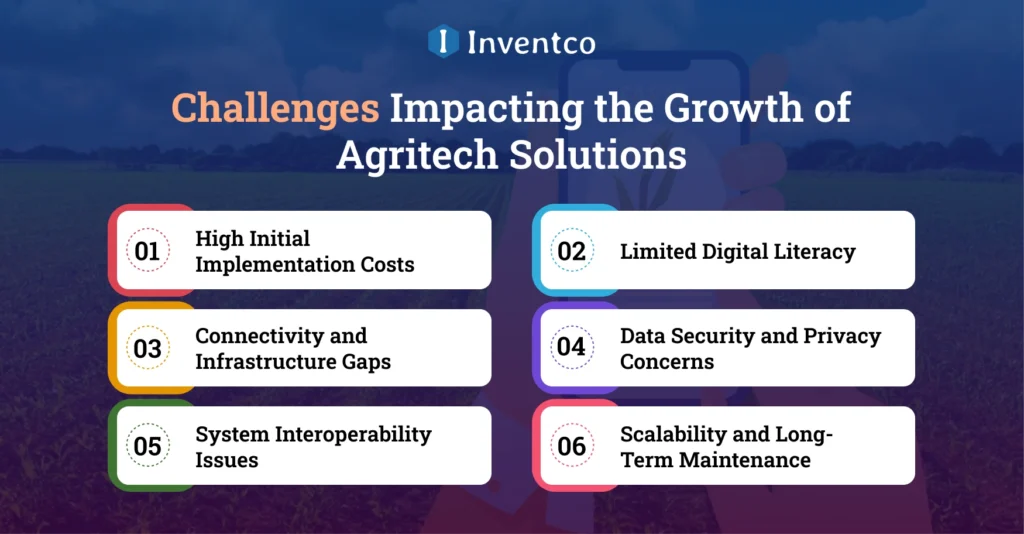
The farming industry, as it completely transforms to incorporate agritech innovations, has the potential to create new shifts. However, there are several issues preventing agritech from being utilized.
1. High Initial Implementation Costs
Cutting-edge agritech products can put significant financial strain on small and medium farmers. Large agritech products require substantial investment in new software, technology, and equipment, hindering smaller farmers’ ability to invest.
2. Limited Digital Literacy
Many farmers and users of farming technologies are unfamiliar with complex digital technologies. Without adequate training to use farming apps, the potential of agricultural technologies is greatly underutilized.
3. Connectivity and Infrastructure Gaps
Most rural areas of the developing world have poor internet access. When farming technology relies on the cloud, it cannot be utilized to its full extent if data cannot be transferred in real time.
4. Data Security and Privacy Concerns
Given the sensitive operational data farms generate, protecting and securely storing data, as well as ensuring compliance, are major concerns in enterprise-level deployments.
5. System Interoperability Issues
The seamless integration of new agritech platforms with existing tools, equipment, and data systems remains a challenging task.
6. Scalability and Long-Term Maintenance
Many solutions face increasing app maintenance costs and performance risks as farm operations grow, yet they do not scale efficiently.
For founders and investors, addressing these app development challenges through intuitive user experience design, offline-friendly systems, and tiered, manageable cloud storage is fundamental to building sustainable, high-impact agricultural applications.
Who Benefits Most from Modern Agritech Trends?
Decision-makers have the power to influence the future of the agriculture sector. Agritech trends 2026 will be most applicable to:
- Investors interested in agritech and digital farming are offering scalable and impactful opportunities.
- Agritech startup founders looking to develop farming apps or SaaS solutions.
- Agribusiness companies are upgrading legacy systems to enhance operational efficiency, traceability, and data optimization.
- Government agencies and digital cooperatives are advocating for the digital transformation of rural areas and the sustainability of farming, food security, and rural areas.
Stakeholders across food production, supply chains, and agricultural services must treat agritech trends as urgent strategic priorities and adopt sustainable app monetization strategies that support long-term scalability, innovation, and market competitiveness.
How Inventco Can Help You in Agriculture App Development?
To develop agriculture apps that are future-ready, there must be more than just technical execution, there must be an understanding of the industry, the architecture should be scalable, and there must be a product vision for the long term to be successful. Inventco stands out as the best mobile app development company for agricultural solutions, delivering secure, scalable, AI-enabled platforms aligned with modern farming needs.
From enterprise-grade systems for farm management to precision-farming apps, Inventco offers solutions that prioritise performance, utility, and a positive return on investment (ROI). The company prioritizes app security, regulatory compliance, and the adoption of emerging technologies to help founders and investors bring agritech ideas to market while building reliable digital products designed for long-term growth.
Inventco combines proven agritech and agriculture app development expertise with a founder-led, agribusiness, and innovation-driven team to develop solutions for real farming problems. By building hands-on platforms for precision agriculture, data-driven agriculture apps, and scalable cloud systems, Inventco has a proven understanding of the agribusiness’s operational, regulatory, and scalability demands. As such, Inventco has earned the trust within the agritech sector to become a technology partner for a venture.
Conclusion
The trends of agritech for the year 2026 have shown us that technology is not simply a tool but the very foundation of agriculture. With innovations from AI-powered analytics to smart apps for agriculture, the way food is produced and how it is managed and distributed has changed tremendously.
For founders and investors, this has changed how scalable and future-proof solutions can be created. With the right development partner and strategy, the potential is limitless. From the data-driven platforms and the development of experienced teams, businesses can prepare for the next large-scale revolution in agriculture.
FAQ’s
Q1. What are the biggest agritech trends in 2026?
Ans. AI-powered precision farming, smart agriculture apps, automation, and blockchain-based traceability are among the most impactful agritech trends in 2026.
Q2. Why are agriculture apps important for modern farming?
Ans. Agriculture apps centralize data, automate processes, and enable real-time decision-making, improving efficiency, productivity, and sustainability.
Q3. Is agritech a good investment opportunity?
Ans. Yes, agriculture technology trends show strong growth potential due to rising food demand, sustainability goals, and digital transformation.
Q4. What challenges do agritech startups face?
Ans. Common challenges include high development costs, digital adoption barriers, infrastructure limitations, and data security concerns.
Q5. How do I choose the right partner to build an agriculture app?
Ans. Look for a best mobile app development company with agritech experience, scalable architecture expertise, and a strong focus on ROI and compliance.

Jitendra Jain
He is the CEO and Co-founder of Inventco, driving innovation in advanced computing and digital transformation. With deep expertise in modern IT ecosystems, he leads scalable, secure, future-ready solutions. His strategic leadership helps businesses accelerate growth, adopt innovation, and achieve success. You can connect with him on LinkedIn to follow his technology insights.