Chatbots have created a huge buzz in the business community across various industries globally. Their revolutionary success has reshaped the way brands interact with their customers. Using best practices in chatbot development has helped businesses set new standards for customer service.
In today’s digital world, it is essential to keep customers engaged and supported by providing instant, personalized 24/7 support. However, an effective AI chatbot development company needs a deep understanding of human conversation to deliver precise, helpful responses.
In this blog, we will discuss the key elements of AI Chatbot development services to improve interactions for businesses.
Key Takeaways
- The global AI chatbot market is rapidly expanding, with projections exceeding USD 61 billion by 2032, making strategic chatbot adoption a business necessity.
- Effective chatbot development requires optimized workflows, real-time decision-making, personalization, and continuous performance improvement.
- Selecting the right tools and ensuring CRM, inventory, and system integration are critical for scalability and operational efficiency.
- Strong security frameworks, including encryption and authentication, are essential for protecting sensitive customer data and ensuring compliance.
- Conversational UI design, user experience focus, and chatbot personality significantly improve engagement and customer satisfaction.
- Following structured chatbot development best practices leads to improved accuracy, consistency, measurable ROI, and long-term digital growth.
- Real-world implementations like Wehad Bot demonstrate how scalable architecture and secure integration drive meaningful business outcomes.
AI Chatbot Market Statistics & Growth Outlook
- Before implementing best practices, it’s important to understand what AI chatbot technology is and why adoption is accelerating globally.
- The global chatbot market is projected to surpass USD 10–11 billion by 2026.
- According to industry research, the global conversational AI market is expected to grow from approximately USD 12.24 billion in 2024 to USD 61.69 billion by 2032, reflecting strong long-term demand and investment in AI-powered interaction technologies.
- Businesses evaluating the top AI chatbots are increasingly investing in automation, personalization, and AI-driven engagement.
Best Practices for Chatbot Development
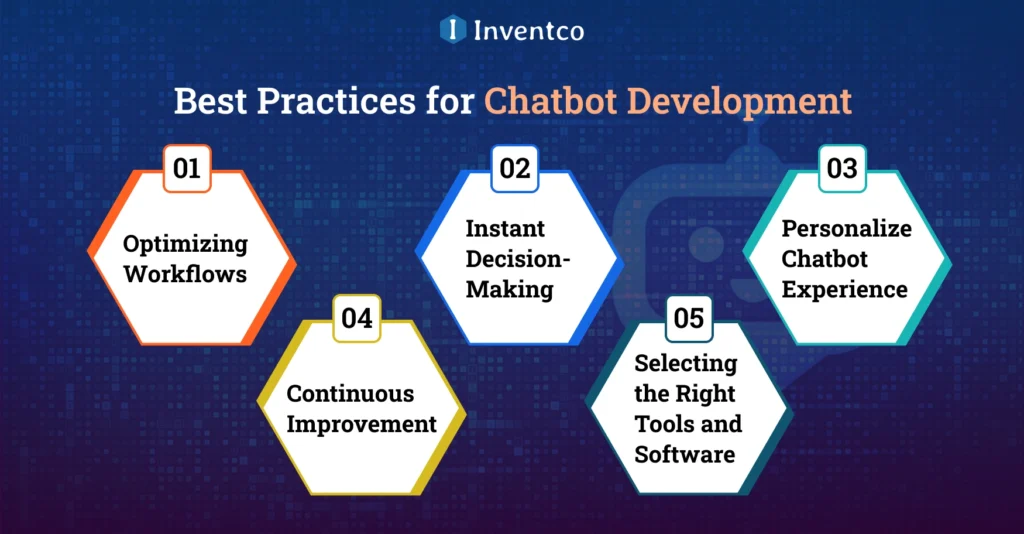
Chatbot development best practices can be defined as the guidelines for creating effective design, excellent implementation, and adequate management of bots. Have a look at those practices in detail below:
1. Optimizing Workflows
Customer service demands efficiency, and streamlining workflows allows chatbots to do this thing efficiently. Developing workflows that give resolution to the queries helps customers resolve their queries adequately and prompts brand loyalty. So, it is highly recommended that a proper strategy for chatbot workflows should be created to guide users in receiving precise and instant solutions.
2. Instant Decision-Making
If a chatbot faces a query that is beyond its understanding, it is essential to transfer the conversation to a real agent to give the best interaction to the customer. Also, the chatbot Development Company should think about connecting the bot to inventory management, customer relationship management, or other similar platforms to boost efficiency.
3. Personalize Chatbot Experience
Every customer wants to feel special while connecting to a brand, and adding personalization in the chatbot development process can help in doing so. For example, customizing interactions to recommend tailor-made solutions that meet customer needs can let them feel valued.
4. Continuous Improvement
A chatbot’s continuous improvement is the key to ensuring faster resolution and higher customer satisfaction. Measuring key performance indicators regularly is recommended to ensure the chatbot is performing according to its capabilities. It will help in finding the areas that need improvement for different types of chatbots. Also, think about gathering regular feedback from customers to enhance the performance.
5. Selecting the Right Tools and Software
Every chatbot comes with a few distinct features that are created for a certain purpose. That is why selecting the right type is considered one of the best practices for chatbot development to ensure your business purpose is fulfilled.
Whether it is about handling security compliance or scalability requirements, your AI chatbot development company should ensure the right tools and software are selected. This is especially important when chatbots are part of a larger mobile app development project, where integration and scalability are key.
Chatbot Design Best Practices
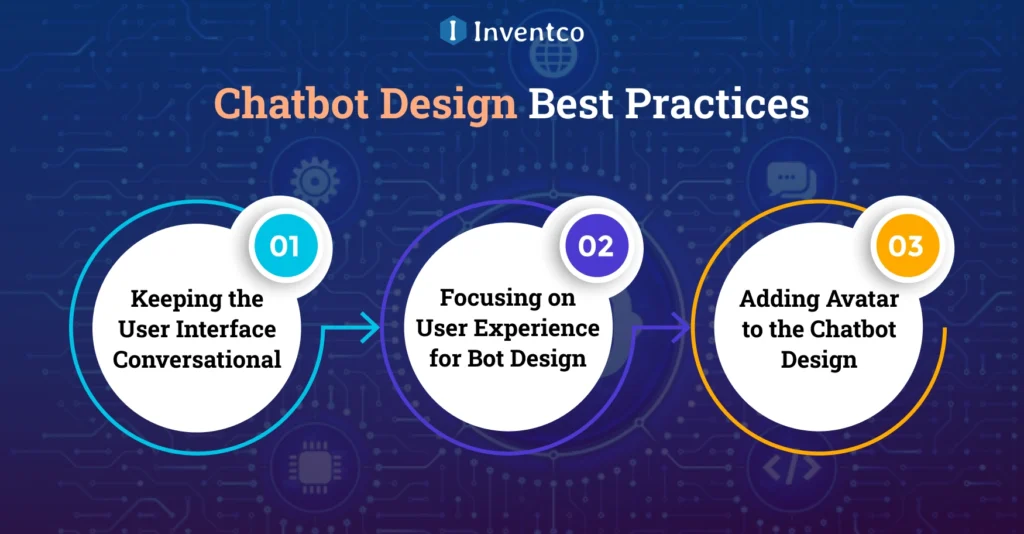
Creating a chatbot requires a highly intuitive design to boost customer experience. Let’s have a look at the major chatbot design practices in detail below:
1. Keeping the User Interface Conversational
Design a chatbot that offers natural conversations to the users rather than having a robotic tone. Having an engaging language won’t only provide engagement to the conversations but also let the bot guide customers effectively.
2. Focusing on User Experience for Bot Design
User experience will always play a critical part in maintaining interest during interactions. It is one of the best practices in chatbot building that ensures users can enjoy quick responses to its interface. If the developers create a visually appealing UI, it won’t only make the conversations efficient but also boost the user experience.
3. Adding Avatar to the Chatbot Design
None of the users will prefer to engage with a plain and boring chatbot. That is why we recommend designing a chatbot with a specific personality. It is one of the most incredible chatbot design practices for making conversations engaging.
Why Chatbot Development Best Practices Matter?
If you opt for a professional enterprise AI chatbot development service, you will find that they follow a certain set of practices that ensure precise working and accurate responses from chatbots. They will adhere to established frameworks to ensure bots meet customer expectations.
Have a look at the reasons why best practices for chatbot development can boost your business operations:
1. Improved Accuracy and Consistency
Companies can choose to develop a customized bot that can address FAQs and give step-by-step guides for common issues faced by customers. The chatbot development company will stipulate predefined replies that ensure brands can exercise control over the information that drives communication.
It minimizes the chances of inconsistent answers that can happen with human agents. Also, companies can monitor bots’ performance by running a few tests by opting for professional chatbot development services that help improve the accuracy of answers.
2. Better Security & Compliance
If a company regularly tracks the chatbot’s performance, it can help in finding any issues for taking instant action. It will also ensure the bot fulfills the regulatory requirements while handling user data.
That’s not all; selecting the right set of tools is very helpful in upholding security. A well-designed chatbot will come with integrated security features, like user authentication, encryption, and safe data storage, that ensure customers’ sensitive information stays protected.
3. Increased Engagement with Potential Customers
A bot developed using the best practices for chatbot development will allow companies to engage more potential customers and expand their customer base.
Customers get attracted to the brands with whom they have positive interactions. By following the right set of practices, the company can succeed in having a positive impact on the minds of potential customers.
Case Study: Wehad Bot – AI & WhatsApp Chat Support Platform
Inventco designed and deployed Wehad Bot using a structured, enterprise-grade chatbot development process focused on scalability, compliance, and seamless system integration. The solution was engineered to integrate smoothly with the WhatsApp Business API and to synchronize with internal CRM and content management systems, ensuring centralized control of communication.
One of the primary challenges in implementing chatbots involves safeguarding sensitive customer data without compromising real-time personalization. To address this, Inventco implemented end-to-end encryption, secure authentication protocols, and structured conversational workflows that balanced automation with data protection standards.
The result was a secure, AI-powered communication platform capable of delivering context-aware responses at scale. Wehad Bot illustrates how selecting the right types of chatbots and aligning technical architecture with business objectives can generate measurable improvements in customer engagement, operational efficiency, and long-term digital performance.
Conclusion
Adopting best practices for chatbot development will enable your company to deliver efficient, effective, and top-quality customer service. Whether it is by choosing the perfect software or integrating personalization capabilities, enhancing the level of customer interactions is quite important.
Connecting with Inventco will allow you to access a workspace that integrates a customized chatbot seamlessly with your company’s existing solutions.
FAQs
Q1. What is a Chatbot?
Ans. A chatbot can be defined as software that mimics human conversation using voice commands and texts to give automated communication support to businesses.
Q2. What is the Difference between Chatbot vs. Conversational AI?
Ans. A chatbot usually works according to a predefined conversation flow, whereas conversational AI uses advanced technology to make interactions natural and effective.
Q3. What is the Cost to Develop a Chatbot?
Ans. We have to consider lots of different factors while considering the cost, ranging from complexity to design and technology. The chatbot development cost can be anywhere between $ 10,000 and US$ 200,000 or even more. For more details, we can connect with our team.
Q4. How long does it take to develop a chatbot?
Ans. Time to develop a chotbot depends on the complexity of the chatbot. Generally, a chatbot of mid-level complexity can be made in around 3-12 weeks. For more details you can contact our team.
Q5. Why is conversation flow important in chatbot design?
Ans. A conversation flow is crucial because it decides how quickly and better a bot can answer user queries. It creates the pathway for making conversations engaging and efficient.
Q5. What are the common mistakes to avoid in chatbot development?
Ans. Some popular mistakes to avoid include selecting the wrong bot type, a poor testing system, poor strategy making, and an overcomplicated design.

Sandeep Agrawal
Sandeep Agrawal is the visionary CTO at Inventco, bringing innovation to life through his technical expertise. With a passion for cutting-edge technologies, Sandeep leads the team in developing robust solutions. His dedication and continous efforts to pushing the boundaries of what’s possible defines his role as a transformative and innovative force in the tech industry. You can connect with him on LinkedIn to follow insights.