Every founder pitching a live streaming app idea over the past few years has to answer the same question from investors: “How much is it going to cost to build, and when is it going to turn a profit?” So the simple answer is that the cost to develop a live streaming app can start from $10,000 and exceed $100,000+, based on the desired scope and features.
This is a valid question to ask. The required investment to develop a product with a vision to capture the live streaming market, which has lucrative revenue potential, can be justified. The industry appears very enticing from the outside. Twitch generates billions in revenue, TikTok Live has changed the way creators make money, and Zoom’s growth during the pandemic proved that real-time videos are an essential part of the digital world.
However, this is where many of the initial decisions of an entrepreneur go wrong. The first major mistake that many founders make is underestimating the technical, infrastructural, and operational costs of sustaining and maintaining a quality product that offers users a seamless experience in real time and that is scalable.
The live streaming app development cost is not a single number. It is a combination of architectural decisions, feature priorities, platform choices, development team location, and post-launch obligations that most online cost calculators conveniently overlook.
This guide explains all the considerations that go into developing a live stream app, particularly the costs that will be incurred to support the app. The guide also has costs for a variety of different projects, and most importantly, a framework to help keep your finances on track.
Key Takeaways
- Live streaming app development cost ranges from $10,000 (basic MVP) to $100,000+ (enterprise platform).
- The global live streaming market is projected to surpass $247 billion by 2027.
- Core cost drivers: real-time video infrastructure, CDN integration, interactive features, and post-launch maintenance.
- A live streaming MVP can be built for $10,000–$30,000; full-featured platforms range from $60,000 to $100,000+.
- Hidden costs, CDN bandwidth, third-party API licensing, and ongoing maintenance add 15–25% to the initial budget.
Global Market Statistics for Video Streaming Apps
Global demand for video streaming apps is accelerating rapidly, fueled by growing internet penetration, mobile-first content consumption, creator economies, and the increasing preference for on-demand and live digital entertainment.
- According to Grand View Research, the global video streaming market size was estimated at USD 129.26 billion in 2024 and is projected to reach USD 416.8 billion by 2030, growing at a CAGR of 21.5% from 2025 to 2030.
- The Global Live Streaming Market is expected to register a CAGR of 25.60% during the forecast period and is estimated to reach USD 1,104.72 million by 2035 from USD 90.01 million in 2024.
- Leading platforms such as YouTube, Twitch, and Instagram collectively generate more than 1 billion live streaming sessions every month, highlighting massive user engagement worldwide.
Live Streaming App Development Cost
The cost to build a live streaming app is around $10,000 to $100,000+, but it depends on several factors like features, complexity, platform choice, and so on.
Here is the breakdown of the cost to build a mobile app:
| App Type | Estimated Cost |
| Basic MVP (single platform, limited features) | $10,000 – $30,000 |
| Mid-tier app (dual platform, core streaming features) | $30,000 – $60,000 |
| Full-featured platform (iOS + Android + Web) | $60,000 – $100,000 |
| Enterprise-grade platform (custom CDN, AI features) | $100,000+ |
1. Basic MVP (Single Platform, Limited Features)
Basic MVP (Minimum Viable Product) focuses on cost-effective product validation using basic functionality. Basic MVP mobile apps strive to incorporate features like user registration and content navigation/playback in mobile apps (iOS or Android). These features help in performing market testing and collecting feedback for product iteration with minimum upfront investments. These MVPs are also great for entry-level digital products or platforms.
2. Mid-Tier App (Dual Platform, Core Streaming Features)
A mid-tier app is a product with more invested, polished features and the ability to support both iOS and Android platforms. Mid-tier apps include core streaming capabilities, such as a content library, user profile, and search features; subscription and payment support; and backend services for app streaming. While increased cost and complexity of app features and services are a priority, this is a critical point for businesses that are providing reliable streaming services and competitive user experiences.
3. Full-Featured Platform (iOS + Android + Web)
This tier goes beyond mobile apps to streaming capabilities on the web. The features at this tier also include advanced streaming, user-customized recommendations, content management and delivery, analytics, subscriptions, and mobile app security. Other required features are cross-platform sync and infrastructure that can expand and grow. This level of investment is appropriate for companies that are committed to a quality digital streaming service.
4. Enterprise-Grade Platform (Custom CDN, AI Features)
Platforms built for enterprises are designed to handle a considerable number of users and large-scale operations. The platforms integrate advanced technologies such as a custom CDN for faster content delivery, AI recommendations, predictive analytics, and automated moderation, along with advanced security frameworks. The platforms are built for scalability, reliability, and high performance. Customizations, infrastructure complexity, and a need for constant optimization also drive high costs, which can easily go over $100,000.
Why Is the Live Streaming App Market Worth Investing In?
Live streaming is an interesting area for business owners and investors alike due to the fast-growing consumer markets, the ability to easily monetize, and the opportunities that exist in the creator, enterprise, and niche markets.
The Creator Economy Is Not Slowing Down
The growing live streaming platforms that help creators to instantly monetize through donations, subscriptions, or live commerce are likely to be very successful.
Engagement Metrics Are Incomparable
Live content consistently outperforms on-demand video in time-on-app, social sharing, and in-session purchase rates. This directly affects your ability to monetize through ads, subscriptions, and in-app transactions.
Niche Is The New Scale
To earn money through your mobile live streaming app, you do not need to be a competitor of Twitch. The goal-specific applications for activities, such as instructional fitness, real estate, e-learning, webinars, and other B2B activities, help to find a strong market with low acquisition costs.
Enterprise Demand Is Rising
Live streaming infrastructure is important for companies’ all-hands meetings, product launches, training, and investor communications. This creates an opportunity for B2B SaaS with higher contracts and lower churn compared to a consumer app.
Key Factors That Affect Live Streaming App Development Cost
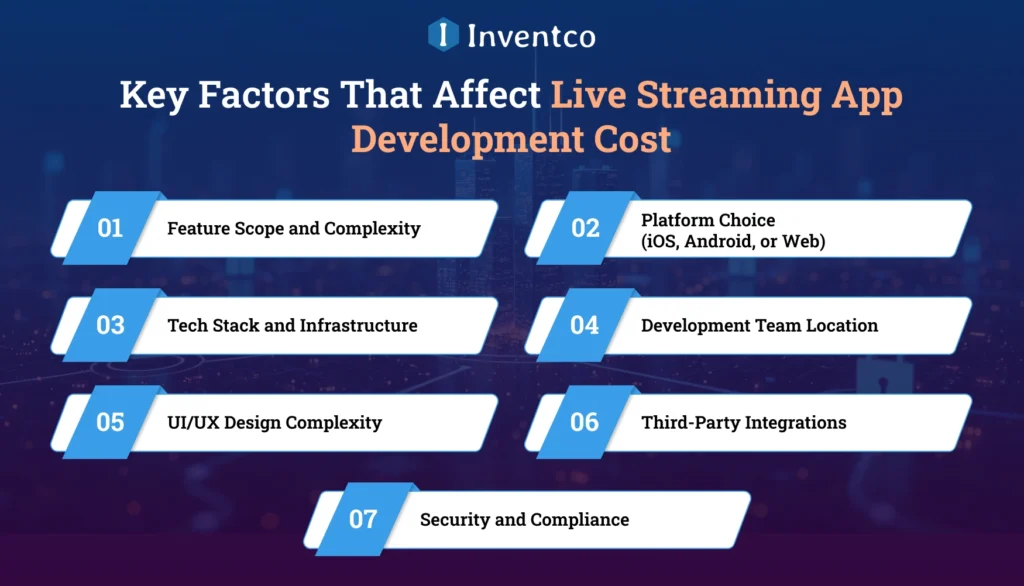
The cost of building a live streaming app is influenced by multiple technical and business factors. Understanding these variables helps founders create realistic budgets, prioritize features, and avoid unexpected development expenses.
1. Feature Scope and Complexity
Real-time video streaming requires a fundamentally different architecture from pre-recorded content. Mobile app features like multi-host streams, interactive chat, tipping systems, screen sharing, or virtual backgrounds each add engineering complexity and cost.
2. Platform Choice (iOS, Android, or Web)
Building for a single platform is significantly cheaper than building for all three. A cross-platform approach using Flutter or React Native can reduce cost by 30–40%, but comes with trade-offs in performance and customization.
3. Tech Stack and Infrastructure
WebRTC handles peer-to-peer real-time communication efficiently at a small scale. But once you are managing thousands of concurrent viewers, you need a CDN and a media server architecture, both of which add to your infrastructure costs.
4. Development Team Location
| Team Location | Avg. Hourly Rate |
| North America | $100 – $200/hr |
| Western Europe | $80 – $150/hr |
| Eastern Europe | $40 – $80/hr |
| India / South Asia | $20 – $50/hr |
5. UI/UX Design Complexity
App wireframing, prototyping, and iterative UX testing for a live streaming product typically adds $5,000–$15,000 to the project cost.
6. Third-Party Integrations
Payment gateways, social login, push notifications, analytics dashboards, and moderation tools all require integration work, and some carry per-minute API licensing fees that become material at scale.
7. Security and Compliance
End-to-end encryption, content moderation, GDPR compliance, and DRM for premium content each add to the development scope and cost.
Must-Have Features and Their Cost Impact
Feature decisions are budget decisions. Here is how the core feature set maps to development effort and cost:
| Feature | Complexity | Estimated Cost |
|---|---|---|
| User Registration & Profiles | Low | $1,000 – $3,000 |
| Live Video Broadcast | High | $8,000 – $20,000 |
| Real-Time Chat & Reactions | Medium | $3,000 – $8,000 |
| Multi-Host / Co-Streaming | High | $5,000 – $15,000 |
| In-App Tipping & Gifting | Medium | $4,000 – $10,000 |
| Subscription & Paywall | Medium | $4,000 – $8,000 |
| Push Notifications | Low | $1,500 – $3,000 |
| Recording & VOD Playback | Medium | $5,000 – $12,000 |
| Admin Dashboard & Analytics | Medium | $5,000 – $10,000 |
| Content Moderation Tools | High | $5,000 – $12,000 |
| Search & Discovery | Medium | $3,000 – $7,000 |
Development Cost Breakdown by Phase
Understanding how much building a streaming app costs per phase helps you develop your budget more effectively, as building a streaming app requires a systematic approach.
1. Discovery & Planning ($2,000 – $8,000)
This phase builds the initial outline to understand the goals of the project. Some of this includes defining the users and performers of the service as well as planning the technical framework of the project. Understanding the outline and defining the initial goals will limit the risks tied to the project in the long run.
2. UI/UX Design ($5,000 – $15,000)
This step focuses on creating the mobile app prototypes and visual tools for the streaming app. A good UI/UX design is important for better user engagement and retention, and an overall good design helps facilitate a good user experience across all devices.
3. Frontend & Backend Development ($20,000 – $60,000)
Developing the UI and business logic of the app and creating the infrastructure for databases and APIs is done in this phase. Of all the phases, this has the largest monetary investment due to the impact it has on the overall functionality and user experience of the app.
4. Streaming Infrastructure ($5,000 – $15,000)
In this phase, the development of the media servers, CDNs, and the streaming optimization and delivery infrastructure is constructed. This ensures quality, fast loading, streaming, and server traffic.
5. Testing & QA ($3,000 – $10,000)
Mobile app testing and QA ensure the various aspects of the application, from functionality to performance and, of course, security and usability of the application. A variety of tests are performed to assess load and latency, and as the name of this phase suggests, quality.
6. Deployment & Launch ($2,000 – $5,000)
Deployment entails the preparation, monitoring, and support of an optimized launch of the streaming application, as well as all the tasks involved in submitting the application to the various app stores. This phase also makes the streaming application available to its users.
Pro Tip: One of the biggest financial blunders that teams can make is skipping the discovery phase. Requirements that are not clearly defined cause scope creep and budget overruns. The cost of skipping the discovery phase is always going to be less than the cost of having to do the work multiple times.
How Platform Choice Impacts Live Streaming App Development Cost
| Platform | Cost Range | Best For |
| iOS Only | $15,000 – $45,000 | Premium consumer market, fast go-to-market |
| Android Only | $15,000 – $45,000 | Global reach, emerging markets |
| iOS + Android (Native) | $35,000 – $90,000+ | Maximum performance, large audiences |
| Cross-Platform (Flutter/RN) | $25,000 – $60,000 | Cost efficiency, dual-platform reach |
| Web + iOS + Android | $60,000 – $100,000+ | Complete product, maximum coverage |
Cross-platform frameworks like Flutter are increasingly viable for streaming use cases. A technical discovery session with your development partner will clarify which approach fits your specific product requirements.
Live Streaming App Tech Stack: Technologies and Cost Considerations
The mobile app technology stack that you use to build your mobile live streaming platform is as much a financial decision as it is an engineering one.
1. Real-Time Communication
Real-time communication technologies such as WebRTC, Wowza, and Ant Media allow near-instant video communication. They can be expensive, with licenses, hosting, and scaling costs averaging $300 to $1,500 a month.
2. CDN
Content Delivery Networks like AWS CloudFront, Cloudflare, and Fastly transport video streams, delivering them around the world. These networks typically charge between $0.01 and $0.04 per GB.
3. Cloud Infrastructure
Cloud platforms such as AWS, Google Cloud, and Azure provide computing and networking resources, but can be expensive, with an average range of $500 to $5,000 a month.
4. Backend Language
Backend technologies like Node.js and Go power application logic and real-time processing. Development costs of these technologies are scalable and highly dependent on the design of the system and the expertise of the engineers.
5. Database
PostgreSQL, Redis, and Cassandra are among the many choices for databases that hold user data and content, along with application performance. Costs vary with design choices, scaling, and maintenance, as well as possible licensing.
6. Mobile Framework
Mobile app frameworks including Swift, Kotlin, Flutter, and React Native influence development speed and performance. Framework selection directly impacts project timelines, resource allocation, maintenance, and overall development costs.
Hidden Expenses That Impact Streaming App Budgets
The cost of developing a live streaming app is only one piece of the puzzle. There are ongoing costs for operations, infrastructure, compliance, and costs related to the use of the app that can significantly impact profits and should be factored in.
1. CDN and Bandwidth Costs at Scale
If your app streams video at 720p to 10,000 users for one hour, that app would use 4.5TB of bandwidth. At a cost of $0.02/GB, that equates to a cost of $90 for each hour of live streaming. If your app hosts multiple live streams each day, this cost will become a significant expense.
2. Third-Party API Licensing
Agora, Twilio, and Vonage support real-time communication for the majority of streaming apps. Their pricing is per minute and per user, which is not a concern at the beginning, but must be considered as the company grows.
3. Content Moderation
The user-generated live content of streaming platforms places a number of regulatory and reputational burdens on them. Larger platforms will find AI-based content moderation an increased cost, and further, human moderation will be a significant operational expense.
4. App Store Fees
Platform moderation that is either tipping-based or subscription-based is effectively a cost share, as both Google and Apple charge 15-30% commissions on in-app purchases. This share needs to be accounted for in the unit economics of the app from the outset.
5. Legal and Compliance
DMCA compliance and the setup of a live content platform will require policy and legal support for your privacy and terms of service. The initial legal setup will cost between $3,000 and $10,000.
Live Streaming App Maintenance Cost After Launch
Building the app is the beginning of your investment, not the end. Mobile app maintenance is an ongoing operational cost that most budget models underestimate.
Annual Maintenance Budget: 15–20% of initial development cost. For a $60,000 platform, that is $9,000–$12,000 per year.
This covers:
- Bug fixes and performance optimization
- OS updates and new iOS and Android releases require compatibility testing and patches
- Feature additions based on user feedback and market changes
- Security patches and vulnerability remediation
- Infrastructure scaling and cost optimization
- App store policy compliance updates
A live streaming platform that does not keep pace with OS changes and security standards will face increasing churn and eventually marketplace delisting. Building a maintenance budget into your financial model from launch is a mark of operational maturity.
How to Reduce Development Cost Without Compromising Quality
The focus should be on making the right technical and business decisions instead of cutting corners to control the costs of developing a live streaming app. This will maximize the potential return on investment. It will also allow the app to be launched faster and more efficiently.
1. Start with a Live Streaming MVP
An MVP might streamline development with approximately $10K to $30K to get your app to market, with relevant functionality for your business model such as live, interactive video and a chat room. After launching, you’ll receive user feedback that will help you get a better return on investment for your next development.
2. Choose Cross-platform Development Strategically
If market analysis shows a balance in your streaming app users for the iOS and Android platforms, you can save 30% to 40% in development costs with Flutter, with little impact on the quality of the streaming experience.
3. Use Managed Cloud Streaming Services
Instead of building a custom media server infrastructure, use AWS Elemental or Cloudflare Stream. Even though the cost is higher, the cost of not using these services and building the infrastructure yourself is far greater.
4. Hire a Dedicated Team on a Time-and-Materials Model
Streaming services are complex, and having a dedicated team of professionals is a cost-effective way of having flexibility with the requirements of the project.
5. Invest in Design and Architecture Upfront
Putting an additional $5,000 to $10,000 in the design and discovery phase of a solution typically results in an overall saving of $20,000 to $40,000 in the mobile app development process.
How Long Does It Take to Build a Live Streaming App?
Cost and time to build a mobile app are directly correlated in software development. Here is a realistic view:
| Project Type | Estimated Timeline |
| MVP (Single Platform, Core Features) | 3 – 4 Months |
| Mid-Tier App (Dual Platform) | 4 – 7 Months |
| Full-Featured Streaming Platform | 7 – 12 Months |
| Enterprise Platform with Custom Infrastructure | 12+ Months |
Teams that invest in the discovery phase and come to development with clear requirements consistently deliver on or ahead of schedule. Teams that enter development with ambiguous requirements consistently overrun.
Conclusion
The cost for your Live streaming app isn’t set in stone, rather, it is an aggregation of the choices each founder must make intentionally. The choices pertain to development platform, feature set, core infrastructure, cross-platform development, and sequencing features for market release.
Across project types, the market opportunity is real, the technical app development challenges can be navigated with the right partner, and the costs associated with doing it well the first time are less than the costs associated with doing it poorly and having to do it again.
This is true for estimates between $10,000 and $30,000 for a streaming MVP, or $60,000 and $100,000+ for a full-featured platform. The most important investment is the time spent before a single line of code is written to engage with a skilled development partner implementing a technology solution that understands the business context.
FAQ’s
Q1. What is the average live streaming app development cost in 2026?
Ans. The average video streaming app development cost ranges from $10,000 for a basic MVP to $100,000+ for a full-featured, multi-platform streaming platform. Most mid-tier streaming apps with core features on both iOS and Android fall in the $40,000–$70,000 range.
Q2. How much does it cost to build a live streaming app like Twitch?
Ans. A platform comparable to Twitch in feature depth would require $100,000+ and 12+ months of development. Most founders start with a niche-specific MVP and scale toward that feature set over multiple product iterations.
Q3. What is the live streaming MVP development cost?
Ans. A well-scoped MVP covering user profiles, live broadcast, real-time chat, and a single app monetization mechanism can be built for $10,000–$30,000 on a single platform.
Q4. What are the ongoing costs after launching a streaming app?
Ans. Post-launch costs include CDN and bandwidth fees, mobile app maintenance (15–20% of development cost annually), third-party API licensing, cloud infrastructure, content moderation, and app store compliance updates. Budget at least $15,000–$25,000 annually for a mid-scale platform.
Q5. How long does it take to develop a video streaming app?
Ans. Timelines vary from 3–4 months for a single-platform MVP to 7–12 months for a full-featured dual-platform product. Enterprise platforms typically require 12+ months.
Q6. Is cross-platform development a good choice for streaming apps?
Ans. Cross-platform frameworks like Flutter can reduce costs by 30–40% compared to native development on both platforms. They work well for standard streaming use cases but may introduce trade-offs for highly customized video processing features.

Ajay Bhal
He is an on-demand app solutions expert with 11+ years of experience in business consulting and building scalable, user-centric digital products. He specializes in robust on-demand platforms across industries, combining technical expertise with business-focused strategy to deliver efficient, top notch solutions that drive growth and enhance user experience. You can connect with him on LinkedIn to follow insights.