One of the most important stages of investment in the travel technology market is the interest of app developers around the world. According to Statista, the online travel market is projected to generate over $1.1 trillion in revenue by 2028, fueled by rising digital adoption, increasing consumer demand for seamless travel experiences, and the accelerating shift from offline to app-first booking behavior. AI-driven travel solutions and app-based booking to travel tech solutions are paving the way for significant developments in this area of digital commerce.
Among other areas for potential investors and founders who want to participate in this field of digital commerce, the first question is indisputably the same: what is the cost of developing travel apps? This is a very relevant question. With competitive development costs and a good plan, founders can determine the potential features, choose the target geographic markets, and decide if they want to challenge industry giants like Booking.com, Airbnb, and Expedia or carve out a growing niche in the travel app development market.
The cost of travel app development will typically range from $10,000 for a basic Minimum Viable Product (MVP) to over $100,000 for a comprehensive travel tech solution in 2026. App type, complexity of features, geographic scope, third-party integrations, and legal considerations are among the many factors that affect app development costs.
This guide is built for decision-makers who need clarity, not complexity. Here, you will find a cost breakdown for mobile travel applications according to application type, feature tiers, and development models. In addition, we include the hidden costs that most vendors will not mention at the start. We offer practical solutions to help maximize your budget and improve your product’s monetization, while picking the best development partner to achieve the best ROI.
Key Takeaways
- The cost to develop a travel app ranges from $10,000 to $100,000+, depending on complexity, features, and team location.
- Basic travel apps with core booking features cost $10,000–$25,000, enterprise-grade platforms can exceed $100,000.
- Development cost drivers include app type, feature set, tech stack, UI/UX design, third-party integrations, and compliance requirements.
- Hidden costs, maintenance, API fees, security audits, and marketing often add 20–40% to the base development budget.
- Choosing the right development partner significantly affects ROI and long-term scalability.
Why Invest in Travel App Development?
Before committing a budget, every founder and investor deserves a compelling answer to one fundamental question: why now? The market data makes a strong case.
Global travel app downloads exceeded 1.8 billion in 2024, with mobile bookings now accounting for more than 40% of all online travel transactions worldwide. The post-pandemic rebound in international travel, combined with the growing preference for self-serve digital experiences, has created sustained demand for well-designed travel platforms. Millennials and Gen Z, who collectively represent the fastest-growing traveler segment, overwhelmingly prefer booking through mobile apps over traditional OTA websites or phone-based agents.
Beyond consumer adoption, the enterprise angle is equally compelling. Corporate travel management, hotel group platforms, airline ancillary revenue tools, and B2B tour operator software represent multi-billion-dollar verticals with relatively low mobile-first penetration, creating white-space opportunities for purpose-built applications.
Types of Travel Apps and Their Development Costs
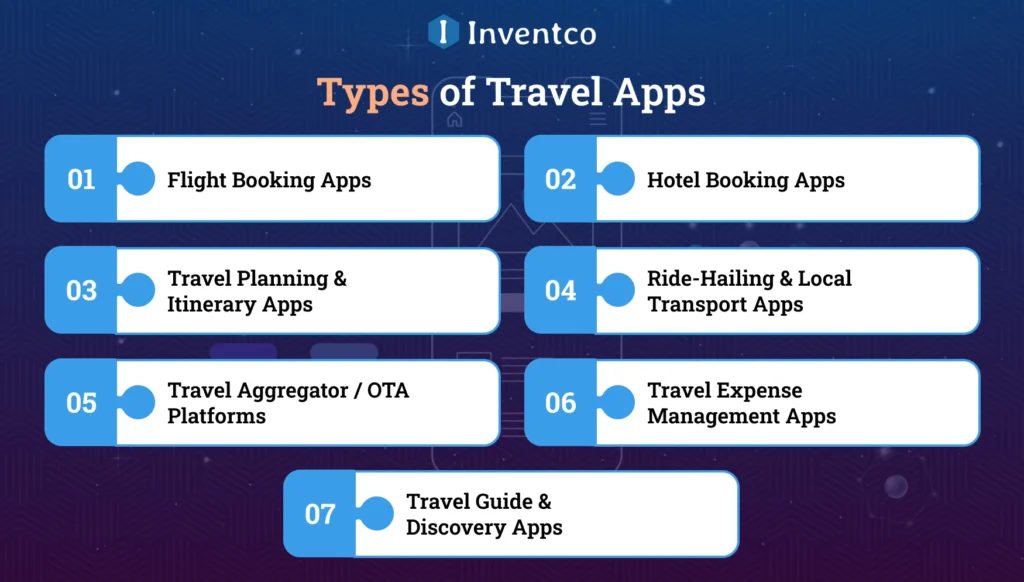
Travel applications can be very different, and this is reflected in their costs. The first step to creating an accurate budget is knowing which category your product is in.
1. Flight Booking Apps
Flight Booking Apps: Apps that allow users to view flight schedules and prices to book tickets. The most costly part of development is the Global Distribution System (GDS) integration. GDSs include Amadeus, Sabre, and Travelport.
Estimated Development Cost: $10,000 – $70,000
2. Hotel Booking Apps
Hotel Booking Apps: Apps that allow users to view and book hotel reservations. Development becomes more costly with the use of the Expedia Partner Solutions API or other Property Management Systems.
Estimated Development Cost: $20,000 – $90,000
3. Travel Planning & Itinerary Apps
These mobile applications may include AI trip planning, collaborative travel itineraries, and offline travel guides. Cost is significantly impacted by the complexity of design and the recommendation engine.
Estimated Development Cost: $15,000 – $80,000
4. Ride-Hailing & Local Transport Apps
These applications provide tourists with on-demand travel solutions. Development of these applications is centered on real-time tracking, driver matching, and payment gateway solutions.
Estimated Development Cost: $40,000 – $100,000+
5. Travel Aggregator / OTA Platforms
These combine flights, hotels, car rentals, and activities into a single full-stack booking engine. This is the most complicated and capital-intensive category in travel tech.
Estimated Development Cost: $55,000 – $100,000+
6. Travel Expense Management Apps
These B2B apps assist with the automation of expense reports and multi-currency conversion in conjunction with corporate travel policy automation. Typically requires the integration of ERP and Accounting solutions.
Estimated Development Cost: $30,000 – $85,000
7. Travel Guide & Discovery Apps
These are content-rich with travel guides, user reviews, and local experiences. These typically have affiliate and premium content for income. Offline mapping may also be provided.
Estimated Development Cost: $15,000 – $80,000
Key Factors Affecting Travel App Development Cost
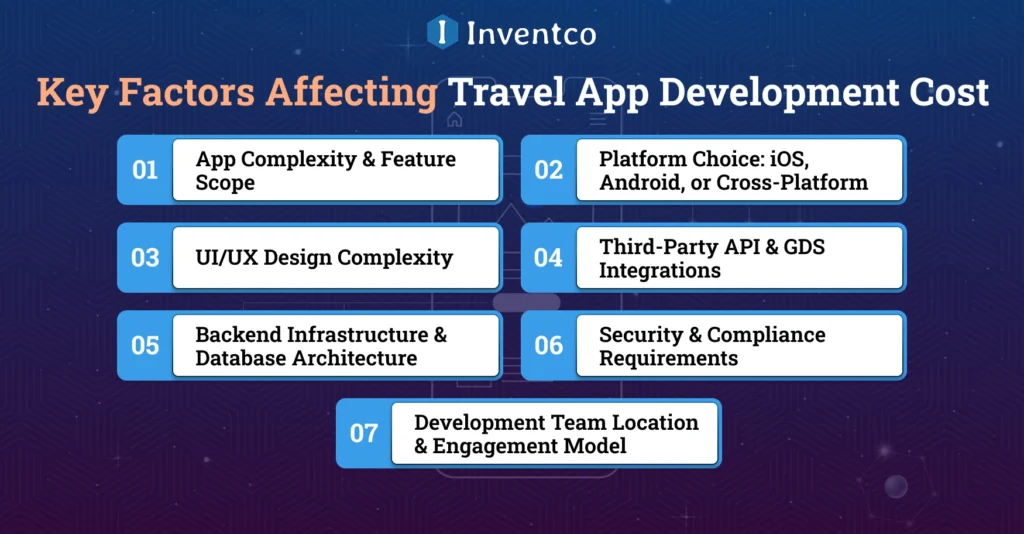
The cost to develop travel apps is not a set price, but is determined by an array of technical and strategic decisions during the planning and scoping. Below are the primary factors that should be addressed by your development partner during initial discussions.
1. App Complexity & Feature Scope
The price to develop a simple travel app with core functionalities (search, book, and get confirmation) will be far less than a fully featured enterprise app with AI customization, real-time booking channel synchronization, and multi-language support. The more layers of app features that are added, the greater the cost and time to develop.
2. Platform Choice: iOS, Android, or Cross-Platform
The mobile app development cost will be higher if developing a native app for both iOS and Android. Frameworks that support cross-platform development make costs more efficient, with an approximate 30-40% decrease in cost. Device preferences of the target audience should be the concern, not costs.
3. UI/UX Design Complexity
Travel apps focus heavily on UI/UX design, and customers expect them to perform like apps they’re used to, like Airbnb and Google Flights. For UI/UX design that includes the elements listed previously, expect to spend $3,000 to $10,000 based on your app’s design needs.
4. Third-Party API & GDS Integrations
There are a number of APIs you will need to integrate to create a functional travel app. GDS, payment APIs, mapping APIs, weather APIs, and review APIs will all come with their own implementation and licensing costs. Each API’s complexity will impact the price of each integration, but expect each API to add $3,000 to $15,000 to your overall development costs.
5. Backend Infrastructure & Database Architecture
Most travel applications will require highly scalable infrastructure such as AWS, Google Cloud, or Azure. The architecture of your travel application’s backend infrastructure will affect the travel application’s performance and cost of hosting services for the travel application in the future.
6. Security & Compliance Requirements
Travel apps will deal with passport, payment, and personal data, making them a compliance nightmare. From PCI-DSS to GDPR, compliant apps will cost between $10,000 and $25,000 based on the complexity of the compliance.
7. Development Team Location & Engagement Model
Development costs vary greatly depending on the country of your development team. US teams will cost $100 to $180 an hour, teams from Eastern Europe $50 to $90, and teams in South Asia will cost $25 to $50. Team composition and development model will be the best cost levers.
| Development Team Location | Average Hourly Rate | MVP Travel App Development Cost |
| United States / Canada | $100 – $180/hr | $80,000 – $200,000+ |
| Western Europe (UK, Germany) | $75 – $130/hr | $65,000 – $170,000 |
| Eastern Europe | $50 – $90/hr | $45,000 – $130,000 |
| South Asia | $25 – $55/hr | $15,000 – $60,000 |
| Southeast Asia | $30 – $65/hr | $30,000 – $100,000 |
Essential Features of a Travel App and Their Cost Impact
The travel app features you choose will impact the overall cost of developing the app. One way to understand some of the major levels of app features and their associated development costs is outlined below.
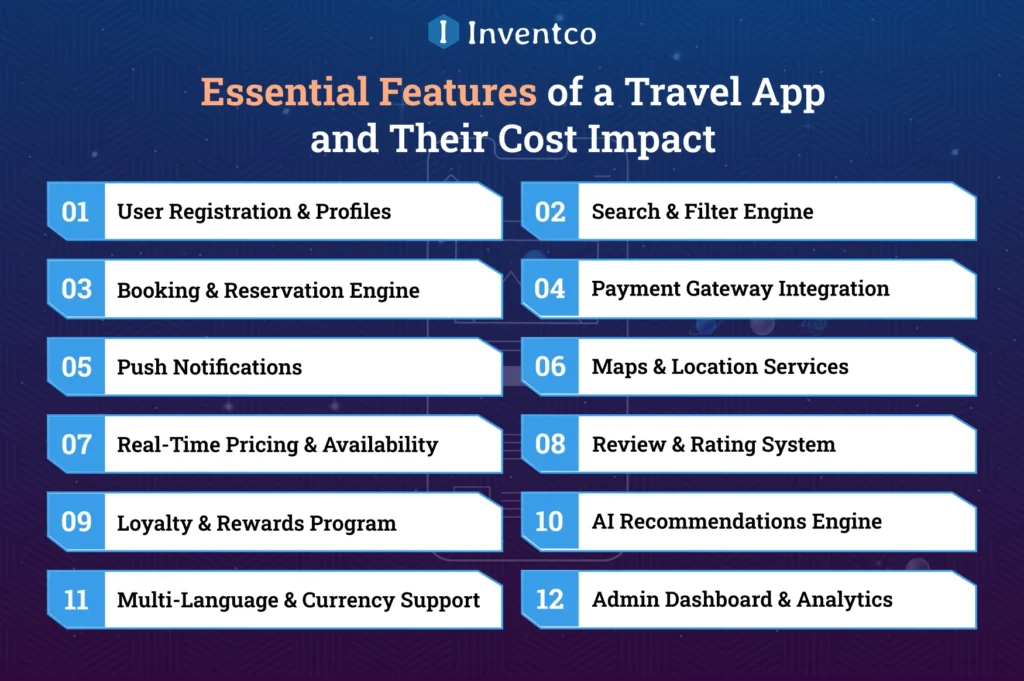
1. User Registration & Profiles ($2,000–$9,000)
User registration allows travelers to create and manage profiles, including personal information and travel history. For basic user registration, the cost is around $2000. Advanced registration, including customizable profiles, registration via social media, and user verification, is around $9000.
2. Search & Filter Engine ($5,000–$25,000)
Users should be able to search for flights, hotels, locations, and activities and have these results refined through a filter. Costs of implementing these features will fall between $5,000 and $25,000 and depend on the complexity of the search, the filters, whether the search is predictive, and whether the search results are being supplemented in real time.
3. Booking & Reservation Engine ($8,000–$35,000)
This feature is the most integral to the functionality of a travel app. This feature ranges from $8,000 to $35,000 based on the booking app’s different workflows and functions, management of inventory and reservations, cancellation, and supplier integrations with availability updates.
4. Payment Gateway Integration ($4,000–$25,000)
A payment gateway allows secure, varied transactions. The cost to implement a payment gateway is between $4000 and $25000. Costs are dependent on features and cost protection, including anti-fraud tools, international payments, and payments that are automatically initiated.
5. Push Notifications ($2,000–$7,000)
Push notifications help users stay informed of confirmations, travel updates, promos, and price changes. This feature costs between $2,000 and $7,000 based on the customization level for user segmentation, automation of notifications, and real-time systems.
6. Maps & Location Services ($3,000–$25,000)
Maps and location services help clients discover destinations, plan routes, and navigate. These services generally cost from $3,000 to $25,000 depending on the complexity of GPS and geofencing implementations, real-time location services, and third-party mapping service integrations.
7. Real-Time Pricing & Availability ($5,000–$30,000)
Real-time pricing and availability offer clients booking conditions that are both current and accurate. These services can cost anywhere from $5,000 to $30,000 based on how many suppliers are involved, the complexity of real-time inventory systems, adaptive pricing, and the magnitude of the data to be processed.
8. Review & Rating System ($3,000–$10,000)
Review and rating systems allow travelers to evaluate and share experiences and opinions of services. These systems generally range from $3,000 to $10,000 depending on the inclusion of automated content moderation, user verification, and analytical and content management systems.
9. Loyalty & Rewards Program ($8,000–$25,000)
Loyalty and rewards programs offer customers memberships, points, discounts, and special access to services to improve customer retention. The typical development cost for these programs is $8,000 to $25,000 and depends on the mechanisms and structures of the rewards.
10. AI Recommendations Engine ($12,000–$70,000)
AI-based recommendation engines analyze user data and adaptive learning to create itineraries with extremely accurate recommendations tailored to a user’s preferences and travel habits. The cost for this service ranges from $12,000 to $70,000.
11. Multi-Language & Currency Support ($8,000–$25,000)
Multi-language and currency support helps travel clients serve customers in multiple geographic areas. These services generally cost $8,000 to $25,000 depending on the scope of localization and currency conversion as well as regional compliance.
12. Admin Dashboard & Analytics ($5,000–$30,000)
An admin dashboard helps centralize user and booking management as well as content and operational control. These services range from $5,000 to $30,000 depending on reporting and analytics complexity and custom dashboards and business intelligence requirements.
Hidden Costs of Travel App Development
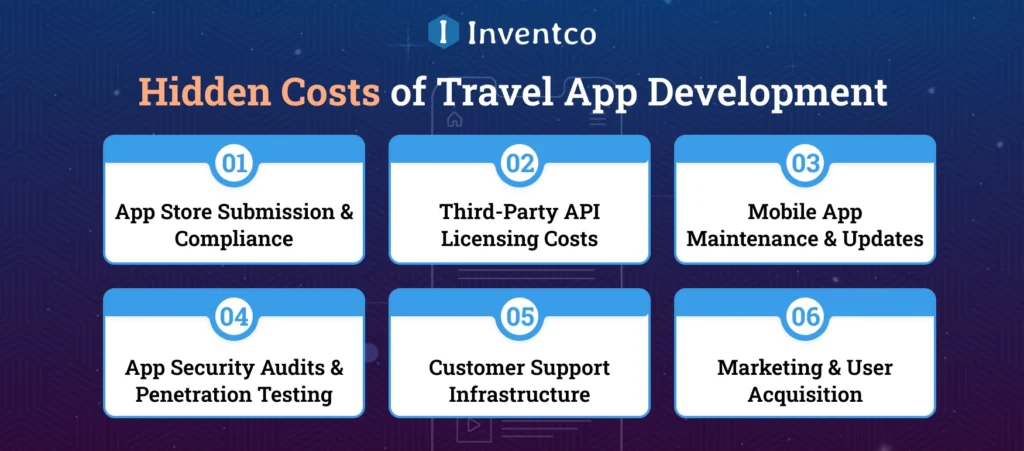
Most development estimates focus on upfront build costs. But the total investment to develop, launch, and sustain a competitive travel app includes a second layer of expenses that many founders discover too late.
1. App Store Submission & Compliance
Apple App Store and Google Play have distinct submission requirements, review processes, and annual developer fees. Expect $100–$300 in platform fees annually, plus additional time for compliance documentation.
2. Third-Party API Licensing Costs
GDS API access (Amadeus, Sabre, Travelport) involves setup fees and per-transaction pricing. Google Maps API usage beyond free tier thresholds, Stripe payment processing fees, and SMS notification costs all accumulate with user volume.
3. Mobile App Maintenance & Updates
Industry benchmarks suggest that annual mobile app maintenance, including OS update compatibility, bug fixes, security patches, and minor feature additions, costs 15–25% of the original development budget. For a $100,000 app, that’s $15,000–$25,000 per year.
4. App Security Audits & Penetration Testing
Travel platforms handle high-value data. Third-party mobile app security audits, required for PCI-DSS compliance and increasingly expected by enterprise clients, cost $5,000–$20,000 per audit cycle.
5. Customer Support Infrastructure
Travel apps require responsive support channels, in-app chat, email, and phone support, especially around booking changes and cancellations. This operational cost is routinely underestimated in early-stage budgets.
6. Marketing & User Acquisition
App Store Optimization (ASO), performance marketing, influencer partnerships, and content marketing are necessary to drive downloads in a saturated market. Reserve a minimum of 20–30% of your development budget for launch-phase user acquisition.
Important Note: When modeling your travel app investment, budget for 18–24 months of total cost of ownership, not just the development sprint. Founders who plan only for build costs consistently face cash flow constraints at the worst possible time: post-launch.
Cost to Build Popular Travel App Clones
Benchmarking against established platforms is a practical exercise for scope definition. The following estimates represent the cost to replicate core functionality, not full feature parity with mature, decade-old platforms.
1. Airbnb Clone ($40,000 – $80,000)
An app that operates like Airbnb will have host and guest profiles, property listings, and bookings, along with payment, review, and messaging features. Customizing an app like this with added features such as scalable architecture, third-party integrations, and added functionality like AI recommendations or dynamic pricing will increase cost.
2. Booking.com Clone ($50,000 – $90,000)
A Booking. com-type travel app would have a system to search for hotels, a booking system, reviews, a loyalty rewards system, and an inventory system to hold hotels. The cost would increase with the need for many filters, search type scalability, and the need for bookings and inventory to be up to date in real time.
3. Expedia Clone ($70,000 – $100,000+)
An Expedia-type travel app would offer bookings for cars, hotels, and flights all in one system. More complex systems would increase the cost of development, such as booking all three systems at once and offering recommendations on travel and pricing in real-time.
4. TripAdvisor Clone ($30,000 – $70,000)
A TripAdvisor-type travel app would help users discover travel destinations with a system to post reviews, ratings, and recommendations on travel, along with a system to upload photos. The cost would increase based on features for a content management system for reviews and travel recommendations, and systems to engage users.
5. Skyscanner Clone ($40,000 – $80,000)
A Skyscanner-type travel app would offer a system to search for travel, a comparison system, and a flexible date travel search. A price comparison and search in real-time would require the most development. Also, systems for travel alerts and a comparison of ticket prices would affect pricing the most.
6. Uber Clone for Travel Transport ($30,000 – $80,000)
An Uber-like transportation platform incorporates several core features such as GPS, systems for matching drivers and passengers, booking rides, optimizing routes, and payment integrations. The price variance for these products is dependent on the complexity of real-time tracking, the level of scalability, security, and support for multi-modal transport.
How Much Does Travel App Development Cost
For businesses planning to enter the travel technology market, understanding the relationship between app complexity, development timeline, and budget is essential. Travel app development costs can range from $10,000 for a basic MVP to $100,000+ for a fully featured enterprise-grade OTA platform, depending on the project’s scope, complexity, and feature requirements. The following table provides a high-level overview of typical travel app development costs based on project scope and feature requirements.
Basic MVP ($10,000 – $25,000)
Basic MVPs are great for travel tech startups that wish to reduce costs and bring their product to market quickly. These travel apps will include the most basic features such as user sign-up, destination listings, search and book travel, and the app’s payment functionality.
Mid-Tier Travel App ($25,000 – $50,000)
Mid-Tier apps offer a range of add-on travel app features that include suggestions for travel, itineraries, user reviews and ratings, travel notifications, as well as various travel service integrations. Travel apps at this tier are generally used by businesses that wish to travel further along the customer engagement continuum.
Full-Featured Travel Platform ($50,000 – $80,000)
Businesses that want to offer competitive travel services that include a robust platform with ease of booking flights and accommodations, travel recommendations, dynamic pricing, loyalty programs, and customizable travel experiences would choose this level of a travel service platform.
Enterprise-Grade OTA Platform ($80,000 – $100,000+)
Enterprise Online Travel Agency (OTA) platforms are specially designed for large-scale operations. They include extensive inventory management, multi-vendor systems, CRM tools, business intelligence, advanced security, and high-performance systems. These platforms can support high levels of traffic and complex travel operations.
How to Reduce Travel App Development Costs
The development of a quality travel app relies on business-savvy choices rather than an unlimited financial outlay. The following techniques can help you lower travel app development costs while preserving user experience and future scaling of the app.
1. Start With an MVP
A Minimum Viable Product (MVP) is the easiest and most affordable method to launch an app and begin the validation process of product-market fit. This method is the least expensive, fastest, and most effective way to mitigate risk.
2. Choose Cross-Platform Development
The use of the Flutter or React Native frameworks will result in the development of iOS and Android apps from one codebase and a decrease in the development time of a mobile app by 30–40% compared to native app development. For the majority of travel startups, cross-platform development is the correct choice and not a trade-off.
3. Leverage White-Label Solutions for Non-Core Components
There is no need for custom development for basic components like feedback systems, loyalty programs, and chat support. There are pre-built options that allow the focus of development to be on differentiating features.
4. Use Pre-Built Third-Party APIs
Rather than building flight search or hotel inventory databases internally, leverage established GDS APIs and aggregator services. The integration cost is a fraction of what internal development would require.
5. Partner With an Experienced Development Firm
A knowledgeable travel app development team provides libraries, connectors, and patterns specific to the field, thus helping reduce the project time and cost, unlike a team that has to build every capability from scratch.
Best Monetization Strategies for Travel Apps
Understanding how your travel app will generate revenue is as important as understanding what it costs to build. These are the most proven mobile app monetization models in the travel tech space.
1. Commission-Based Revenue
OTA-style platforms earn 5–25% commission on every booking transaction. This model aligns platform incentives with user activity and scales naturally with transaction volume.
2. Subscription Plans
Offer travelers or business users premium membership tiers with benefits like zero booking fees, priority customer support, exclusive deals, and lounge access. Subscription revenue provides predictable MRR.
3. Advertising & Sponsored Listings
Destination marketing organizations, hotel chains, and local experience providers pay for featured placement within your app’s search results and discovery feeds.
4. Affiliate Partnerships
Earn commission by directing users to partner products, travel insurance, currency exchange services, and local transport providers, without managing the underlying fulfillment.
5. Dynamic Packaging Fees
Charge a service fee for bundled packages (flight + hotel + car), adding margin on top of individual component pricing while delivering perceived value to the traveler.
6. B2B SaaS Model
White-label your booking engine or travel management platform to hotels, tour operators, or corporate travel managers as a subscription-based B2B product.
Why Choose Inventco for Travel App Development?
Creating apps for the current travel market needs something beyond the ability to develop. It requires an understanding of the business side of travel tech, the modern traveler, and the build of scalable tech.
Inventco has extensive knowledge of the spectrum of travel tech, from the MVPs of flight booking to full-scale enterprise OTAs with GDS, AI-based customization and personalization, and infrastructure for multiple currencies.
Our people worked on travel tech for various customers, from independent startups to regional hotel businesses and corporate global travel businesses.
Here’s what makes Inventco a proven travel app development partner:
- Domain-specific expertise: We understand the unique compliance, integration, and UX requirements of travel platforms, not as a generic software product, but as a specialized domain with its own architecture patterns and regulatory landscape.
- Full-cycle development: Inventco will take care of the entire app development process from the initial ideas, product, and UI/UX development to quality assurance of the travel app, publishing it in App Stores, and providing ongoing support.
- Scalable technology choices: We build travel apps on proven, scalable stacks, React Native and Flutter for cross-platform mobile, Node.js and Python for backend services, AWS and GCP for infrastructure, architected to grow from 1,000 to 1,000,000 users without rearchitecting.
- Transparent cost modeling: We provide detailed cost breakdowns before development begins, so you have full visibility into how your budget is allocated across feature development, design, infrastructure, and mobile app testing.
- Post-launch partnership: We don’t disappear after delivery. Inventco offers structured maintenance and feature development retainers that ensure your app evolves with user feedback, market changes, and new mobile OS requirements.
Would you like to outline the details of your travel app development and get an exact price? The Inventco team is offering complimentary consultations. Let’s design a scalable solution.

Conclusion
The investment in travel app development has many factors to consider, and now is the time to act before competition forces you out of the market. Consumers are increasingly mobile, and travel technology is continuing to expand rapidly. The opportunity is not going to last.
To create a travel app in 2026 is going to cost between $10,000 and $100,000. The first number is for a minimally viable product, while the last number is for a full, robust travel app. The right investment for your business is determined by the product you decide to build, the market you intend to target, and the speed of your growth.
For now, build a mobile app that has a defined strategy and a serviceable, high-quality, tech foundation with a partner who is committed to your end goal and not just the build. If you are ready to take that step, Inventco is ready.
FAQ’s
Q1. How much does it cost to develop a travel app in 2026?
Ans. The travel app development cost in 2026 ranges from $10,000 for a basic MVP to $100,000+ for an enterprise-grade platform. The final cost depends on your app type, feature scope, platform (iOS/Android/cross-platform), and development team location.
Q2. How long does it take to build a travel app?
Ans. Timeline varies by complexity. A basic MVP typically takes 3–5 months; a mid-tier product with booking integration takes 5–9 months; and a full-featured OTA platform can require 12–18+ months of development.
Q3. What is the most cost-effective approach to travel app development?
Ans. Starting with a cross-platform MVP (using Flutter or React Native) that focuses on your core value proposition is the most cost-efficient path. This approach validates your product-market fit before committing to full feature development.
Q4. Do travel apps require GDS integration, and how does it affect cost?
Ans. GDS integration (Amadeus, Sabre, Travelport) is required for real-time flight and hotel inventory. Each integration adds $5,000–$25,000 to development cost plus ongoing API licensing fees based on transaction volume.
Q5. What hidden costs should I plan for in my travel app budget?
Ans. Beyond development, plan for annual app maintenance costs (15–25% of build cost), third-party API fees, security audits, App Store compliance, customer support infrastructure, and user acquisition marketing.

Jitendra Jain
He is the CEO and Co-founder of Inventco, driving innovation in advanced computing and digital transformation. With deep expertise in modern IT ecosystems, he leads scalable, secure, future-ready solutions. His strategic leadership helps businesses accelerate growth, adopt innovation, and achieve success. You can connect with him on LinkedIn to follow his technology insights.