Mobile apps today are no longer optional digital extensions of a business; they have become integral business tools. Whether it is tracking health data, booking travel, or running a full-fledged business, mobile apps enable users to make critical decisions, perform transactions, and provide optimal customer experiences.
As we look to 2026, the average mobile application will have extensive design and support, with advertising used to market it. However, the market-leading application will focus on the integral features that enhance the app’s performance, retention, and scalability, and provide measurable ROI. Users of mobile apps expect speed, personalization, seamless usability, security, and consistent value. Businesses need visibility into analytics, the readiness to monetize, and the ability to scale.
The performance of mobile apps can meet user and business expectations by incorporating the right features. Mobile app development can provide users with a simple experience, equip the app with the right tools to enhance functionality, offer a scalable framework, and support the app throughout development. Mobile app development must provide the ability to integrate with growing trends through development.
In the following guide, we will cover which mobile app features will help a business succeed in the market in 2026, including MVP features and those that support future business growth. The goal is to develop a mobile app that succeeds in the market, rather than just occupying market space.
Key Takeaways
- Mobile applications have become a crucial part of any business operation. They help with revenue generation, brand positioning, customer engagement, operational efficiency, and become a critical part of a company’s differentiation.
- The combination of available features also affects the business’s success. The mobile application must have a balanced mix of standard and special features to support retention, scalability, monetization, and the company’s long-term success.
- Consumer patterns keep changing. The basic requirements for mobile applications have now become industry standards. Mobility, seamless and unobstructed cross-device usage and navigation, and intuitive personalization and security are required.
- With an anticipated $167 billion in global in-app purchase revenue in 2025, the inclusion of subscriptions, in-app purchases, advertising, and other app monetization systems is crucial to long-term success in mobile application architecture.
- App development for cross-platform mobile applications will help expand mobile application architecture. The mobile application must support seamless, unobstructed cross-device usage and navigation. The basic requirements for mobile applications have now become industry standards.
- In modern mobile application development, there will be a need for the latest technologies, such as real-time synchronization, predictive analytics, and voice technologies.
- Begin with an MVP build-out with sophistication. Start with features that secure product-market fit, then add sophisticated features aligned with strategic, data-driven insights.
- The evolution of a product must be driven by data. Features such as in-product analytics, performance tracking, and behavior tracking must be used in the data-driven app optimization and evolution of product features.
- The ability for a product to grow must be built in as a fundamental characteristic. As the worldwide mobile app market is projected to exceed $378 billion by 2026, apps need to be built to grow beyond their initial product launch.
Market Statistics: Mobile App Features & Performance Trends (2026)
Understanding the market landscape helps define which mobile app features truly matter. Here are the latest data points shaping feature strategy in 2026:
- Market Growth: The mobile application market is expected to exceed $378 billion. The global mobile application market is projected to exceed $378 billion in 2026. The global mobile application market is projected to exceed $1 trillion by 2034.
- Consumer Purchasing: Global in-app purchase revenue continued to grow at a double-digit pace, reaching an estimated $167 billion in 2025. This shows the expectation and demand for revenue-generating features.
- Increasing Subscriptions: Subscription-based monetization is one of the fastest-growing segments within the mobile application market, with in-app purchases now accounting for nearly 48.85 % of total mobile app revenue, and subscriptions growing at a significant CAGR through 2031.
- Need for AI and Personalization: Demand for AI personalization is increasing, as personalization and smart recommendations are now standards in e-commerce and media.
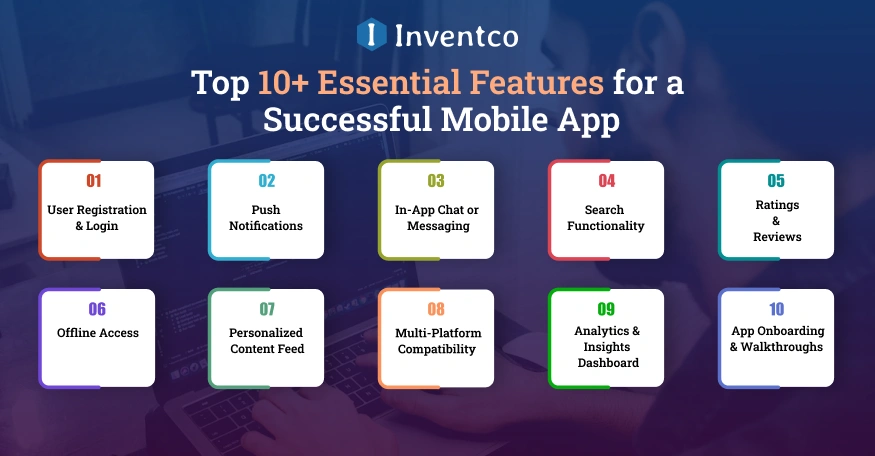
Top 10+ Essential Features for a Successful Mobile App
By 2026, the app will need to do much more than just look aesthetically pleasing, it will need to perform, engage, and convert. When developing a mobile app for the Gen Z fashion lifestyle ecommerce sector, the inclusion of critical app features is essential. Here is a list of mobile app features that every business should incorporate to earn customer loyalty.
1. User Registration & Login
Registration with the app is mandatory. Provide the ability to join the app using one’s telephone number, email address, or social networking services such as Google, Facebook, or Apple ID. The more seamless the onboarding experience is, the more likely users will quickly engage and start using the app. Users should not be required to endure complex, time-consuming, or non-intuitive processes. User convenience will be improved by adding login preferences, such as biometric authentication via Face ID or Fingerprint scans.
2. Push Notifications
After onboarding, users should continue to receive active reminders from the app. Effective use of push notifications offers an excellent opportunity to re-engage users and prompt desired behavior. Sending notifications is a great way to re-engage users and bring them back to check your app regularly. User engagement can be increased with notifications about offers, discounts, or new features. “Hey, we have something new and spicy for you” is a good example of a notification text to get users back. Users appreciate personalized notifications and can become annoyed by non-personalized ones. Keep your notifications streamlined and focus on quality rather than quantity.
3. In-App Chat or Messaging
Users love to talk, and when they can do it inside your app, it’s like magic happens. Whether it’s chatting with customer support or working with service providers in real time, create authenticity and earn users’ trust. Adding more features to your in-app chat, such as sending emojis, sharing media, and reply lines, makes your app feel more dynamic and lively. In 2026, community building is not just a bonus, it’s a requirement to create your brand value.
4. Search Functionality
Your app can have the best possible content, but if users can’t find it quickly, they will leave. The search function acts as a guide for your app. To provide a good experience, you can offer keyword searches, group filters, voice searches, and other AI-powered search options. A strong search function is crucial for a good app.
5. Ratings & Reviews
Allow your users to review and rate the different products, services, or content available in your application. That gives your application more credibility, fosters engagement, and builds confidence in first-time users to act. A proven methodology is to use user feedback to help improve your products and services. This creates bonds as people appreciate feeling important.
6. Offline Access
One of the most critical features of a mobile application is the ability to work offline. Users want to use their application, and the online status should not hinder them. Whether enabling users to save articles, view previously downloaded videos, or cache data, the ability to access the application offline is a revolutionary breakthrough. Offering offline access to your application is a way to show you care about your users, particularly those with unreliable internet connections.
7. Personalized Content Feed
In this modern world, Generic is out, and Personal is in. Let’s build a recommendation engine that recommends content based on the user’s behavior, history, and preferences. With a personalized content feed, the user’s needs are anticipated, and their satisfaction and retention increase. With a personalized content feed, users will be engaged. YouTube and Instagram are great examples. They recommend content based on users’ engagement and search history, which makes them spend even more time on these platforms. You don’t want to be spending more than a few seconds on the waiting screen.
8. Multi-Platform Compatibility
Your mobile app should be compatible with Android, iOS, and even the web. As they said, ‘Consistency is the key to success’. When users switch devices, they shouldn’t feel as if they’re in a different app. Your UI/UX, data synchronization, and overall performance should be consistent and seamless. Cross-platform compatibility is not a trend but a necessity in the app development ecosystem.
9. Analytics & Insights Dashboard
You can’t improve what you don’t measure. Analytics helps you understand user behavior in your app, which is very valuable. Retention, performance, and behavior analytics are crucial for developers. The ability to understand the working and non-working aspects, as well as areas requiring improvement, is crucial for product owners and stakeholders.
10. App Onboarding & Walkthroughs
First-time users are like first-timers going on a date: confusing, exciting, and ready to run if things get awkward.
Smooth the onboarding process:
- Highlight the app’s key features at the front.
- Show how to navigate.
- Add tooltips and animations to create a wow factor.
This small tutorial phase makes a huge difference in reducing friction and maximizing engagement from the start.
Why These Features Matter?
The features are not just a little treat to entice users, they are the framework for your application. They build your user journey, elevate your app, and define your brand’s mobile experience. When mobile app must-have features are integrated into your functionality checklist, they give your application the edge it needs to compete and improve.
Advanced Features and Future Trends in Mobile Apps
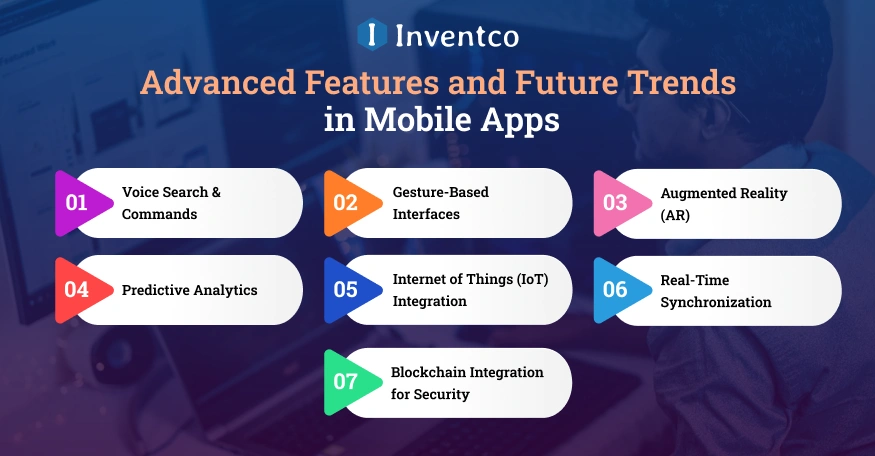
As mobile application innovation accelerates, user demands are changing faster than ever. Basically, functionality isn’t enough anymore, today’s users expect apps that are better, faster, and simpler. So, what’s cooking in the world of advanced mobile app features that can truly set your app apart in 2025? Let’s analyze the features constituting the mobile app development trends:
1. Voice Search & Commands
Voice commands and search are the cornerstone of mobile app development. The way in which we engage with and navigate mobile apps is being transformed by voice commands. Users prefer to issue verbal commands rather than type them and then wait for the app to generate the desired response.
Voice commands and search enable seamless product searching, control, and use of the mobile application. The incorporation of voice commands into your mobile application improves navigation, is stress-free, and enhances the hands-free experience for users.
2. Gesture-Based Interfaces
With cutting-edge technologies available, reliance on traditional practices in business applications is unwarranted. Instead of traditional button taps, gesture technologies will power business applications and enhance customer satisfaction and user experience. Immersive applications driven by enhanced user engagement will be created by the ability to utilize swipes, pinches, shakes, air gestures, and more.
Gesture-based controls create streamlined, seamless experiences and reduce screen clutter, especially in content-heavy applications and gaming apps. Gesture controls are also among the most cutting-edge mobile app features, offering an impressive level of practicality for your users.
3. Augmented Reality (AR)
Gone are the days when augmented reality (AR) was just for gaming. With the pace of the mobile app market, AR has also penetrated the shopping, real estate, and education sectors. Consider an eCommerce app that uses AR for ‘Try On’ features or allows users to virtually place furniture in their living rooms.
This app feature provides an engaging, interactive experience by blending real-life elements with digital components, greatly enhancing user interaction. AR integration may be technologically advanced, but it provides users with interactive experiences that set your app apart.
4. Predictive Analytics
Data is the king, but predictive analytics is the crystal ball. Apps can forecast demand and adjust experiences by analyzing prior user interactions. Consider smart content recommendations, dynamic pricing, or inventory management in eCommerce apps. Predictive analytics enhances your app’s intelligence and user satisfaction. It is one of the most essential features of mobile app development.
5. Internet of Things (IoT) Integration
IoT is one of the fastest-growing sectors of the mobile app development industry. IoT is growing in popularity across numerous areas, including smartphones, fitness trackers, smart homes, health monitoring, and more. Integrating IoT features into a business application allows users to manage multiple appliances and provides seamless access and control, coupled with real-time updates and data sharing. IoT features are a must-have for applications in health, smart home security, and industrial automation, as well as for any applications that are future-ready.
6. Real-Time Synchronization
Data and information are used seamlessly across multiple systems. Live data updating ensures that all changes made on one device are automatically and promptly reflected on every other device, regardless of whether the device is used for communication, data storage, or configuration. This feature provides reliability and value to a system, and greatly streamlines the use of multiple, interconnected devices.
7. Blockchain Integration for Security
The importance of mobile app security cannot be overstated, especially in the digital age. As cyber threats proliferate in the digital environment, the development of Blockchain technology for applications is providing a novel means of protecting data and interactions through decentralized ledgers.
Blockchain technology provides assurance of transparency, data integrity, and protection from fraud. This makes Blockchain technology suitable for applications in financial technology, supply chain management, and digital identity verification. Although the process of incorporating blockchain technology may be intricate, it enhances the trust and security that your users value.
Why These Features Matter?
These are not just the lollipops or sweets to attract users, they are the foundation of the app. They shape your user journey, fuel relationships, and define your brand’s mobile experience.
When backed into your app functionality checklist, these essential mobile app features give your product the edge it needs to compete and grow.
The Future is Now
Your app will gain and retain users if you use the latest mobile app tech stack and features. The latest mobile technologies enable apps to be superior, secure, and interconnected.
AI-Based Features You Can Integrate in Your Mobile App
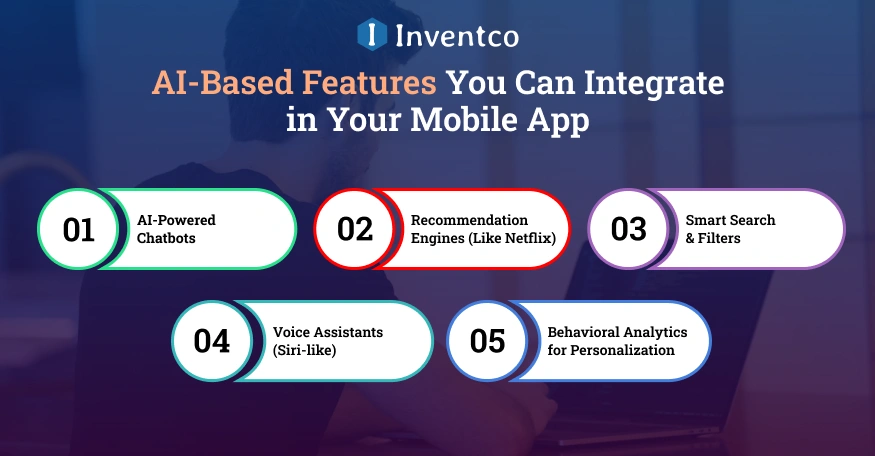
Mobile apps created for 2026 and beyond will be able to perform more complex tasks and use Artificial Intelligence to enhance their overall functionality and versatility. With AI, mobile apps can streamline the customer experience by learning from data. If you are contemplating AI use for your mobile applications, consider using the following AI-based features:
1. AI-Powered Chatbots
Mobile apps can also incorporate AI chatbots that are capable of much more than providing automated responses. These chatbots can guide users through complex tasks, offer support, and respond to user inquiries around the clock, delivering a more satisfactory user experience. These chatbots can also reduce or even eliminate the need to hire support personnel, therefore lowering operational and app maintenance costs.
2. Recommendation Engines (Like Netflix)
Apps that include a recommendation engine can improve the user experience by providing personalized feedback based on users’ interests and past behavior. This increased engagement will help improve overall brand recognition and can even increase revenue for the associated company by extending usage periods and reducing the likelihood of user churn.
3. Smart Search & Filters
Instead of just seeking keywords, AI improves search functionality by understanding the user’s aim and context, thereby enhancing the value of search. By describing what the user seeks, the mobile app’s AI and advanced features, such as natural language processing (NLP) and Smart Filters, help them easily identify what they want, even if they are unsure of the phrasing. AI search improvements increase user engagement and experience.
4. Voice Assistants (Siri-like)
Voice assistants are no longer bound to built-in phone apps. They are one of the most trending AI mobile app features in mobile app development. Integrating voice recognition and commands within the app allows hands-free engagement and faster travel. From making notes to controlling app features, voice assistants bring convenience and accessibility, catering mainly to on-the-go users.
5. Behavioral Analytics for Personalization
Behavioral analytics, one of the most powerful applications of AI, involves monitoring user behavior and then modifying the app’s content to suit it. Consider a mobile device that offers a fully personalized experience. Users get live updates for incentives. Every session offers a customized user interface (UI) change so users feel their mobile device is tailored to their needs. This significantly increases user engagement and loyalty.
Why AI Matters for Your App’s Success?
Integrating AI features is no longer optional for apps looking to compete in 2026. The AI functionality in mobile applications transforms them from simple tools into dynamic solutions that meet users’ expectations. With an AI app development expert, you achieve the ideal implementation of functionality while ensuring cohesion with the mobile app development objectives and the target users’ needs through proper mobile app testing. Strategic AI functionality in mobile applications delivers sustained improvements in user engagement, personalization, and productivity.
How to Choose the Right Features for Your Mobile App?
Choosing the right app development features is like creating the perfect song, it’s all about matching the mood, the audience, and the time. Pick the wrong tracks, and your readers might just hit skip.
Ask Yourself These Key Questions:
- Who is my target audience? Understanding who will use your app helps you prioritize features that genuinely add value.
- What’s my core app purpose? Define the main problem your app solves or the experience it offers. This keeps your feature list focused.
- What platforms will I use? Different platforms have unique requirements. Consider Android and iOS app development features to ensure seamless experiences across devices.
Keep It Lean
Don’t overstuff your app with every shiny feature out there. Use an app feature list for startups to guide the inclusion of only the essentials. This helps reduce complexity and development time.
Budget Smartly
Remember, while features like AR or AI can be appealing, they often come with higher costs. Understanding how different app features affect mobile app development costs lets you mix must-have features with selective, smart features, balancing innovation and budget. Focus on what truly matters, and your app will hit all the right notes.
Looking for a Strategic Mobile App Development Partner?
Choosing a mobile app development company is critical to a range of important operational attributes, including performance, scalability, security, and return on investment over time.
At Inventco, we apply our engineering and design expertise to create mobile applications that address specific business goals, user demands, and technical specifications. Our process begins with product discovery, a structured market analysis, and the prioritization of features that enable your application to deliver not just a set of features, but the potential for measurable improvements in business outcomes.
Our engineering team will deliver the flexibility and performance your application needs to meet all requirements in your development roadmap, including core functional features, personalization, advanced analytics, secure cross-platform payment systems, and high-performance analytics. We will create customized, on-demand, enterprise, eCommerce, AI-enabled mobile solutions.
Every app we develop is built to perform well for a wide range of end users and to adapt to changes, meet contemporary expectations in the mobile application industry, and evolve with them. Clean architecture, flexible backend design, and front-end UI/UX design, as well as long-term maintainability, will ensure that your application is maintainable.
If you’re looking to launch an app that performs well, securely, and that will be able to adapt to future business changes, we will construct a well-designed solution to ensure your business’s development.
Wrapping Up
By 2026, your mobile app will not be a product, but rather an immersive experience that can make or break your business. With mobile app development that suits your business needs, you’re not just staying ahead of the competition, you’re shifting the paradigm. Using a combination of fundamental mobile app features, a bit of creativity, and the ability to forecast emerging mobile app development trends will reward you immensely.
Also, never ignore mobile app scalability options so that your app can evolve with your growing customer base. Wondering which features to include? No worries. The Inventco team of experts will assist you in building a high-performing, future-proof app that meets your needs and goals. Let’s get started on making your app a big success.
FAQ’s
Q1. What are the must-have mobile app features in 2026?
Ans. Key features include user registration, push messages, in-app chat, intelligent search, personalization, offline access, and cross-platform compatibility.
Q2. Why is personalization important in modern apps?
Ans. Personalized content boosts user engagement and retention by providing relevant experiences tuned to individual preferences.
Q3. How does AI enhance mobile apps?
Ans. AI adds innovative features like chatbots, recommendation engines, and behavioral analytics, making the app more intuitive and engaging.
Q4. Are offline features still relevant in 2026?
Ans. Absolutely! Offline access improves user experience, especially in areas with poor connectivity or while on the move.
Q5. What’s the benefit of integrating blockchain into an app?
Ans. Blockchain enhances security, facilitates open transactions, and fosters trust, particularly in finance, gaming, and eCommerce applications.
Q6. Should my app work on both iOS and Android?
Ans. Yes! Multi-platform compatibility provides a bigger reach and uniform experience across all devices.
Q7. How do I decide which features to add?
Ans. Focus on your goal, users, app purpose, cash, and scalability. Start lean, then grow as needed.
Q8. Can Inventco help with feature selection and development?
Ans. Of course! Inventco guides you through the entire process, from feature selection to full-scale mobile app development.
Q9. How long does it take to create a mobile app in 2026?
Ans. Depending on complexity, it can take anywhere from 2 to 6 months for MVPs, while feature-rich or enterprise-level apps may take 6–12+ months.
Q10. What’s the cost to create a mobile app in 2026?
Ans. App development costs vary based on features, platforms, and team location, but expect anywhere from $5,000 to $300,000+, depending on scale and tech.

Jitendra Jain
He is the CEO and Co-founder of Inventco, driving innovation in advanced computing and digital transformation. With deep expertise in modern IT ecosystems, he leads scalable, secure, future-ready solutions. His strategic leadership helps businesses accelerate growth, adopt innovation, and achieve success. You can connect with him on LinkedIn to follow his technology insights.