Most mobile apps don’t fail because of bad ideas, they fail because they are built on outdated assumptions. In 2026, success depends on aligning your product with the technologies that are actively shaping user behavior. What separates a high-ROI mobile product from an app that gets downloaded and forgotten is whether it is built on the right technology trends, and whether those trends align with how users actually behave, engage, and convert.
The global mobile application market is accelerating at a pace few industries can match. With over 7 billion smartphone users worldwide and consumers spending more than four hours per day on mobile devices, the scale of opportunity is undeniable. But so is the downside. Businesses are still investing heavily in mobile products that fail, not because the idea is wrong, but because the timing, technology choices, or user experience strategy are misaligned with market reality.
For founders preparing to raise a Series A, investors evaluating mobile-first startups, and enterprise leaders shaping long-term digital roadmaps, this is no longer about following trends, it’s about selecting the right ones with precision.
In this guide, we break down the 15 most consequential mobile app development trends shaping 2026, the business rationale behind each, and how they directly impact product-market fit, scalability, and long-term returns.
Key Takeaways
- AI integration and Generative AI are no longer optional, they are the baseline expectation for competitive mobile products in 2026.
- 5G is rewriting what mobile apps can do, enabling real-time, latency-sensitive experiences across healthcare, logistics, and entertainment.
- Super apps are emerging in Western markets, inspired by Asian leaders like WeChat, creating platform-driven ecosystems that redefine user acquisition, retention, and long-term monetization strategies.
- Low-code/no-code platforms are reducing time-to-market but require experienced oversight to scale securely.
- Mobile commerce is projected to surpass $700 billion by 2026, making M-Commerce optimization a direct revenue lever.
- Partnering with the right mobile app development company remains the fastest path to capturing these trends with technical excellence and business focus.
Market Stats: Why Mobile App Trends Matter More Than Ever
Before diving into individual trends, it’s critical to ground decisions in real market data. The mobile economy is not just growing, it’s scaling at a pace that directly impacts product, investment, and technology decisions.
- According to Statista, global mobile app revenue is projected to exceed $935 billion annually by 2026, driven by in-app purchases, subscriptions, and advertising
- The global mobile application market is expected to reach approximately $378 billion by 2026, reflecting strong and sustained industry growth
- According to Grand View Research, the mobile app market is projected to grow to $626.39 billion by 2030, at a CAGR of 14.3%
- Global app downloads are projected to surpass 300 billion annually by 2026, highlighting massive and increasing user adoption
- According to Business of Apps, over 142 billion apps were downloaded in 2025 alone, showing continued year-over-year growth in demand
The right app development trend can make your business more visible and accessible to your target audience. Beyond the direct revenue benefits, aligning with emerging mobile app trends helps you foster brand awareness, reach new customers, and establish a defensible niche in your market.
Top App Development Trends Shaping 2026
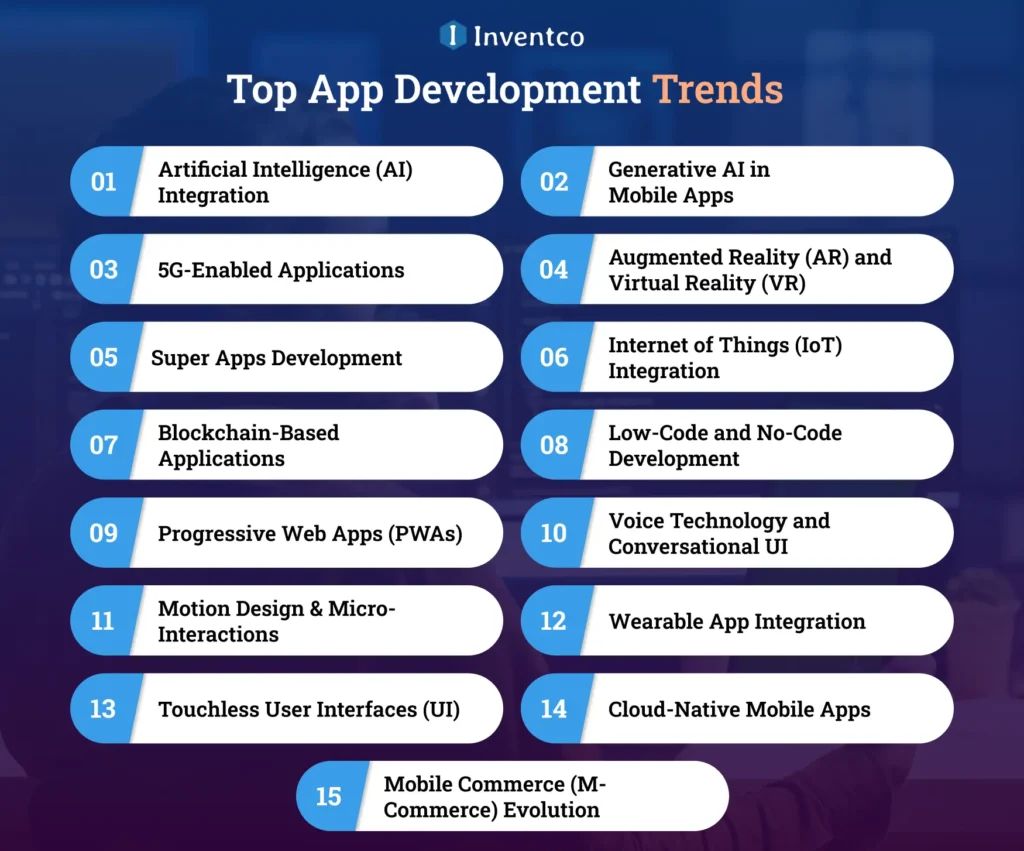
These are not predictions. They are market realities that category-leading companies are adopting right now. Each mobile app development trend below includes the business case, the technical reality, and the strategic question every founder and investor should be asking.
1. Artificial Intelligence (AI) Integration
Artificial Intelligence has moved from a differentiator to a foundational layer in mobile app development. In 2026, high-performing apps are designed to continuously learn from user behavior, adapt in real time, and deliver context-aware experiences across every interaction. Capabilities such as recommendation engines, predictive analytics, and intelligent automation are no longer optional, they define product relevance.
The commercial impact is measurable. AI-driven personalization can increase user retention by up to 40% and session duration by over 25% when implemented within core user journeys. By reducing decision friction and guiding users toward high-intent actions, AI directly improves engagement, conversion, and lifetime value.
For founders, the priority is strategic implementation, embedding AI to influence key business metrics. For investors, depth of AI integration signals product maturity, scalability, and long-term defensibility.
Business Insight: AI-driven personalization can reduce churn by up to 30% in subscription-based mobile products. This is a direct impact on LTV, one of the most important metrics for mobile business valuation.
2. Generative AI in Mobile Apps
Generative AI is rapidly becoming a core layer in modern mobile applications, extending beyond traditional AI capabilities into real-time content creation. In 2026, mobile apps will embed generative features such as text generation, AI image editing, voice synthesis, and dynamic content creation, delivered through on-device processing or efficient cloud inference.
This shift is unlocking entirely new product categories. From AI writing assistants and design tools to personalized learning platforms and content generators, generative AI is enabling experiences that were not commercially viable just a few years ago. Products built on strong foundation models and intuitive mobile UX are seeing faster adoption and stronger market positioning.
For businesses, this is not a feature upgrade, it is a platform shift. Treating generative AI as a core capability, rather than an add-on, is critical to building scalable, competitive mobile products in 2026.
Business Insight: The fastest-growing consumer apps in 2025 and 2026 have one thing in common: they make users feel like they have a capable, intelligent partner in their pocket. Generative AI solutions are the technology that delivers that experience at scale.
3. 5G-Enabled Applications
5G is more than a speed upgrade, it is a foundational shift in mobile infrastructure. With ultra-low latency, multi-gigabit speeds, and the ability to support massive device density, 5G enables a new class of real-time, high-performance mobile experiences that were previously impractical.
In 2026, this translates into tangible use cases, seamless AR/VR interactions, high-definition telemedicine consultations, cloud gaming with near-console performance, and industrial IoT applications with instant data processing. These are not experimental, they are rapidly becoming mainstream across industries.
As 5G adoption expands globally, businesses must evaluate where 5G-native capabilities can create meaningful differentiation. Companies that architect their mobile apps for 5G performance today are positioning themselves for scalability, superior user experience, and long-term competitive advantage.
Business Insight: 5G-native features, such as real-time streaming, edge computing, and AR, are becoming key differentiators in competitive markets like health tech, logistics, and entertainment. Early movers are setting UX expectations that late entrants will struggle to match.
4. Augmented Reality (AR) and Virtual Reality (VR)
AR and VR have moved beyond experimentation into real-world deployment. In 2026, advances in 5G, on-device processing, and hardware such as Apple Vision Pro and Meta Quest are accelerating adoption across both consumer and enterprise environments.
On the consumer side, AR is transforming mobile commerce through virtual try-ons and product visualization, helping users make faster, more confident purchase decisions. In enterprise settings, VR is being used for training in healthcare, manufacturing, and defense, reducing costs while improving learning outcomes and retention.
The key to success lies in use-case precision. Experiences built around clear, repeatable user needs outperform novelty-driven implementations.
Business Insight: AR-enabled commerce apps have demonstrated 40% higher conversion rates compared to traditional product pages in multiple retail deployments. The technology is mature enough to build commercial products on, the question is whether your use case justifies the investment.
5. Super Apps Development
It is a multi-functional platform that combines services such as payments, messaging, commerce, and mobility, and is emerging as a dominant model in mobile app development. Proven by platforms such as WeChat, Grab, and Gojek, this approach is now expanding into fintech, retail, and logistics markets globally.
The business case is strong. Super apps increase user lifetime value by capturing a larger share of daily user activity, reducing acquisition costs through cross-service engagement, and building defensible ecosystems that are difficult to replicate. For investors, this signals a shift from single-product thinking to platform-level scalability.
However, execution requires significant capital, strong infrastructure, and regulatory alignment. For companies positioned to scale, the 2026 mobile app development landscape clearly favors ecosystem-driven platforms over isolated applications in high-frequency use cases.
Business Insight: Super apps achieve 2–3x higher daily active user rates compared to single-function apps in the same category. If your product touches users daily, the super app architecture deserves serious strategic consideration.
6. Internet of Things (IoT) Integration
Mobile apps are rapidly becoming the control layer for a connected world. In 2026, IoT integration is a core trend in mobile app development across smart homes, healthcare wearables, industrial monitoring, and connected vehicles. According to Statista, IoT-connected devices are expected to surpass 40.6 billion by 2034, highlighting the growing role of mobile apps as primary control interfaces.
For businesses, this shifts apps from data displays to intelligent control systems. Modern IoT apps orchestrate devices, automate actions, and transform real-time sensor data into meaningful insights, whether managing health metrics, home ecosystems, or fleet operations.
The real competitive edge lies in building secure, low-latency, and scalable architectures. Companies that succeed create deeply integrated ecosystems where device connectivity and data network effects drive long-term user retention and strong market defensibility.
Business Insight: IoT-integrated apps generate high retention because they become operationally essential to users. When an app controls your home, monitors your health, or manages your business operations, churn drops dramatically.
7. Blockchain-Based Applications
Blockchain in mobile apps has moved beyond cryptocurrency speculation into a foundational layer for trust and transparency. In 2026, its most impactful use cases include identity verification, supply chain tracking, digital asset ownership, and secure peer-to-peer transactions. These applications address real-world challenges with increasingly production-ready infrastructure.
Decentralized finance (DeFi), NFT marketplaces, and tokenized ecosystems continue to attract targeted user segments, while blockchain-based identity solutions are gaining traction in regulated industries requiring secure, tamper-proof verification.
For founders, the critical question is strategic fit. Blockchain should be implemented where it enhances trust, transparency, or operational efficiency within core workflows, not where it adds unnecessary complexity. The current mobile app development landscape shows that blockchain delivers the most value when decentralization enhances the product experience rather than complicates it.
Business Insight: Enterprise blockchain mobile apps focused on supply chain and compliance are showing strong B2B adoption in 2026. The consumer market remains nascent outside of digital assets, but the infrastructure is maturing rapidly.
8. Low-Code and No-Code Development
Low-code and no-code platforms have significantly reshaped the economics of mobile app development. In 2026, tools like OutSystems, Mendix, Bubble, and FlutterFlow enable faster prototyping and deployment, allowing teams to build and iterate up to 3–5x faster than traditional development approaches.
This trend lowers the barrier to entry, reduces upfront investment, and accelerates time-to-market, making it easier for founders to validate ideas and for product teams to experiment rapidly.
However, at scale, custom engineering remains essential for performance, mobile app security, and a differentiated user experience. The real value of low-code lies in accelerating learning cycles and early-stage execution, not serving as long-term infrastructure for complex, high-growth applications.
Business Insight: Low-code development can reduce initial app development costs by 50–70% and time-to-market by 60%. For seed-stage founders validating product-market fit, this is a compelling argument for starting with a low-code MVP before investing in a full custom build.
9. Progressive Web Apps (PWAs)
Progressive Web Apps (PWAs) bridge the gap between the web and mobile, delivering app-like experiences directly in the browser without installation. In 2026, PWAs have matured to support capabilities such as push notifications, offline access, camera integration, and near-native performance across modern devices.
From a business perspective, PWAs offer a compelling advantage, especially for content-driven platforms, e-commerce businesses, and products targeting broad or global audiences. They are discoverable via search engines, load efficiently even on low-bandwidth networks, and eliminate the need to maintain separate iOS and Android codebases, reducing development and app maintenance costs.
PWAs are gaining strong traction in emerging markets where storage and data constraints limit app downloads. For scalable, global products, combining PWA and native strategies is becoming a standard approach.
Business Insight: PWAs deliver 36% higher conversion rates than traditional mobile websites and eliminate the app store as a distribution barrier. For e-commerce and SaaS businesses, the PWA path to monetization is often faster than native app development.
10. Voice Technology and Conversational UI
Voice is becoming a primary interface in modern mobile apps. In 2026, voice technology extends far beyond basic commands, evolving into fully conversational experiences embedded across productivity, healthcare, finance, and accessibility-focused applications.
Advancements in large language models have significantly improved voice interactions, enabling users to complete multi-step tasks, ask complex questions, and navigate entire app workflows using natural language. This reduces friction and enhances usability, particularly in hands-free or time-sensitive environments.
For businesses targeting voice-active user segments, such as older adults, drivers, or healthcare professionals, voice-first design is a strategic advantage. Mobile experiences are increasingly shifting toward multimodal interfaces where voice, touch, and gestures work seamlessly together.
Business Insight: Apps with robust voice UI report 20–35% higher engagement among users over 45, and in hands-free contexts such as driving and exercise. This is a largely underserved segment with strong monetization potential.
11. Motion Design & Micro-Interactions
Motion design and micro-interactions are no longer aesthetic enhancements, they are critical to user experience quality in 2026. High-performing apps differentiate not just through functionality, but through how they feel. Every tap, swipe, transition, and loading state is intentionally designed to create a fluid, responsive, and intuitive experience.
Beyond visual appeal, micro-interactions serve clear functional purposes. They provide feedback, guide user attention, communicate system status, and reduce cognitive load. Well-designed interactions make apps easier to use, more engaging, and more trustworthy, directly influencing retention and app store ratings.
In highly competitive categories where app features are similar, experience becomes the differentiator. Investing in structured design systems, including motion principles, enables consistency, improves usability, and creates a lasting competitive advantage in mobile product design.
Business Insight: Apps with polished micro-interactions and motion design score 0.3–0.5 stars higher on average in app store reviews compared to functionally equivalent apps with static UX. That rating difference directly translates into organic discovery and download volume.
12. Wearable App Integration
The wearable ecosystem is evolving into a critical extension of mobile applications. Devices like Apple Watch, Samsung Galaxy Watch, and Google Pixel Watch are driving adoption across healthcare, fitness, finance, and productivity use cases.
The strategic advantage lies in contextual computing, delivering timely, relevant insights without requiring users to open their phones. Whether it’s real-time health monitoring, instant financial alerts, or adaptive fitness tracking, wearable-integrated apps create continuous engagement and deeper user reliance.
For businesses operating in data-driven or real-time environments, wearable integration is no longer a premium feature. It is becoming a baseline expectation for delivering seamless, always-on user experiences that enhance retention and long-term product value.
Business Insight: Wearable app users show 2x higher daily engagement compared to smartphone-only users of the same app. This dramatically improves retention metrics, a critical factor in mobile app valuation.
13. Touchless User Interfaces (UI)
Touchless UI, spanning gesture control, eye tracking, voice commands, and proximity sensing, is expanding how users interact with mobile apps. In 2026, it is no longer limited to accessibility; it is a broader design paradigm for hands-free, high-efficiency environments across consumer, enterprise, and healthcare applications.
Advancements in front-facing cameras, LiDAR, and on-device AI processing enable real-time interpretation of gestures and gaze, making interactions faster and more intuitive. Innovations in spatial computing, led by devices like Apple Vision Pro, are shaping interaction models that will increasingly influence mainstream mobile design.
For businesses operating in field services, healthcare, or industrial settings, touchless UI is becoming essential. It improves usability in hands-busy scenarios while supporting hygiene and operational efficiency, key factors driving adoption in regulated and high-performance environments.
Business Insight: Touchless UI adoption in enterprise mobile apps correlates with faster user onboarding and lower training costs in field deployment scenarios. For B2B mobile products, this directly impacts customer acquisition cost and time-to-value.
14. Cloud-Native Mobile Apps
Cloud-native architecture, built on microservices, containerization, and managed cloud infrastructure, has become the standard for scalable mobile applications in 2026. This approach enables apps to scale dynamically, deploy continuously, and recover quickly from failures, outperforming traditional monolithic systems.
From a business perspective, cloud-native apps reduce operational overhead, support global deployment with low latency, and enable rapid iteration, critical for achieving and sustaining product-market fit. For high-growth startups, this is not just a technical choice but a strategic requirement for handling unpredictable scale.
Key trends include serverless computing, auto-scaling databases, and CDN-backed delivery for faster performance worldwide. Companies that adopt cloud-native architecture early avoid costly re-engineering and are better positioned to scale efficiently and reliably.
Business Insight: Cloud-native apps experience 40% fewer downtime incidents and can scale to 10x user load with minimal additional infrastructure cost compared to traditional server-based deployments. For founders planning for growth, this architectural choice has direct P&L implications.
15. Mobile Commerce (M-Commerce) Evolution
Mobile commerce is no longer a supporting channel, it is the primary driver of digital transactions. By 2026, global M-Commerce is projected to exceed $700 billion, fueled by seamless checkout experiences, AI-driven recommendations, AR-based product visualization, and integrated mobile payment ecosystems.
This evolution extends beyond retail. Industries such as finance, travel, healthcare, and real estate are increasingly enabling transactions through mobile-first interfaces. The rise of social commerce is further accelerating this shift, blending content and purchasing into a single, frictionless experience. For businesses, M-Commerce optimization is a direct revenue lever. Even small improvements in checkout flow, payment flexibility, and user experience can significantly impact conversions.
Business Insight: M-Commerce apps that support digital wallets (Apple Pay, Google Pay) see 15–20% higher checkout completion rates compared to card-only flows. This single feature addition can represent millions in incremental revenue at scale.
How Can Inventco Help You Stay Ahead With Mobile App Trends?
The mobile app landscape in 2026 rewards precision, speed, and informed decision-making. But identifying trends is only the first step, executing them to drive measurable business outcomes requires deep technical expertise and strategic alignment.
At Inventco, we work with founders, investors, and enterprises to translate mobile app trends into scalable, high-performance products. Our focus is not just on building features, but on delivering real ROI.
What We Bring to Your Mobile Product?
- Strategic roadmap alignment: We help you identify which mobile app development trends are relevant to your market, users, and growth stage, and which are not worth the investment.
- Full-stack mobile expertise: From AI and Generative AI to cloud-native architecture and IoT integration, we build across the entire mobile technology stack with production-grade quality.
- Speed without shortcuts: Our agile delivery approach accelerates time-to-market while ensuring your app is built on a scalable, secure foundation.
- Investor-ready infrastructure: We develop robust, scalable codebases that pass technical due diligence and support rapid product iteration for funded startups.
- End-to-end ownership: From product discovery and UX design to development, QA, launch, and optimization, we act as a single accountable partner focused on outcomes.
Partnering with an experienced mobile app development company is one of the fastest ways to operationalize emerging trends. Inventco combines technical depth with business-first thinking, ensuring your mobile product is not just functional but strategically positioned to lead in a competitive market.
Conclusion
The mobile app development trends of 2026 present both a massive opportunity and real execution risk. AI integration, 5G experiences, super apps, M-Commerce, and AR/VR are no longer future bets, they are active battlegrounds where market leaders are being defined.
For founders and investors, the priority is strategic alignment. The mobile app trends you adopt must align with user behavior, revenue models, and scalability goals. Success depends not just on awareness, but on execution with the right technical and product expertise.
Choosing the right app development trends directly impacts visibility, engagement, and growth. Beyond revenue, it strengthens brand positioning, expands reach, and drives user advocacy. The mobile economy will reward multiple winners, but only those who build with clarity, speed, and a strong focus on delivering real user value.
FAQ’s
Q1. What are the most important mobile app trends for founders to prioritize in 2026?
Ans. Founders should prioritize AI integration, M-commerce optimization, and cloud-native architecture in 2026. These mobile app trends directly influence user experience, revenue generation, scalability, and long-term product competitiveness, making them critical to sustainable business growth and investor attraction.
Q2. How much does it cost to build a mobile app with AI integration in 2026?
Ans. Building an AI-integrated mobile app in 2026 typically costs $10,000–$35,000 for an MVP app using low-code tools, while fully custom, scalable apps with advanced AI features range from $70,000–$100,000 or more, depending on complexity and requirements.
Q3. Should I build a native app or a Progressive Web App (PWA)?
Ans. Choosing between a native app and a PWA depends on business goals. Native apps deliver performance and hardware access, while PWAs offer cost efficiency, faster deployment, and broader reach. Many businesses combine both strategies effectively.
Q4. What is the biggest mistake founders make when investing in mobile app development?
Ans. The biggest mistake founders make is focusing on excessive features instead of core user value. Successful apps prioritize key workflows, leveraging AI, personalization, and design to deliver meaningful experiences and maximize long-term business impact.
Q5. How do I choose the right mobile app development company for my project?
Ans. Choose a mobile app development company based on technical expertise, proven case studies, and strong communication processes. The right partner understands your business goals, asks critical questions, and delivers scalable, outcome-driven mobile solutions efficiently.
Q6. Is Generative AI a viable investment in mobile app development right now?
Ans. Generative AI is a strong investment when aligned with real user needs. Features like content generation and personalization improve engagement and retention, but success depends on clear use cases rather than adding AI for novelty.

Sandeep Agrawal
Sandeep Agrawal is the visionary CTO at Inventco, bringing innovation to life through his technical expertise. With a passion for cutting-edge technologies, Sandeep leads the team in developing robust solutions. His dedication and continous efforts to pushing the boundaries of what’s possible defines his role as a transformative and innovative force in the tech industry. You can connect with him on LinkedIn to follow insights.