According to industry benchmarks like the Standish Group, over 70% of software projects fail, run over budget, or miss deadlines, execution, not ideas, is the real risk. The gap is rarely the idea itself. In most cases, outcomes are directly tied to the execution capability and strategic alignment of the development partner leading the build.
Choosing a mobile app development company in the USA is not a procurement decision, it is a capital allocation decision. The right partner accelerates product-market fit, optimizes development costs, and ensures scalability. The wrong one introduces delays, technical debt, and missed market opportunities.
This guide is built for founders and investors who want to make that decision with clarity. You’ll understand which signals indicate real expertise, which risks to avoid, and how to select a partner aligned with your product roadmap and long-term growth objectives.
Why the Right Mobile App Development Partner Is a Strategic Asset?
Hiring a mobile app development company is not a vendor decision; it’s a strategic one. The company you choose will significantly influence your product architecture, user experience, time-to-market, and long-term scalability.
Here’s why expertise and fit matter:
1. Platform-Specific Technical Expertise
iOS and Android are fundamentally different ecosystems in their design language, performance benchmarks, and review processes. A competent mobile app development company in the USA will have dedicated expertise in both native and cross-platform development. Whether you need to hire iOS app developers for Swift-based performance or Android specialists for broader device compatibility, platform-specific expertise directly translates into app quality.
2. Faster Time to Market Without Sacrificing Quality
Speed matters, especially in competitive markets. Building an in-house team from scratch can take 6 to 12 months before a single line of production code is written. An experienced mobile app development agency in the USA brings pre-assembled teams, established workflows, and reusable components that can cut your development timeline by 30 to 50%, without cutting corners on quality.
3. Access to Emerging Technologies
The best mobile app development company in the USA are already integrating AI-driven personalization, edge computing, and cross-platform frameworks such as Flutter and React Native into their delivery stacks. When you hire Flutter developers or React Native developers from an established agency, you gain access to modern technology stacks that future-proof your product, without bearing the cost of training or experimentation.
4. Structured QA, Security, and Compliance
A professional mobile app development company in the USA does not treat quality assurance as an afterthought. They embed QA engineers throughout the development lifecycle, run automated and manual testing protocols, and apply industry-standard mobile app security frameworks. For apps handling user data or payments, this layer is non-negotiable.
5. Post-Launch Support That Keeps You Competitive
The app launch is not the finish line, it’s the starting point. OS updates, user feedback, performance monitoring, and mobile app features rollouts require ongoing engineering investment. Leading application development companies in the USA offer structured maintenance contracts that ensure your product evolves in line with market demands.
Key Criteria to Evaluate a Mobile App Development Company in the USA
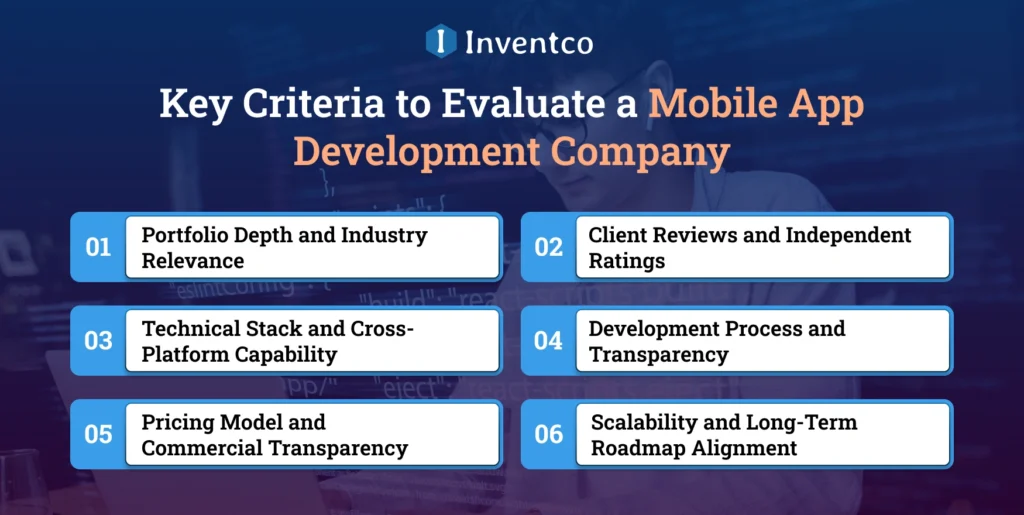
With thousands of agencies competing for your project, the selection process can feel overwhelming. Here’s a structured framework that separates capable partners from the rest:
1. Portfolio Depth and Industry Relevance
Start with the portfolio. Look for apps that are live in production, not just mockups, and that operate in sectors relevant to your business. A mobile app development company in the USA with experience building fintech apps, for instance, understands compliance, data security, and transaction flows in ways that a generalist agency may not. Ask for case studies that demonstrate measurable outcomes, such as user retention rates, App store ratings, or revenue impact.
2. Client Reviews and Independent Ratings
Third-party platforms like Clutch, GoodFirms, and G2 provide verified client reviews and independent rankings. Pay close attention to how the agency communicates under pressure, handles scope changes, and responds to post-launch issues. Positive ratings for communication and transparency are often more predictive of a good partnership than technical scores alone.
3. Technical Stack and Cross-Platform Capability
Clarify upfront whether the agency has genuine native capability across iOS and Android, or whether they primarily work in cross-platform frameworks. Both approaches have merit, but the choice should be driven by your product requirements, not the agency’s convenience. If you’re targeting both platforms, ask whether they recommend hiring React Native developers or Flutter developers, and why. The answer will tell you a great deal about how they think.
4. Development Process and Transparency
The best mobile app development agencies in the USA follow structured methodologies, typically Agile or Scrum, with regular sprint reviews, milestone-based delivery, and clear escalation paths. Ask for access to project management tools, and clarify whether you’ll have a dedicated project manager and a named technical lead. Lack of process structure is the single biggest predictor of project delays.
5. Pricing Model and Commercial Transparency
The cost to hire an app developer or a full mobile development team varies significantly based on scope, complexity, and engagement model. Fixed-price contracts work well for clearly defined MVP builds, and time-and-materials contracts offer more flexibility for evolving products. Whatever model you choose, insist on a detailed breakdown of deliverables, milestones, and payment schedules. Hidden costs and scope ambiguity are where most project budgets collapse.
6. Scalability and Long-Term Roadmap Alignment
Your app’s architecture today must support your business three years from now. Ask prospective agencies how they design for scalability, modular codebases, microservices, API-first architecture, and whether their team can scale with your product as it grows. A mobile app development company in the USA that thinks only about launch, and not about scale, is a liability in disguise.
Native vs. Cross-Platform: What Founders Need to Know
One of the most consequential technical decisions you’ll make is choosing between native and cross-platform development. Here’s a practical breakdown:
| Factor | Native (iOS / Android) | Cross-Platform (Flutter / React Native) |
| Performance | Highest, fully optimized for platform-specific performance | Near-native performance for most use cases |
| Development Speed | Slower, requires building and maintaining two separate codebases | Faster, single shared codebase accelerates time-to-market |
| Cost | Higher upfront investment due to separate development efforts | More cost-efficient with shared resources and reduced development time |
| Best For | Complex, high-performance, feature-heavy applications | MVPs, startups, and products targeting multi-platform reach quickly |
| Team Required | Separate iOS and Android developers needed | Single team using Flutter or React Native frameworks |
For most early-stage products, cross-platform development with React Native or Flutter offers the best balance of speed, cost, and user experience. For enterprise-grade applications where performance and device-level APIs are critical, native development remains the stronger choice.
Red Flags to Watch for When Evaluating Agencies
Beyond what agencies claim to do right, spotting early warning signs can save you from costly mistakes:
- Vague or templated proposals that fail to address your specific product requirements or business goals
- Portfolio lacking live applications or verifiable client references, making delivery credibility questionable
- No dedicated QA team or clearly defined app testing process outlined in the proposal
- Fixed-price quotes delivered within hours, before any meaningful discovery or technical scoping
- Absence of a post-launch maintenance plan or structured long-term support model
- Communication is routed only through sales representatives, with no direct access to technical decision-makers
If you encounter even one of these signals, pause and investigate further. If multiple appear together, the risk is not theoretical, it is operational.
Why Inventco Is Built for Founders and Investors?
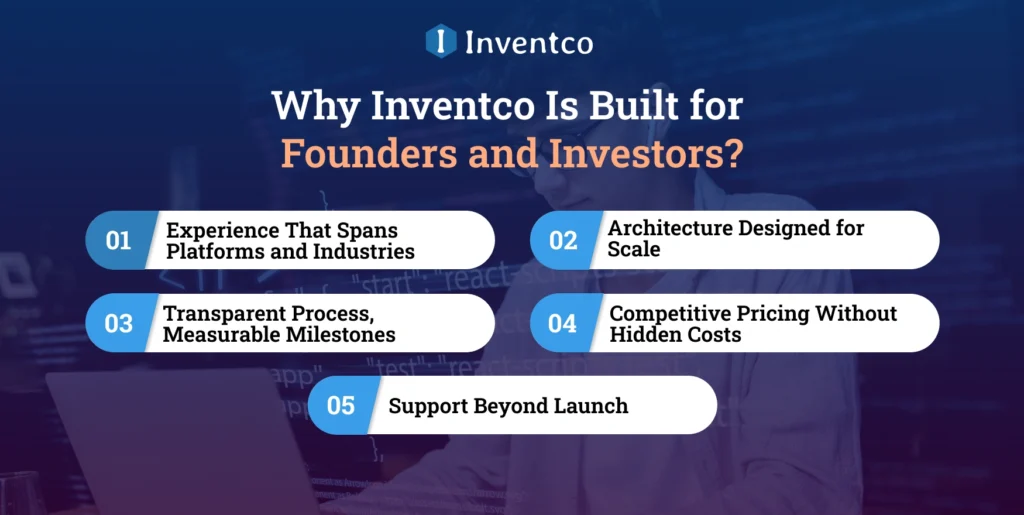
At Inventco, we work with founders and investors who have a clear business vision and need a technology partner, not just a development vendor, to bring it to life. Here’s what that partnership looks like in practice:
1. Experience That Spans Platforms and Industries
Our team includes senior engineers with deep expertise in iOS, Android, Flutter, and React Native development. Whether you need to build a consumer-facing marketplace, a B2B SaaS platform, or an enterprise mobility solution, we bring direct industry experience to your project, not a generic playbook.
2. Architecture Designed for Scale
We don’t just build what you need today. Our architects design for the traffic, feature complexity, and team sizes your product will require at Series A, Series B, and beyond. Modular codebases, cloud-native infrastructure, and API-first design are standard, not optional extras.
3. Transparent Process, Measurable Milestones
Every engagement at Inventco is structured around clearly defined milestones, regular sprint reviews, and direct access to your project team. You’ll always know what’s being built, what’s been tested, and what’s next, without chasing status updates.
4. Competitive Pricing Without Hidden Costs
We offer flexible engagement models, fixed prices for defined MVP builds, and time-and-materials for products with evolving requirements. Every quote includes a detailed breakdown by deliverable, with no surprise line items at invoice time.
5. Support Beyond Launch
Our post-launch support programs include dedicated monitoring, OS update compatibility, performance optimization, and feature expansion. We stay engaged because your app’s success, measured in retention, revenue, and reviews, is the only metric that matters to us.
Conclusion
Choosing a mobile app development company in the USA is one of the highest-stakes vendor decisions a founder or investor makes. The right partner accelerates your roadmap, protects your capital, and builds a product that users actually want to use. The wrong one costs you months, money, and market opportunity.
Do your due diligence. Evaluate portfolios critically, check references independently, and ask the hard questions about the app development process, scalability, and post-launch support before you sign a contract. The best mobile app development companies in the USA will welcome that scrutiny because they have the experience and track record to answer it confidently.
FAQ’s
Q1. How do I choose the right mobile app development company in the USA?
Ans. Evaluate portfolio relevance, technical expertise, client reviews, and development process. Focus on scalability, transparency, and communication to ensure the company aligns with your product vision and long-term business goals.
Q2. What factors affect the cost of mobile app development?
Ans. App complexity, platform choice, features, design requirements, and engagement model impact cost. Fixed-price suits are better for defined projects, while time-and-materials suits are better for evolving apps that require flexibility and continuous iteration.
Q3. Should I choose native or cross-platform app development?
Ans. Native development offers high performance and deeper integration, while cross-platform solutions like Flutter or React Native reduce cost and development time, making them ideal for startups and MVP-focused products.
Q4. What are common mistakes when hiring a mobile app development company?
Ans. Choosing based on low cost, ignoring portfolio quality, unclear requirements, lack of scalability planning, and poor communication can lead to delays, increased costs, and long-term technical challenges.
Q5. Why is post-launch support important for mobile apps?
Ans. Post-launch support ensures app performance, security updates, feature enhancements, and compatibility with OS updates. Continuous improvement helps maintain user engagement, competitiveness, and long-term product success in evolving markets.

Jitendra Jain
He is the CEO and Co-founder of Inventco, driving innovation in advanced computing and digital transformation. With deep expertise in modern IT ecosystems, he leads scalable, secure, future-ready solutions. His strategic leadership helps businesses accelerate growth, adopt innovation, and achieve success. You can connect with him on LinkedIn to follow his technology insights.