![Astrology App Development Guide: Cost, Features, and Types [2026]](https://www.inventcolabssoftware.com/blog/wp-content/uploads/2024/07/Blog-Banner-9-1024x493.webp)
The global wellness and spirituality app market has crossed $5.6 billion in 2026, and astrology sits right at its center. Co–Star, Nebula, and Astro Future collectively drive over 50 million monthly active users, and that number is growing. If you have been considering building a spiritual or celestial-intelligence platform, this astrology app development guide sets the foundation before you move from idea to execution.
This guide is built specifically for founders and investors; it focuses on the decisions that impact capital, scalability, and long-term product success. You will find a structured breakdown of app types, feature architecture, the real cost to develop an astrology app, and how to choose the right mobile app development company. Every section is grounded in what actually moves the needle for a business, not just what sounds exciting on paper.
By the time you finish reading, you will know exactly what you are building, what it will cost, and how to avoid the mistakes that kill most app launches before they reach 1,000 users.
Key Takeaways
- Astrology apps are evolving into scalable digital wellness platforms with strong subscription and consultation revenue models.
- The global astrology market is growing, with mobile apps driving the majority of user engagement.
- AI-powered personalization is becoming a core differentiator, significantly improving user retention and engagement metrics.
- Multiple app types exist, each requiring distinct feature architecture, monetization strategies, and investment levels.
- Development costs vary widely, ranging from MVP builds to enterprise-grade platforms with advanced AI capabilities.
- High-value users prefer personalized consultations, while Gen Z drives volume through content-driven astrology experiences.
- Success depends on execution quality, user trust, and aligning product features with real market demand signals.
What is an Astrology App? Market Overview & the 2026 Opportunity
Astrology apps are digital platforms that deliver astrological insights, birth charts, horoscopes, transit readings, compatibility reports, and live expert consultations to users via smartphones and the web. What began as novelty widgets on early Android phones has transformed into a sophisticated, subscription-driven vertical that sits confidently at the intersection of wellness, AI, and personalized media.
Market Size and Growth Forecast (2026–2031)
Before investing in astrology app development, understanding market dynamics helps founders and investors validate demand and assess long-term scalability. The data paints a clear, opportunity-driven picture:
- The global astrology market was valued at USD 12.8 billion in 2021 and is projected to reach USD 22.8 billion by 2031, growing at a CAGR of ~5.7%.
- The global astrology app market is experiencing rapid expansion, expected to grow from USD 3 billion in 2024 to USD 9 billion by 2030, registering a ~20% CAGR.
- In another estimate, the astrology app market is projected to reach USD 11.7 billion by 2030, growing at nearly 19.8% CAGR, driven by rising demand for digital spiritual wellness solutions.
- The broader online psychic and spiritual services market (closely related segment) was valued at USD 6.8 billion in 2025 and is expected to reach USD 14.2 billion by 2034, growing at a CAGR of 8.5%.
- Emerging reports also indicate the astrology app ecosystem could scale to USD 28.5 billion+ by 2033, with ~24% CAGR, highlighting strong long-term digital adoption trends.
Why Investors Are Paying Attention to Astrology Apps?
The timing is not coincidental. Three macro-forces are converging in 2026 to make astrology app development one of the more compelling product bets in the consumer wellness space:
- AI Infrastructure Maturity: Large language models and personalization engines have finally become affordable and integration-ready for mid-size product teams. A well-designed AI astrology app can deliver experiences that feel genuinely personal, not templated.
- Subscription Fatigue In Adjacent Verticals: Users are leaving generic meditation and horoscope apps for platforms that offer real expert interaction, cultural relevance, and dynamic content. That gap is your opportunity.
- Expanding Monetization Surface: From per-minute consultation fees and monthly subscriptions to digital reports, Kundali matching, and e-commerce (gemstones, spiritual products), astrology apps have multiple high-margin revenue streams that most consumer apps simply do not.
Key Demographics and Monetization Potential
Understanding who pays, and why, is essential before any product decision. Here is what the current data tells us:
- Primary User Segment: Women aged 25–40, with above-average disposable income, high app engagement, and demonstrated willingness to pay for premium content
- High-Growth Segment: Gen Z users (18–26) primarily consume daily horoscopes and compatibility content, high volume, lower ARPU initially, but strong lifetime value with the right retention mechanics
- Highest-Value Segment: The US and the UK users who pay for live 1:1 consultations at rates between $1–$15 per minute
Average revenue per user (ARPU) for mid-level astrology platforms runs between $8–$22 per month for subscription models, while consultation-based platforms report significantly higher figures when retention is strong.
Types of Astrology Apps You Can Build
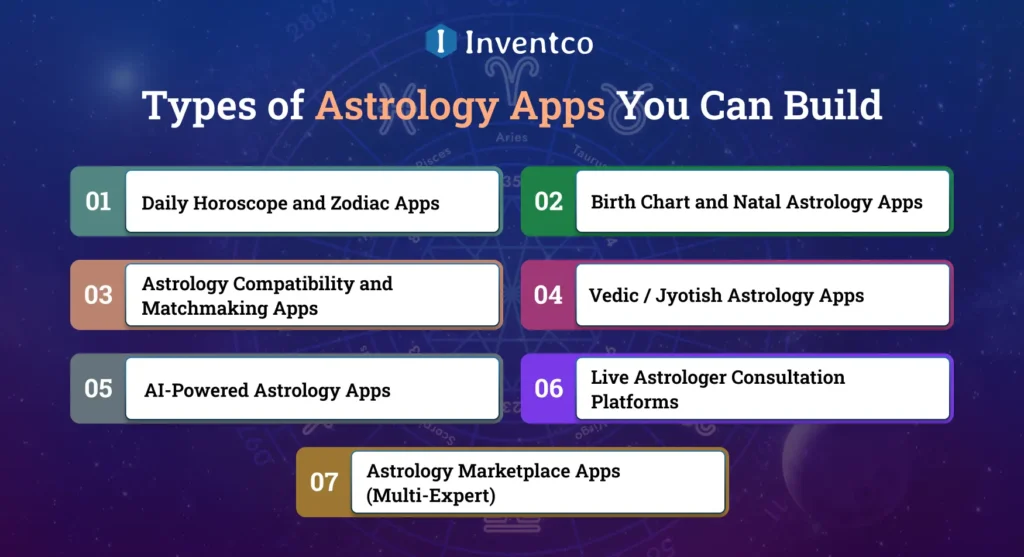
Not all astrology apps serve the same market or use the same business model. Before engaging an astrology app development company, you need to be precise about the category you are entering, because each type demands a different feature architecture, content strategy, and investment level.
1. Daily Horoscope and Zodiac Apps
The most accessible entry point. These apps deliver content-driven sun sign horoscopes, compatibility insights, and daily affirmations. Think of them as editorial media products with a spiritual lens. Monetization typically runs on advertising or light freemium models. They generate high volume but relatively low ARPU unless paired with a premium tier. Co–Star’s early version is a reference point here: content-first, community-driven, low-friction.
Best for: Founders building consumer media brands or testing the market before scaling into consultation or AI-led features.
2. Birth Chart and Natal Astrology Apps
More sophisticated by nature. These apps require a calculation engine, typically built on Swiss Ephemeris or AstroAPI, to generate an accurate natal chart based on a user’s date, time, and location of birth. The output is rich, personalized, and deeply engaging for the core user. Retention is considerably higher than horoscope-only apps because the content is unique to each individual.
Best for: Founders targeting depth-over-breadth audiences who value precision and are willing to pay for it.
3. Astrology Compatibility and Matchmaking Apps
A high-retention category that leverages the social sharing behavior native to the target demographic. Users generate synastry reports, compare charts with friends or partners, and share results on social media, creating organic acquisition loops. When integrated with a broader matchmaking platform, compatibility features drive significant engagement metrics.
Best for: Founders in the dating or relationship wellness space looking to differentiate through astrological intelligence.
4. Vedic / Jyotish Astrology Apps
A strategically important category that remains underpenetrated relative to its total addressable market. Vedic astrology commands deep trust and cultural authority across India, Sri Lanka, Nepal, and the South Asian diaspora globally, a combined audience exceeding 1.5 billion potential users. Apps like AstroSage have demonstrated the revenue potential here, but the category still lacks a truly premium, design-forward product.
Best for: Founders with access to Vedic astrologers and an appetite for the South Asian market. The competitive moat is real if the product quality is there.
5. AI-Powered Astrology Apps
The fastest-growing and most strategically compelling category in 2026. AI astrology apps use large language models, fine-tuned on astrological knowledge, to deliver conversational, real-time readings that adapt to user context. Unlike static content apps, AI-first platforms feel dynamic and genuinely responsive. Nebula’s AI chat feature saw a 340% engagement lift after launch, a signal of what the right implementation can achieve.
This is where selecting an AI app development company becomes critical. The difference between a generically prompted LLM and a purpose-built astrology AI is significant in user experience, accuracy perception, and ultimately retention. If you are building in this space, partner with an AI app development team that has demonstrated competency in both LLM fine-tuning and domain knowledge in the astrological domain.
Best for: Founders with a technology-first vision and investors seeking high defensibility through proprietary AI models.
6. Live Astrologer Consultation Platforms
The highest-revenue category in terms of transaction value. These are marketplace models, think Thumbtack or Zocdoc, but for astrology, connecting users with vetted, rated astrologers via chat, voice, or video. Platforms like Nebula and Keen have demonstrated that the US market can sustain high-value, consultation-based models, with users willing to pay premium rates for personalized, one-on-one guidance.
The core engineering challenge is real-time communication infrastructure, astrologer onboarding and quality control, and payment flow design for per-minute billing.
Best for: Founders with marketplace experience or investment in operations-heavy businesses with large addressable markets.
7. Astrology Marketplace Apps (Multi-Expert)
An evolution of the consultation model that layers in content commerce, selling reports, charts, digital products, and physical goods (gemstones, remedies, puja bookings) alongside live sessions. This model creates multiple revenue streams within a single app ecosystem and significantly raises LTV. It is also operationally complex and capital-intensive to scale.
Best for: Well-funded founders with a platform vision and a 24-36 month growth horizon.
Must-Have Features of a Competitive Astrology App in 2026
The feature decisions you make now will define your product’s market position, your development timeline, and your total investment. Below is a structured breakdown of the mobile app feature landscape, organized from foundational to advanced.
Core Features Every Astrology App Needs
- Birth Chart Engine: An accurate, real-time calculation engine powered by Swiss Ephemeris or a comparable API. This is non-negotiable for any app making astrological claims, incorrect calculations destroy credibility immediately.
- User Onboarding and Profiling: Date, time, and location of birth captured during signup, feeding into all downstream personalization. The UX here sets the tone for the entire product experience.
- Daily Horoscope Feed: Push notification-driven content that brings users back every day. The most powerful retention mechanic in the category.
- Zodiac Compatibility Tool: A high-shareability feature that drives organic user acquisition through social referrals.
- Subscription Management: Seamless in-app purchase infrastructure for iOS and Android, supporting weekly, monthly, and annual plan structures.
AI Features That Differentiate in 2026
If your product roadmap does not include AI, you are building yesterday’s app. The most important AI capabilities in astrology app development today are:
- Conversational AI Astrologer: An LLM-based chat interface that can answer nuanced astrological questions in natural language, maintain context across a session, and adapt its tone to the user’s emotional state.
- Personalized Transit Alerts: AI-driven notifications that alert users to significant planetary events affecting their chart, not generic messages, but genuinely personalized ones.
- Predictive Compatibility Scoring: Machine learning models that go beyond simple sun-sign matching to analyze full chart compatibility across multiple astrological dimensions.
- Sentiment-Aware Content Generation: Dynamic horoscope and guidance content that shifts based on the user’s interaction history, time of day, and current planetary transits.
Implementing these features well requires working with an AI astrology app development company that has actual LLM integration experience, not just a team that outsources the AI layer to a generic ChatGPT wrapper.
Platform and Engagement Features
- Live Chat, Voice & Video: WebRTC or Agora-powered real-time communication for consultation sessions. Architecture must support per-minute billing, session recording, and quality monitoring.
- Astrologer Dashboard: A dedicated interface for expert practitioners to manage their calendar, sessions, earnings, and client history.
- Multi-language and Localization: For any product targeting the US or global markets, localization into Spanish is essential, given its large user base. For broader expansion, adding support for Portuguese, French, and German strengthens accessibility and unlocks international growth.
- Admin Panel and Analytics: Business-level dashboards for tracking user cohorts, revenue metrics, astrologer performance, and content engagement, essential for any investor-facing business.
Advanced Features for Enterprise-Grade Products
- AR Sky Map: An augmented reality feature that overlays real-time planetary positions on the phone’s camera view. High engagement, high development cost, reserve for later-stage roadmaps.
- Kundali Matching Module: A full Vedic compatibility analysis system including Ashtakoot matching, Mangal Dosha assessment, and remedial suggestions. Critical for the South Asian market.
- Digital Report Generation: Automated PDF generation of detailed astrological reports that users can purchase as standalone products or as premium subscription benefits.
- E-commerce Integration: Gemstone recommendations tied to astrological analysis, with in-app purchase capability, a meaningful supplementary revenue stream.
Step-by-Step Process to Build an Astrology App
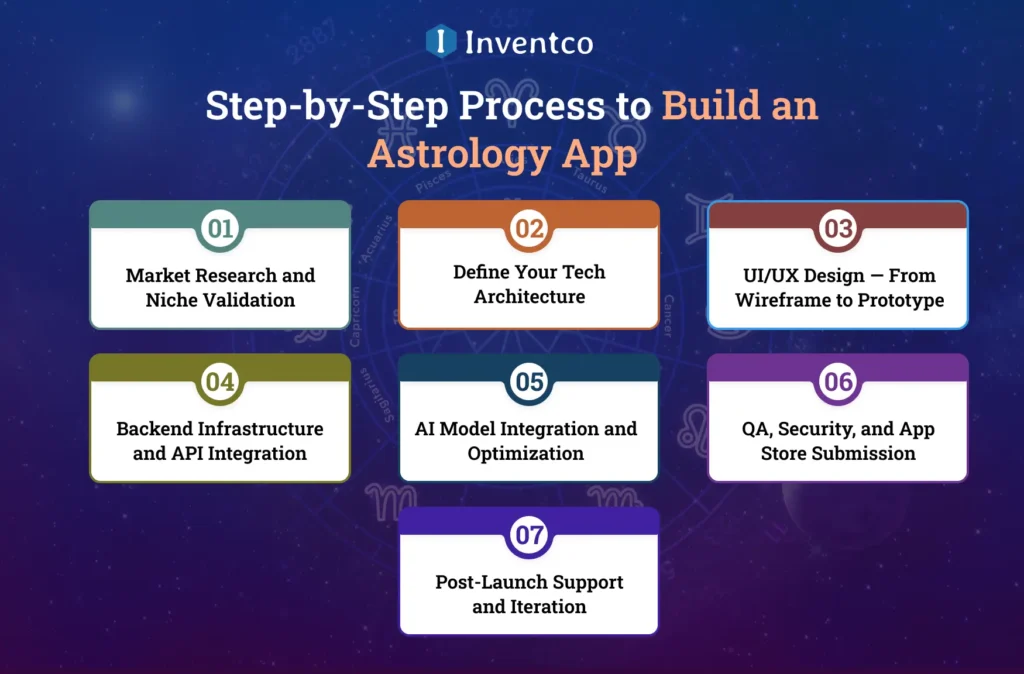
Knowing what to build is only half the equation. Understanding how the build actually unfolds, and where projects typically go wrong, is what separates founders who ship on time and on budget from those who do not. The mobile app development process is not a straight line. It is a series of decisions that narrows your options downstream. Getting the sequence right from the start is the single most controllable variable in your project’s outcome.
What follows is a step-by-step breakdown of the astrology app development process, from initial market validation through post-launch iteration, with practical guidance at each stage for founders and investors managing real constraints of capital, time, and market timing.
Step 1: Market Research and Niche Validation
Before you build a mobile app, validating your niche is essential. The astrology market may appear saturated, but real opportunities exist in emerging app development trends such as AI-first platforms, premium Vedic astrology, and regional-language solutions. Starting with an MVP mobile app lets you test demand quickly while minimizing upfront risk.
Conduct structured user interviews, analyze competitor reviews, and validate your monetization model early. Founders who invest time here reduce uncertainty, define clear positioning, and enter development with confidence, ensuring their product aligns with real user expectations rather than assumptions.
Step 2: Define Your Tech Architecture
Your technology foundation determines scalability, performance, and long-term cost efficiency. The choice between Android vs. iOS or cross-platform development should align with your business goals, timeline, and available budget. Native development offers superior performance, while mobile app development frameworks like Flutter provide cost-efficient alternatives with strong user experience.
A well-defined architecture also considers AI integration, real-time communication, and API structure from the beginning. Planning these elements early prevents costly rebuilds later and ensures your app can scale seamlessly as your user base grows and feature complexity increases.
Step 3: UI/UX Design — From Wireframe to Prototype
Design is not just visual, it directly influences user behavior and conversion. Begin with app wireframing to structure your app’s flow logically, followed by an interactive app prototype to test usability before development begins. This structured approach reduces design errors and ensures efficient execution.
Onboarding is particularly critical in astrology apps, as it captures essential user data. Even small improvements in onboarding completion can significantly boost engagement and revenue. Investing in thoughtful UX design ensures your app feels intuitive, trustworthy, and engaging from the very first interaction.
Step 4: Backend Infrastructure and API Integration
Your backend must support authentication, real-time interactions, and high-volume data processing without compromising performance. Implementing a scalable system aligned with mobile app security best practices ensures user data remains protected while maintaining system reliability. Cloud infrastructure plays a key role in efficiently handling growth.
Additionally, selecting the right APIs and properly structuring your backend ensures accuracy and responsiveness. A robust backend enables seamless feature expansion, ensuring your application delivers consistent performance even as user demand increases over time.
Step 5: AI Model Integration and Optimization
AI is a major driver of modern product differentiation and a leading trend in app development. Early-stage apps can leverage prompt-based AI systems to deliver personalized experiences without significant investment, while advanced products benefit from fine-tuned models for deeper customization.
The focus should be on accuracy, scalability, and user trust. A well-integrated AI system enhances engagement, delivers meaningful insights, and evolves as user behavior changes. Investing strategically in AI ensures your app remains competitive while delivering value that users consistently return for.
Step 6: QA, Security, and App Store Submission
Thorough mobile app testing is essential to ensure performance, stability, and seamless functionality across devices. Testing should cover usability, load handling, and payment flows while maintaining compliance with global security standards to protect sensitive data.
Alongside testing, implement strong app store optimization strategies to improve visibility and downloads. A well-executed launch minimizes risks, enhances user trust, and positions your app competitively in the marketplace from day one.
Step 7: Post-Launch Support and Iteration
After launch, continuous mobile app maintenance becomes essential for long-term success. Regular updates, bug fixes, and performance improvements ensure the app remains stable and aligned with evolving user expectations. Understanding mobile app maintenance costs helps plan sustainable growth strategies.
This phase also reveals real-world challenges in mobile app development, enabling data-driven improvements. Iterative updates influence the overall time to develop a mobile app for future versions, ensuring your product evolves efficiently while maintaining a high-quality user experience.
How Much Does It Cost to Develop an Astrology App in 2026?
This is the question every founder and investor asks first, and rightly so. The cost to develop an astrology app can range from $10,000 to $1,00,000+ and varies significantly based on scope, feature complexity, team geography, and technology choices.
Here is a transparent, structured breakdown of the mobile app development cost for the Astrology app.
1. Cost to Build a Basic Astrology App ($10,000–$30,000)
A basic astrology app includes sun sign horoscopes, a simple birth chart display, daily push notifications, and social sharing. It is a functional product, viable as an MVP to test user acquisition and content strategy before committing to a larger build.
What you are typically getting at this investment level: a cross-platform build (Flutter or React Native), a pre-built astrology API integration, basic user authentication, and 3-6 months of app store support. What you are not getting: AI features, live consultation infrastructure, or the performance architecture to scale past 50,000 users without a significant rebuild.
This tier makes sense for first-time founders testing a niche, or for established content brands adding an astrology layer to an existing audience.
2. Cost to Build a Mid-Level Astrology App with AI ($30,000–$60,000)
This is where most serious product bets live. At this investment level, you are building a market-ready product: a custom birth chart engine, an AI-powered conversational interface, in-app purchases with subscription management, live chat or video consultations, and a basic admin dashboard.
The AI component is the primary cost driver at this tier. Integrating a well-engineered LLM-based astrology assistant, including prompt architecture, retrieval augmentation, and safety guardrails, typically adds $8,000–$20,000 to the base development cost, depending on the complexity of the conversational design.
When evaluating AI astrology app development companies for a project in this range, ask specifically about their experience with LLM integration and whether they have shipped AI chat features in production, not just in demos.
3. Cost to Build an Enterprise Astrology Platform ($60,000–$100,000+)
Enterprise-scale platforms, live consultation marketplaces, Vedic astrology ecosystems, or multi-expert platforms with e-commerce require a significantly more complex architecture. At this investment level, you are funding native iOS and Android development (separate codebases), a custom AI engine, real-time communication infrastructure, multi-language support, Kundali matching, an astrologer onboarding and management system, and enterprise-grade admin analytics.
The $60,000–$100,000 range reflects only development costs. Marketing, content acquisition, astrologer onboarding operations, and 12 months of infrastructure hosting are separate budget items that founders often underestimate.
Factors That Directly Affect Your Astrology App Development Cost
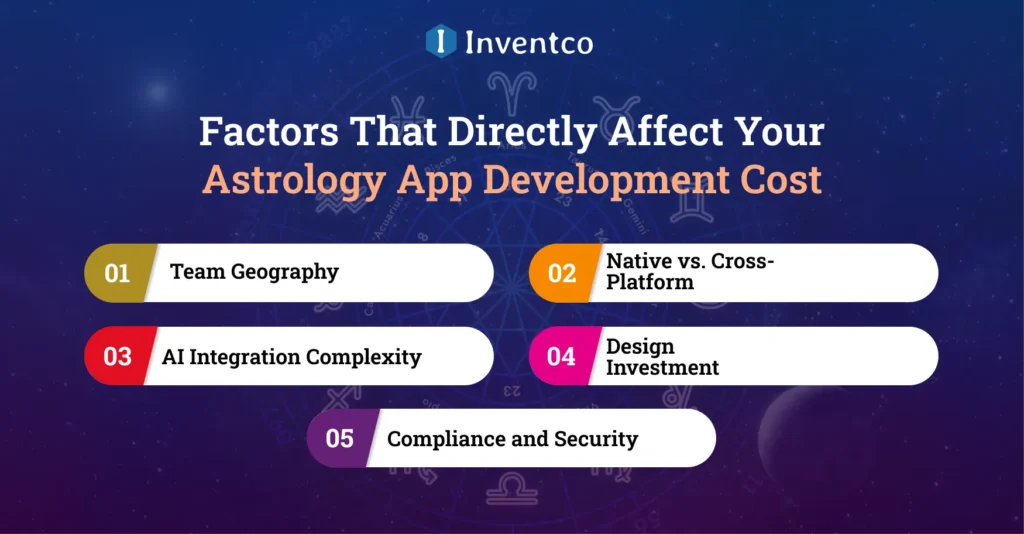
Several critical factors influence the costs of astrology app development, including team location, platform choice, AI complexity, design quality, and compliance requirements, all of which directly affect budget, scalability, and long-term product success.
- Team Geography: Development teams in India typically charge $25–$50/hr. Eastern European teams run $40–$80/hr. US and Western European agencies charge $100–$200/hr. Most quality astrology app development service providers operate from India or hybrid models, delivering strong ROI when you choose a firm with documented delivery quality.
- Native vs. Cross-Platform: Native development adds 35–50% to your budget in exchange for superior performance and platform-specific UI fidelity. Cross-platform (Flutter/React Native) is the pragmatic choice for most products with a total budget below $100,000.
- AI Integration Complexity: A GPT-4 integration with a well-designed system prompt costs a fraction of what a purpose-built, fine-tuned model costs. Be clear about what level of AI sophistication your product actually requires at launch versus what can be added in version 2.
- Design Investment: Underinvesting in UX design is the most common mistake in this category. Budget 15–20% of your total development cost for dedicated UI/UX design, it pays off in conversions and retention.
- Compliance and Security: GDPR, DPDP Act 2023 compliance, and payment security (PCI-DSS) add development overhead. Budget $3,000–$8,000 for proper compliance architecture, depending on your target markets.
Tech Stack for Astrology App Development
The technology decisions you make during development define your product’s performance ceiling, your ability to scale, and the cost of adding features in future versions. Here is the recommended mobile app tech stack for a modern, competitive astrology app:
| Layer | Recommended Technologies |
|---|---|
| Frontend (iOS) | Swift, SwiftUI |
| Frontend (Android) | Kotlin, Jetpack Compose |
| Cross-platform | Flutter, React Native |
| Backend | Node.js, Python (Django/FastAPI) |
| Database | PostgreSQL, MongoDB, Firebase |
| AI/ML Engine | OpenAI GPT-4o, Google Gemini, Custom LLMs |
| Astrology APIs | AstroAPI, Swiss Ephemeris, Astro.com |
| Cloud Infrastructure | AWS, Google Cloud, Azure |
| Payment Gateway | Stripe, Razorpay, PayPal |
| Real-time Communication | Twilio, Agora, WebRTC |
A few considerations worth highlighting for founders evaluating their options:
Flutter vs. React Native: Both are production-grade cross-platform frameworks. Flutter has an edge in animation performance and visual fidelity, important for the celestial, dynamic UI that astrology apps demand. React Native has a larger developer ecosystem and integrates more naturally with JavaScript-heavy backend teams.
Astrology API Selection: Swiss Ephemeris is the gold standard for calculation precision and is used by deep astrology software worldwide. AstroAPI offers a more developer-friendly REST interface at the cost of some calculation depth. Your choice should reflect the precision requirements of your specific product.
AI Infrastructure: OpenAI GPT-4o offers the best out-of-the-box performance for conversational astrology features. Google Gemini is a strong alternative with better cost efficiency at scale. Custom LLM fine-tuning is a worthwhile investment when you have proprietary interaction data and need to create a genuinely distinct AI voice.
Real-Time Communication: Agora.io and Twilio are both production-proven for per-minute consultation billing. Agora offers lower latency and a more feature-complete SDK for video consultation use cases.
Revenue Models for Astrology Apps
Choosing the right monetization strategy defines your app’s success, balancing user value with revenue growth through subscriptions, consultations, and scalable digital offerings that maximize long-term profitability.
- Freemium: Core features are free; premium content and AI features are behind a paywall. The dominant model for content-led apps. Conversion to paid typically runs 3–8% of the free user base when the value gap between free and paid is well-designed.
- Subscription: Monthly, quarterly, and annual plans. Annual plans at a discount improve LTV and reduce churn. The standard for mid-level and enterprise astrology apps. Average subscription prices range from $4.99/month (basic) to $24.99/month (premium with AI and expert access).
- Pay-Per-Reading / Pay-Per-Minute: Transaction-based model for live consultation platforms. High ARPU, lower volume compared to subscription, but extremely high LTV for platforms that achieve strong astrologer quality and user trust.
- Marketplace Commission: Platform takes 20–40% of each astrologer’s earnings. Scales with supply-side growth. In the astrology and spiritual services space, apps like Keen demonstrate that the US market supports strong revenue generation through expert-led, transaction-based interactions.
- Digital Product Sales: One-time purchases of detailed natal reports, yearly forecasts, compatibility analyses. Complements subscription revenue with a meaningful upsell opportunity.
- E-Commerce Integration: Gemstone recommendations, spiritual products, puja booking. A high-margin supplementary revenue stream is particularly well-suited for Vedic-focused platforms.
How Inventco Helps You Build a Scalable Astrology App?
Building a scalable astrology app requires more than just clean code, it demands the right architecture, AI capability, and a long-term product mindset. This is where Inventco plays a strategic role as your development partner.
Inventco starts with a scalability-first architecture, ensuring your app can handle growing user demand, real-time consultations, and high-volume data processing without performance issues. From backend infrastructure to database design, every layer is built to support future expansion.
A key differentiator is Inventco’s AI-driven approach. Instead of generic integrations, the team develops tailored AI systems that deliver personalized horoscopes, conversational experiences, and predictive insights, enhancing engagement and retention from day one.
Inventco also brings deep domain expertise in both Vedic and Western astrology. This ensures accurate calculations, culturally relevant user experiences, and content strategies that build user trust, an essential factor in this category.
Execution is equally strong. With structured sprint cycles, weekly demos, and transparent communication, you always have visibility into progress and can adapt quickly based on feedback.
Most importantly, Inventco doesn’t stop at launch. Their post-launch support and optimization model ensures continuous improvements, performance tuning, and feature evolution, helping your app scale efficiently as your user base grows.
In short, Inventco helps you move from idea to a high-performance, scalable astrology platform built for real-world success.
Final Thoughts
The astrology app market in 2026 is not a novelty play. It is a legitimate, growing digital wellness vertical with proven monetization, strong user engagement fundamentals, and, for founders who move deliberately, a significant opportunity to build an enduring business.
This astrology app development guide has walked you through every major decision you will face: the type of app that fits your market thesis, the features that define a competitive product, the realistic cost to develop an astrology app at each scope level, the technology choices that will shape your product’s future, and the criteria for selecting the right astrology app development company.
The founders who win in this space share a common trait: they invest in product quality, understand their users deeply, and treat AI not as a gimmick but as a genuine product capability that serves a real user need. They also move quickly, because the market is moving whether or not they are.
If you are ready to move from idea to execution, the next step is a structured discovery conversation with a development partner who has shipped in this category. Present your product hypothesis, target user, and business model clearly. The right team will help you sharpen all three and build something worth funding.
FAQ’s
Q1. How much does it cost to develop an astrology app?
Ans. Astrology app development typically costs between $10,000 and $1,00,000+, depending on features, AI integration, platform choice, and complexity. MVP apps fall in the lower range, while advanced platforms require higher investment.
Q2. How long does it take to build an astrology app?
Ans. A basic astrology app takes around 2–3 months. Mid-level apps with AI and consultation features require 4–6 months, while complex platforms can take up to 12 months.
Q3. What features are essential in an astrology app?
Ans. Core features include horoscope predictions, birth chart generation, AI-based insights, real-time consultations, push notifications, and secure payments. Advanced apps also integrate multilingual support and personalized recommendations.
Q4. Do I need AI in my astrology app?
Ans. AI is not mandatory initially, but it significantly improves personalization, user engagement, and retention. Modern astrology apps leverage AI for conversational experiences, predictive insights, and scalable content delivery.
Q5. How do astrology apps make money?
Ans. Astrology apps monetize through subscriptions, pay-per-consultation sessions, freemium upgrades, and digital reports. Many successful platforms combine multiple revenue streams to maximize user lifetime value and profitability.
Q6. What is the best tech stack for astrology app development?
Ans. Popular stacks include Flutter or React Native for the frontend, Node.js or Python for the backend, PostgreSQL or MongoDB for databases, Swiss Ephemeris APIs, and AI tools like OpenAI or Gemini.

Ajay Bhal
He is an on-demand app solutions expert with 11+ years of experience in business consulting and building scalable, user-centric digital products. He specializes in robust on-demand platforms across industries, combining technical expertise with business-focused strategy to deliver efficient, top notch solutions that drive growth and enhance user experience. You can connect with him on LinkedIn to follow insights.