Every day, billions of dollars of goods move across cities, countries, and continents. Yet, most logistics operations still run on outdated systems, manual processes, and fragmented communication. The result? Costly delays, lost shipments, and frustrated customers.
Here is the reality: the global logistics market is projected to surpass $16.19 trillion by 2028, growing at a CAGR of over 6.5%. Meanwhile, the on-demand logistics app market alone is expected to reach $75.6 billion by 2030. Businesses that fail to digitize their logistics operations are already falling behind.
If you are a founder or investor looking to build a logistics app, the first question on your mind is probably: how much does logistics app development cost? The honest answer is that it ranges from $10,000 for a focused MVP to $100,000+ for a fully scalable, enterprise-grade platform. The exact number depends on your feature set, platform choice, technology stack, and your development partner’s expertise.
This guide breaks it all down for you, with real numbers, real insights, and a clear roadmap to help you make an informed investment decision.
Key Takeaways
- Logistics app development costs range from $10,000 (MVP) to $100,000+ (enterprise-grade), depending on complexity, features, and platform.
- The global logistics market is projected to surpass $16.19 trillion by 2028, making now the ideal time to invest in a logistics mobile app.
- MVP logistics apps focus on core workflows like shipment tracking and booking, whereas advanced apps include AI routing, predictive analytics, and IoT integration.
- Platform choice, iOS, Android, or Web, significantly affects development timelines and cost; cross-platform development with React Native or Flutter can reduce spend by 30-40%.
- Hidden costs, including app maintenance, security audits, third-party API integrations, and App Store Optimization (ASO), can add 20-30% to your total budget.
- Selecting the right monetization model- SaaS subscriptions, commission-based revenue, or freemium tiers- directly impacts your long-term ROI and investor appeal.
- Partnering with an experienced logistics app development company in the USA, such as Inventco, with a proven track record in apps like BringMe, ensures faster time-to-market, a scalable architecture, and reduced technical debt.
Market Stats of the Logistics App Industry
Before committing to logistics app development, understanding the market landscape gives founders and investors the confidence to move forward. The numbers tell a compelling story:
- The global logistics market size was valued at USD 5.88 Trillion in 2025 and is projected to reach USD 8.23 trillion by 2034, exhibiting a CAGR of 3.71% during the forecast period 2026-2034.
- The Digital Transformation Spending on Logistics Market size was valued at USD 57.2 billion in 2023, and the total Digital Transformation Spending on Logistics Market revenue is expected to grow at a CAGR of 9.35% from 2024 to 2030, reaching nearly USD 106.95 billion.
- The global logistics market size was valued at USD 3,794.4 billion in 2023 and is projected to reach USD 5,951.0 billion by 2030, growing at a CAGR of 7.2% from 2024 to 2030.
The data is clear: logistics app development is not just a cost center, it is a high-return investment opportunity for forward-thinking businesses.
What is a Logistics App?
A logistics app is a digital platform that streamlines the movement, tracking, and management of goods, vehicles, and supply chain operations. It serves as a command center connecting shippers, carriers, warehouse managers, and end customers in real time.
Logistics apps can range from simple parcel-tracking tools to sophisticated enterprise platforms that manage multimodal freight, warehousing, route optimization, and driver dispatch. The scope of your app determines both the logistics app development cost and its potential to scale.
Key stakeholders a logistics app serves:
- Shippers and senders who need to book and track deliveries
- Carriers and drivers who manage routes and pickups
- Warehouse managers who oversee inventory and dispatch
- End customers are expecting real-time visibility and timely delivery
Whether you are building an Uber-like logistics app, a freight marketplace, or a fleet management system, the fundamentals remain consistent: real-time data, smart automation, and seamless user experience.
How Much Does It Cost to Develop a Logistics App?
The cost of mobile app development for logistics is not fixed, it can range from $10,000 to $ 100,000+. It is determined by a combination of scope, features, team structure, and technology choices. Here is a practical breakdown:
MVP (Minimum Viable Product): $10,000 – $30,000
An MVP logistics app delivers core functionality, shipment booking, real-time tracking, user authentication, and basic notifications. Built to validate the business model quickly with minimal investment, it allows founders to test market fit before scaling. Ideal for startups entering the logistics space.
Mid-Level Logistics App: $30,000 – $70,000
A mid-level logistics app expands on the MVP by adding driver management, route optimization, in-app payments, multi-role dashboards, and advanced analytics. It targets growing businesses with an established customer base that need scalable operations. Supports Android, iOS, and web. Suitable for regional logistics players ready to modernize.
Advanced / Enterprise App: $70,000 – $100,000+
An enterprise logistics app integrates AI-powered routing, IoT fleet tracking, predictive analytics, multi-warehouse management, ERP integrations, and white-label capabilities. Designed for large-scale logistics operations with complex workflows and compliance requirements. It requires a senior engineering team and robust infrastructure for long-term scalability.
Key Factors That Influence Logistics Mobile App Development Cost
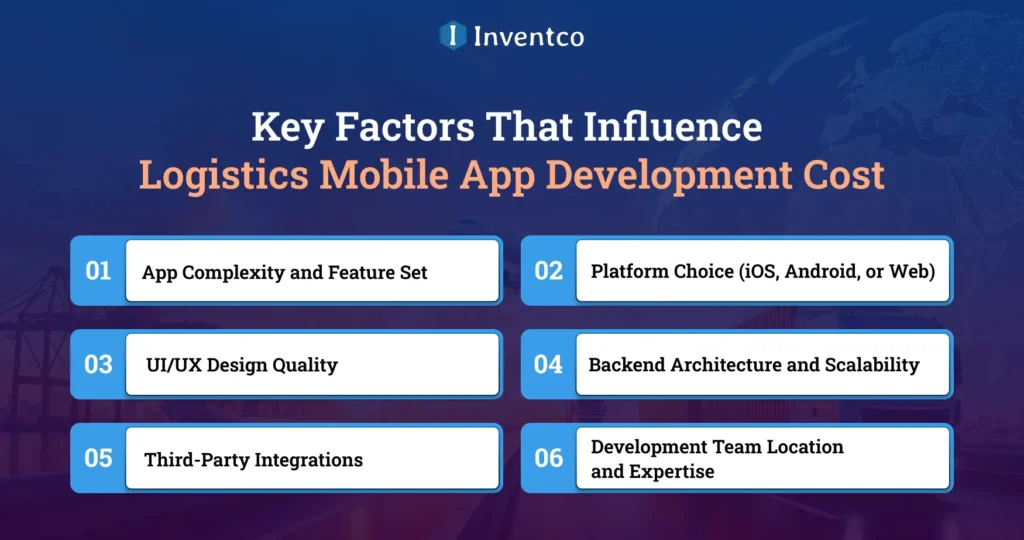
Understanding what drives the cost of logistics app development helps you make smarter investment decisions and avoid scope creep. Here are the six most critical factors:
1. App Complexity and Feature Set
The more features you build, the higher the cost. Basic tracking and booking are straightforward; AI dispatching, predictive ETAs, and IoT integrations require significantly more engineering effort and testing.
2. Platform Choice (iOS, Android, or Web)
Developing natively for both iOS and Android doubles the effort compared to a cross-platform approach. Understanding the trade-offs between Android and iOS development is essential for cost-effective planning. Web dashboards add another layer of complexity.
3. UI/UX Design Quality
A logistics app serving multiple user roles- driver, dispatcher, admin, and customer- requires thoughtful UX design and app wireframing. Complex interfaces with custom elements increase design and front-end development costs.
4. Backend Architecture and Scalability
Logistics apps handle high-frequency data: real-time GPS updates, concurrent user sessions, and large transaction volumes. Building a scalable backend with microservices, API gateways, and cloud infrastructure increases upfront cost but reduces long-term scaling pain.
5. Third-Party Integrations
GPS and mapping APIs (Google Maps, HERE), payment gateways, SMS/notification services, ERP systems, and customs APIs all add to integration complexity and licensing costs. Each integration adds to the mobile app development timeline.
6. Development Team Location and Expertise
Hiring a logistics app development company in the USA commands higher rates ($100-200/hour) but delivers superior quality, communication, and accountability. Nearshore or offshore teams offer lower rates but often require more oversight and iteration cycles.
Types of Logistics Apps and Their Development Cost Comparison
The logistics industry spans multiple verticals, each with its own tailored solution. Here is a comparison of the six most in-demand logistics app types and their estimated development costs:
1. On-Demand Delivery App (Uber-like): $25,000 – $80,000+
An on-demand logistics app connects users with drivers in real time, offering booking, tracking, payments, and ratings. Costs depend on features like GPS tracking, route optimization, scalability, and integrations, making it ideal for hyperlocal delivery businesses.
2. Fleet Management App: $30,000 – $90,000+
A fleet management app helps businesses monitor vehicles, drivers, fuel usage, maintenance, and routes. Development costs vary based on telematics integration, analytics dashboards, IoT connectivity, and automation features, making it essential for logistics companies managing large transportation operations efficiently.
3. Freight Marketplace / Load Board: $40,000 – $100,000+
This platform connects shippers with carriers, enabling load posting, bidding, tracking, and payments. Costs increase with real-time matching algorithms, verification systems, and analytics. It’s ideal for businesses aiming to digitize freight brokerage and optimize logistics operations at scale.
4. Warehouse Management System (WMS): $35,000 – $85,000+
A WMS app manages inventory, order fulfillment, picking, packing, and shipping operations. Costs depend on automation, barcode/RFID integration, analytics, and ERP connectivity. It’s critical for businesses aiming to streamline warehouse operations and significantly reduce operational errors.
5. Last-Mile Delivery App: $20,000 – $60,000+
A last-mile delivery app focuses on final delivery from hub to customer, featuring route optimization, driver tracking, proof of delivery, and notifications. Costs vary with real-time capabilities and scalability, making it crucial for eCommerce and hyperlocal delivery businesses.
6. Supply Chain Visibility Platform: $50,000 – $100,000+
This platform provides end-to-end visibility across the supply chain, tracking shipments, inventory, and disruptions in real time. Costs rise with AI, predictive analytics, and IoT integration, making it valuable for enterprises seeking transparency and proactive decision-making capabilities.
On-demand logistics apps, similar to the Uber model, tend to be the most popular entry point for founders due to their proven business model and strong consumer demand. Each type has its own set of must-have features and integration requirements that directly affect the final development cost.
Must-Have Features for a Scalable Logistics App
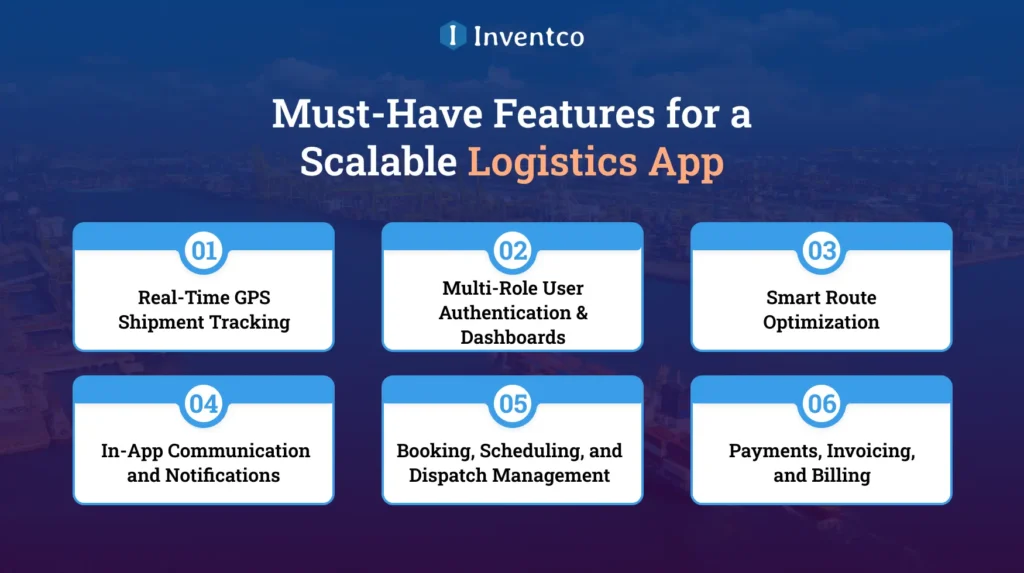
Regardless of your app type or budget tier, these six core features are non-negotiable for any serious logistics platform:
1. Real-Time GPS Shipment Tracking
Live tracking is the backbone of any logistics app. It provides end-to-end shipment visibility for customers, dispatchers, and drivers, reducing support queries, improving trust, and enabling proactive exception management. A core must-have mobile app feature for logistics.
2. Multi-Role User Authentication & Dashboards
Logistics apps serve multiple stakeholders: customers, drivers, dispatchers, and admins. Secure role-based authentication, combined with customized dashboards, ensures each user sees relevant data while maintaining strict data and mobile app security best practices.
3. Smart Route Optimization
AI-driven route optimization reduces fuel consumption, delivery times, and operational costs. The system calculates the most efficient delivery sequence by accounting for traffic, vehicle capacity, delivery windows, and driver availability, delivering measurable ROI from day one.
4. In-App Communication and Notifications
Push notifications, in-app chat, and SMS alerts keep all stakeholders informed throughout the delivery lifecycle. Real-time updates on pickups, delays, and deliveries dramatically improve customer satisfaction and reduce failed-delivery rates, which are critical for on-demand logistics operations.
5. Booking, Scheduling, and Dispatch Management
A seamless booking interface with scheduling options, pickup time selection, and automated dispatch assignment streamlines operations. Intelligent auto-dispatching reduces manual workload for coordinators and ensures faster order fulfillment, especially vital for same-day and express delivery apps.
6. Payments, Invoicing, and Billing
Integrated payment processing supports credit cards, digital wallets, and corporate billing. Automated invoicing, GST/tax compliance, and digital receipts eliminate manual accounting bottlenecks. A robust payment infrastructure is essential for building a trusted, monetizable logistics platform.
Advanced Features That Increase Logistics App Development Cost
These six advanced features push your logistics app from functional to formidable, and they come with added development complexity and cost:
1. AI-Powered Predictive Analytics
Machine learning models analyze historical data, weather, and traffic patterns to forecast delivery delays, demand surges, and fleet maintenance needs. Predictive intelligence enables proactive decision-making, reduces operational surprises, and creates a significant competitive moat for your logistics platform.
2. IoT Integration for Fleet and Asset Tracking
IoT sensors embedded in vehicles and parcels provide granular data on location, temperature, and handling conditions. Real-time IoT dashboards ensure compliance for sensitive cargo, pharmaceuticals, and perishables, and reduce losses from mishandling or theft across your supply chain.
3. Automated Document Processing (OCR/AI)
Optical character recognition and AI automate data extraction from bills of lading, customs documents, and delivery proofs. Eliminating manual data entry reduces human error, accelerates customs clearance, and significantly lowers operational costs at scale for cross-border logistics.
4. Blockchain for Supply Chain Transparency
Blockchain creates immutable, tamper-proof records of every transaction and handoff in the supply chain. This is especially valuable for regulated industries and international freight, where proof of provenance, chain of custody, and compliance documentation are legally required and heavily scrutinized.
5. Dynamic Pricing Engine
Algorithmic pricing adjusts rates in real time based on demand, distance, vehicle type, fuel costs, and competitor pricing. A dynamic pricing engine maximizes revenue during peak periods, attracts price-sensitive customers during low-demand windows, and creates a self-optimizing revenue model.
6. Multi-Language and Multi-Currency Support
For logistics platforms targeting international markets, localization is a growth multiplier. Multi-language interfaces and multi-currency payment support remove friction for global users, enabling rapid market expansion without rebuilding your app for each geography, a crucial feature for investor scalability.
Technology Stack Required for Logistics Mobile App Development
The right technology stack ensures your logistics app is fast, scalable, and maintainable. Here is the recommended mobile app technology stack for a production-grade logistics platform:
| Layer | Recommended Technologies |
| Mobile Frontend | React Native, Flutter, Swift (iOS), Kotlin (Android) |
| Web Frontend | React.js, Next.js, Vue.js |
| Backend / API | Node.js, Django / FastAPI, Go |
| Database | PostgreSQL, MongoDB, Redis (caching) |
| Real-Time Engine | WebSockets, Firebase, MQTT (IoT) |
| Cloud Infrastructure | Amazon Web Services, Google Cloud Platform, Microsoft Azure |
| Maps & Routing | Google Maps API, HERE Maps, Mapbox |
| CI/CD & DevOps | Docker, Kubernetes, GitHub Actions |
| Security | OAuth 2.0, JWT, SSL/TLS, End-to-End Encryption |
Selecting the right mobile app development frameworks during the architecture phase prevents costly refactoring later. A senior engineering team evaluates your scalability requirements, data volumes, and integration needs before recommending a stack. Mobile app technology stack decisions should align with your five-year growth roadmap, not just your launch requirements.
Hidden Costs in Logistics Mobile App Development You Must Know
Many founders budget for development but overlook the costs that emerge after launch. Here are the hidden expenses every investor and founder must factor in:
1. App Store Fees and App Store Optimization (ASO)
Apple charges $99/year for developer accounts; Google charges a one-time $25 fee. Beyond fees, App Store Optimization, keyword research, metadata, screenshots, and reviews management are recurring investments that directly impact your organic discoverability and download velocity.
2. Mobile App Maintenance and Bug Fixes
Plan to allocate 15-20% of your initial development cost each year to mobile app maintenance. This covers OS updates, device compatibility, bug fixes, and performance improvements. Apps that are not maintained quickly develop technical debt, security vulnerabilities, and poor user ratings. Learn more about mobile app maintenance cost planning.
3. Third-Party API Licensing
Google Maps API, payment gateways, SMS providers, and IoT platforms all have usage-based pricing. At scale, these costs can reach thousands of dollars monthly. Budget for API costs early and evaluate self-hosted or open-source alternatives where appropriate.
4. Security Audits and Compliance
Logistics apps handle sensitive shipment data, payment information, and customer PII. Annual mobile app security best practices audits, penetration testing, and GDPR/CCPA compliance reviews are non-negotiable costs for enterprise customers and regulated markets.
5. QA and Mobile App Testing
Rigorous app testing, including automated regression testing, device compatibility testing, load testing, and user acceptance testing, adds 20-25% to development effort. Skipping this phase is a false economy that results in production failures, negative reviews, and customer churn.
6. Cloud Infrastructure Scaling
As your user base grows, your cloud costs scale proportionally. Budget for database scaling, CDN costs, and load balancing infrastructure. Working with a DevOps engineer during the architecture phase helps forecast and optimize your cloud spend from the start.
How to Optimize Logistics App Development Cost Without Compromising Quality?
Building a logistics app on a budget does not mean cutting corners. It means making smart architectural and strategic decisions:
- Start with an MVP mobile app to validate your business model before investing in advanced features. Ship early, learn fast, and iterate based on real user data.
- Choose cross-platform development (Flutter or React Native) to build a single codebase for both iOS and Android, reducing development time by 30-40% without sacrificing user experience.
- Prioritize must-have features over nice-to-have features in your first release. Use the mobile app development process framework to sequence features by user value and business impact.
- Build a reusable, modular architecture that allows new features to be added without rebuilding core functionality. This reduces future development costs significantly.
- Use open-source mapping libraries and self-hosted solutions where possible to minimize third-party licensing costs at scale.
- Partner with a development company that offers dedicated teams with transparent pricing, milestone-based billing, and post-launch support, ensuring predictable costs and no hidden invoices.
Understanding the time required to develop a mobile app at each stage helps you accurately plan resource allocation and investor reporting. Rushed timelines create technical debt; unrealistic budgets create scope compromise. The goal is a lean, focused, and scalable product.
Monetization Models for Logistics Apps
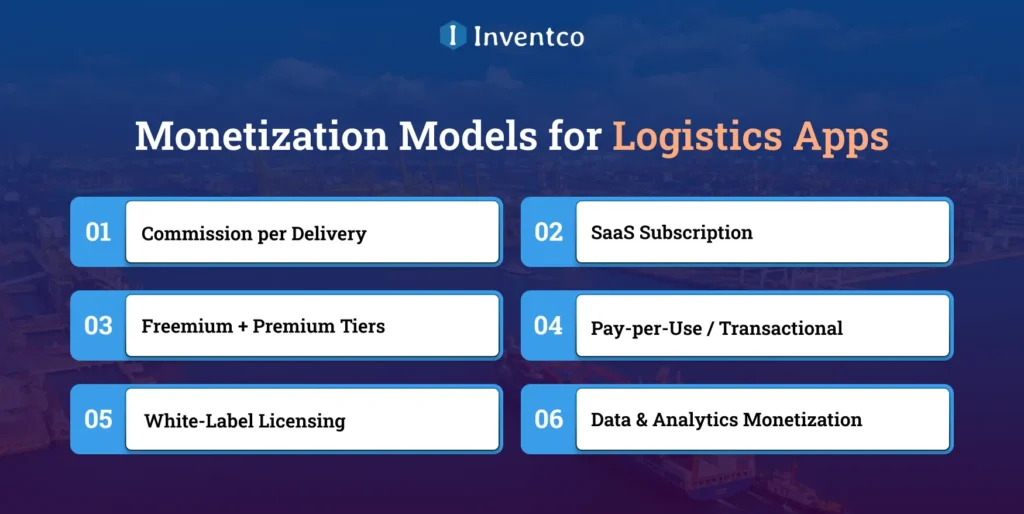
A great logistics app needs a sustainable revenue model. Here are the most effective mobile app monetization strategies for logistics platforms:
1. Commission per Delivery
This model charges a percentage or fixed fee per completed delivery. Ideal for marketplaces, it scales revenue with transaction volume, aligns platform incentives, and supports rapid growth without upfront user costs or subscription commitments.
2. SaaS Subscription
Businesses pay recurring monthly or annual fees to access logistics software. Best for fleet management and WMS platforms, it ensures predictable revenue, supports continuous updates, and offers tiered pricing based on features, users, or usage levels.
3. Freemium + Premium Tiers
Users access basic features for free, with advanced capabilities unlocked through paid tiers. Ideal for SMB logistics tools, it drives adoption, builds trust, and converts users into paying customers through feature limitations and value-based upgrades.
4. Pay-per-Use / Transactional
Users are charged based on actual usage, such as bookings or transactions. This model suits freight platforms and load boards, offering flexibility, low entry barriers, and cost alignment with business activity and operational demand levels.
5. White-Label Licensing
This model allows businesses to license the platform and rebrand it as their own. Ideal for enterprises and carriers, it generates high-value contracts, expands market reach, and reduces development effort for clients seeking ready solutions.
6. Data & Analytics Monetization
Platforms monetize aggregated logistics data by offering insights, predictive analytics, and reporting tools. Ideal for supply chain visibility solutions, it creates new revenue streams, enhances decision-making value, and differentiates the platform through intelligence-driven offerings.
The most successful logistics apps combine multiple revenue streams. For example, an on-demand delivery platform can charge commission per delivery while offering a SaaS subscription to enterprise shippers for volume discounts and priority access. Designing your monetization model before you build ensures your app architecture supports the revenue logic from day one.
Why Partner with Inventco to Build a Logistics App in the USA?
Choosing the right logistics app development company is not just a technical decision, it is a business-critical one. Here is why Inventco is the trusted technology partner for founders and investors building logistics platforms in the USA.
Proven Experience in Logistics App Development
Inventco has delivered end-to-end mobile app solutions across logistics, transportation, and on-demand delivery verticals. Our team combines deep domain expertise with modern engineering practices to build apps that scale with your business, not against it.
Real-World Expertise: BringMe — Built by Inventco
BringMe is a cutting-edge parcel delivery mobile application developed by Inventco that exemplifies our logistics app capabilities. Here is what we built:
- Full-Stack Delivery Platform: BringMe connects individuals and businesses needing to send parcels with a network of reliable, efficient delivery personnel, available on both iOS and Android.
- End-to-End Parcel Workflow: Users can create accounts, enter pickup and delivery addresses, specify parcel details (weight and dimensions), and select from same-day, express, or standard delivery options.
- Transparent Pricing Engine: BringMe surfaces transparent, real-time pricing so senders can compare and select the most cost-effective delivery option, removing friction and building customer trust.
- Real-Time Tracking and Matching: Once a delivery is placed, BringMe matches senders with the most suitable available delivery personnel in the vicinity. Senders track their shipment live throughout the entire journey.
- Multi-Discipline Delivery: Inventco’s team covered Backend Engineering, Frontend Development, Software Testing, UX/UI Design, and Strategic Product Consulting, delivering BringMe as a market-ready product.
BringMe is not a concept, it is a live, operational product that demonstrates Inventco’s ability to take a logistics app from strategy and wireframing through to App Store deployment. It is proof that we build logistics apps that work in the real world, at scale.
What Inventco Delivers for Your Logistics App?
- Full-cycle custom logistics app development, from strategy and app prototype to launch and post-launch mobile app maintenance
- Scalable architecture designed for millions of transactions, real-time data, and multi-region deployment
- Compliance-ready development adhering to mobile app security practices and data privacy regulations
- Transparent milestone-based project delivery with clear timelines, budgets, and communication
- Post-launch support, performance monitoring, and iterative feature development
If you are ready to build a logistics app and want a technology partner who has done it before, successfully, Inventco is your answer.
Final Thoughts
The logistics industry is undergoing a digital transformation, and the window for early movers to capture market share is wide open. Whether you are building an MVP logistics app to validate a new business model or developing an enterprise-grade platform to modernize a supply chain operation, the investment is well-justified by the market opportunity.
Logistics app development cost ranges from $10,000 for a targeted MVP to $100,000+ for a full-featured enterprise platform. The key is to start with a clear scope, build on a scalable foundation, and partner with a team that brings both technical expertise and logistics domain knowledge.
Inventco has the experience, portfolio, and team to make your logistics app a competitive product, not just a feature list. Let us help you build something that moves the market.
FAQ’s
Q1. What is the average cost of logistics app development?
Ans. The average cost of logistics app development ranges from $10,000 to $100,000+, depending on features, platform, and development team. A basic MVP costs $10,000- $30,000, while a full-featured enterprise app can exceed $100,000.
Q2. How long does it take to build a logistics app?
Ans. Development timelines range from 2-4 months for an MVP to 8-18 months for an advanced enterprise platform. The time to develop a mobile app depends on feature complexity, team size, and third-party integrations.
Q3. Which platform should I choose for my logistics app — iOS or Android?
Ans. For most logistics apps targeting North American or European markets, starting with iOS is recommended due to higher enterprise adoption. However, cross-platform development with Flutter or React Native allows you to target both iOS and Android simultaneously at a lower cost. See our Android vs iOS comparison for a detailed breakdown.
Q4. What are the hidden costs in logistics app development?
Ans. Hidden costs include App Store fees, mobile app maintenance (15-20% of development cost annually), third-party API licensing, security audits, cloud infrastructure scaling, and ongoing QA and mobile app testing.
Q5. Can I build a logistics app on a tight budget?
Ans. Yes. Starting with an MVP mobile app focused on core features, tracking, booking, and notifications, allows you to enter the market efficiently and validate your model before investing in advanced capabilities. Cross-platform development further reduces upfront costs.
Q6. Why should I choose Inventco for logistics app development?
Ans. Inventco brings proven logistics app development experience, with live products like BringMe demonstrating our full-cycle capabilities, from UX/UI design and backend engineering to testing and deployment. We deliver scalable, market-ready logistics platforms for founders and investors in the USA.

Ajay Bhal
He is an on-demand app solutions expert with 11+ years of experience in business consulting and building scalable, user-centric digital products. He specializes in robust on-demand platforms across industries, combining technical expertise with business-focused strategy to deliver efficient, top notch solutions that drive growth and enhance user experience. You can connect with him on LinkedIn to follow insights.