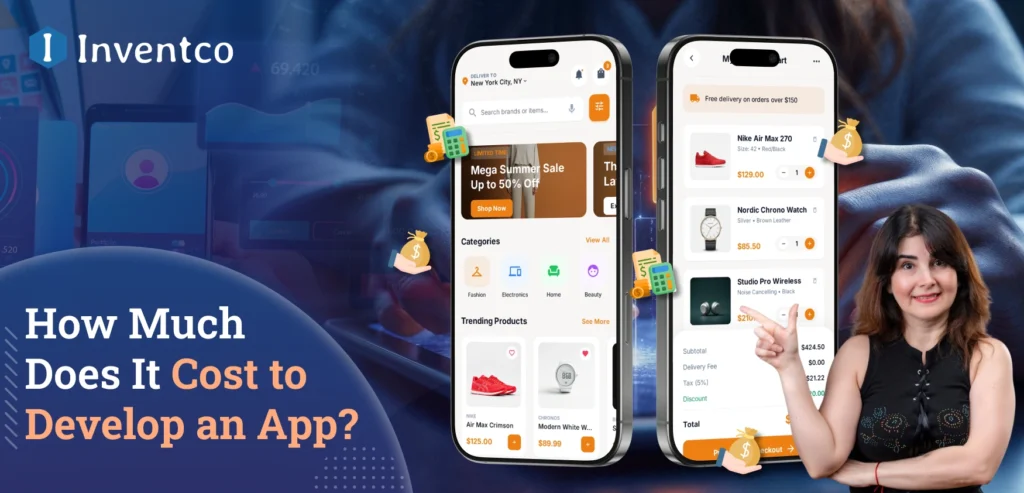
Are you thinking about creating an app in 2026? The first thing that probably hits your mind is, “How much will it cost me?” So, the answer is that the mobile app development cost can range from $10,000 to $100,000+ for advanced features and the complexity of your app. The cost to develop a mobile app can vary depending on app design, type, platform, functionality, location of development team and so on.
App development costs vary, but if you know this further, the app development process you can manage your budget and get the perfect app to work. Whether you are a startup founder or a growing business, 2026 is the best time to build your app. Ready to find out why 2026 is the golden year for app development? Let’s dive in.
Key Takeaways
- Mobile app development in 2026 is a strategic growth investment, essential for visibility, engagement, competitive advantage, and sustained customer loyalty.
- Development costs range from $10,000 MVPs to $100,000+ complex apps, depending on features, platforms, integrations, design depth, and security.
- Major cost drivers include AI, blockchain, compliance standards, cloud infrastructure, advanced integrations, and development team location pricing differences.
- Hidden expenses include maintenance, hosting, scaling, licensing, marketing, audits, and ASO, often adding 15–20% annually beyond development.
- A structured lifecycle—from discovery to post-launch scaling—improves cost control, prevents scope creep, and maximizes long-term return on investment.
- Industry type significantly impacts costs, as eCommerce, travel, enterprise, fantasy sports, and dating apps require different infrastructure.
- Strategic planning, scalable technology choices, transparent budgeting, and experienced partners transform app development from expense into sustainable business growth engine.
Mobile App Development Cost Trends in 2026
I know you are eager to know how much it will cost to bring your app idea to reality in 2026. You are not alone. As technology advances and clients need more features in their app, the cost of mobile app development has become more dynamic than ever. In 2026, it’s more than simply creating an app; it’s also about building an innovative, future-ready solution.
AI-powered customisation, cross-platform compatibility, blockchain integration, and robust security protocols are no longer optional; they’re required. These advances not only increase the cost of developing a mobile app but also improve its usefulness, scalability, and ROI of your custom app. Whether you’re launching a basic MVP or a full-fledged mobile app, you need to understand that these changes can help you budget better, plan more effectively, and prevent costly errors.
Should You Build a Mobile App in 2026?
Yes, you definitely should build an app in 2026, but only if you are strategic. By the end of 2026, there will be over 7.5 billion mobile device users, indicating a significant demand. Whether you are a startup or an enterprise, investing in app development gives significant results. For that, you just need to know how much it costs to create an app and which mobile app development service is good for you.
Before we jump into the mobile application development cost, first we need to know that should you build an app in 2026? Here are the key reasons why this is the best time to build an app:
► The Mobile Market Is Thriving
Global app revenue is expected to reach between $600 billion and $935 billion by 2026. That’s proof people aren’t just getting, they’re paying, interacting, and wanting more.
► Convenience is key to Success
In this time, users are expecting fast access to services, banking, fitness, shopping, and so on. Your mobile app delivers smooth contact and quick solution of their problems and needs by which helps your business touch different heights.
► Stay Ahead of Competitors
This is one of the famous ways to grow in the service market, if your competitors have an app, so why don’t you have one? You are clearly lacking it and losing the direct customer engagement and brand loyalty.
Building your app becomes your clear path to attract customers and put yourself one step ahead of your competitors. So, why wait? If you are aware of what your customers need in 2026, and have proper supplies, price, and strategy, then it is high time to jump into the mobile app field.
Average Cost to Develop a Mobile App: What to Expect
So, how much does it cost to create an app in 2026? Let’s be honest: every founder is thinking about this subject, and deservedly so! The fact is that the app development cost varies greatly depending on the app complexity, advanced features and the size of the development team.
MVP and simple apps can be built around $10,000 and $25,000, however, if you need something more advanced like AI, Blockchain, AR/VR, or real-time location, which increases your app cost and goes up to $100,000 or more.
Below is the breakdown table for easy understanding:
| App Type | Cost Range | Examples | Timeline |
| Simple Apps | $10,000 – $25,000 | Budget Tracker, Meditation Timer, Daily Quote App | 2 – 4 months |
| Moderately Complex | $25,000 – $60,000 | Food Delivery App, Salon Booking App, Language Learning App | 4 – 6 months |
| Highly Complex | $60,000 – $100,000+ | AI Fitness Coach, Crypto Wallet App, On-Demand Doctor Platform | 6 – 12 months or more |
This cost structure is not just about coding, it includes the overall app development process from mobile app testing to app maintenance.
Additionally, where your developers are situated has a significant influence.
- Hiring a mobile app development team from Asia or Eastern Europe? Expect more inexpensive rates.
- Going with US or UK agencies? Top-tier work has a higher price tag.
Do you want to build an app for both platforms, whether it is iOS and Android? To save time and money, you can choose cross-platform app development, or you can double the budget and go for the native app development.
Understand your app complexity and objective, which can help you to manage your investment sensibly. Still figuring out how much it will cost you? Let’s look at the key factors that impact the mobile app development cost in 2026.
Key Factors That Affect Mobile App Development Costs
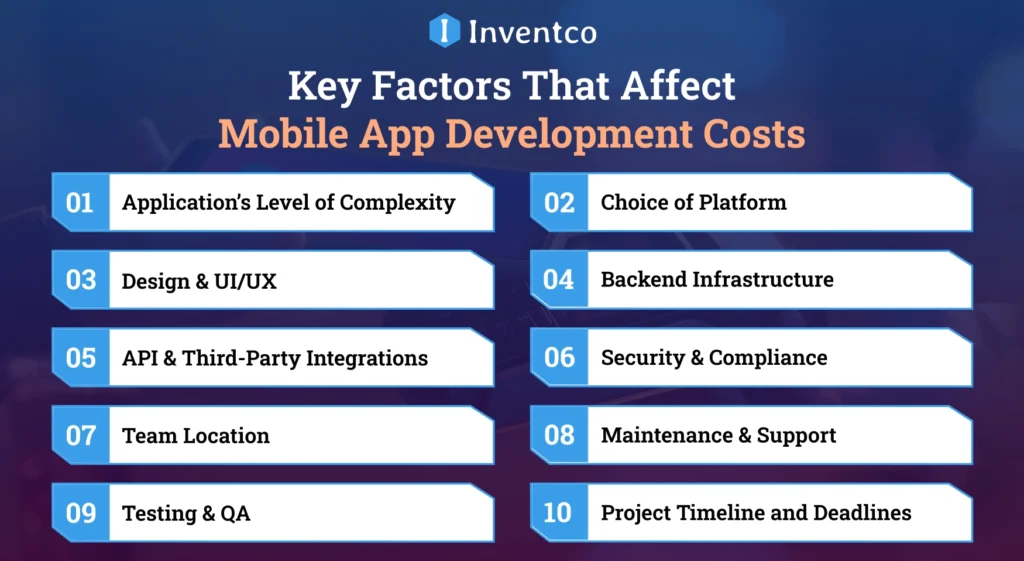
The creation of a mobile app goes beyond just writing code. Mobile app development includes a plethora of processes: app design, mobile app tech stack, and many others. Focusing on the important things is called the app development leading money factors.
1. Application’s Level of Complexity
Mobile app complexity is one of the major factors that influences the budget of your app development. The preview of the simple business MVP app may cost between $10,000-$25,000. A full-scale app containing core and advanced functionalities such as user registration, in-app payments, and even a real-time messaging system may set you back $25,000–$60,000.
Mobile applications such as Uber, Tinder, or ESPN Fantasy, which have complex features such as real-time tracking, cloud multi-user sharing, multi-user layers, or advanced Artificial Intelligence, will increase your mobile app development costs by $50,000 to $1,00,000+.
2. Choice of Platform
Your business app is simply the most important module, and yes, it also dictates the budget of app development. The time and complexity involved in creating a Native Android app development service or iOS app development service far overruns the average pricing. Each app from one particular native platform takes anywhere between $15,000-$40,000.
The cost of cross-platform mobile apps can be anywhere between $20,000-$55,000 or more, which is a much better deal than getting separate apps for each platform. That is especially true if you also consider the use of mobile app development frameworks like React Native or Flutter app development, whose use can drastically improve the overall mobile app development cost.
3. Design & UI/UX
Creating a great design isn’t a luxury; it’s the soul of your mobile app. Hire a professional UI/UX design Agency to ensure your app is simple, smooth, and beautiful to see. You need to give 10-20% of your total app development cost to UI/UX. So if you’re making a $1,50,000 app, then design could account for around $15k-$30k.
You need to think about the app prototype, app wireframing, motions, usability, and Unique pictures in your design. Cutting back on the app design might save some budget initially, but it may cost you, clients, eventually.
4. Backend Infrastructure
In the case where your mobile application has a real-time information feature or integrates a more complex system, such as a database, it would mean the application is highly multifaceted and would thus require specialized server support.
Such high-level servers as AWS, Firebase, Azure and Google Cloud would greatly support mobile app development, however, the expenses would also increase. All three of these top-tier cloud services are likely going to add 10%-15% of your total app development cost.
5. API & Third-Party Integrations
The integration of third-party tools and services, as well as the addition of APIs, tends to greatly increase the app’s development budget. The integration would suggest the addition of complex features such as payment gateways and AI systems like ChatGPT or Google Gemini. These high API’s greatly increase the app development budget as well. Complex APIs tend to cost within the range of 2,000-10,000 USD based on the level of intricacy, configuration based on your business app requirements, licensing, and customization.
6. Security & Compliance
Security is not just a feature, it is one of the most essential aspects in mobile apps, and as we know, good things come with a great price. If your mobile app is for industries like healthcare, finance, or business areas, then you need to invest more in your business app for data safety. Security features like encryption, GDPR, HIPAA, PCI DSS compliance, and two-factor authentication can add 5–10% (or more) to your total app budget.
7. Team Location
Your team’s geography heavily influences development costs.
- Offshore teams (Europe, Asia): $20–$40/hour.
- Local/Onshore teams (US, UK, Australia): $80–$150+/hour
Choosing the right app development company involves cost balancing, quality, and communication.
8. Maintenance & Support
As you know, just launching an app does not stop your journey. Mobile apps need changes and regular app maintenance to keep working smoothly and give a proper user experience to your users. Solving bugs to ensure compatibility with the latest version of the OS is a must in app development. Mobile app features updates are also required to enhance the performance of your app, and this may usually cost 15-20% of the original app development budget annually.
9. Testing & QA
No one likes bugs. And in 2026, users are less forgiving than ever. That’s why mobile app testing isn’t optional, it’s essential. QA (quality assurance) ensures your app works perfectly across devices, screen sizes, and platforms. Allocate 10–15% of your total app budget for human and automatic testing, including performance, app security, and user testing. A missed bug in production can cost way more than finding it during app testing.
10. Project Timeline and Deadlines
Project deadlines are just not dates; they are a commitment. And in 2026, the speed of the project work will be as important as the quality of the app. That’s the reason to give a clear mobile app project timeline, which is just not an option, it is essential.
A realistic timeline helps you to manage expectations of work done, your app task progress, and avoid scope creep. Make sure to create a buffer time for testing, feedback, and updates. Rushing can break your app and its planning.
Every choice, from features to hiring dedicated app developers, affects the cost of creating a mobile app. Want a lean MVP? Stick to basics and partner carefully. Dreaming big? Budget big. Need help benchmarking your idea against real-world costs? Then we’re here to help you map your budget like a pro.
Hidden Costs in Mobile App Development You Didn’t See Coming
There are so many types of hidden costs in mobile app development that are not covered in the development process. Factors like app store fees, ongoing app maintenance, third-party APIs, market launch, and more.
Whenever you think about app development, you only think about the development, app design, and deployment, but there are so many things that you also need to remember while creating an app. Let’s look at the mobile app development cost breakdown and shed some light on the hidden cost:
1) Post-Launch Maintenance
Post-launch maintenance is one of the key hidden costs of development. After the launch, your mobile app needs to fix bugs and upgrade to the latest OS versions, and also needs to add the latest features to keep your app upto date for your users.
The mobile app maintenance cost is around 15-20% of your overall app development cost per annum. Let’s take an example: your business mobile app costs $100,000, then you need to pay $15,000-$20,000 each year to ensure your app runs smoothly and securely.
2) App Scaling for Growth
Once your user base starts growing, your app must scale properly. More people equals more server load means more backend power. This includes optimizing computers, boosting storage, updating APIs, and preparing the database for greater activity. Depending on your app’s growth rate, growing can cost between $10,000 and $50,000.
3) Cloud Hosting Services
Your app isn’t going to float around in cyberspace without a home. No matter if it’s AWS, Google Cloud, or Microsoft Azure, each has a monthly subscription fee. Smaller apps are expected to cost $1000/year while complex apps can go over $10,000 a year, depending on the speed, storage, and usage.
Do you want assistance in configuring the cloud for cost optimization? This is precisely where Cloud Consulting Services can assist you the best. They will help you choose, configure, and optimize your cloud architecture without excessive spending.
4) Legal and Compliance Fees
If your app processes sensitive and controlled elements, you cannot ignore legal compliance. Apps in finance or healthcare are expected to follow legal frameworks such as GDPR, HIPAA, or PCI-DSS. Built-in compliance capabilities, such as secure login, the availability of encryption, and legal advice, will always boost the cost of your app development by $5,000—$20,000, and are a must for sensitive domains.
5) Software Licensing
Do you utilize third-party tools or APIs? There is a payment for that. Such licenses, regardless if it is a geolocation service, integration of an AI-driven chatbot, or a payment gateway, are expensive. Basic licensing fees range from $500 to $5,000. However, advanced AI-powered systems might cost over $ 20,000 a year.
6) App Store Optimization (ASO)
Without App Store Optimization, launching your app is equivalent to launching a business without a store sign. It requires keyword research, compelling graphics, and appropriate metadata to gain attention in saturated markets. Budget approximately $1,000 to $5,000 to enhance your visibility on Google Play and the App Store.
7) Customer Support Setup
The success of an application translates to the exposure of user, support, or customer support services. If these services are rendered by setting up robots, online support systems or live agents, the fee will be around $5,000 to $15,000 as a one-time payment. The monthly subscriptions to AI systems or the monthly payroll to the support team are additional operational costs that can add up extraordinarily fast.
8) Audit of Safety Measures.
The increasing demand for detailed checks parallels the escalation of cybercrime. Every year, the expenses for security checks go up. This includes assessments of intrusion, data encryption, rule checks, as well as payment compliance for applications that deal with user data. This can add up to $5,000 to $20,000.
9) Modification for Regional Markets.
If an app is to be used globally, it will need these features. Leveling the app content, adapting it to the features of various countries, and complying with their legislations is both time and cost-heavy. Estimates indicate that the cost of these services ranges from $5,000 to $30,000, depending on the market and the languages of interest. Although an app’s most basic form may cost around $5,000, its cost can increase to $70,000 due to complexity, the addition of AI enhancements, or a focus on the app’s global market.
10) Marketing and user acquisition
Part of investing in the development of a mobile app is creating the most desirable mobile app. The other half of the work requires the company to assume the risk of the investment to ensure app downloads and usage.
This is the stage where real work and real expenditure focus. This is also the stage where the expenditure shifts from investment and starts to revolve around other expenditures like the influencer shout-out and the paid ads post app launch to ASO, email marketing, and adds other forms of social platform marketing steps.
An app’s success is dictated by the execution of a plan that services a particular market during a determined period of time. Purchase costs for the region under consideration, the objectives for the app, and the advertising platforms all dictate the expenditure on marketing and user acquisition, which in turn can range from $10,000 to $150,000+.
The costs of behind-the-app investment are also considerable, and can come from a purchase of custom UI/UX design from leading firms, iOS app development services, or complex backend systems, which add significant cost.
This better understanding of the mobile application development cost breakdown should encourage you to budget efficiently. Always remember the objective, and plan not only for the launch.
Popular Types of Mobile Apps and Their Estimated Development Costs
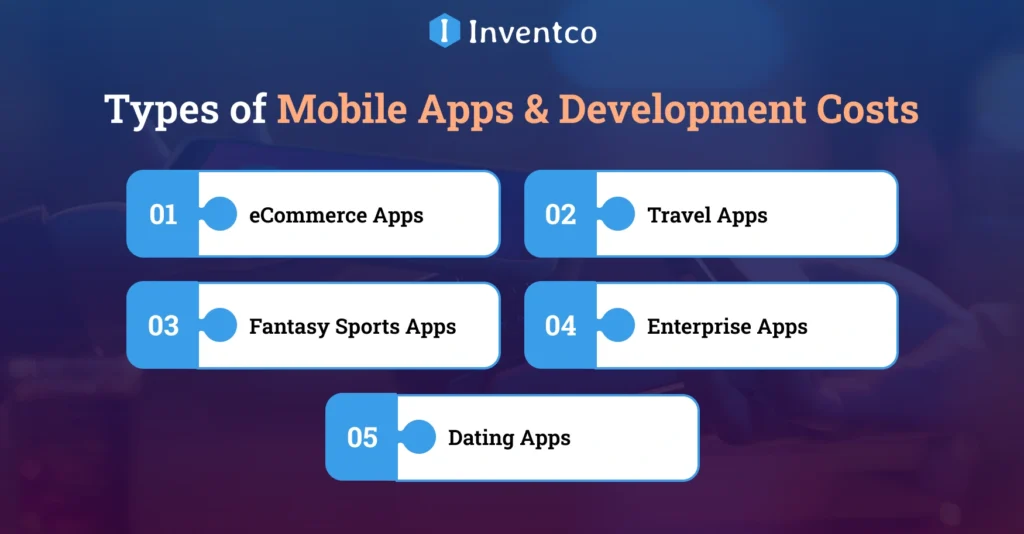
Not all apps are built with the same features; each industry has its own set of features, complexity, and cost implications. Let’s explore the most common type of industry-based apps and their typical costs to build in 2026.
1. eCommerce Apps
eCommerce is one of the most common industries for creating an app, many small enterprises are looking to develop an app like Amazon and Shopify. eCommerce apps have a separate set of features like shopping carts, product catalogs, user accounts, manager screens, and payment gateways of different kinds to cater to all types of users.
The cost to develop an eCommerce mobile app can range between $60,000- $150,000, which depends on mobile app design, complexity, connections, and custom features as per your business demands.
2. Travel Apps
Travel apps are in demand, and this industry is booming, so apps like Hooper, Airbnb, and Triplt are the leaders in this industry. To create a travel app, you need to add features like search, booking, directions, reviews, and push notifications. If you’re thinking about creating a travel mobile app, then the cost to develop can range between $40,000 and $120,000.
3. Fantasy Sports Apps
One of the most trending industries in the world right now is fantasy gaming. Platforms like FanDuel, ESPN Fantasy Sports, and DraftKings are the top apps in this industry. Fantasy sports apps deliver features like live scores, player information, leagues, and chat, and if you plan to make a fantasy app like FanDuel, then it will cost around $30,000- $150,000, which depends on the features, complexity, and APIs.
4. Enterprise Apps
From internal toolsets to CRM apps and supply management, business applications like those developed by Salesforce, SAP, or Odoo can be heavy-duty. The cost to develop a business mobile app can start from $20,000 and can exceed $1,20,000+. It totally depends on the technology, scalability, connections, AI development services and data security of the app.
5. Dating Apps
Are you looking to create an app like Tinder, Bumble, and Hinge, which are leading dating apps in the world? Dating apps typically include features such as profile creation, swipe-based matching, real-time chat, geolocation, video calls, and advanced matching algorithms.
The cost of creating a dating app ranges from $10,000 to $80,000. It depends on various factors such as UI/UX design, server infrastructure, and in-app purchase methods. If you are looking to build an AI-driven, advanced-features dating app, it may cost up to $100,000+.
Step-by-Step Mobile App Development Process and How It Impacts Your Budget
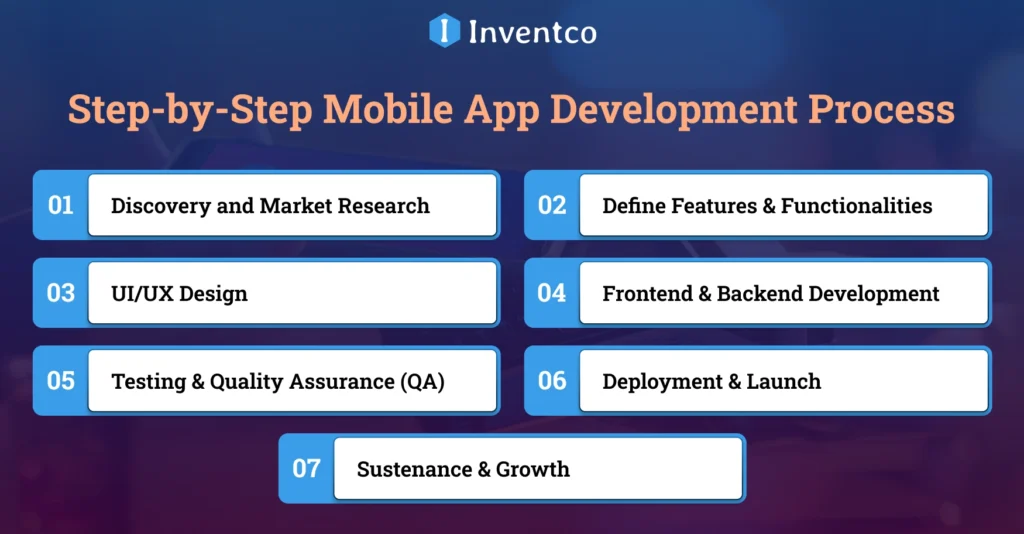
Creating a mobile app involves more than just coding; it involves a thorough app development process. The starting point and endpoint being an idea and an app, respectively, every phase of mobile app development has a significant impact on the budget.
Have you ever wondered about the cost of developing an app in the year 2026? As such, we will examine cost estimation and offer suggestions on planning and budget allocation for developing an app.
1. Discovery and Market Research
Due to the intricate nature of mobile app development, it is wise to allocate funds and resources for mobile app research and development. This initial phase gives you the ability to identify the target audience, behaviors, and analyze competing mobile applications in the field. Failing to conduct research can lead to inefficient features and even a mobile application that no one will use.
Action: Organizing and conducting user reactions, app store reviews, polls, and a comprehensive SWOT analysis of competitors in your mobile app niche.
Outcome: An app that addresses a need and is in line with a market demand. Accordingly, cost estimates with a clear roadmap to achieving your goals.
2. Define Features & Functionalities
The next stage in developing your app is determining the main elements for the MVP. This is where you determine the formative elements for the launch and the ones that can remain for user testing and feedback later. Concentrating on the most critical functions, such as account creation, payment processing, and communication, helps streamline the development and testing phases in order to validate your venture in as little time as possible.
Action: Develop a feature set that prioritizes critical features in the MVP app, such as payment and document sharing, to the more advanced features, such as offline functionality and AI.
Outcome: An efficient, cost-effective product blueprint enabling rapid development, initial user input for improvements, and facilitations for advanced features as the app scales.
3. UI/UX Design
The attractiveness and overall user experience associated with your app are crucial. A seamless and appealing UI/UX design is not only for visual stimulation but also serves as bait for retention. Sluggish and complicated user workflows will make your product get deleted quicker than “Oops”.
Action: Constructing an app prototype, Wireframing, designing user paths, and developing high-precision prototypes. Early feedback rounds are crucial for refinement.
Outcome: A design for an application that is not only aesthetically pleasing but also functionally sound, that increases user retention while minimizing bounce rate.
4. Frontend & Backend Development
This is where engagement kicks in and where your app comes to life and your idea turns into reality. The user interface is the frontend that your users experience, while the server-side logic, API’s, databases, and third-party integrations form the backend that supplies everything in the background.
Action: Choose the most suitable tech stack, using Flutter for cross-platform or Swift for a seamless iOS app. Set up online infrastructure, create scalable backend architecture, and ensure uninterrupted data flow.
Outcome: A mobile application that is fully complete, sound, and feature-rich is ready for internal testing and final adjustments before being published to the app stores.
5. Testing & Quality Assurance (QA)
App testing is an integrative part of the development process. It protects the quality of the mobile application by ensuring it is completely secure, safe, and bug-free before it reaches the end users. In an environment where users readily abandon an application with bugs, quality assurance becomes a supply of reviews and retention, rather than a demand. From functional checks to testing performance, utility, and safety, every single break matters.
Action: Conduct user testing, failure testing, load testing, and security assessments on a variety of devices and functional OS versions.
Outcome: A mobile application that has been completed and stably optimised to run seamlessly on multiple devices, earning high trust, reviews, and loyalty from users.
6. Deployment & Launch
It’s time to deploy the application. Releasing the app on the App Store and Google Play is more than a one-click process. You have to put the ASO (App Store Optimization) and marketing strategies in place, along with captivating content and compliance with the safety policies of the platforms.
Action: Optimized app listings, with pre-set tracking tools such as Firebase or Mixpanel, and polished marketing materials (screenshots, promo videos, descriptions) for a streamlined outcome.
Outcome: A seamless release that enhances visibility, attracts early users, and fosters the intent to download, engagement, and reviews from users.
7. Sustenance & Growth
The life of your application begins at its launch. One of the elemental pillars for achieving app relevancy and user satisfaction remains the work done post-launch. For example, the deployment of new features and resolving bugs, and the installation of new operating systems, features, and updates are all mandatory for the continual functionality of a system.
Action: Determine and analyze data, listen to your audience, respond to queries in a timely manner, and schedule system updates to increase user engagement
Outcome: The system is now able to adapt to user feedback, achieving customer satisfaction, positive ratings, and positive feedback. Sustaining relevancy is now possible as the system is able to adapt to user trends and market fluctuations.
Professional Advice
No matter which feature of the development life cycle they are analyzing, a mobile app developer should be able to take all factors into consideration. Start from feature development and consider which mobile app development team you want to hire. Every decision you make is bound to affect the final mobile application development cost estimate you will receive.
Just like any other mobile app, the expense associated with the construction of a mobile app is correlated with the planned steps that are intended to fulfill the aim and complexity of the app, in addition to the tech blend and team organization as of 2026. It is worth noting that the steps should be simplified and done in a coherent manner in order to fulfill standard financial parameters.
| Step | Estimated Cost | Development Timeline |
| 1. Discovery & Market Research | $2,000 – $10,000 | 2–3 weeks |
| 2. Define Features & Functionalities | $4,000 – $20,000 | 3–4 weeks |
| 3. UI/UX Design | $5,000 – $25,000 | 3–5 weeks |
| 4. Frontend & Backend Development | $15,000 – $70,000 | 8–12 weeks |
| 5. Testing & Quality Assurance (QA) | $5,000 – $25,000 | 3–4 weeks |
| 6. Deployment & Launch | $1,000 – $5,000 | 1–2 weeks |
| 7. Maintenance & Scaling (Annually) | 15–20% of initial dev cost/year | Ongoing (Annual Updates) |
| Total | $30,000 – $100,000+ | 4–6 Months (Initial) |

Wrapping Up
So, how much does it cost to develop a mobile app in 2026? The answer changes based on your app’s complexity, features, platform, and development partner. A simple MVP might cost significantly less than a full-scale enterprise app with advanced connections.
However, careful planning and choosing the right development partner can make all the difference. At Inventco, we help you balance quality and cost-efficiency, turning your idea into a powerful, scalable mobile app without breaking the bank.
Whether you’re a newbie or an established business, we tailor the right solution to meet your goals and your budget.
FAQ’s
Q1. How much does it cost to develop an app?
Ans. Though it’s impossible to quote how much mobile app development costs, here are the approximate costs to build an app:
- Simple apps: $10,000-$25,000.
- Medium complex app: $25,000-$60,000.
- Complex app: $60,000-$1,00,000 and above.
Still wondering how much your app will cost? Contact us today for a transparent and accurate pricing estimate.
Q2. How do free apps make money?
Ans. Free apps make money through app monetization strategies like in-app purchases, ads, subscriptions, affiliate marketing, sponsorships, or selling premium features, depending on the app’s business model.
Q3. How long does it take to build an app?
Ans. The development time of a mobile app depends on the complexity of the app:
- Simple Apps: 3-6 months.
- Moderately App: 6-9 months.
- Highly Advanced Apps: 9-12+ months.
Q4. What are the latest trends in mobile app development?
Ans. The Latest Mobile app development trends include integrating Blockchain, AI, AR/VR, IoT connectivity, PWAs, Enhanced App security, and low-code platforms, driving smarter, faster, and more immersive user experiences.
Q5. Is Inventco a good fit for startups?
Ans. Yes, we offer flexible pricing, transparent cost breakdowns for mobile application development, and scalable solutions for every budget.

Jitendra Jain
He is the CEO and Co-founder of Inventco, driving innovation in advanced computing and digital transformation. With deep expertise in modern IT ecosystems, he leads scalable, secure, future-ready solutions. His strategic leadership helps businesses accelerate growth, adopt innovation, and achieve success. You can connect with him on LinkedIn to follow his technology insights.