
If you are a founder or investor evaluating the fantasy sports space, you are entering one of the fastest-scaling digital entertainment markets globally. The real question is not whether to build, but how to approach the investment with complete financial clarity.
The cost to develop a fantasy sports app typically ranges from $10,000 to $100,000+, depending on product scope, feature depth, platform strategy, and the expertise of your development partner. Whether you are launching an MVP to validate market demand or building a scalable platform positioned alongside leaders like DraftKings and FanDuel, understanding the cost structure upfront is critical to avoiding budget overruns and execution delays.
This guide provides a structured, expert-led breakdown of the factors that directly impact the cost of fantasy sports app development, from core features and infrastructure requirements to hidden expenses often underestimated during early planning.
Key Takeaways
- Fantasy sports app development costs range from $10,000 to $100,000+, depending on scope and scalability.
- Starting with an MVP reduces risk, validates demand, and prevents unnecessary early-stage capital burn.
- Core cost drivers include features, platform choice, real-time data integration, and development team expertise.
- Real-time sports data, security infrastructure, and compliance are essential, not optional, investments.
- Advanced features like AI, micro-contests, and blockchain significantly increase development cost but drive differentiation.
- Hidden costs such as data licensing, cloud scaling, and maintenance can add 20–30% to total investment.
- Choosing the right development partner directly impacts scalability, time-to-market, and long-term ROI.
The Fantasy Sports Market in 2026: Why the Timing Is Right
Before dissecting costs, it is worth understanding why investors are pouring capital into this space right now.
- The global fantasy sports market is valued at approximately $37.41 billion in 2026 and is projected to reach $114.19 billion by 2035, growing at a CAGR of 13.2%.
- Mobile-first adoption continues to dominate the industry, with over 60% of total revenue coming from mobile platforms, and the segment expanding at a 14.21% CAGR, driven by real-time engagement and on-the-go gameplay.
- In terms of user scale, the North American market leads globally, with over 80 million adults in the U.S. and Canada participating in fantasy sports or sports betting in recent years, underscoring the region’s maturity and monetization potential.
What Is a Fantasy Sports App?
A fantasy sports app allows you to build virtual teams using real-life athletes. You can compete against other users, and the app is updated with real-time in-game stats. You can draft players to build your team, and the app will update your scores. The stat categories and types vary, but can include anything from a quarterback’s passing yards to a batsman’s runs to a footballer’s assists.
Compared to traditional fantasy leagues, modern-day fantasy apps offer year-round Daily Fantasy Sports (DFS) and even micro-contests that let users bet on the game in their live fantasy league and compete against their friends. Some apps even incorporate AI and offer recommendations on which athletes to pick for your line-up. With all the leagues to choose from, the NFL, NBA, and even eSports, the potential for strategy and revenue from the apps is endless.
Cost to Develop a Fantasy Sports App in 2026
The cost to develop a fantasy sports app is not a single figure. It varies based on what you choose to develop, the required timeline, and the developer. The cost to develop a fantasy sports app can range from $10,000 to $100,000 or more.
Here is how the investment breaks down across three development tiers:
MVP (Minimum Viable Product) — $10,000 to $25,000
MVP fantasy sports apps will have user registration, player drafting, scoring, and contest options. This level of app development is meant for those looking to ascertain the demand for their potential product before going all-in. This version of the app focuses on getting users to the application and investors to notice it before loosening their futuristic options.
Mid-Level App — $25,000 to $60,000
Mid-level tiers are expected to offer multi-competition support, real-time data, multiple contest variations, payment options, and dashboards for administrators. This is the expected level for organizations looking to enter a market and compete effectively with a product that is currently undervalued and overpriced.
Advanced / Enterprise App — $60,000 to $100,000+
Enterprise-grade fantasy apps will include AI, custom recommendations, blockchain use cases, and gamification. These apps will be ready to operate at scale on launch day and have the capacity to support aggressive sales strategies across multiple offers.
Key Factors That Influence Fantasy Sports App Development Cost
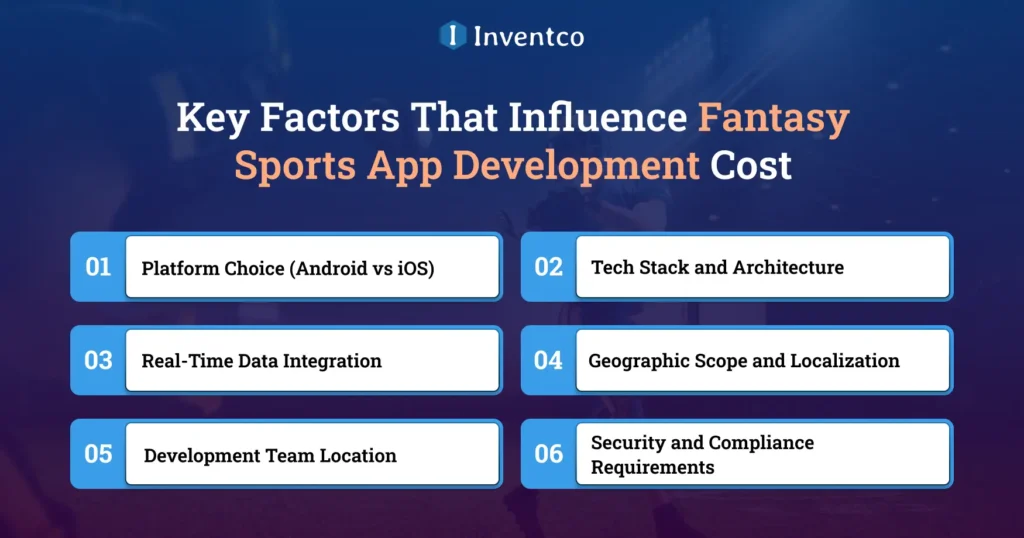
Several aspects influence the cost of developing a fantasy sports app. Know these when deciding on architecture to avoid unpleasant surprises as costs start to accumulate.
1. Platform Choice (Android vs iOS)
Building for a single platform, whether Android or iOS, costs significantly less than developing for both simultaneously. A cross-platform approach using app frameworks like React Native or Flutter can reduce costs while maintaining a near-native experience across both operating systems. The right choice depends on your target market’s device preferences, a factor your development partner should assess early in the mobile app development process.
2. Tech Stack and Architecture
Although it costs more to develop a scalable, microservices-based backend, it will save you money by reducing mobile app maintenance costs as your customer base grows. This is a significant decision.
3. Real-Time Data Integration
For user-engaged apps to become successful, sports data is imperative. Integrating with high-quality data services such as Sportradar or Stats Perform is a high-cost, long-term investment that justifies user trust in your app with real money.
4. Geographic Scope and Localization
Building for a single market is cheaper. A multi-regional app requires localized payment gateways, currency support, language options, and regulatory compliance across jurisdictions, each of which adds mobile app development cost and time.
5. Development Team Location
The development costs for the fantasy sports app are tied to your business team’s location. Offshore team costs range from $25 to $75 for most South Asian and Eastern European agencies. If building your team in North America or Western Europe, expect costs of $100 to $250.
6. Security and Compliance Requirements
Fantasy mobile apps that are real-money gaming platforms must implement mobile app security best practices to comply with regulations and ensure fair gameplay. These practices safeguard your users and your business license. Therefore, KYC verification, data encryption, and fraud-prevention practices must be implemented to protect the business and its users.
Must-Have Features of a Fantasy Sports App
Every fantasy app needs the perfect feature set to become a user favorite and to avoid a high uninstall rate. Here are both basic and advanced mobile app features:
Core Features of a Fantasy Sports App
- User Registration and Profile Management: Provide a simple way for users to sign up with their social media accounts. Then perform KYC to improve user retention and trust. Customized personalization boosts user retention, too.
- Player Selection and Draft System: Let users choose real-life professional sports players to create their fantasy sports team. The players’ stats help users make better decisions about the players.
- Live Scoring and Match Tracking: Calculate and relay players’ scores for the active match. Lead notifications and updated results help users understand their performance and motivate their scores.
- Contest Management (Leagues and Tournaments): This feature allows users to create, join, and run contests, including head-to-head matchups, public tournaments, and private leagues. This is the primary feature of any fantasy sports app.
- Secure Payment Gateway and Wallet System: Users can quickly and securely deposit and withdraw funds, and manage bonuses in real time. Transparency is maintained through app-based transaction trails.
Advanced Core Features of a Fantasy Sports App
- Admin Dashboard and Analytics Panel: A versatile management console that provides full control over user flow, contest management, revenue control, and fraud alerts, along with real-time performance metrics of the platform.
- Push Notifications and Engagement Triggers: Automated smart notifications that can send reminders for contests, lineup lock, score updates, and active user promotions. Very important for increasing daily active users and decreasing user drop rate.
- Referral and Loyalty Programs: An integrated rewards system that gives users an incentive to invite their friends to the platform and keep them craving to return. Well-designed referral loops are among the best user-acquisition methods.
- Multi-Sport Support: The infrastructure to host fantasy contests across multiple sports simultaneously, NFL, cricket, soccer, NBA, and esports, allowing you to capture diverse audience segments and reduce seasonal revenue dips.
- Social Features and Friend Leagues: Private leagues, in-app chat, head-to-head challenges, and social sharing capabilities that turn users into active members of the community. Great for user retention and organic user growth.
Advanced Features That Increase Development Cost
As your platform matures, these advanced capabilities differentiate you from commodity apps and justify premium positioning.
1. AI-Powered Lineup Recommendations
Machine learning algorithms that analyze player form, match conditions, and historical data to suggest optimal lineup configurations. This feature drives engagement significantly among data-savvy users willing to pay for a competitive edge.
2. Real-Time Video Streaming Integration
In-app live sports streaming is tied directly to active contests, so users can watch the match while tracking their fantasy scores. This dramatically increases session duration and time-on-platform metrics.
3. Blockchain-Based Transactions and NFT Integration
Transparent, tamper-proof payment processing and the ability to issue exclusive NFT-based player cards or collectibles. This opens entirely new monetization verticals while building platform trust through verifiable transaction records.
4. AR/VR Immersive Experiences
Augmented reality features such as virtual team stadiums, player visualization overlays, and immersive match-day experiences. These capabilities position your platform as a next-generation product, particularly attractive to Gen Z users.
5. In-Play or Micro-Contest Formats
The ability to run ultra-short contests tied to specific moments within a live match, a single over in cricket, a single quarter in basketball. This format is growing at a 13.85% CAGR and creates high-frequency engagement loops.
6. Predictive Analytics and Injury Tracking
A dedicated data intelligence layer that monitors player injury status, travel fatigue, weather conditions, and opponent matchups to surface risk-adjusted lineup insights. Serious fantasy players will pay a subscription to access this.
Monetization Models for Fantasy Sports Apps
Understanding the mobile app monetization strategy before you build is essential, as your revenue model directly impacts how you architect the product.
- Entry-Fee Contests (DFS Model): Users pay an entry fee to enter paid contests, and platforms collect winnings and take a 10%–15% cut of the prize pool. Entry-fee contests are expected to reach 61% of the fantasy sports market share in 2025.
- Subscription Plans: Premium membership schemes remove barriers, ads, and contests. Paid memberships also boost the firm’s revenues and provide more stable, forecasted income as its business grows over its lifecycle.
- In-App Advertising: Freemium users incur advertising fees. Users must engage with purchased displays through contests and even leagues. The ads stabilize the firm’s income while the users draw a portion of the ads.
- In-App Purchases: Users purchase perks, extra draft picks, contest tokens, or elite perks. The microtransactions also stabilize a continually forecasted income.
- Freemium Upsells: The firm sets up an unequally distributed game with a premium membership fee. The design encourages users to engage with the product enough to make a purchase, with nearly no forced buying and a long-term interaction value.
Hidden Costs You Should Not Ignore
Many founders think the costs required to develop a fantasy sports app are limited to the vendors’ quotes. The true investment includes several additional layers.
- Sports Data Licensing: Integrating dynamic data from official sources like Sportradar, Opta, or Stats Perform is not free. Sports Data Licensing fees can start from $5,000 and go up to $50,000+, and depend on the sports and coverage level you need.
- Regulatory Compliance and Legal Fees: Real money gaming is regulated differently across jurisdictions. Legal counsel, licensing applications, and infrastructure costs, such as KYC (Know Your Customer) and Anti-Money Laundering systems, are a large but, in the long run, necessary overhead.
- App Store Optimization: Tactics for being listed in the App Store and Google Play include drafting an ASO plan, optimizing the listing, creating app promo videos, securing app store banners, and A/B testing.
- Mobile App Maintenance: Maintenance is required after the app goes live, including bug fixes, OS updates, app security updates, and performance optimization. This costs around 15-20% of the app development costs annually.
- Cloud Infrastructure and Scaling Costs: During major sporting events, fantasy apps attract large numbers of users. Your cloud must be prepared to handle 10x your normal load.
- Third-Party API Costs: Payment gateway, push notifications, systems to monitor for fraud, and third-party analytics systems all increase your monthly overhead.
Challenges in Fantasy Sports App Development
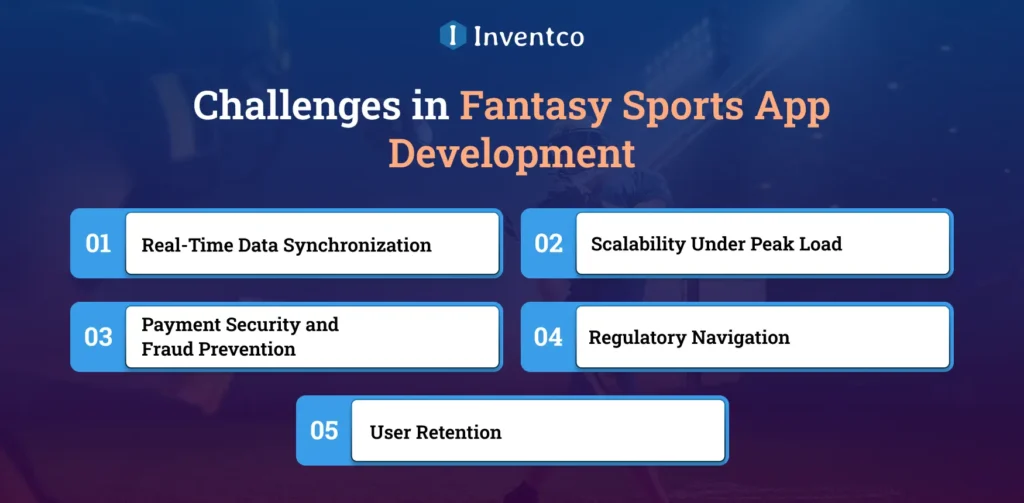
Understanding the mobile app development challenges in Fantasy Sports helps plan how to address the difficulties of creating a fantasy sports app. Here are a few:
- Real-Time Data Synchronization: Large-scale events require a powerful back-end architecture to keep score updates accurate and close to real-time despite high traffic. Platform abandonment and user complaints will come fast if updates take even 10 seconds.
- Scalability Under Peak Load: During major events like IPL finals or NFL playoffs, traffic can spike 20x in minutes. Your infrastructure must scale elastically without service degradation, a challenge that requires careful engineering and cloud architecture planning.
- Payment Security and Fraud Prevention: Fantasy Sports apps that support real-money transactions are among the highest-risk apps to develop. Abusive players can create bots to obfuscate money laundering. Robust systems that detect fraud and monitor transactions are hard to develop and are operationally critical.
- Regulatory Navigation: The legalities surrounding fantasy sports are a gray area. Something that is legal in one country, region, or even state may not be legal in another. It is critical to build flexible compliance into your platform development from the beginning.
- User Retention: The biggest challenge fantasy sports apps have is overcoming user abandonment after the initial playing period. It is important to develop new and engaging ways to keep players interested and active.
Future Trends in Fantasy Sports App Development (2026 & Beyond)
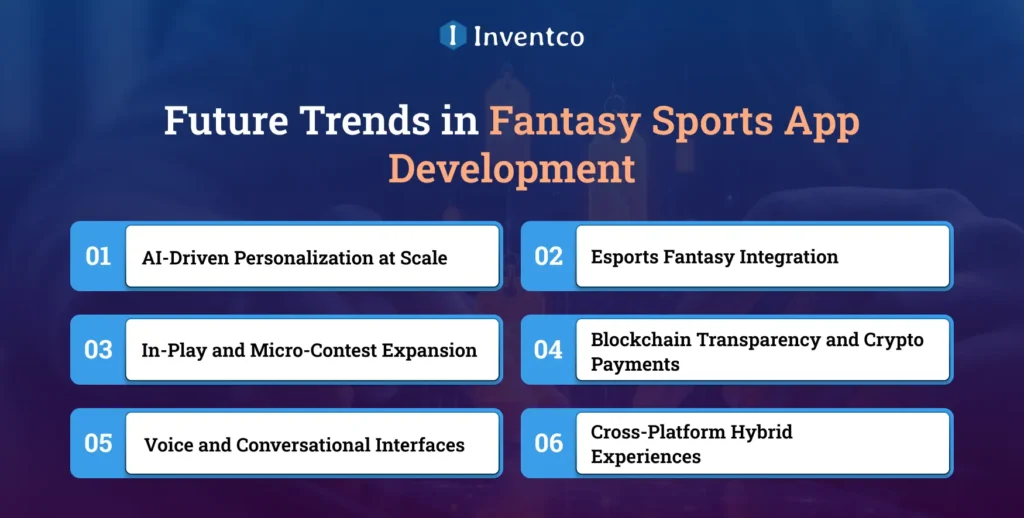
Staying ahead of app development trends is critical for founders who want to build platforms with long-term relevance.
- AI-Driven Personalization at Scale: Enhanced (horizontal & vertical) recommendations drive contest entries and retention without the need for traditional development paradigms.
- Esports Fantasy Integration: Fantasy Esports will enable companies to capitalize on a market growing at 14.64% that includes a new audience integrating fantasy esports with traditional fantasy sports.
- In-Play and Micro-Contest Expansion: These formats will generate the most revenue per player through contests lasting less than a minute and engaging players with contests tied to specific live events.
- Blockchain Transparency and Crypto Payments: Businesses will stand out by leveraging token-based, citable payment technologies, especially in spaces with low trust in centralized technologies.
- Voice and Conversational Interfaces: Listening to users to manage their props, view their scores, and enter contests will be expected on premium platforms if they integrate Alexa, Siri, and Google Assistant.
- Cross-Platform Hybrid Experiences: Combining Fantasy Sports with other app ecosystems that incorporate social, streamed, or active betting apps will be the dominant strategy.
How to Choose the Right Fantasy Sports App Development Company?
Choosing a development partner is one of the highest-stakes decisions you will make as a founder. The wrong choice costs you time, money, and market position. Here is what to evaluate.
- Proven Fantasy or Gaming Experience: Look for an agency with real-money gaming or sports project portfolios. The experience involved in generalist app development is unlikely to meet the technical requirements of sports fantasy app development.
- Full-Stack Capability: You want a partner able to take you from laying a wireframe to live code to post-launch maintenance. The industry gap in services across what would otherwise be a unified team is a mistake.
- Transparent Pricing and Milestone Structure: Enthusiastically serious partners break costs down by milestones, clearly stating what each payment supports and, in most cases, who is accountable and liable.
- Scalability Architecture Expertise: Ask specifically how they have handled traffic spikes for previous clients. Platforms built without scalability in mind become expensive liabilities the moment you get traction.
- Post-Launch Support Commitment: After go-live, the app development scaffolding is minimal. Evaluate partners based on post-launch SLAs, maintenance, and support for what they would consider to be critical status.
How Inventco Helps You Build a World-Class Fantasy Sports App?
At Inventco, we do not just write code, we architect products designed to scale, monetize, and retain users in competitive digital markets. Our approach to fantasy sports app development is built on real delivery experience across complex, high-traffic applications.
Our Expertise, Demonstrated: The Wager App
As a leading mobile app development company, we have a strong example of our capability: the Wager App, a live, multi-category social wagering platform that Inventco designed, developed, and delivered end-to-end. The Wager App allows users to place bets across categories, including politics, cinema, gaming, the Premier League, cryptocurrency, and live events. Users can create custom bets, invite friends to participate, and experience a fully social, interactive wagering environment.
Here is what the Wager App delivery required, and what we brought to the table across every layer:
- Backend Engineering: We architected a secure, scalable backend that manages concurrent bet processing, real-time outcomes, and automated prize distribution. The system ensures transparent, tamper-proof transaction records and accurate distribution of winnings at scale.
- Frontend Development: Our frontend team delivered a clean, intuitive interface that makes bet creation, friend invitations, and contest participation frictionless, even for first-time users. The experience was designed to drive both initial conversion and long-term engagement.
- Software Testing: Rigorous mobile app testing across functional, performance, and security test cases ensured the platform launched without critical issues. We stress-tested the system under high concurrent load to validate stability before public release.
- Product Strategy: We worked directly with the founding team to define the product roadmap, contest structure, monetization logic, and growth mechanics, not just executing a spec, but actively contributing to product-market fit.
- UX/UI Design: The Wager App’s design language prioritizes trust and clarity, two non-negotiables in any real-money platform. Our UX team conducted user flow mapping and app wireframing before a single line of code was written, ensuring the interface aligned with how real users make wagering decisions.
The result is a live platform trusted by its users and built on an architecture that scales as the business grows. That is the Inventco standard, and it is what we bring to every fantasy sports engagement.
Whether you are at the MVP mobile app stage or ready to build an enterprise-grade platform, our team is equipped to take you from concept to launch with precision. We handle the full mobile app development process, from discovery and prototyping through build, test, and scale.

Final Thoughts
The fantasy sports market in 2026 is one of the most commercially compelling spaces in mobile technology. The users are there, the revenue models are proven, and the technology to build a mobile app has never been more accessible.
But the cost to develop a fantasy sports app is not just a budget question, it is a strategic one. The decisions you make at the architecture stage, the features you prioritize in your MVP mobile app, and the technology partner you choose will determine not only what you spend, but also what you build and how quickly it scales.
FAQ’s
Q1. What is the average cost to develop a fantasy sports app in 2026?
Ans. The cost to develop a fantasy sports app typically ranges from $10,000 for an MVP to $100,000+ for an enterprise-grade platform with advanced features like AI analytics and blockchain integration. Your final cost depends on the platform (iOS/Android), feature complexity, tech stack, and development team location.
Q2. How long does it take to build a fantasy sports app?
Ans. An MVP typically takes 3–4 months. A mid-level product with multi-sport support and payment integration takes 6–9 months. An advanced platform with real-time data, AI, and blockchain features can take 10–14 months from discovery to launch.
Q3. Do I need real-time sports data to build a fantasy app?
Ans. Yes. Real-time player statistics and live match data are non-negotiable for any serious fantasy sports platform. You will need to license data from providers like Sportradar or Stats Perform, which adds to your operating costs but is essential for user trust and product accuracy.
Q4. What is the best monetization model for a fantasy sports app?
Ans. Entry-fee contests with a platform rake (10–15% of prize pools) are the dominant model, accounting for over 61% of industry revenue. Combining this with subscription tiers, in-app purchases, and advertising creates a diversified revenue structure that reduces reliance on any single income stream.
Q5. Is it better to build for iOS or Android first?
Ans. This depends entirely on your target market. In India, Android dominates. In North America, iOS holds a premium user base with higher in-app spending. Many teams start with a single platform to reduce initial costs and then expand. Cross-platform frameworks like Flutter can make both platforms viable from day one at a lower cost delta.
Q6. What are the highest hidden costs in fantasy sports app development?
Ans. Sports data licensing, regulatory compliance, cloud infrastructure scaling, third-party API fees, and ongoing mobile app maintenance are the most commonly underestimated costs. Budget 20–30% beyond your development quote to account for these operational realities.

Ajay Bhal
He is an on-demand app solutions expert with 11+ years of experience in business consulting and building scalable, user-centric digital products. He specializes in robust on-demand platforms across industries, combining technical expertise with business-focused strategy to deliver efficient, top notch solutions that drive growth and enhance user experience. You can connect with him on LinkedIn to follow insights.


