Fintech is undergoing a structural shift, and Buy Now Pay Later sits at its center. Consumers are no longer just seeking credit, they are prioritizing control, flexibility, and predictability in how they pay.
For founders and investors, BNPL is not just a passing trend but one of the most commercially scalable opportunities in digital finance today. The challenge is no longer whether to enter the space, but how to build a platform sophisticated enough to compete with established players while remaining differentiated.
This guide breaks down the top buy now pay later apps in 2026, what drives their success, and what it takes to build a competitive BNPL platform from the ground up.
Key Takeaways
- The global BNPL market is projected to exceed $700 billion by 2028, with the US remaining the largest single market.
- Top-performing BNPL apps succeed through frictionless UX, AI-driven risk assessment, and deep merchant integrations.
- Regulatory pressure from the CFPB is reshaping BNPL compliance requirements, new platforms must build compliance into their architecture from day one.
- The best BNPL apps differentiate through virtual card issuance, loyalty programs, and embedded financial health tools.
- Building a BNPL app today requires a technology partner with experience in secure payment infrastructure, escrow logic, and real-time Underwriting.
Market Stats and Data
The numbers behind the BNPL market tell a compelling story for anyone evaluating an entry into this space:
- The global buy now pay later market size was valued at USD 44.89 billion in 2025 and is projected to grow from USD 54.56 billion in 2026 to USD 286.02 billion by 2034, exhibiting a CAGR of 23% during the forecast period.
- According to the latest available Charge Flow report on buy now, pay later data, the global BNPL market reached approximately $560.1 billion in 2025 (GMV), marking a 13.7% year-over-year increase.
- The Buy Now, Pay Later (BNPL) market is growing rapidly, with over 360 million users worldwide, projected to surge by 157% to 900 million by 2027.
These are not vanity metrics. They represent a structural shift in how consumers prefer to pay, and a durable business model for platforms that get the fundamentals right.
Why the BNPL Market Is Booming in 2026 and Beyond?
Several macro and micro forces are converging to accelerate BNPL adoption in 2026:
1. Credit Card Fatigue
With average US credit card APRs exceeding 22% in 2025, a growing segment of consumers, particularly younger demographics, actively avoids revolving credit. BNPL offers a structured, often interest-free alternative that feels fundamentally different from debt.
2. The Embedded Finance Movement
BNPL is no longer a standalone checkout button. It is being embedded directly into banking apps, loyalty platforms, and even payroll systems. This embedded finance trend dramatically expands the addressable market beyond traditional e-commerce.
3. AI-Driven Underwriting
Modern BNPL platforms can make real-time credit decisions in under two seconds using alternative data signals, purchase history, device behavior, and transaction patterns, without requiring a hard credit inquiry. This is a game-changer for financial inclusion.
4. Merchant Demand for Conversion Tools
In a competitive e-commerce environment, merchants are actively seeking checkout tools that convert browsers into buyers. BNPL has proven ROI at the point of sale, which means merchant acquisition costs for BNPL platforms have a strong business case.
5. Regulatory Clarity Creating Market Confidence
The CFPB’s 2024 ruling classifying BNPL lenders as credit card issuers created short-term compliance challenges but long-term market confidence. Institutional investors and enterprise merchants are now more willing to engage with BNPL platforms that operate under a clear regulatory framework.
Top 10 Buy Now Pay Later Apps in 2026
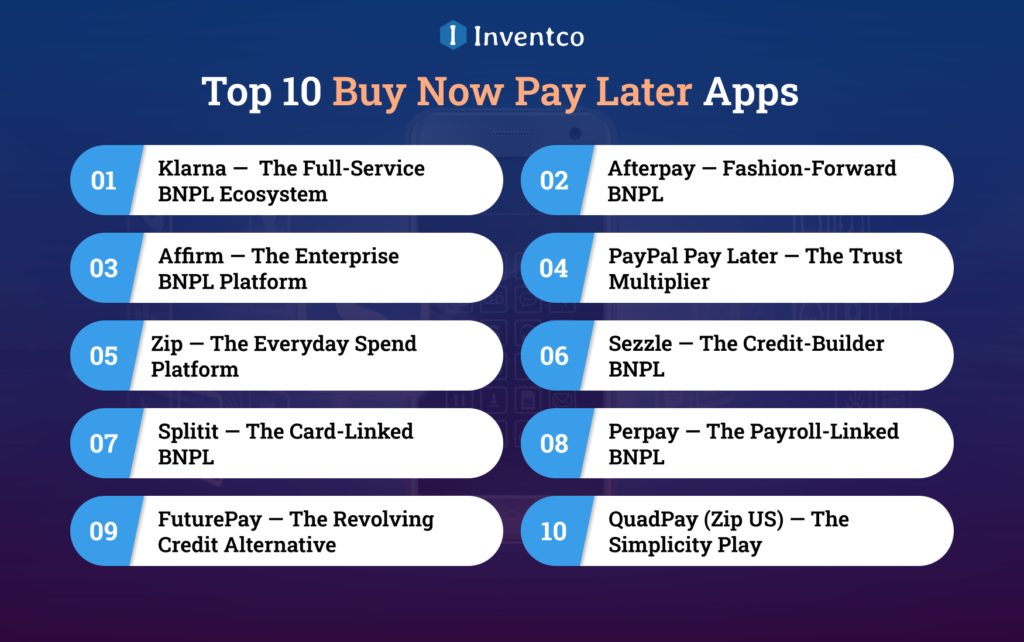
Buy Now Pay Later is reshaping global commerce, giving consumers flexible payment options while enabling merchants to boost conversions, increase order values, and drive repeat purchases. Here are the top Buy Now Pay Later Apps in 2026 you can choose in the US:
1. Klarna — The Full-Service BNPL Ecosystem
Klarna remains the most recognized name in BNPL globally, and for good reason. Originally a Swedish payment company founded in 2005, Klarna has evolved from a simple Pay-in-4 tool into a comprehensive shopping ecosystem that includes price comparison, product discovery, and a virtual shopping card.
What separates Klarna from competitors is its breadth: it operates in over 45 countries, has 150 million active consumers, and partners with more than 500,000 merchants. Its AI-powered shopping assistant, launched in 2024, helps users find the best deals across retailer catalogs, turning Klarna from a payment method into a shopping destination.
Key differentiators: Ghost card for universal use, real-time price-drop notifications, and seamless returns management. For founders studying the BNPL market, Klarna’s evolution offers a masterclass in platform expansion.
2. Afterpay — Fashion-Forward BNPL
Acquired by Block (formerly Square) in 2022 for $29 billion, Afterpay has built its brand identity around fashion and lifestyle retail. Its Pay-in-4 model, four equal fortnightly installments at 0% interest, remains one of the cleanest BNPL propositions in the market.
Afterpay’s strategic strength lies in curating its merchant network. Rather than pursuing volume across every retail vertical, it built deep penetration in fashion, beauty, and lifestyle categories with high repeat purchase frequency and strong brand loyalty.
Its integration with Block’s Cash App ecosystem provides a powerful distribution channel, enabling Cash App’s 50+ million+ users to access Afterpay directly from their digital wallets.
3. Affirm — The Enterprise BNPL Platform
Affirm is the BNPL platform of choice for large-ticket purchases, and its partnerships with Amazon, Walmart, and Shopify reflect its enterprise positioning. With loan amounts up to $17,500 and repayment terms extending to 60 months, Affirm addresses a segment that traditional BNPL Pay-in-4 models cannot serve.
Affirm’s underwriting model uses a proprietary risk engine that evaluates each transaction individually, rather than applying a blanket credit limit. This per-transaction underwriting approach results in higher approval rates while maintaining controlled default rates.
For investors, Affirm’s revenue model is notable: it earns from merchant discount rates on 0% APR transactions and from consumer interest on longer-term loans, creating a dual revenue stream that buffers against market volatility.
4. PayPal Pay Later — The Trust Multiplier
PayPal’s BNPL offering benefits from one structural advantage that no startup can replicate quickly: consumer trust built over two decades. With over 400 million active accounts, PayPal Pay Later (including Pay in 4 and Pay Monthly) can reach an existing user base that other BNPL platforms spend billions to acquire.
PayPal’s no-late-fee, no-interest Pay in 4 product has driven significant adoption among users who might otherwise be skeptical of newer BNPL brands. For merchants already integrated with PayPal Checkout, enabling BNPL requires minimal incremental work.
The strategic lesson for founders: distribution matters as much as product. PayPal’s BNPL success is built on existing trust infrastructure, not a superior payment mechanism.
5. Zip — The Everyday Spend Platform
Originally an Australian fintech, Zip has positioned itself as the BNPL platform for everyday transactions, groceries, utilities, and recurring expenses, rather than limiting itself to retail checkout. This positions Zip against credit cards more directly than most BNPL apps do.
Zip’s virtual card approach allows users to shop at virtually any merchant without requiring merchant integration, significantly expanding its addressable market. Its Zip Money product also includes a revolving credit line, giving it greater product flexibility than pure Pay-in-4 platforms.
6. Sezzle — The Credit-Builder BNPL
Sezzle has carved out a differentiated position by focusing on credit building. Its Sezzle Up program reports payment history to major credit bureaus, making it one of the few BNPL apps that actively help users improve their credit scores. This appeals to younger consumers and thin-file borrowers who see BNPL as a pathway to financial health rather than just a payment tool.
Sezzle’s merchant network is primarily composed of independent and mid-size retailers, giving it a footprint in underserved merchant segments that Klarna and Afterpay focus less heavily on.
7. Splitit — The Card-Linked BNPL
Splitit operates on a fundamentally different model from most BNPL apps: rather than extending new credit, it splits existing credit card limits into installment payments. This means no credit check, no application process, and no new debt, users restructure what they already have.
This model resonates strongly with prime credit card holders who want the control of installments without the friction of a new credit application. Splitit’s merchant integrations are particularly strong in travel, luxury goods, and healthcare, verticals where high-value purchases benefit from installment options.
8. Perpay — The Payroll-Linked BNPL
Perpay is one of the most innovative BNPL models in the market. It links repayments directly to payroll deductions, eliminating the primary default risk that plagues conventional BNPL platforms. Payments are deducted from a consumer’s paycheck before they even hit a bank account, resulting in industry-leading repayment rates.
Perpay reports to credit bureaus, charges no interest, and has no late fees, making it an exceptionally consumer-friendly product. For investors, the payroll-linked model offers structurally lower default risk, translating into superior unit economics at scale.
9. FuturePay — The Revolving Credit Alternative
FuturePay operates as a revolving line of credit rather than a fixed installment product, giving consumers a BNPL-adjacent experience with the flexibility of a credit line. Users draw from a pre-approved credit limit across participating merchants and repay over time with minimum monthly payments.
This model serves consumers who value flexibility over structure, a meaningful segment that pure Pay-in-4 products do not fully address. FuturePay’s revolving structure also generates more predictable revenue from interest income, a model characteristic that is attractive to investors.
10. QuadPay (Zip US) — The Simplicity Play
QuadPay, now fully rebranded as Zip in the US market, built its early traction on a simple value proposition: four payments, six weeks, zero interest. Its app-first approach and clean user experience made BNPL accessible to consumers who found competitors’ platforms overly complex.
Zip’s ghost card feature, a virtual card that works wherever Visa is accepted, dramatically increases its usability beyond partner merchants. For early-stage BNPL founders, Zip’s growth trajectory demonstrates how product simplicity and UX clarity can drive adoption even in a competitive market.
Best Buy Now Pay Later App Comparison: Side-by-Side Overview
Use this reference table to evaluate the structural differences between leading BNPL platforms, a critical input for any founder doing competitive due diligence before building.
| App | APR / Interest | Late Fees | Max Limit | Credit Check | Merchant Coverage | Best For |
|---|---|---|---|---|---|---|
| Klarna | 0%–29.99% | Up to $7 | Up to $10,000 | Soft | 500,000+ | Fashion & Retail |
| Afterpay | 0% | $8–$68 | Up to $2,000 | Soft | 100,000+ | Fashion |
| Affirm | 0%–36% | None | Up to $17,500 | Soft | 235,000+ | Large Purchases |
| PayPal Pay Later | 0% | None | Up to $1,500 | Soft | Millions | Online Shopping |
| Zip | 0% | $5–$10 | Up to $1,500 | Soft | 50,000+ | Everyday Spend |
| Sezzle | 0% | Up to $10 | Up to $2,500 | Soft | 47,000+ | Small Retailers |
| Splitit | 0% | None | Card Limit | None | Card Networks | No Credit Check |
| Perpay | 0% | None | Up to $2,000 | None | 1,000+ | Credit Building |
| FuturePay | Variable | Varies | Varies | Soft | Select Merchants | Revolving Credit |
| QuadPay / Zip | 0% | $5–$10 | Up to $1,500 | Soft | 50,000+ | Flexibility |
How to Choose the Best BNPL Apps for Your Needs?
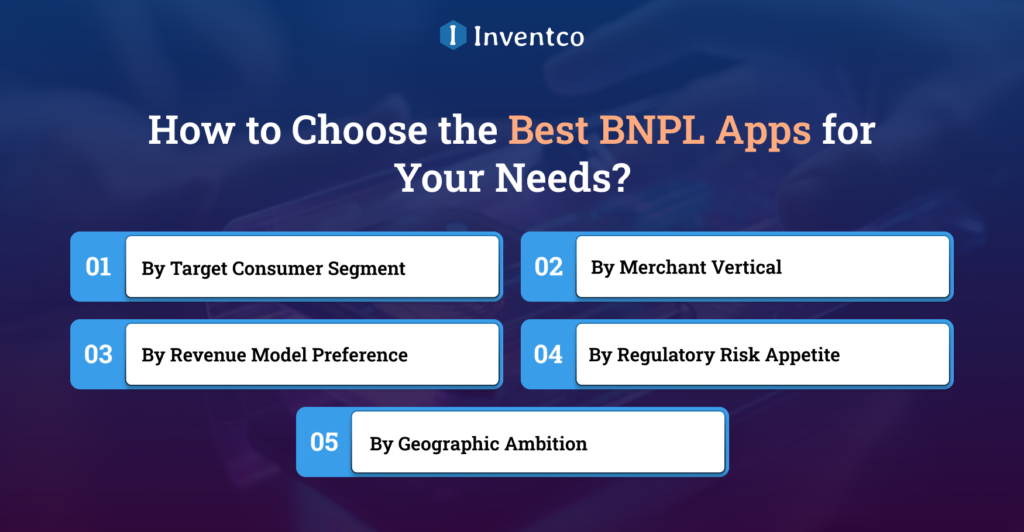
For investors and founders evaluating the BNPL landscape, the right platform depends on context. Here is a strategic framework for assessing fit:
1. By Target Consumer Segment
If you are building for thin-file or credit-building consumers, consider models like Sezzle and Perpay that integrate with credit bureaus. For prime consumers, Splitit and Klarna’s premium offerings are more relevant.
2. By Merchant Vertical
Afterpay and Klarna best serve fashion and lifestyle merchants. Large-ticket verticals, such as healthcare, home improvement, and travel, align well with Affirm’s extended-term capabilities. Every day, platforms like Zip address FMCG and utility contexts.
3. By Revenue Model Preference
Founders should clearly understand whether they are building a merchant-funded model (0% APR, MDR-based revenue), a consumer-funded model (interest income), or a hybrid. Each has different capital requirements, regulatory obligations, and unit economics.
4. By Regulatory Risk Appetite
BNPL platforms in 2026 operate under increasing CFPB oversight. Platforms without robust KYC/AML infrastructure and compliance with lending license requirements face significant regulatory risk. Build compliance into your architecture, not as an afterthought.
5. By Geographic Ambition
If global scale is part of the vision, prioritize platforms and technology stacks that support multi-currency and multi-jurisdiction from the beginning. Retrofitting cross-border capabilities is expensive and time-consuming.
Key Features That Make These BNPL Apps Successful
The difference between a BNPL app that captures market share and one that stagnates comes down to the depth of its feature architecture. Here is a breakdown of the must-have core features and the differentiating capabilities that separate the leaders from the rest:
Core Features of Buy Now Pay Later Apps
- Instant Credit Decisioning: Real-time soft credit checks that approve or decline within seconds, using AI-driven risk models. This keeps friction low for consumers while protecting lenders from default risk.
- Flexible Repayment Structures: Support for Pay-in-4, monthly installments, and revolving credit lines. Multi-model flexibility is what separates scalable BNPL platforms from single-use tools.
- Merchant SDK & API Integration: Seamless checkout embedding via JavaScript SDKs, REST APIs, or native plugins for Shopify, WooCommerce, and Magento. The faster the merchant can go live, the wider the network effect.
- Consumer Dashboard & Notifications: A centralized dashboard showing active plans, upcoming payments, and spending history, paired with automated SMS/push reminders that dramatically reduce missed payments.
- Regulatory Compliance Engine: Built-in KYC/AML flows, data encryption (AES-256), and state-by-state lending license logic. Non-negotiable in 2026 as CFPB oversight tightens around BNPL providers.
Advanced Features of Buy Now Pay Later Apps
- AI-Powered Spending Insights: Personalized financial health dashboards that analyze spending patterns and proactively flag over-extension risks. Builds user trust and reduces churn.
- Virtual Card Issuance: Instant virtual debit/credit card generation for use at any merchant, expanding BNPL beyond partner networks. Klarna and Affirm have both leaned heavily into this.
- Loyalty & Rewards Integration: Points, cashback, or referral bonuses tied to BNPL usage. Loyalty mechanics improve retention and increase repeat transaction volume.
- Multi-Currency & Cross-Border Support: Essential for platforms targeting global markets. Real-time FX rates, local payment rails, and currency conversion built into the checkout flow.
- Dispute Resolution & Escrow Module: An integrated dispute management layer, including fund holding and mediation workflows, that protects both buyers and sellers in high-value or service-based transactions.
Want to Build Your Own Buy Now Pay Later App?
If you are a founder or investor evaluating the BNPL opportunity, the real challenge is not identifying features, it is executing across infrastructure, compliance, and user experience at scale.
Building a BNPL platform requires tightly integrated systems, including real-time underwriting engines, secure payment rails, regulatory compliance layers (KYC/AML), and consumer-facing applications that minimize friction while maintaining trust. Even small gaps in these systems can lead to delayed launches, regulatory exposure, or poor retention.
Why Inventco?
Inventco has worked on complex financial applications where transaction security, real-time processing, and compliance are non-negotiable. In one such project, a full-stack escrow mobile application was developed to support high-value transactions with milestone-based fund releases, encrypted payment processing (AES-256), and integrated dispute resolution workflows.
What makes this relevant for BNPL founders is the underlying architecture. Escrow systems and BNPL platforms share critical components, including multi-party transaction handling, fund state management, and compliance-aware workflows. Building these systems correctly from the start is what determines whether a BNPL product can scale reliably.
Inventco’s Escrow Mobile Application: A Case Study in Secure Financial Engineering
The Escrow Mobile Application we developed is a full-stack secure transaction platform that holds funds in a trusted third-party account until all agreed-upon conditions are met, protecting both buyers and sellers from financial risk throughout the transaction lifecycle.
What makes this relevant to BNPL founders is the architecture underneath it:
- Real-time transaction status tracking and notifications for all parties
- Support for both single-payment and milestone-based fund release, directly analogous to BNPL installment logic
- Encrypted payment processing with AES-256 security standards
- Integrated dispute resolution workflow with supporting document management
- Full-stack delivery across Backend, Frontend, Mobile, UX/UI, Strategy, and QA
The escrow model requires exactly the kind of rigorous fund management, compliance-aware design, and multi-party workflow logic that a BNPL platform demands at scale. Building both requires the same foundational capabilities: secure payment rails, real-time state management, and consumer trust engineering.
“Inventco’s approach is not to ship a product and iterate on safety later. We build trust into the architecture from the first line of code, because in financial applications, trust is the product.”
What We Deliver for BNPL Founders
- End-to-end product strategy, from market positioning to technical architecture
- Compliant BNPL infrastructure with built-in KYC/AML, underwriting logic, and regulatory reporting
- Merchant SDK and API development for rapid partner onboarding
- Consumer-facing mobile applications with conversion-optimized UX
- Scalable backend systems built for high transaction volumes and real-time decisioning
If you are evaluating the BNPL opportunity and want to understand what a build timeline, technology stack, and go-to-market plan looks like for your specific use case, Inventco is the partner that can map it out with you.
Conclusion
The BNPL market in 2026 is not a single product category, it is a spectrum of financial products, consumer experiences, and business models, each with different risk profiles, revenue mechanics, and competitive dynamics.
For founders, the opportunity is real: the market is growing rapidly, consumer demand is structurally persistent, and the technology infrastructure to build competitive BNPL platforms is more accessible than ever. But so is the competition.
The best buy now pay later apps succeed not because they offer installment payments, but because they build consumer trust at scale, embed seamlessly into merchant workflows, and make compliance an architectural feature rather than a compliance checkbox. These are the principles that separate platforms worth building and investing in from those that will struggle for differentiation.
If you are ready to build in this space, the market window is open. The question is whether you have the right team to execute.
FAQ’s
Q1. What is the best buy now, pay later app for someone building a new platform?
Ans. There is no single answer, the best BNPL model for you depends on your target consumer segment, merchant vertical, geographic market, and revenue model preference. Study Affirm for large-ticket installments, Klarna for ecosystem breadth, and Perpay for structural default risk reduction.
Q2. Are BNPL apps regulated in the US?
Ans. As of 2024, the CFPB has ruled that BNPL lenders must provide many of the same consumer protections as credit card issuers, including dispute resolution rights and periodic statements. Any new BNPL platform must build regulatory compliance into its architecture from day one.
Q3. How much does it cost to build a BNPL app?
Ans. A production-ready BNPL application, including underwriting logic, merchant APIs, a consumer mobile app, and compliance infrastructure, typically requires an investment of $10,000 to $1,00,000+, depending on feature scope, regulatory complexity, and geographic markets.
Q4. What are the best apps for buy now pay later for merchants looking to integrate?
Ans. Affirm, Klarna, and Afterpay offer the most mature merchant integration ecosystems, with native plugins for Shopify, WooCommerce, Magento, and BigCommerce. For merchants on custom platforms, Affirm and Klarna provide robust REST APIs with developer documentation.
Q5. What are the best apps for buy now pay later if I want to avoid interest?
Ans. Afterpay, PayPal Pay in 4, Sezzle, and Splitit all offer 0% interest BNPL options. Platforms like Affirm and FuturePay charge interest only on longer-term or revolving credit products, and this is clearly disclosed at the point of application.
Q6. What’s the best buy now pay later app for credit building?
Ans. Sezzle and Perpay are the strongest options for consumers focused on credit building, as both report payment history to major credit bureaus. Perpay’s payroll-linked model makes it particularly reliable for thin-file consumers building credit.

Jitendra Jain
He is the CEO and Co-founder of Inventco, driving innovation in advanced computing and digital transformation. With deep expertise in modern IT ecosystems, he leads scalable, secure, future-ready solutions. His strategic leadership helps businesses accelerate growth, adopt innovation, and achieve success. You can connect with him on LinkedIn to follow his technology insights.