Imagine your sales team closes a deal, but your finance team has no idea. Your marketing department is still nurturing the same lead. Your support team is asking the customer questions they have already answered. This is not a hypothetical, it is the daily reality for thousands of businesses operating with disconnected systems.
That gap costs real money. According to IDC, poor data integration costs businesses up to 30% of their annual revenue. Yet most growing companies continue to rely on siloed tools, a standalone CRM here, an ERP there, a project management platform somewhere else, each holding a fragment of the customer truth.
CRM integration is the strategic answer to this fragmentation. It connects your Customer Relationship Management platform with the rest of your business ecosystem, your ERP, LMS, marketing automation, helpdesk, and more, creating a single, unified view of every customer interaction, deal, and relationship.
This guide breaks down exactly what CRM integration is, the types available, the measurable benefits, and how to choose the right CRM development partner for your business. Whether you are a founder scaling your first SaaS product or an investor evaluating technology infrastructure, this is the definitive resource you need.
Key Takeaways
- CRM integration connects your CRM software with external tools, platforms, and workflows to eliminate data silos.
- Businesses using integrated CRM systems report up to 29% more revenue and 34% higher sales productivity (Salesforce).
- There are six primary types of CRM integrations, each serving a specific business function.
- Key benefits include improved data accuracy, faster sales cycles, enhanced customer experience, and better ROI measurement.
- Choosing the right CRM integration partner requires evaluating scalability, security, industry expertise, and post-launch support.
Market Stats and Data: CRM Software in 2025–2026
The numbers make a compelling case for taking CRM integration seriously. Here is where the market stands:
- The global CRM market was valued at $73.4 billion in 2024 and is projected to reach $163.16 billion by 2030 at a CAGR of ~14.6%.
- 91% of companies with more than 10 employees use CRM systems to streamline customer relationships and operational workflows.
- According to Nucleus Research, businesses earn an average return of $8.71 for every dollar invested in CRM systems, demonstrating measurable ROI.
These figures are not abstract benchmarks; they represent real competitive advantages that integrated businesses hold over those still running on disconnected platforms. For founders, this is infrastructure. For investors, this is a measurable indicator of operational maturity.
What Is CRM Integration?
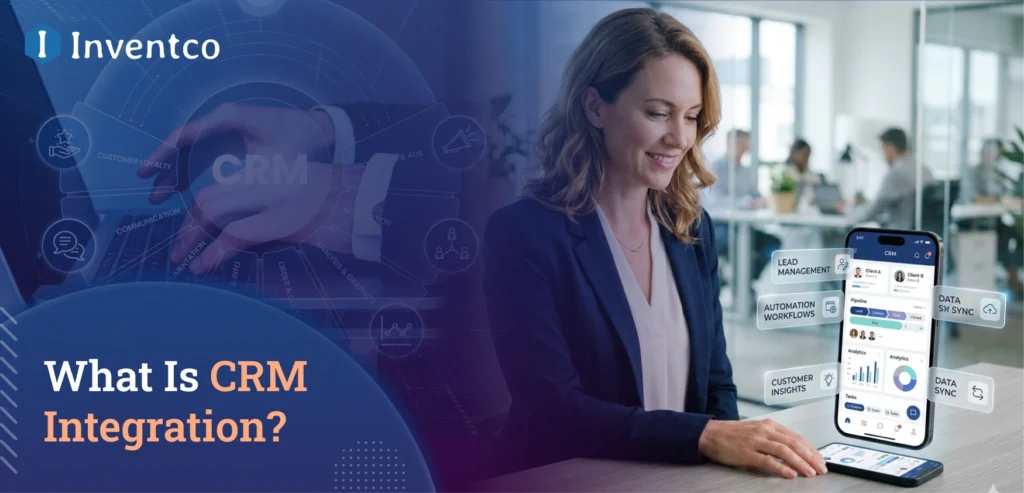
CRM integration is the process of connecting your CRM system with other business tools, applications, and platforms so that data flows automatically and consistently across your entire organization, without manual exports, copy-paste errors, or system switching.
In plain terms, what is a CRM integration? It is the technological bridge between your customer data and every department that needs it, from sales and marketing to finance, operations, and support.
What does CRM integration mean in practice? It means your sales rep closes a deal in the CRM, and your finance team sees the invoice trigger automatically. Your marketing team sees the customer move out of the nurture stage. Your support team has the full account history before the first ticket is opened.
What is an integrated CRM? An integrated CRM is one that does not function in isolation. It is connected to your broader technology stack, your ERP, marketing automation, helpdesk, e-commerce platform, LMS, or project management tool, creating a real-time, 360-degree view of your customer journey.
Think of it as the central nervous system of your business operations. Without integration, data sits in silos. With integration, it flows accurately, automatically, and actionably.
Types of CRM Integrations
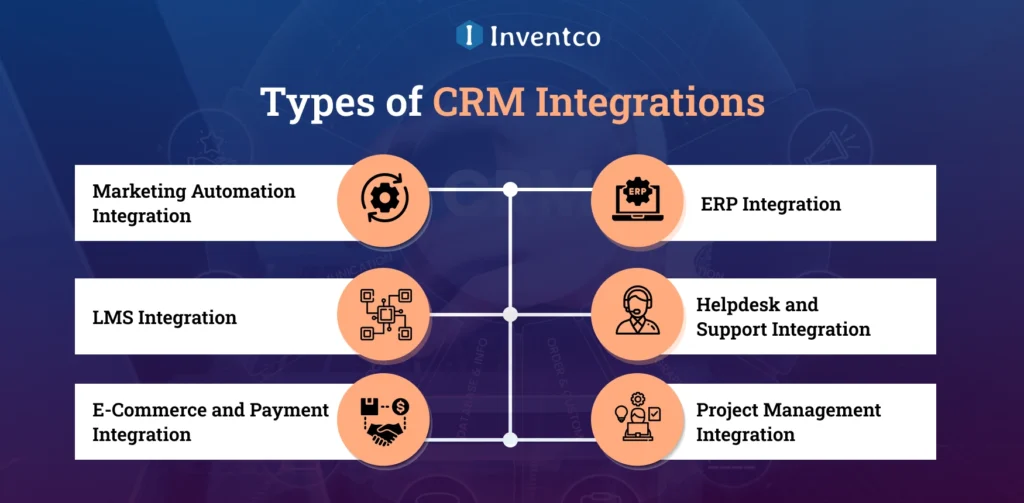
Understanding what CRM integrations mean and knowing the six core categories. Each serves a distinct operational purpose and unlocks a different layer of business intelligence.
1. Marketing Automation Integration
This connects your CRM with platforms like HubSpot, Marketo, or Mailchimp. Lead behavior, campaign engagement, and email performance sync directly into the CRM, enabling sales teams to follow up on warm leads with full context, at exactly the right moment.
2. ERP Integration
CRM and ERP integration bridges the gap between the front office (sales, marketing) and the back office (finance, inventory, procurement). The benefits of CRM and ERP integration are significant: real-time inventory visibility, automated billing triggers, unified financial reporting, and elimination of duplicate data entry across departments.
3. LMS Integration
What is the benefit of CRM integration with LMS? It enables businesses to track customer training progress, certifications, and onboarding milestones inside the CRM. Sales and customer success teams can personalize outreach based on how deeply a customer has engaged with your product education.
4. Helpdesk and Support Integration
Connecting your CRM with tools like Zendesk or Freshdesk ensures every support ticket, conversation, and resolution is logged against the customer record. Support agents gain full account visibility. Account managers know when a key client is frustrated, before the renewal conversation.
5. E-Commerce and Payment Integration
This ties purchase history, cart behavior, and transaction data directly into the CRM. It enables upsell triggers, churn prediction based on purchase gaps, and personalized campaigns based on actual buying behavior, moving far beyond demographic segmentation.
6. Project Management Integration
CRM project management integration benefits include connecting deal stages to project delivery timelines. When a contract is signed in the CRM, the project is automatically created in your PM tool. Teams see client context; clients experience seamless transitions from sales to delivery.
Key Benefits of CRM Integration
The benefits of CRM integration extend across every function of a modern business. The table below maps each benefit to its direct business impact and the departments that gain the most:
| Benefit | Business Impact | Who Gains Most |
|---|---|---|
| Unified Customer Data | Eliminates silos; single source of truth for all teams | Sales, Marketing, Support |
| Increased Sales Productivity | Reps spend less time on admin; more time closing deals | Sales Team |
| Faster Sales Cycles | Automated follow-ups and lead routing accelerate deal velocity | Sales & Revenue Ops |
| Improved Customer Retention | Proactive engagement triggered by behavior signals | Customer Success, Support |
| Better Marketing ROI | Attribution clarity: campaigns informed by real purchase dat | Marketing & Growth |
| Real-Time Reporting | Dashboards reflect live data across systems, not yesterday’s export | Leadership & Ops |
| Reduced Manual Errors | Automated data sync eliminates copy-paste mistakes | All Departments |
| Scalable Operations | Systems grow with the business without re-platforming | Founders, CTOs, Ops |
| Enhanced Compliance | Centralized data makes audit trails and GDPR compliance manageable | Legal, Finance, IT |
| Faster Onboarding | New reps ramp up faster with full customer context available | HR, Sales Management |
Pros of Integrated CRM Features
Understanding the pros of integrated CRM features means distinguishing between the fundamentals every business needs and the advanced capabilities that drive competitive differentiation. Here are the key features that matter most.
Core Features
1. Contact and Account Synchronization: Automatically syncs customer records across all connected platforms in real time. Eliminates duplicate entries, outdated information, and the manual overhead of maintaining separate databases across departments.
2. Pipeline and Deal Management: Provides a unified view of every deal, its stage, associated contacts, and activity history. Integrated CRM pipelines pull data from connected tools, giving sales leaders an accurate, real-time forecast without manual data gathering.
3. Email and Calendar Integration: Syncs communications and schedules meetings directly into customer records. Sales reps never lose context in a conversation, and managers can automatically see engagement patterns across the entire account history.
4. Automated Task and Activity Logging: Captures calls, emails, meetings, and notes without manual input. Keeps customer records current and accurate, freeing sales and support teams to focus on conversations rather than CRM data entry.
5. Reporting and Analytics Dashboards: Pulls metrics from all integrated systems into a single dashboard. Leadership gets a real-time view of revenue, pipeline health, customer satisfaction, and marketing performance, all from one screen.
Advanced Features
1. AI-Powered Lead Scoring: Machine learning models analyze behavioral signals, engagement data, and firmographic attributes to rank leads by conversion likelihood. Sales teams prioritize the right prospects and dramatically reduce wasted outreach time.
2. Predictive Churn Detection: Integrated CRM platforms cross-reference support tickets, usage frequency, and NPS scores to flag at-risk accounts before renewal. Customer success teams can intervene proactively, not reactively, after a cancellation.
3. Workflow and Process Automation: Trigger multi-step business processes automatically based on CRM events: a won deal launches a project, a signed contract triggers billing, and an inbound lead is routed to the right rep in seconds, not hours.
4. Cross-Platform Customer Journey Mapping: Visualizes the complete customer lifecycle from first touchpoint to post-sale, pulling data from marketing automation, helpdesk, and product usage tools. Reveals exactly where customers drop off or disengage across the journey.
5. API-First Custom Integrations: Enables businesses to connect proprietary systems, legacy platforms, or niche industry tools that lack out-of-the-box connectors. API-first CRM integrations future-proof your technology stack as your business scales and evolves.
Why Do Businesses Need CRM Integration?
The question is no longer whether to integrate your CRM, it is how quickly you can do so without disrupting operations. Here is the business case, grounded in the realities founders and investors face every day.
- Operational Fragmentation Is a Revenue Leak: When teams work from separate systems, errors multiply. A sales rep works from an outdated contact list. Finance reconciles invoices manually. Marketing re-engages customers who have already converted. Every one of these friction points has a cost, in time, in revenue, and in customer trust.
- Scale Requires System Alignment: Growing from 10 to 100 employees does not scale unless your systems keep pace. CRM integration ensures that as your team grows, your data stays consistent, your workflows stay automated, and your customer experience stays coherent, regardless of headcount.
- Investors and Boards Expect Data Maturity: When a Series A or B investor asks about unit economics, customer acquisition cost, or churn, you need real-time, accurate data. Integrated CRMs make that possible. Disconnected systems make spreadsheet reconciliation a nightmare that undermines confidence.
- Customer Expectations Have Permanently Shifted: Modern customers expect the company to know their history, preferences, and current situation at every touchpoint. CRM integration makes that possible by giving every department the same customer context in real time.
- Competitive Advantage Is Built on Speed: Businesses with integrated systems respond to leads faster, close deals quicker, resolve support issues sooner, and adapt to market changes more rapidly. In a market where speed is a moat, integration is the infrastructure that enables it.
For companies building digital products, whether a mobile app, a SaaS platform, or a marketplace, CRM integration is foundational infrastructure. Much like understanding the mobile app development process or choosing the right mobile app technology stack, early CRM integration decisions define how effectively your business scales later.
How to Choose the Right CRM Integration for Your Business?
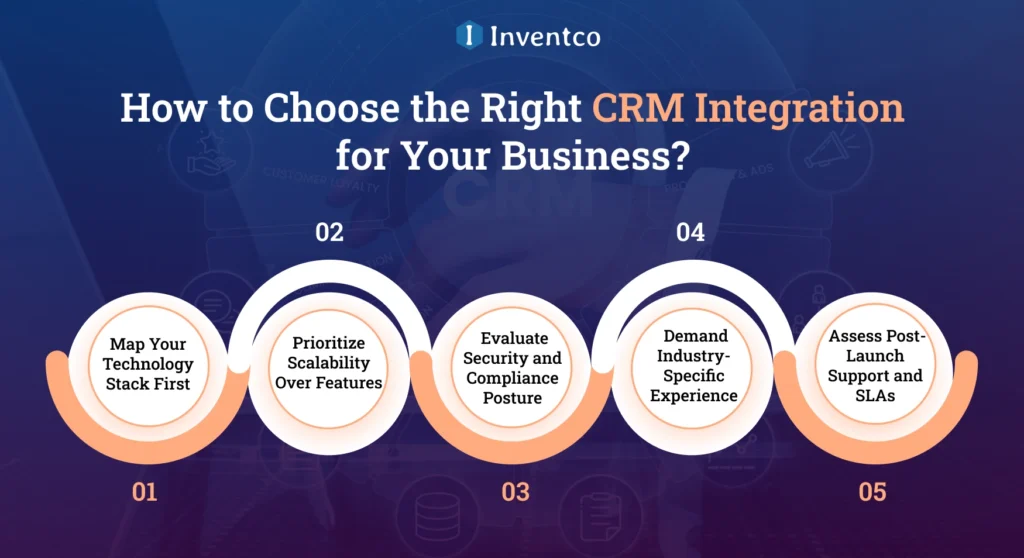
Choosing a CRM integration is not a software decision; it is a strategic infrastructure decision. The wrong choice costs you months of re-platforming. The right choice compounds your operational advantage for years. Here is how to evaluate your options with confidence.
1. Map Your Technology Stack First: Before evaluating any integration solution, document every system your business uses, including CRM, ERP, marketing tools, helpdesk, project management, and any proprietary platforms. The best CRM integration connects to what you already have, not what a vendor wishes you had.
2. Prioritize Scalability Over Features: A startup today becomes an enterprise faster than most founders expect. Choose an integration architecture that handles 10x your current data volume and user count without requiring a rebuild. API-first, microservices-based architectures are the standard for scalable integrations in 2026.
3. Evaluate Security and Compliance Posture: Data flowing between systems creates exposure. Ensure your integration partner has a clear security architecture, encryption in transit and at rest, role-based access control, audit logging, and compliance with GDPR, SOC 2, or HIPAA, depending on your industry.
4. Demand Industry-Specific Experience: Generic integration partners build generic solutions. If you are in fintech, healthtech, or edtech, your CRM integration requirements are not generic. Look for partners who have built integrations in your vertical and understand its regulatory and operational constraints.
5. Assess Post-Launch Support and SLAs: Integration is not a one-time project. Systems update, APIs change, and business requirements evolve. Your integration partner must provide proactive monitoring, rapid response SLAs, and ongoing optimization, not just a delivery handoff.
Why Inventco Is the Right Integration Partner?
Inventco brings over a decade of experience building custom technology solutions for founders, startups, and enterprise businesses worldwide. When it comes to CRM integration, Inventco does not deliver off-the-shelf connectors, it engineers integration architecture tailored to your specific business model, technology stack, and growth trajectory.
Here is what sets Inventco apart:
- Deep technical expertise across leading CRM platforms, including Salesforce, HubSpot, Zoho, and Microsoft Dynamics.
- Proven experience integrating CRMs with ERPs, LMS platforms, mobile applications, and custom-built systems.
- Security-first engineering: every integration is built with enterprise-grade data protection from day one.
- Industry-specific experience in fintech, healthtech, edtech, e-commerce, and SaaS.
- End-to-end partnership: from discovery and architecture design to deployment, monitoring, and long-term support.
Inventco has helped founders move from fragmented tools to fully integrated technology ecosystems, giving their teams the data clarity and automation they need to compete and scale. Whether you are building a mobile app with CRM capabilities, integrating an existing CRM with a new platform, or re-architecting a legacy system, Inventco has the experience and the commitment to deliver results.
Just as the right mobile app development frameworks and MVP mobile App strategy lay the foundation for a great digital product, the right CRM integration partner lays the foundation for a connected, data-driven business. Inventco sits at the intersection of product thinking and technical execution.
Conclusion
Integrating a CRM system is a core organizational skill, not just a part of the system. The modern organization is challenged to pool and organize customer data that is typically spread across numerous systems. The modern organization thrives by justifying the complete integration of its systems, clarifying and continually optimizing activities, and making it a practical and energizing skill to control the organization.
Formalizing the integration of CRM systems within the organization creates an efficient, productive working environment. For the owner, it is predictive and innovative. For the employee, it integrates skills in a more appropriate and creative order, finally, for the customer, it facilitates a more systematic and informative system rather than a repetitive one.
Competitors are unable to assess the boundary between progress and profit in CRM. The expectation is: how fast will the competitor be allowed to exploit this potential? Inventco is the partner you want when you are ready to scale the technology foundation of your business. From the initial architectural discussions to deployment in production, and wherever your journey takes you after that.
FAQ’s
Q1. What is CRM integration, and why do I need it?
Ans. CRM integration connects your CRM to other business tools, such as ERP, marketing, and helpdesk, so data flows automatically. You need it to eliminate silos, reduce manual work, and gain a unified view of every customer.
Q2. What does CRM integration mean for a small business?
Ans. For small businesses, CRM integration means fewer manual processes, less data duplication, and faster team alignment. It creates operational efficiency that lets small teams compete with the speed and precision of much larger organizations.
Q3. What are the main benefits of CRM integration?
Ans. Core benefits include unified customer data, higher sales productivity, improved customer retention, better marketing ROI, and real-time reporting. Businesses typically see measurable improvements within the first 90 days of deployment.
Q4. What is the benefit of CRM integration with LMS?
Ans. CRM and LMS integration lets teams track customer training progress, certifications, and onboarding milestones inside the CRM, enabling personalized outreach based on actual product engagement and education completion rates.
Q5. What are the benefits of CRM and ERP integration?
Ans. CRM and ERP integration unifies sales and financial data, automates billing triggers, reduces duplicate entry, and gives leadership real-time visibility into revenue, inventory, and order status across the business.
Q6. What are the pros of integrated CRM features in work management platforms?
Ans. Integrated CRM features in work management platforms connect deal stages to project delivery, automate task creation upon contract signing, and provide delivery teams with full client context, improving handoffs and accelerating time-to-value for customers.

Jitendra Jain
He is the CEO and Co-founder of Inventco, driving innovation in advanced computing and digital transformation. With deep expertise in modern IT ecosystems, he leads scalable, secure, future-ready solutions. His strategic leadership helps businesses accelerate growth, adopt innovation, and achieve success. You can connect with him on LinkedIn to follow his technology insights.