Musculoskeletal conditions remain one of the leading causes of disability worldwide, and millions of patients still lack consistent access to high-quality physical therapy between clinic visits. The result is measurable: lower adherence, slower recovery timelines, and escalating costs across care systems.
For founders and investors evaluating how to build a physical therapy app, this is a structurally strong digital health opportunity. The convergence of telehealth maturity, AI-enabled care personalization, and expanding reimbursement for remote therapeutic monitoring has created a clear market inflection point heading into 2026.
This guide provides a practical, execution-focused roadmap, from validating market demand to launching a compliant, scalable product. Whether you are building from the ground up or extending an existing healthcare platform, early decisions around architecture, compliance, and product strategy will directly influence clinical credibility, adoption, and long-term commercial performance.
Key Takeaways
- The global digital physical therapy market is projected to exceed $22 billion by 2030, growing at a CAGR of over 17%.
- Successful physical therapy apps combine clinical-grade exercise libraries, real-time feedback, and telehealth integration to drive patient adherence.
- Development costs range from $10,000 for an MVP to $100,000+ for an enterprise-grade platform with AI and wearable integrations.
- HIPAA/GDPR compliance, EHR integration, and evidence-based content are non-negotiable requirements for market credibility.
- A phased approach, MVP first, then scale, reduces risk and accelerates time-to-market for founders and investors.
- Choosing the right mobile app technology stack and development partner is the most consequential decision in your build process.
Market Stats and Data
The numbers make a compelling case. Digital health as a whole is booming, but physical therapy specifically is undergoing a structural shift driven by aging populations, rising sports injury rates, and post-pandemic adoption of remote care.
- The global physical therapy software market size was valued at USD 1.25 billion in 2023 and is projected to reach USD 2.52 billion by 2030, growing at a CAGR of 11.0% from 2024 to 2030.
- Another forecast estimates the market reaching $2.6 billion by 2032, with a 9.7% CAGR, indicating consistent long-term demand for PT software.
- The global telehealth market size was estimated at USD 123.26 billion in 2024 and is projected to reach USD 455.27 billion by 2030, growing at a CAGR of 24.68% from 2025 to 2030.
These figures signal that the window to build a mobile physical therapy app is not just open, it is widening. First-mover advantage matters in healthcare software, particularly where clinical trust and EHR integrations create meaningful switching costs.
Why Build a Physical Therapy App in 2026?
The timing argument for physical therapy app development services has never been stronger. Here is why 2026 represents a strategic inflection point:
1. Insurance and RTM Reimbursement Is Now Mainstream
Remote Therapeutic Monitoring (RTM) CPT codes introduced by CMS have fundamentally changed the business model for PT apps. Clinics can now bill insurance for digital patient monitoring, creating a recurring revenue channel that did not exist three years ago. If you build a physical therapy app today with RTM-compliant reporting, you are building a product that pays for itself through clinical reimbursement.
2. AI and Computer Vision Are Finally Cost-Effective
Real-time movement analysis using smartphone cameras, something that required specialized hardware as recently as 2025, can now be deployed via API-driven computer vision models. This means you can make a physical therapy app that provides instant postural feedback without expensive wearables, dramatically reducing the patient barrier to entry.
3. Patient Expectations Have Permanently Shifted
Post-pandemic, patients expect digital continuity of care. A clinic without a companion app is now seen as behind the curve. Founders who build a physical therapy app in 2026 are not building a nice-to-have, they are meeting a baseline expectation that is already reshaping patient acquisition and retention for PT practices.
4. Competitive Consolidation Is Still Early
Unlike telemedicine as a whole, the physical therapy app market remains fragmented. There is no single dominant platform. This gives well-funded, well-designed new entrants a realistic path to meaningful market share, particularly in niche verticals like sports performance, pediatric PT, or post-surgical rehabilitation.
5. Investor Appetite for Clinical-Grade Digital Health Is Robust
Healthcare-focused VCs and strategic investors are actively deploying capital into condition-specific digital therapeutics. A physical therapy app with demonstrated clinical outcomes and an RTM-enabled revenue model is a compelling investment narrative.
Types of Physical Therapy Apps
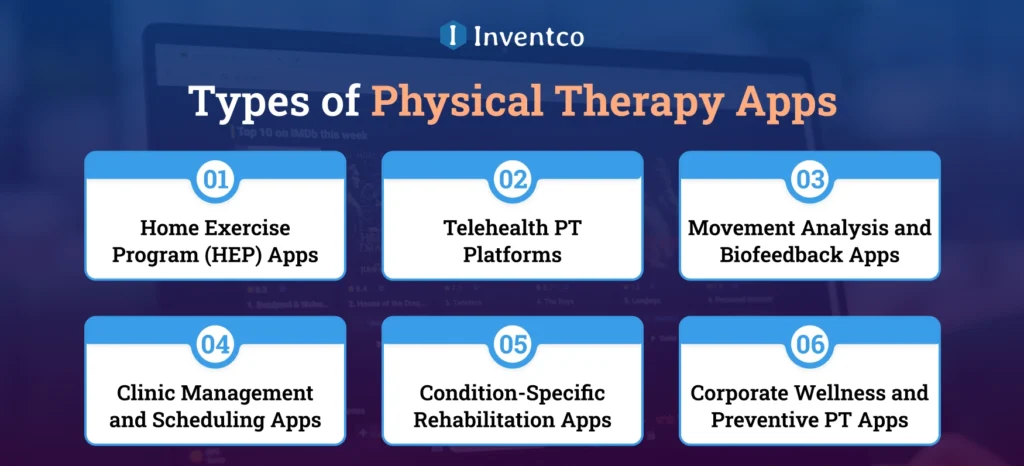
Before you develop a physical therapy app, you need to define the product category you are building. Each type has a different user base, regulatory exposure, and monetization model.
1. Home Exercise Program (HEP) Apps
These apps deliver prescribed exercise programs to patients between clinic visits. They are the most widely adopted category and the natural starting point for an MVP. Core value: improving adherence to prescribed routines with video guidance, reminders, and progress tracking.
2. Telehealth PT Platforms
Video consultation platforms specifically built for physical therapists, enabling remote assessments, live coaching, and real-time exercise correction. Regulatory note: these platforms must comply with HIPAA, and in some jurisdictions, practitioners need specific licensure for cross-state telehealth delivery.
3. Movement Analysis and Biofeedback Apps
Apps that use the smartphone camera, wearables, or connected sensors to analyze movement quality and provide corrective feedback. These are technically more complex and often positioned as clinical decision-support tools for practitioners.
4. Clinic Management and Scheduling Apps
Operational tools for PT practices: appointment booking, intake forms, billing integration, and patient communication. These B2B tools often complement patient-facing HEP apps and are a natural upsell within a platform strategy.
5. Condition-Specific Rehabilitation Apps
Focused apps targeting specific conditions, post-ACL surgery, lower back pain, rotator cuff recovery, and stroke rehabilitation. Condition-specific depth creates stronger clinical credibility and clearer marketing positioning than general PT apps.
6. Corporate Wellness and Preventive PT Apps
Employer-sponsored apps targeting injury prevention, ergonomics correction, and musculoskeletal wellness. These B2B2C models offer attractive contract-based revenue and are increasingly integrated with corporate health benefit platforms.
Development and Design of a Physical Therapy App: Key Considerations
The development and design of a physical therapy app are fundamentally different from those of a standard consumer app. Clinical context, regulatory requirements, and user diversity (including elderly patients and post-surgical individuals) demand design decisions that balance simplicity with depth.
1. Regulatory Compliance from Day One
HIPAA compliance in the US and GDPR in Europe are not optional features, they are architectural decisions. Your data storage, encryption, access control, and audit logging must be built to meet these standards before your first patient uses the app. Mobile app security practices must be embedded in your development process, not bolted on post-launch.
2. Clinical Content Validation
Exercise libraries must be developed with or validated by licensed physical therapists. Inaccurate or contraindicated exercise guidance creates both clinical risk and significant legal liability. Partner with clinical advisors early and establish a content governance process for ongoing updates.
3. Accessibility and Inclusive Design
Your users may include post-surgical patients, elderly individuals, or people with limited tech literacy. Large tap targets, high-contrast visuals, voice guidance, and simple onboarding flows are not accessibility extras, they are table stakes for clinical credibility.
4. EHR and Practice Management Integration
For B2B physical therapy apps targeting clinics, integration with major EHR systems (Epic, Cerner, WebPT, Jane App) is a competitive necessity. Plan your API architecture for interoperability from the start, as retrofitting EHR connectivity is expensive and time-consuming.
5. Android vs iOS: Platform Strategy
Your platform choice affects both development cost and market reach. When evaluating Android vs iOS, consider that iOS dominates in the US and Western European healthcare settings (higher adoption among paying users), while Android’s global reach is essential for international expansion. Most enterprise PT apps launch on iOS first, then expand to Android. Understanding the Android vs. iOS trade-offs early will save high costs and rework later in your project.
6. App Wireframing and Prototyping
Before a single line of code is written, invest in thorough app wireframing and app prototype development. Given the complexity of PT workflows, therapist dashboards, patient exercise flows, progress reporting, and video consultation, a validated prototype can save weeks of expensive development rework. Prototyping with real physical therapists and patients should be non-negotiable in your process.
How to Develop a Physical Therapy App: Step-by-Step
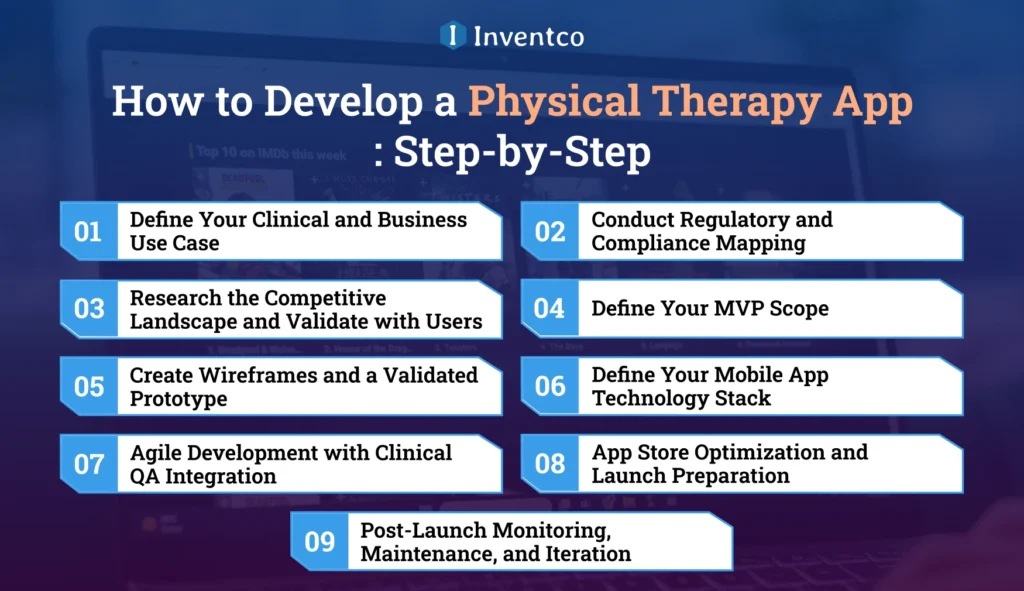
Here is a proven, step-by-step mobile app development process specifically adapted for physical therapy applications. Each step builds on the last, reducing risk and ensuring your product is built for both clinical credibility and commercial success.
Step 1: Define Your Clinical and Business Use Case
Start with a precise problem definition. Who is your primary user, the patient, the therapist, or both? What clinical outcome are you targeting? What is your revenue model? Founders who skip this step build technically functional apps with no product-market fit. Your use case document becomes the north star for every subsequent decision in the process.
Step 2: Conduct Regulatory and Compliance Mapping
Before scoping features, map the regulatory landscape for your target markets. HIPAA, GDPR, FDA Software as a Medical Device (SaMD) classification, and state telehealth licensing rules all have direct implications for your architecture, content, and go-to-market timeline. Engage a healthcare compliance attorney at this stage, not after launch.
Step 3: Research the Competitive Landscape and Validate with Users
Analyze direct and adjacent competitors: Hinge Health, Kaia Health, RecoveryOne, and PhysiApp. Map their strengths, weaknesses, and pricing. Then run structured user interviews with target physical therapists and patients. Real user insight at this stage shapes features that drive adoption rather than features that look impressive in a demo.
Step 4: Define Your MVP Scope
An MVP mobile app for physical therapy should deliver one core workflow exceptionally well, typically a home exercise program with video guidance, progress tracking, and therapist messaging. Resist the temptation to include everything. A focused MVP validates your core hypothesis faster, reaches the market sooner, and costs significantly less. Understand what an MVP mobile app entails and build for learning, not perfection.
Step 5: Create Wireframes and a Validated Prototype
Translate your MVP scope into detailed app wireframes covering every screen, user flow, and edge case. Develop an interactive prototype and run usability testing sessions with real therapists and patients. This stage is where expensive development mistakes are caught cheaply. Invest time here, every hour of prototyping saves three to five hours of development rework downstream.
Step 6: Define Your Mobile App Technology Stack
Select your mobile app technology stack based on your target platform, team capabilities, and scalability requirements. For cross-platform development, React Native and Flutter are the leading mobile app development frameworks in 2026. For backend, Node.js or Python with HIPAA-compliant cloud infrastructure (AWS Healthcare, Google Cloud Healthcare API, or Azure Health Data Services) are proven choices. Your stack decision significantly affects long-term maintenance costs.
Step 7: Agile Development with Clinical QA Integration
Execute development in two-week sprints with continuous integration and clinical quality assurance embedded in the process. Mobile app testing for healthcare applications must go beyond standard functional testing, it must include clinical workflow validation, accessibility testing, security penetration testing, and performance testing under real-world network conditions. This is where disciplined mobile app testing separates credible healthcare products from liability risks.
Step 8: App Store Optimization and Launch Preparation
App Store Optimization (ASO) for healthcare apps requires a nuanced approach. Medical claims in app store listings are regulated by Apple and Google, so your metadata, screenshots, and descriptions must be carefully crafted. Prepare your privacy policy, HIPAA documentation, and clinical disclaimer language. Plan your launch with a clinic partner who can provide real-world validation and initial case studies for credibility.
Step 9: Post-Launch Monitoring, Maintenance, and Iteration
Launch is not the finish line. Establish robust mobile app maintenance protocols, including performance monitoring, security patching, clinical content updates, and user feedback cycles. App maintenance costs are a budget line many founders underestimate. Plan for 15-20% of initial development costs annually. The apps that succeed long-term are the ones with disciplined post-launch operations built into the business plan from day one.
Must-Have Features of a Physical Therapy App
A successful physical therapy app is defined by the quality and integration of its features, not just the quantity. Here are the essential capabilities your product must include, split between foundational mobile app features every PT app needs, and advanced capabilities that differentiate enterprise-grade platforms.
Core Features
1. Video Exercise Library with Guided Instructions
A clinically validated library of exercise videos with clear audio and visual cues, filterable by body region, condition, and difficulty. This is the core clinical value of any home exercise program app, and the feature patients interact with most daily.
2. Personalized Exercise Program Builder
A tool enabling therapists to create, assign, and adjust customized exercise plans for individual patients. Drag-and-drop program creation with dosage controls (sets, reps, hold time) is the minimum baseline for clinical usability and therapist adoption.
3. Progress Tracking and Pain/Outcome Reporting
Patient-reported outcome measures (PROMs), pain scale check-ins, and visual progress dashboards. This data drives clinical decisions, demonstrates the app’s value to payers, and serves as the foundation for must-have mobile app features in any evidence-based PT platform.
4. In-App Messaging and Therapist Communication
Secure, HIPAA-compliant messaging between patients and their care team. Real-time communication increases adherence, allows for timely exercise modifications, and reduces clinic call volume, a clear operational ROI for PT practices adopting the platform.
5. Appointment Scheduling and Reminders
Integrated scheduling with automated push notification reminders for both exercise sessions and clinic appointments. Adherence reminders alone can improve exercise completion rates by 30-40%, making this a direct clinical and commercial value driver for the platform.
Advance Features
1. AI-Powered Movement Analysis with Real-Time Feedback
Computer vision-based analysis of patient movement via smartphone camera, providing instant postural correction. This feature differentiates clinical-grade apps from basic content libraries and represents the frontier of mobile physical therapy app development in 2026.
2. Wearable Device and IoT Integration
Bidirectional data sync with Apple Health, Google Fit, Garmin, and medical-grade wearables. Wearable integration enables objective activity monitoring, recovery tracking, and enriched clinical reporting, moving PT apps from self-reported to sensor-validated outcomes data.
3. EHR and Practice Management System Integration
API-based connectivity with Epic, Cerner, WebPT, and other EHR systems for seamless clinical data flow. EHR integration eliminates duplicate documentation for therapists and positions the platform as infrastructure rather than a supplementary tool in the clinical workflow.
4. Telehealth Video Consultation with Live Exercise Coaching
HIPAA-compliant video sessions enabling therapists to assess and coach patients in real time. Integrated directly into the app, this feature supports seamless continuity of care across in-person visits through session recording, exercise demonstrations, and outcome documentation.
5. Advanced Analytics and RTM Billing Dashboard
Real-time reporting dashboards for therapists and clinic administrators covering patient engagement, outcome app development trends, and Remote Therapeutic Monitoring (RTM) billing eligibility. This feature directly supports mobile app monetization by enabling practices to capture insurance reimbursement for digital patient monitoring.
Physical Therapy App Development Cost
One of the most common questions founders ask is: ” How much does it cost to build a physical therapy app?” The answer depends on complexity, platform scope, compliance requirements, and the capabilities of your development partner. Here is a transparent breakdown across three build tiers, covering the full range from $10,000 to $100,000 and beyond.
Before reviewing the cost tiers, it is worth noting that the cost to build a mobile app in healthcare is consistently higher than for equivalent apps in other verticals, primarily due to HIPAA compliance architecture, clinical content development, and the higher quality assurance bar required for patient-facing medical tools.
MVP: $10,000 – $30,000
An MVP mobile app at this tier delivers your core clinical hypothesis to market quickly. Expect a functional home exercise program with video guidance, basic messaging, and progress tracking on a single platform. The goal is not a finished product, it is validated learning. This investment tests your core assumptions before committing to full-scale development, and it gives you the real-world usage data investors want to see before funding a Series A.
Mid-Level: $30,000 – $70,000
This tier delivers a commercially deployable product suitable for clinic partnerships and initial revenue generation. Cross-platform development (iOS and Android), HIPAA-compliant infrastructure, telehealth integration, and outcome reporting are included. This is the tier where mobile app maintenance cost planning becomes critical. Budget 15-20% annually for ongoing support, security updates, and feature iteration based on clinical feedback and changing regulatory requirements.
Enterprise / Advanced: $70,000 – $100,000+
Enterprise-grade builds include AI-powered movement analysis, Remote Therapeutic Monitoring billing integration, multi-clinic administration, and advanced analytics dashboards. These platforms are built to become the operating system for physical therapy practices or to support payer-funded digital therapeutics programs. At this level, the time to develop a mobile app typically spans 9 to 18 months, influenced by integration complexity, feature depth, and regulatory compliance requirements.
Cost Optimization Insight
Founders who build a mobile app with a phased approach, MVP first, advanced features in subsequent releases, consistently achieve better capital efficiency than those who attempt full-featured builds from day one. Your MVP validates the market; your Series A funds the enterprise build.
How Inventco Helps in Building a Physical Therapy App?
Inventco is a healthcare-focused technology partner specializing in regulated healthcare mobile app development. With proven experience across physical therapy, chronic care, and clinical decision-support platforms, the team delivers solutions aligned with real clinical and investor expectations.
Strategy: Every engagement begins with a clinical-first strategy. Inventco defines data models, compliance frameworks, and scalable architectures around real-world care workflows, ensuring HIPAA readiness, EHR integration, and reimbursement pathways are embedded from the start.
UX/UI: User experience is designed for both clinicians and patients. From intuitive dashboards to guided therapy journeys, Inventco builds interfaces that improve adherence, simplify care delivery, and enhance engagement across diverse patient populations.
Backend & Frontend: Inventco engineers robust backend systems with secure APIs, scalable infrastructure, and seamless integrations. On the frontend, they develop high-performance mobile applications optimized for usability, accessibility, and cross-platform consistency.
Software Testing & Ongoing Support: Comprehensive testing ensures performance, security, and compliance before launch. Post-deployment, Inventco provides continuous maintenance, regulatory updates, and feature enhancements, helping healthcare apps remain reliable, compliant, and market-ready as they scale.

Conclusion
The opportunity to create a physical therapy app in 2026 is both significant and well-defined. The market is growing rapidly, regulatory reimbursement pathways now support sustainable digital PT business models, and patient demand for remote care continuity is a permanent behavioral shift, not a pandemic-era anomaly.
The founders and investors who succeed in this space will be those who approach the build process with clinical rigor, strategic patience, and a clear-eyed understanding of what their first product needs to prove.
Start with a focused MVP that validates your core clinical and commercial assumptions. Build compliance and integration capability into the architecture from the beginning. Partner with a team that understands healthcare software at a systemic level, not just a technical one.
If you are ready to move from concept to product, Inventco is the partner to take you there. Let us build something that improves patient outcomes and builds a lasting business.
FAQ’s
Q1. How long does it take to develop a physical therapy app?
Ans. Development timelines vary by complexity. MVPs take 3–5 months, mid-level apps 6–9 months, and enterprise platforms 12–18 months. Experienced partners streamline processes and accelerate delivery timelines.
Q2. Do I need FDA clearance to build a physical therapy app?
Ans. Not always. Wellness apps are exempt from FDA oversight, but diagnostic, AI-driven, or device-integrated apps may require FDA 510(k) clearance. Early regulatory consultation ensures proper classification and compliance planning.
Q3. What is the best platform to launch a physical therapy app, iOS or Android?
Ans. iOS suits US healthcare professionals and premium users. Android offers global reach and a broader demographic base. Most PT apps launch on both platforms, prioritizing based on audience, market strategy, and budget constraints.
Q4. How do physical therapy apps generate revenue?
Ans. Revenue comes from clinic SaaS licensing, patient subscriptions, employer wellness programs, RTM insurance billing, and white-label deals. Scalable models combine B2B licensing with recurring insurance reimbursements for sustained growth.
Q5. What security standards does a physical therapy app need to meet?
Ans. Apps must include encryption, role-based access, audit logs, MFA, and BAA agreements. Regular penetration testing, vulnerability scans, and incident response plans are essential for compliance and secure clinical partnerships.
Q6. Can I use AI in my physical therapy app?
Ans. Yes. AI supports motion tracking, personalized exercise plans, adherence prediction, and symptom triage. Clinical AI must be trained on validated datasets and tested rigorously to ensure safe, reliable patient outcomes.
Q7. What is the maintenance cost after launching a physical therapy app?
Ans. Annual maintenance typically costs 15–20% of the initial development cost. Expenses include updates, security patches, scaling infrastructure, and compliance upkeep. Healthcare apps demand higher maintenance due to regulatory and reliability requirements.

Ajay Bhal
He is an on-demand app solutions expert with 11+ years of experience in business consulting and building scalable, user-centric digital products. He specializes in robust on-demand platforms across industries, combining technical expertise with business-focused strategy to deliver efficient, top notch solutions that drive growth and enhance user experience. You can connect with him on LinkedIn to follow insights.