Have you ever thought about how much it costs to create an AI app?
From chatbots to intelligent personal assistants, the AI app development services are powering the mobile apps in the market. If you are planning to build an app that not just serves but also understands your user needs, then AI is not just an add-on feature; it is a must-have feature for you.
The cost to develop an AI app in 2026 can range from $20,000 to $200,000+, depending on the features and complexity of your app.
It doesn’t matter whether you are a startup or an enterprise; if you want to launch a successful AI app that scales smartly, then it is necessary to understand the cost structure of AI app development.
In this detailed guide for the cost to create an AI app, we explore the actual cost of an AI app, the reason that affects the cost to build an AI app, and how to make an AI app without spending more.
Key Takeaways
- Developing AI applications ranges from $20,000 to $200,000+ depending on the app’s complexity, features and AI functionality.
- Some important factors that influence development costs include the type of AI model, the amount of data needed, the level of app complexity, and the geographic location of the development team.
- Long-term investments are heavily impacted by hidden costs such as model training costs, cloud costs, API costs, and maintenance costs.
- Using pre-trained models and starting with a Minimum Viable Product (MVP) can help keep costs low while retaining quality.
- For long-term success, a scalable architecture (front end, back end, AI, data, and API layers) is key.
- AI has become essential in driving significant business assets for automation, personalization, and growth.
- Working with a development company with extensive experience will enable you to have scalable, on time and cost effective options.
- The real-world applications of AI and automation in OfferIn60 demonstrate the value of AI from the perspective of automation, transparency, and user-centered design.
AI Market Landscape in 2026
2026 is not the beginning of AI, it’s the phase where AI has already become a core business infrastructure. Enterprises are no longer experimenting; they are scaling AI across operations, customer experience, and revenue models.
Key Highlights:
- A report by Grand View Research states that the AI market is projected to grow at a CAGR of over 35% from 2024 to 2030, driven by demand for automation and predictive intelligence.
- According to Statista, the global AI market is projected to exceed $300 billion by 2026, reflecting massive enterprise investment and adoption.
- According to PwC, AI is projected to contribute up to $15.7 trillion to the global economy by 2030, positioning it as one of the biggest commercial opportunities of this decade.
- Enterprise adoption is already mainstream. As per McKinsey & Company, more than 55% of organizations have implemented AI in at least one business function, and this number is growing across industries.
Let it be very clear that investing in AI is just not an option; it is a necessity if you want to stay relevant and competitive in 2026.
Understanding Artificial Intelligence in Mobile App Development
In 2026, mobile app development is evolving gradually, and creating a mobile app is just the first step in the mobile app world, but integrating Artificial Intelligence into your app? That’s the point where the real magic happens. With the leverage of AI, your ordinary app turns into a smart, personalised, responsive, and user-friendly powerhouse.
AI in mobile apps means leveraging the latest mobile app technologies like MAchine learning, NLP, deep learning, and IoT.
Traditional Apps vs. AI Apps
As we know, the traditional mobile app operates based on predefined rules and logic. These kinds of apps require manual updates, and they can’t learn and adapt on their own. On the other hand, AI-powered mobile apps include intelligent algorithms that analyse user data, learn their pattern of how they use the app, and enhance performance, which enhances the user experience, without human input.
This is the reason why the AI app development cost is higher than that of simple and traditional app development. In the AI app development service, a robust data processing system, advanced tools for smarter functionality, and model training are required.
Popular AI Functionalities in Mobile Apps
There are so many AI functionalities in AI mobile apps, so below are some of the top AI functionalities:
- AI voice assistant feature, just like Apple’s Siri and Amazon’s Alexa.
- Image recognition is used in health, travel, and fashion apps.
- Recommendation engines, apps like Netflix and Spotify, are using this for recommendations based on your prior use.
- Predictive analytics for finance and fitness apps.
These latest AI mobile app features don’t just enhance user experiences, they greatly boost mobile app engagement and increase your AI mobile app ROI.
There is no doubt that this smart functionality comes at a price. Well, the AI app Development cost is higher than normal mobile app development cost, but in the long term, the value and performance of your AI mobile app make the investment well worth it.
Why 2026 is the Perfect Time to Invest in AI App Development?
If you are thinking of creating an AI-powered app, then this is the right time to invest in it. AI app development in 2026 is more efficient, accessible, and cost-effective than ever before, thanks to the rapid advancement in mobile app tech stack and powerful mobile app tools.
One of the main advantages of developing an AI mobile app in 2026 is the availability of pre-trained AI models, frameworks, open-sourced, and cloud-based AI platforms. With these leverages, it reduces the mobile app development time and also reduces the overall mobile app development cost.
Here are some reasons why you should invest in AI app development in 2026:
- Now, cloud infrastructures like AWS, Azure AI, and Google Cloud AI have become more scalable and affordable.
- Top AI app development services are now easily accessible across the globe, with expert and skilled AI developers.
- As per the survey, users highly demand a personalized and intelligent app experience.
As we know, the competitors are adopting AI rapidly, so if you wait for a long time, you will miss the growing opportunity and shrink your market share.
Investing in an AI mobile app not only gives you a competitive edge but also ensures your business app aligns with future mobile app trends and user expectations.
AI App Development Architecture (2026)
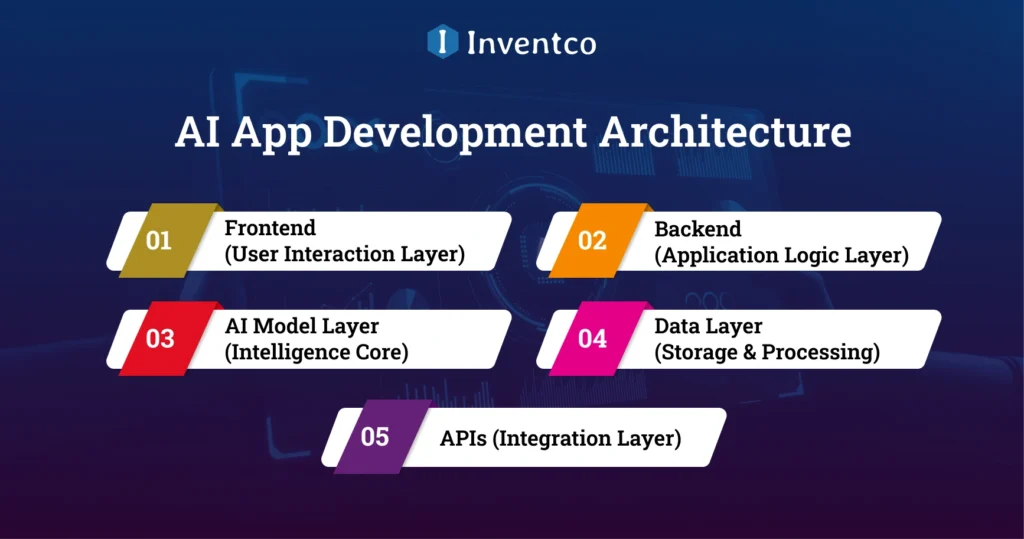
A scalable AI architecture significantly influences both the cost of AI app development and the performance of the final product. As early as 2026, companies will invest in modular, cloud-native architectures that allow real-time processing, secure data management, and on-the-fly scaling.
1. Frontend (User Interaction Layer)
The front end is responsible for presenting the results of the AI in a user-friendly manner. Most modern AI applications implement responsive user interfaces built on frameworks like React or Flutter. This allows for the creation of chat interfaces, voice assistants, and customizable dashboards. An optimized front end minimizes user friction and improves user engagement. This is most important when considering the cost to develop an AI app that will be used by end consumers.
2. Backend (Application Logic Layer)
The backend defines the center of logic, the APIs, and the orchestration of the systems. For AI workloads, some backend architectures allow a more efficient management of such workloads. This is the layer that most determines how much does it cost to develop an AI app, as the complexity of the layer, its integrations, and its traffic management define the financial needs of the supporting infrastructure.
3. AI Model Layer (Intelligence Core)
This is the layer that provides the app with its intelligence, through the use of LLMs, machine learning, and computer vision. The choice between using third party APIs and having a custom trained model to power the intelligence of the app is crucial. This will determine, most of the time, the cost of training, fine tuning and inference which, as a result, will dictate how much does AI app development cost.
4. Data Layer (Storage & Processing)
AI technologies rely on both structured and unstructured data. This data is collected via various means including databases, data pipelines, and vector storage for embeddings. Effective data architecture enhances precision and improves the AI personal assistant app development cost.
5. APIs (Integration Layer)
APIs serve as the links between all constituent parts, providing seamless communication and integration with third-party services. Well-structured APIs provide high levels of flexibility, rapid scaling, and predictable development costs.
Proper architecture yields the best app development cost versus performance and scalability ratios.
Cost Estimation of Developing an AI Mobile App
So how much does it cost to create an AI app in 2026?
Well the cost of building an AI mobile app depends on what are you looking to build. The AI app development cost ranges from $30,000 to $300,000+, it varies on the basis of many factors like, complexity of your mobile app, feature set, and location of where you hire mobile app developers.
Below is the full breakdown of the cost to develop an AI app based on mobile app complexity:
| Type of AI App | Estimated Cost Range | Examples |
| Simple AI Apps | $30,000 – $70,000 | Chatbots, basic recommendation engines |
| Medium Complexity Apps | $70,000 – $150,000 | Image recognition, voice-based apps |
| Advanced AI Apps | $150,000 – $300,000+ | AI personal assistant apps, predictive analytics, virtual agents |
Beyond mobile app development, there are additional costs to consider. Services like cloud infrastructure, third-party APIs, data storage, and AI model training can impact the overall cost of your Artificial Intelligence app development.
Also, if you are comparing this with the simple mobile app development cost, just keep in mind that AI-powered mobile apps are a bit more resource-heavy, but when we think about it for the long term, then it is worth every penny.
Next, let’s break down the top factors that affect the cost of building an AI mobile app.
AI App Cost Breakdown (Hidden Costs)
Many companies look at the development costs when thinking of building an AI product, but the greater costs hit the business post-launch. These costs are ongoing, and they help determine the overall costs of building and scaling an AI application.
1. Training Cost
If your application includes proprietary AI, training this AI model will be a significant expense. This involves the acquisition of large datasets, and high performance computing, and many cycles of tests and iterations. More complex models equate to greater costs.
2. Inference Cost
Once an AI application is deployed, every user interaction with the AI model means the model will process the interaction. Whether it is generating a response, making a prediction or providing an answer, in real time, these are costly operations. As the user base increases, the cost of these operations increases.
3. API Cost
AI applications use a number of third party API’s. These consist of natural language processing, and image recognition APIs. If these APIs are not controlled or optimized, they can be incredibly costly.
4. Cloud Cost
The Cloud is the basis of everything in your application, including the deployment of your AI model, and your app’s data storage. Costs involving compute, storage, and data traffic will be determined in large part to the unmonitored use of the Cloud.
5. Maintenance Cost
Maintenance is a constant element of any AI System. Regular updates, performance monitoring, and retraining are significant and ongoing concerns for any AI application. Your app’s ongoing maintenance will ensure that it continues to deliver results that are accurate and secure.
Finding these costs allows for better business planning, optimized resource use, and sustainable AI application building.
Top Factors That Influence AI App Development Cost
The overall cost to build an AI app isn’t fixed; it heavily depends on what problem your app solves, how it functions, and what tech stack you choose for it.
From basic Chatbot app development to an advanced predictive engine, every feature can influence your final budget for your mobile app.
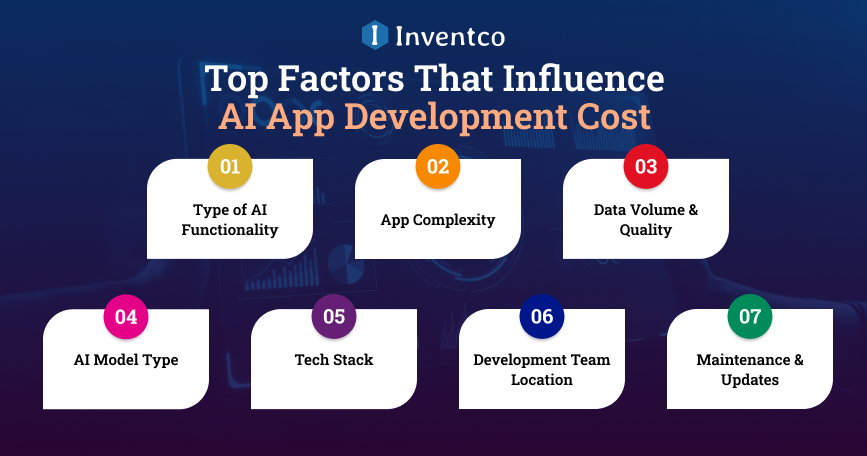
Let’s break down the top reasons that influence the AI mobile app development cost:
1. Type of AI Functionality
The type of AI functionality you want to integrate into your mobile app plays a major role in determining the total cost of developing an AI mobile app.
For example, a basic Chatbot assistance may cost less than a high-end predictive engine or NLP-driven personal assistant.
Each AI functionality has its own set of requirements in terms of training, algorithms, and interaction.
2. App Complexity
Mobile app complexity also affects your budget. Apps with multiple screens, real-time features, and integrated with third-party APIs require more time, effort, and testing, which increases the cost to create an AI app.
3. Data Volume & Quality
One of the top reasons that influence your mobile app costing is data volume and the quality of data. The more data your app processes, the clearer the outcome.
However, the large datasets require more storage and processing power, which may directly impact the cost of your artificial intelligence app development.
4. AI Model Type
The selection of the AI model time also influences your final mobile app development cost. Using pre-trained AI models like OpenAI or Google Gemini can save both time and money for you. But in contrast, building a custom AI model from scratch may deliver unique experiences, but it will also increase the cost to make an AI mobile app.
5. Tech Stack
Choosing the right Mobile tech stack also influences the cost of your mobile app development. The tools, libraries, and frameworks you used in your mobile app development process, such as TensorFlow, PyTorch, or Amazon SageMaker, may also affect the cost.
Additionally, if you use advanced tools, it can enhance the speed of your app development process, but also increase the licensing or usage fees.
6. Development Team Location
The cost to develop an AI app can also vary depending on the choice of your development team; the geolocation of your mobile app development team can create a huge difference. Hiring a dedicated developer team in the US or the UK will cost you more if you hire a mobile app developer team from Asia or Eastern Europe.
7. Maintenance & Updates
Regular mobile app maintenance and app updates are a must in any mobile app development, and AI models need continuous tuning and updating, so it definitely influences your AI mobile app development cost. Moreover, the ongoing mobile app maintenance and monitoring will add long-term influence on the cost of an AI app.
How to Optimize Your AI App Development Cost Without Compromising Quality?
If you’re worried about your AI app development budget but don’t want to compromise on AI app quality?
Then there is good news for you, there are so many smart ways to create an AI-powered mobile app without breaking the bank.
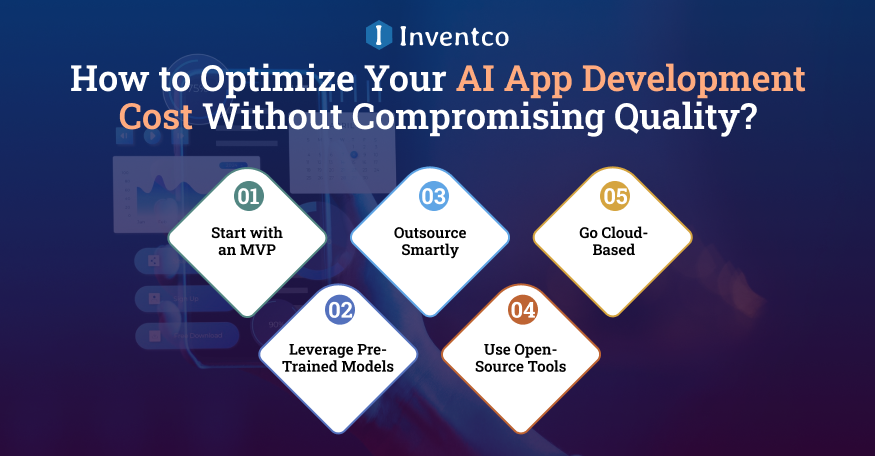
Here are some tried and tested strategies that help you to optimize your AI app development cost:
1. Start with an MVP
Instead of launching a full-featured, rich AI mobile app, you can start with a Minimum Viable Product (MVP).
MVP app focuses on the core AI functionalities of your app that solve your users’ primary problems.
This mobile app development approach not only keeps your budget low but also gives validation to your mobile app idea in the real world before you scale it.
2. Leverage Pre-Trained Models
Why do we need to start from the start? You can take leverage from the open source platforms like OpenAI, Google AI, and AWS SageMaker.
These platforms offer robust pre-trained AI models, which we can customize as per your app goals and functionalities.
Additionally, with the help of these AI platforms, it will help to reduce the time of mobile app development as well as the cost of an AI mobile app, while your app can deliver high-quality results as per your needs.
3. Outsource Smartly
You can partner with the skilled and experienced AI app development services or you can hire dedicated developers in regions like Asia and Eastern Europe.
You can find the top mobile app developers and compare the cost of hiring developers locally in the US or Western Europe.
4. Use Open-Source Tools
You can use your open-source tools for your AI mobile app development process to reduce and optimize your AI app development cost.
Frameworks like PyTorch, Scikit-learn, and TensorFlow are free, powerful and widely used by AI app developers across the globe.
Using these tools definitely reduces the framework cost and allows you to maintain high technical standards for your AI app.
5. Go Cloud-Based
This is one of the best strategies to optimize your mobile app development cost.
Instead of investing in heavy infrastructure, you can leverage the power of a cloud platform to host and run your AI models.
This will definitely help you to control your costs while you can scale your AI mobile app efficiently.
By using these mobile app development cost-saving strategies, you can build a high-performing AI app that is budget-friendly and Innovative at the same time.
Top Global AI Apps & Their Estimated Development Cost
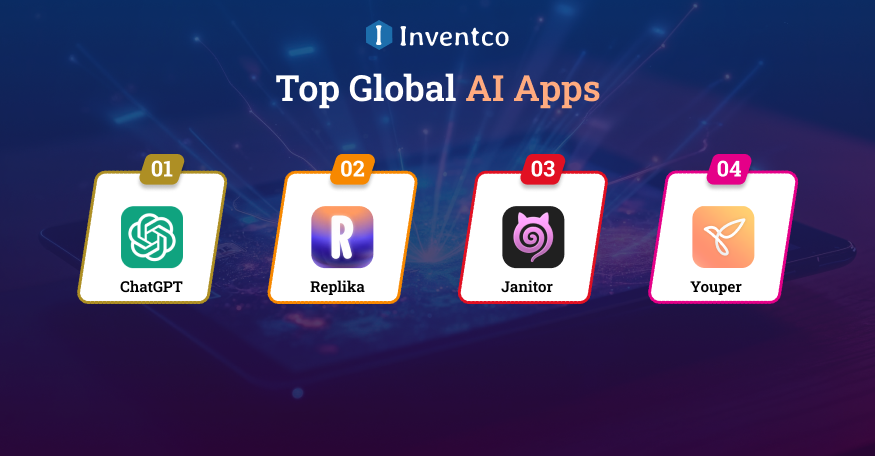
As we know, AI apps reshape the global industries, whether it is the healthcare sector or the education sector.
But the question is, how much does it actually cost to make something on that level?
Let’s have a look at some of the popular and ruling AI apps, and what it likely took to bring them to the top:
1. ChatGPT (AI Chatbot by OpenAI)
ChatGPT is a conversational AI model that interacts with users in natural language and understands the context of the chat.
- Core Feature: The core feature of this generative AI is NLP, multi-turn conversations, and deep learning.
- Estimated Cost: The estimated cost to build an app like ChatGPT is $300,000 – $500,000+
2. Replika (AI Companion)
Replike is one of the most famous and loved AI companions, it is the chatbot that mimics human conversation with an emotional connection.
- Core Features: The core features of the Replika chatbot are emotional intelligence, NLP, and voice chat.
- Estimated Cost: The cost to create an AI companion chatbot is $300,000 – $500,000
3. Janitor AI (Roleplay & Companion Chatbot)
Janitor AI is one of the most popular AI chatbots. This is a customizable AI chatbot platform which is designed for fun, fantasy, or NSFW conversations.
- Core Features: The core features of Janitor AI are based on NLP models, Customizable personas, and voice chat as per your tone.
- Estimated Cost: $200,000 – $400,000
4. Youper (AI Mental Health Assistant)
It is one of the most popular AI apps in the healthcare app development market, as this AI app uses AI-powered therapy using CBT techniques and also emotional check-ins.
- Core Features: This AI healthcare app uses features like AI therapy, mood tracking, and chat interface.
- Estimated Cost: $150,000 – $250,000.
Must-Have Features in an AI-Powered Mobile App
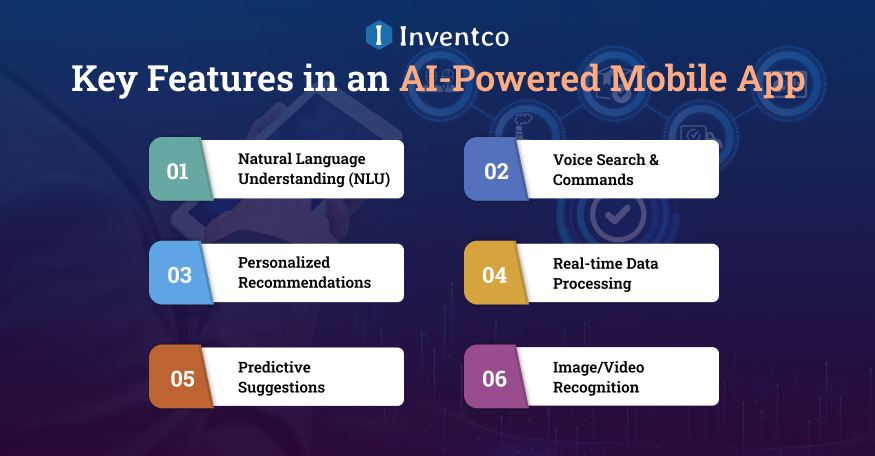
So, are you ready to build the next big AI-powered mobile app?
Here’s the thing: AI isn’t just about fancy automation. It’s about creating intuitive, realistic, and personalized experiences that truly connect with users.
And to make that magic happen, your app needs these key AI features.
1. Natural Language Understanding (NLU)
NLP helps your app understand what your AI app users actually mean, not just what they type. Natural Language Understanding powers the AI functionalities like chatbots, voice commands, and contextual conversations, which make your AI mobile app feel truly intelligent.
2. Voice Search & Commands
If you still think that Apple’s Siri and Amazon’s Alexa are the only options for you for the voice functionality, you are wrong. With AI voice recognition, your AI mobile app users can interact hands-free in your app, which improves accessibility and user engagement of your app.
3. Personalized Recommendations
AI feeds on data, and your AI mobile app uses that data to offer your users personalized recommendations. Whether it is a service, product, or content, it gives data based on their behaviors and preferences.
4. Real-time Data Processing
As the technologies evolve, so do user expectations and now users demand nothing less than high speed. Real-time analytics and AI decision-making help your AI mobile apps deliver instant responses, updates, and changes without lag, which is perfect for dynamic apps like health, finance, or eCommerce.
5. Predictive Suggestions
With the help of predictive suggestion, your AI app can predict what your users want and suggest the content or services based on their previous actions and behavior. With the help of this AI feature, it keeps hooking your user and drives retention and engagement.
6. Image/Video Recognition
With the app of Image and video recognition, the app industries of beauty, fitness, security, or social media get so much leverage. AI-powered computer vision enables smart AI features like object tagging, facial recognition, and AR filters, which help your app users to find thing easily and enhance the user experience and engagement.
While each feature may bump up your development cost, the payoff? A smarter, more engaging, and future-proof app that users (and investors) can’t resist.
How Inventco Helps You Build Cost-Efficient AI Apps?
Building AI apps should be done efficiently and securely while ensuring there is possible ROI. Inventco has the experience in mobile and AI development that helps clients turn concept ideas into scalable applications while avoiding waste. From NLP and machine learning to computer vision, our practitioners are the AI problem solvers that are focused on the business objectives.
What is also unique about our business is the end to end development. Rather than building features that are sophisticated, Inventco is focused on building lean, optimizing and scaling the product in the right moments as the product is maturing and growing.
OfferIn60 is an AI marketplace for car selling. It has been built with the values of speed, transparency and control. It has a big marketplace of potential buyers. Sellers can sell their cars to the AI offered prices, change the offered prices, or invite verified buyers to bid on the car. It provides peace of mind for the sellers in the selling process.
Technically, OfferIn60 integrates a powerful back end, a user-friendly front end, smart data processing, strong testing, and excellent UX design. OfferIn60, with state-of-the-art VIN scanning, real-time bidding, fraud detection, and secure transaction features, illustrates how AI can improve user experience and operational efficiency.
Through OfferIn60, Inventco shows how high-performing AI applications can be built resourcefully and rationally economically, technologically, and operationally.

Conclusion
The developing cost of an AI application in 2026 is influenced by your objectives, the complexity of your target features, your data strategy, and your development methodology. Budget is the least important factor. The more important element in determining success is the efficiency of your planning, improving, and scaling of your solution over time.
Between the years 2026 and 2030, AI will be at the center of operational functionality within an organization, including the automation, customization, and decision-making processes. Investing in scalable AI first will give organizations a significant advantage in highly competitive, rapidly shifting environments.
The ideal approach is to start small, establish your minimum viable product, and grow based on actual user data. AI is no longer a desirable component of a business, but rather an essential component that will improve efficiency, innovation, and growth.
FAQ’s
Q1. How much does it cost to develop an AI app in 2026?
Ans. The cost ranges from $30,000 to $500,000+, depending on features, complexity, AI models used, and app type.
Q2. What factors affect AI app development cost?
Ans. Key factors include features, tech stack, AI models, design complexity, developer expertise, and cloud infrastructure.
Q3. Can I build an AI app on a budget?
Ans. Yes! By starting with an MVP, using pre-trained AI models, and outsourcing smartly, you can significantly reduce costs.
Q4. How long does it take to build an AI app?
Ans. On average, 3–9 months, depending on the scope, complexity, and AI integrations.
Q5. Do AI apps require ongoing maintenance?
Ans. Yes. AI models require regular updates, retraining, and bug fixes to maintain accuracy and efficiency.

Jitendra Jain
He is the CEO and Co-founder of Inventco, driving innovation in advanced computing and digital transformation. With deep expertise in modern IT ecosystems, he leads scalable, secure, future-ready solutions. His strategic leadership helps businesses accelerate growth, adopt innovation, and achieve success. You can connect with him on LinkedIn to follow his technology insights.