Imagine this. It is late at night, the pitch deck is almost finished, and one line sits confidently on the screen: “The Netflix for…” It could be fitness, education, sports, anime, faith, or independent films. The niche changes, but the ambition stays the same. Then comes the question every founder eventually faces:
“How do we actually build it?”
That simple question changes the whole context. The focus is no longer on watching videos. The challenge is to develop a system that supports more than 1,000 simultaneous viewers, guarantees seamless playback, delivers the right recommendations, safeguards digital assets, manages subscriptions, and provisions the system as the audience grows.
Fortunately, developing a streaming system is no longer a multi-billion-dollar project as it was for Netflix, nor does it take years of research. High-quality, modern (cloud) technologies and the right product strategy make things more feasible than ever.
If you want to know the answer to how to build a Netflix app, this guide to building a streaming service is the only guide you need. Our guide will provide you with a detailed path to validate your idea and information on legal compliance, the right technology frameworks, development costs, and appropriate monetization models for a scalable streaming service.
Key Takeaways
- Define a clear niche and audience before development to create a differentiated streaming platform with stronger engagement and long-term growth potential.
- Start with an MVP, validate user feedback, and gradually scale features like AI recommendations, live streaming, and multi-device support.
- Invest in cloud-native architecture, adaptive bitrate streaming, and CDN infrastructure to deliver seamless playback as your audience grows.
- Choose a sustainable monetization strategy, such as subscriptions, advertising, pay-per-view, or a hybrid model, based on your business goals.
- Prioritize security, DRM, data privacy, accessibility, and regional compliance from the beginning to reduce legal risks and future redevelopment costs.
- Partner with an experienced mobile app development company that has proven expertise in building scalable, secure, and high-performance streaming platforms.
Market Stats and Other Data
Before committing capital to a streaming platform, it helps to see where the market actually stands in 2026:
- The global video-on-demand market size was valued at USD 133.44 billion in 2025 and is projected to grow from USD 156.83 billion in 2026 to USD 477.04 billion by 2034, at a CAGR of 14.90% during the forecast period.
- Netflix alone reported over 325 million paid subscribers in Q1 2026 and $12.25 billion in quarterly revenue.
- Netflix’s ad-supported tier reached 250 million monthly active viewers by May 2026, driving over 60% of new signups in markets where it is available.
The takeaway for founders: the market is not just growing, it is diversifying. There is real room for niche, regional, and vertical-specific streaming platforms alongside the giants.
Why Build a Streaming App in 2026?
We have reached a new era in the streaming industry. Today, the success of a streaming system does not depend on its digital library. Instead, success is achieved by the system that delivers the most relevant viewing experiences. It is no longer necessary to invest heavily to develop new streaming services due to advances in cloud systems, AI, and related technologies.
Here are the three biggest reasons founders are investing in streaming apps in 2026:
- Cloud-Native Infrastructure Has Dramatically Lowered Development Costs: Managed video applications, serverless computing, global CDNs, and streaming technologies such as HLS and MPEG-DASH enable companies to build scalable solutions and abstract away video infrastructure. Teams can shift their focus to building a better user experience and curating a high-quality content library.
- Faster Networks Are Expanding the Streaming Audience: The faster and more reliable the internet, the greater the demand for high-quality video. Thanks to the expansion of 5G, fiber internet, and affordable data, users in regions that were more recently connected to the global telecommunications infrastructure can now stream high-quality video, including 4 K video.
- Niche Platforms Are Outperforming One-Size-Fits-All Services: Users are beginning to value services that cater to their preferences for a specific content genre (e.g., sports, anime, educational, religious, fitness, creator-based) over a large content catalog. More personalized user experiences and engagement are driving higher user retention than services with large content catalogs.
Investing in streaming platforms that integrate AI, are scalable, and offer a range of monetization options is a reasonable bet on the continued demand for high-quality, personalized video content.
How to Create a Streaming App Like Netflix: Step-by-Step Process
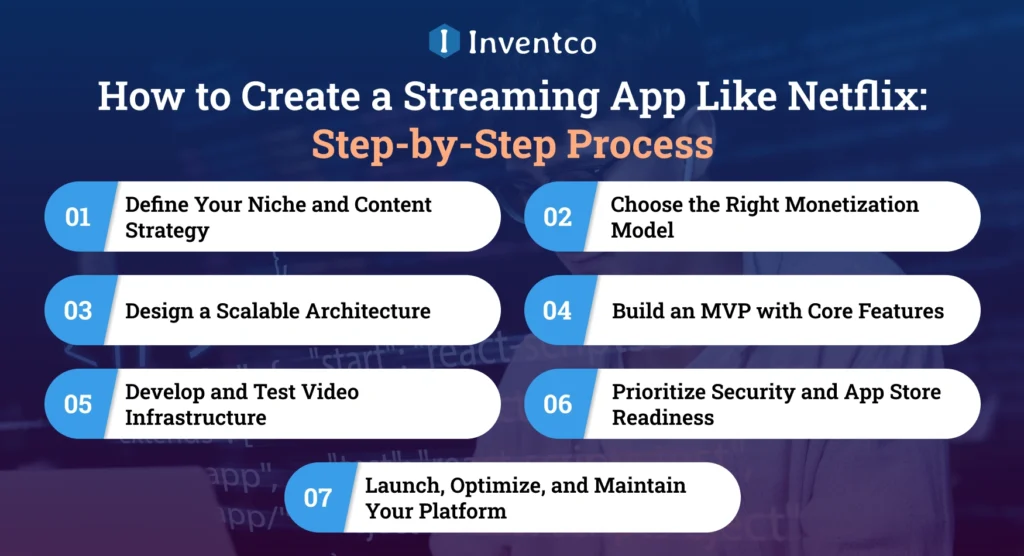
Build a mobile app that delivers seamless streaming by following a structured development roadmap. From validating your idea to scaling post-launch, every step influences your platform’s performance, user experience, and long-term business success.
1. Define Your Niche and Content Strategy
All streaming platforms focus on a specific niche. Determining which audience you would like to attract (e.g., entertainment, sports, education, anime) will help you decide which features to include in your app, what your business model will be, and how to develop content for your app. You should spend a good amount of time doing app wireframes and creating a prototype to help you identify a user journey and validate your idea. This also helps you minimize the risk of creating the app.
2. Choose the Right Monetization Model
The streaming app’s architecture can vary greatly depending on the chosen revenue model, so consider whether your streaming business will be subscription-based (SVOD), ad-based (AVOD), transactional (TVOD), or a hybrid. Having a good plan for mobile app monetization will enable you to offer a range of payment options and subscriptions, manage your advertising seamlessly, and grow your business.
3. Design a Scalable Architecture
Creating an application similar to Netflix means a streaming service will require a robust back-end system to support high traffic and deliver a seamless service. Large-scale traffic requires different services. Expandable and flexible Modular systems, supported by the right mobile app frameworks and tech stack, can enable long-term performance and rapid user growth.
4. Build an MVP with Core Features
Create a mobile MVP that offers a basic version of streaming services. Essential features include: user sign-up, profile creation, browse/search, playback (streaming), playlists, watchlists, manage subscription, etc. Following a mobile development process enables higher rates of validation, feedback, and assessment of features for improvement (i.e., scalable AI recommendations and streaming).
5. Develop and Test Video Infrastructure
Streaming video quality is the greatest factor in user retention. Develop your infrastructure with the essentials for quality, uninterrupted video playback: encoding pipelines, adaptive bitrate streaming (i.e., HLS and MPEG-DASH), cloud storage, and CDN. As part of mobile app testing, the quality and performance of video playback, including load times under various network conditions, should be assessed before your platform reaches Production.
6. Prioritize Security and App Store Readiness
Security must be integrated throughout development, not added after launch. Protect premium content using DRM, encrypted storage, secure authentication, and PCI-compliant payment processing. Follow mobile app security best practices while preparing for App Store Optimization to improve discoverability, maximize downloads, and ensure compliance with Apple App Store and Google Play guidelines.
7. Launch, Optimize, and Maintain Your Platform
The work you do after launching your streaming service will be the most important. Analyze metrics and statistics on user engagement and viewing to inform the future direction of your service. Regular mobile app maintenance will ensure your streaming service remains secure and reliable. Competing in the streaming service market will require you to stay on top of the latest trends in App development while addressing the latest challenges in mobile app development.
Must-Have Features for a Netflix-Like Streaming App
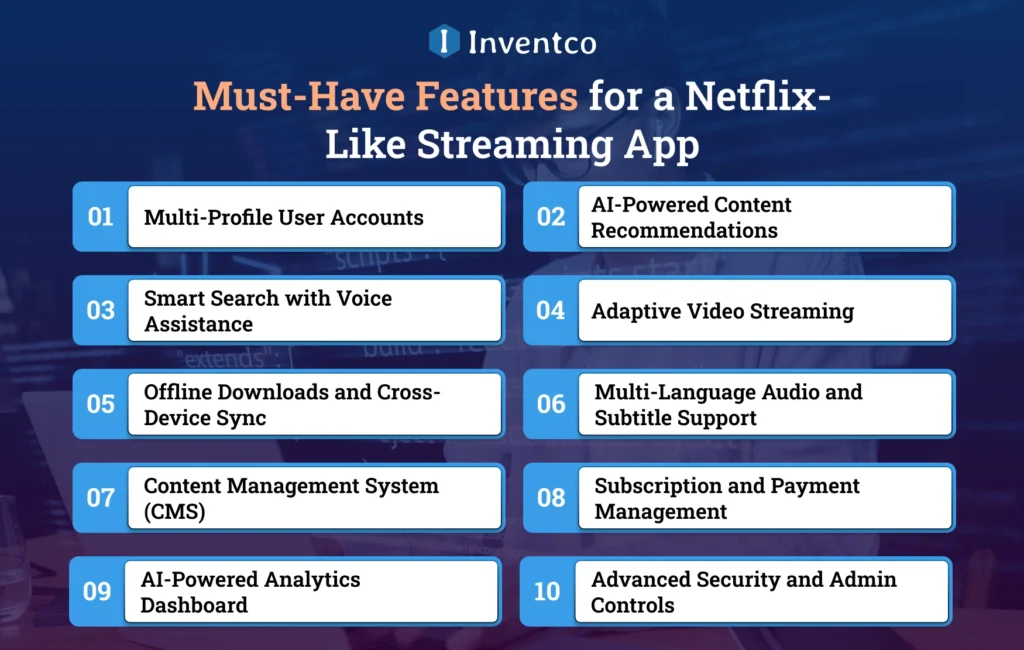
Successful streaming services offer more than just video playback. Mobile app features boost subscriber retention and engagement, provide control over the viewing experience and analytics, and offer strategic monetization for businesses.
1. Multi-Profile User Accounts
Enable multiple user profiles within the subscription. Each profile can have its own viewing history, preferences, and watch lists. This leads to engagement and retention due to the customizability this feature provides.
2. AI-Powered Content Recommendations
AI and ML can be used to generate suggestions based on a user’s viewing history, preferences, and ratings. The content suggestions should be movies and TV shows that keep users engaged. Having a continuous, easy-to-access content-suggestion feature reduces churn.
3. Smart Search with Voice Assistance
An app should have a search feature that supports voice commands. To aid in search, it should also implement predictive search and suggestions. This makes the app more useful and is a big improvement in UX.
4. Adaptive Video Streaming
Deliver uninterrupted playback through adaptive bitrate streaming using HLS and MPEG-DASH. The platform automatically adjusts video quality based on internet speed, ensuring smooth HD and 4K streaming across smartphones, tablets, web browsers, and smart TVs.
5. Offline Downloads and Cross-Device Sync
Allow users to download content to their device for offline viewing. The service should sync content viewing history, user preferences, and content viewing progress to allow users to continue viewing downloaded content seamlessly.
6. Multi-Language Audio and Subtitle Support
Widening your platform’s international accessibility requires support for multilingual audio and subtitles, regional content catalogs, and other inclusion and accessibility features. User satisfaction yields financially beneficial returns. Localizing content affords platform usability to historically underserved populations.
7. Content Management System (CMS)
Provide administrators with a centralized CMS to efficiently upload, organize, schedule, categorize, and manage content. The system should also support metadata management, promotional banners, featured collections, and publishing workflows for streamlined operations.
8. Subscription and Payment Management
Make provision to manage subscriptions of various types with different billing frequencies, multiple payment gateway options, customizable coupons, refunds, and unit currency conversions. The simplified, evidence-based payment infrastructure provides direct benefits to users in subscription management and to your platform in revenue collection.
9. AI-Powered Analytics Dashboard
AI-driven analytics for user engagement and behavior with content provide an extensive view of performance metrics. This empowers platforms to curate content more effectively, provide users with personalized, relevant options, design and implement marketing campaigns, and achieve optimal monetization.
10. Advanced Security and Admin Controls
Multi-DRM, encrypted streaming, geo-restriction, and secure authentication with role-based access control of premium and sensitive content are a layered security approach. A complete administrator control dashboard facilitates user and content approval and moderation, operational oversight, and security control of the streaming platform.
How Much Does It Cost to Build a Streaming App Like Netflix?
The cost to build a mobile app like Netflix varies based on your platform requirements, supported devices, feature complexity, AI capabilities, and streaming infrastructure. Factors such as video processing, cloud architecture, security, and third-party integrations significantly influence the final development budget.
Below is a realistic cost estimate for 2026.
| Build Tier | Estimated Cost | What’s Included | Timeline |
| MVP Streaming App | $10,000 to $25,000 | Single-platform app, user authentication, basic VOD library, video player, watchlists, subscription management, and a simple admin dashboard. | 2 to 4 months |
| Mid-Market Streaming Platform | $25,000 to $60,000 | iOS, Android, and web apps, adaptive bitrate streaming, AI-powered recommendations, payment gateways, multi-profile accounts, analytics, and an advanced CMS. | 4 to 7 months |
| Enterprise Streaming Platform | $60,000 to $100,000+ | Global CDN integration, Multi-DRM protection, live streaming, AI personalization, multilingual support, advanced analytics, scalable cloud infrastructure, and multi-region compliance. | 7 to 12+ months |
Beyond the build itself, ongoing costs include CDN bandwidth, storage, content licensing fees, and DRM licensing, all of which scale with your user base rather than being fixed one-time costs.
Monetization Models for Your Streaming App
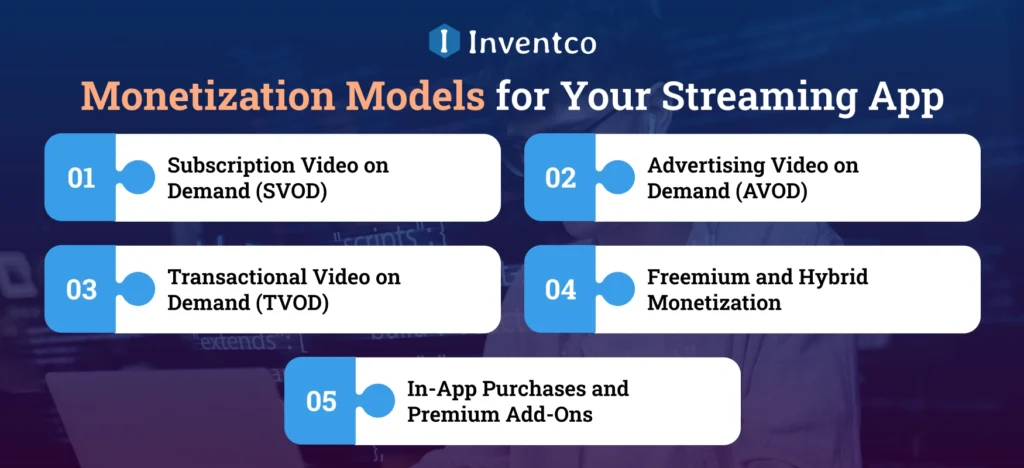
A great feature set is only one side of the value equation. Well-thought-out revenue models provide mobile streaming apps with additional legal revenue sources as they grow and give users reasons to stay, increasing customer lifetime value and satisfaction.
1. Subscription Video on Demand (SVOD)
Charge a regular subscription to allow access to content collections. SVOD usage is highest when exclusive, high-quality, or frequently updated content is presented. This mobile app monetization technique is effective at generating reliable revenue.
2. Advertising Video on Demand (AVOD)
Stream content for free while loading videos with ads. AVOD is effective at generating consistent advertising revenue while offering a low barrier to viewer access and a subscriber-less audience.
3. Transactional Video on Demand (TVOD)
Charge a subscription fee to view specially curated direct content, premium videos, or live events. The TVOD model works great for viewing entertainment that aims to capture time-limited and blockbuster engagements.
4. Freemium and Hybrid Monetization
Higher lifetime value and greater user acquisition are positive characteristics of Hybrid Monetization. This monetization model provides the user with a choice. The user can either settle for an ad-viewed free version of content or upgrade to a subscription plan.
5. In-App Purchases and Premium Add-Ons
Value Enhancement is always monetization-friendly. Choose Premium Channels, exclusive memberships, merch, downloadable media, or content bundles to diversify your revenue and enrich your users’ experience.
Legal & Compliance Considerations
Beyond just entertainment, the streaming service industry focuses on well-established legal and compliance systems. It protects businesses, keeps users confident, and allows service entry to new markets without facing operational or legal restrictions.
1. Content Licensing & Distribution Rights
Copyright disputes and the illegal distribution of content in a market can be avoided by obtaining clear licensing agreements. Good licensing agreements define ownership and grant rights to distribute content in certain regions, stream at certain times, and authorize copyright renewal.
2. Data Privacy & User Protection
User data must be secured to comply with privacy laws such as GDPR and CCPA. Regional authorities may enforce data controls and residence requirements, as well as the transparent implementation of user data protections and consent.
3. Copyright Protection & Anti-Piracy
Safeguarding exclusive and contracted content can be accomplished through streaming encryption, watermarking, Multi-DRM, and DMCA takedown implementation. Content protection counteracts piracy and helps safeguard content.
4. Accessibility Compliance
Providing a streaming service that meets accessibility standards is a legal requirement. Improving navigation for keyboard users, screen readers, and audio players, as well as implementing audio and visual aids, satisfies WCAG.
5. Age Ratings & Content Classification
Minors must be protected, and compliance with age-related broadcasting regulations must be met by implementing age verification and regional parental control systems as mandated by content classification systems.
Pro Tip: Including a compliance budget during early UX and UI designs is a fraction of the cost of adding compliance after launch. Through a well-designed architecture, the platform can ensure privacy and security and develop a framework for DRM and regulatory requirements. This flexibility allows the platform to expand without additional burdens and reduces legal risks and technical debt.
Common Challenges in Building a Netflix-Like App and How to Solve Them
There are multiple mobile app development challenges when developing a streaming platform UX, not the least of which are security, scalability, regulatory compliance, and seamless video playback. Recognizing and understanding these challenges reduces the risk of financial loss and delivering a substandard streaming service.
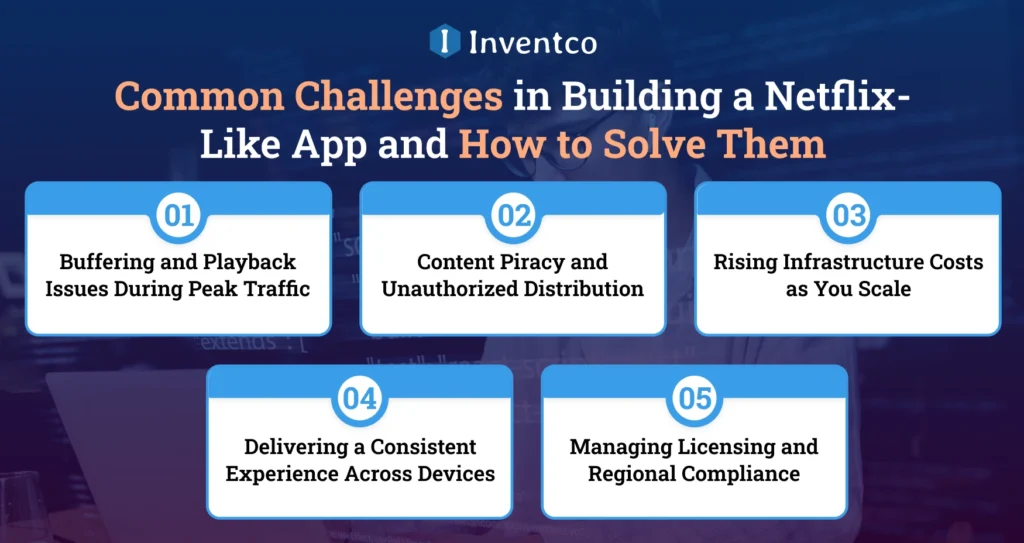
1. Buffering and Playback Issues During Peak Traffic
A platform experiencing a surge in users tends to exhibit video playback latency. This can be more frustrating than seamless video playback. You want to avoid this poor viewing experience by using adaptive bitrate streaming (HLS and MPEG-DASH) and a multi-CDN setup.
2. Content Piracy and Unauthorized Distribution
It is common for premium content to be victimized by piracy, streaming, and redistribution. A Multi-DRM that includes Widevine, FairPlay, and PlayReady, forensic watermarking, streaming encryption, and secure authentication will help defend your platform.
3. Rising Infrastructure Costs as You Scale
The cost of scaling will be most noticeable in your cloud, storage, transfer, and processing bills. This video streaming app development challenge can be solved with a cloud-native microservices architecture that actively controls cloud storage and bandwidth costs.
4. Delivering a Consistent Experience Across Devices
A common expectation among users is that they have the same experience across web browsers, mobile devices, tablets, smart TVs, etc. To make this happen, you should have a common design system, an adequate set of UI components, and a standard video player SDK across all platforms.
5. Managing Licensing and Regional Compliance
When operating in multiple regions, various geo-restrictions on licensing and other legal issues related to end-user privacy and content distribution come into play. To avoid legal issues, partner with developers experienced in geo-fencing, content licensing, DRM, and global legal compliance.
Case Study: How Inventco Helped Afrosportsvibe Handle 1M+ Users in Its Live Streaming Software
Afrosportsvibe approached Inventco with a clear but demanding challenge: build a live-streaming platform for African football and sports content that could handle sudden traffic spikes during live matches without buffering or downtime.
As Inventco is a leading mobile app development company, our engineering team designed a cloud-native, microservices-based streaming architecture featuring a multi-CDN delivery layer, adaptive bitrate streaming (HLS), and auto-scaling infrastructure optimized specifically for live sports traffic rather than traditional video-on-demand workloads. We also implemented intelligent caching and load balancing to handle massive concurrency spikes during the critical minutes before and after kickoff.
The outcome was a high-performance streaming platform capable of supporting more than 1 million concurrent users during peak live events while maintaining smooth, low-latency playback. By leveraging usage-based auto-scaling rather than overprovisioned infrastructure, Afrosportsvibe achieved predictable operating costs, improved viewer engagement, and increased advertiser confidence in its growing ad-supported streaming ecosystem.
Conclusion
With the right architecture, building a Netflix-like streaming platform in 2026 is definitely feasible. Founding a streaming app on scalable video infrastructure, with integrated compliance and monetization models built around the audience, is also a consideration. There is plenty of space in the market to support streaming platforms that are focused and well-designed, not just the global generalist.
Inventco has experience in building and designing streaming platforms that founders in the entertainment, sports, and niche content industries have used to get marketplace traction. If you are interested in building a streaming app, we can walk you through a content strategy, a focused cost plan, and an architecture plan.
FAQs
Q. How much does it cost to create an app like Netflix?
Ans. Building a Netflix-like streaming app typically costs $10,000 to $100,000+, depending on features, supported platforms, AI capabilities, security, and streaming infrastructure requirements.
Q. How long does it take to develop a streaming app like Netflix?
Ans. A basic MVP takes 2 to 4 months, while a feature-rich, multi-platform streaming platform with AI personalization and live streaming requires 7 to 12+ months.
Q. What is the best monetization model for a new streaming app?
Ans. A hybrid model combining subscriptions, advertising, and premium content purchases offers maximum flexibility, higher revenue potential, and sustainable growth for modern streaming platforms.
Q. Do I need my own content library to launch a streaming platform?
Ans. No. Many startups begin with licensed or niche content, then gradually invest in exclusive originals as their audience, engagement, and subscription revenue continue growing.
Q. What technology partner should I choose to build a Netflix-like app?
Ans. Choose a partner with proven expertise in streaming architecture, AI, cloud infrastructure, DRM security, and successful large-scale OTT platform development with measurable results.

Ajay Bhal
He is an on-demand app solutions expert with 11+ years of experience in business consulting and building scalable, user-centric digital products. He specializes in robust on-demand platforms across industries, combining technical expertise with business-focused strategy to deliver efficient, top notch solutions that drive growth and enhance user experience. You can connect with him on LinkedIn to follow insights.