The global revenue for OTT and video streaming is estimated to exceed USD 236.72 billion by 2026, and people now spend more time on streaming services than on other TV broadcasts. This is not lost on founders and investors alike. More and more founders are shifting their focus from whether to create a streaming service to how quickly they can create one.
The interest is certainly there, but so is the confusion. When founders are looking to set up a video streaming service, they find themselves overwhelmed by nonspecific advice, wide-ranging price estimates, and ready-made solutions that claim to take little time to create but cannot scale, ensure compliance, or provide any control over monetization.
Most serious live video streaming services, be it a creator economy service, a live commerce service, or a niche OTT app, typically cost between USD 10,000 and USD 100,000+, depending on requested features, monetization complexity, and the service’s content delivery infrastructure.
This guide is built for founders and investors who want a realistic, execution-ready roadmap rather than a marketing pitch. We’ll walk through what makes a streaming business viable in 2026, the exact steps to build and launch one, the real benefits of live video streaming for businesses beyond entertainment, the mistakes that quietly sink first-time streaming founders, and how a technology partner like Inventco fits into that journey.
Key Takeaways
- The global streaming economy is still expanding, but profitability now depends on niche focus, monetization design, and cost-efficient infrastructure, not just content volume.
- A production-ready streaming platform typically costs between USD 10,000 and USD 100,000+, depending on live-streaming capability, DRM, and scale requirements.
- Choosing the right monetization model (SVOD, AVOD, TVOD, or hybrid) early in the planning stage directly affects your architecture, licensing, and go-to-market timeline.
- Live video streaming is no longer limited to entertainment; it’s a growing channel for revenue and engagement across e-commerce, education, healthcare, and enterprise businesses.
- Most first-time streaming founders lose time and budget to the same avoidable mistakes: skipping content licensing review, underestimating CDN costs, and building for scale too early or too late.
- Working with an experienced technology partner shortens time-to-market and reduces the technical risk of scaling video infrastructure post-launch.
Quick Answer
How to start a video streaming business in 2026: Define your niche and monetization model, secure content rights, choose your tech stack (CDN, DRM, transcoding, and player SDKs), build an MVP with core streaming and payment features, test for performance across devices and networks, and launch with a scalable cloud infrastructure that supports future live-streaming and multi-region expansion. Budget realistically between USD 10,000 and USD 100,000+ depending on scope.
Is Starting a Video Streaming Business Still Profitable in 2026?
Yes, but profitability in 2026 looks different than it did five years ago. Global players dominate the SVOD sector, and smaller players do not win by attempting to copy Netflix or Amazon Prime Video. Founders see opportunities in vertical and hybrid models.
These include streaming for sports and fantasy, streaming for faith and wellness, streaming in regional languages, live shopping, coaching and streaming, and knowledge-streaming services for B2B.
Investors have also been looking at vertical and hybrid models for their streaming ventures. Rather than focusing on subscriber growth, they will assess content acquisition and costs, ad fill rates for AVOD models, churn and engagement, and the streaming platform’s ability to incorporate commerce or live streaming. The most resilient digital business stream is one with a defined audience that consumes content, and it remains one of the most profitable heading into 2026.
It is businesses that treat video streaming as a single category that struggle to be profitable. It is imperative to get that initial decision correct as it determines whether something is a profitable venture or a purely personal expense.
Step-by-Step Guide for Starting Your Video Streaming Business
If you want to build a profitable video streaming business, you need more than a technology solution and video content. If you follow a certain structure during the building process, you will minimize risk, reduce costs, and maximize your platform’s potential. To help you get started, this guide outlines the seven critical steps you need to take for your new streaming business.
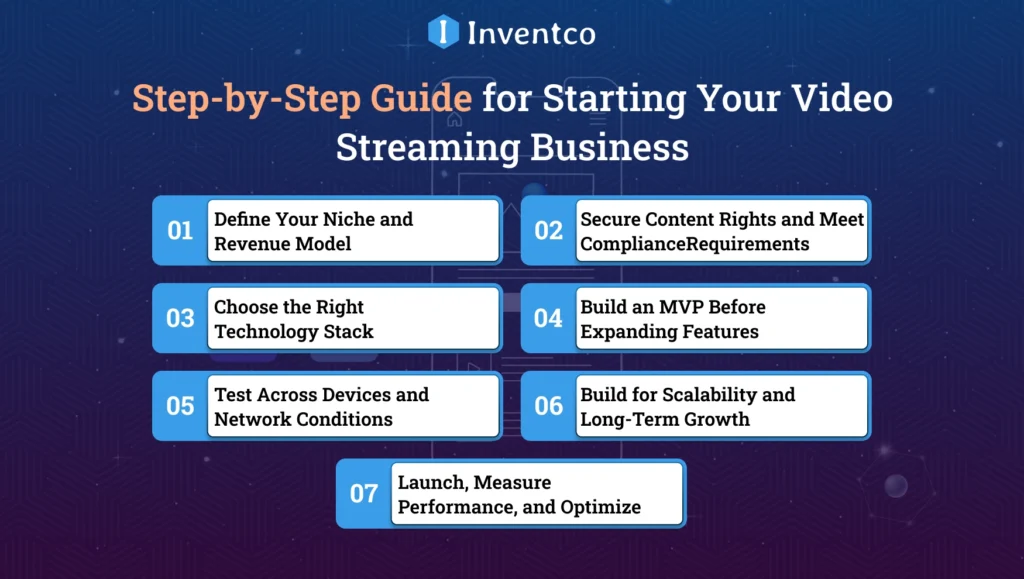
Step 1: Define Your Niche and Revenue Model
Start by identifying a specific audience instead of competing with broad entertainment platforms. Focus on niches like sports, education, fitness, or regional content to build loyal communities. Once you have your audience defined, decide your business monetization goals and select your strategy: SVOD, AVOD, TVOD, or a hybrid model. Planning mobile app monetization early ensures sustainable revenue and supports your long-term build a mobile app strategy.
Step 2: Secure Content Rights and Meet Compliance Requirements
Before you begin developing your mobile app, you must acquire content and obtain the proper legal streaming rights. To avoid delays and costly issues at launch, ensure your platform complies with GDPR, DPDP, and regional broadcast laws. This not only strengthens your mobile app security but also the foundation of your mobile app development process.
Step 3: Choose the Right Technology Stack
The performance of your platform is reliant on the technologies you choose. Select a platform that integrates secure payment, analytics, scalable cloud technologies with CDN, DRM, and adaptive streaming technologies. Determine the future scope and scalability of your platform while improving performance. Choosing the right mobile app technology stack and evaluating suitable mobile app development frameworks improve scalability, performance, and future expansion while keeping development efficient.
Step 4: Build an MVP Before Expanding Features
Launch a focused MVP mobile App instead of developing every advanced feature initially. An MVP mobile app can quickly validate market demand if it includes features such as playback, user authentication, subscriptions, and content management. Building an app prototype and completing app wireframing before development minimizes rework, speeds up launch, and enables the collection of user feedback that helps inform future improvements.
Step 5: Test Across Devices and Network Conditions
Mobile app testing is crucial to ensuring a smooth streaming experience for your users. This includes extensive testing of playback quality on every device, including smartphones, tablets, smart TVs, and multiple internet speeds. It is also critical to test your mobile app under heavy loads and resolve buffering and optimization issues to improve it and enhance the user experience.
Step 6: Build for Scalability and Long-Term Growth
Design your platform with future growth in mind. Use scalable cloud services, modular architecture, and flexible infrastructure that can support increasing users, live events, and content libraries. Keeping up with every mobile app development trend while planning ongoing mobile app maintenance helps your platform remain secure, competitive, and ready for continuous expansion.
Step 7: Launch, Measure Performance, and Optimize
Launching your platform is only the beginning. Track engagement, subscriber retention, revenue, and user behavior to identify opportunities for improvement. Continuously refine recommendations, pricing strategies, and content offerings based on analytics. Regular optimization, combined with App Store Optimization, increases visibility, attracts new users, and drives sustainable business growth after launch.
Typical Investment Range for a Video Streaming Platform
Understanding the cost of mobile app development for a video streaming platform helps founders set realistic budgets and prioritize essential features. Your investment depends on platform complexity, streaming capabilities, monetization model, scalability requirements, and third-party service integrations.
| Platform Tier | Core Features | Estimated Cost (USD) |
| MVP / Niche Platform | On-demand streaming, single monetization model, basic CDN, web + mobile apps | $10,000 – $30,000 |
| Growth-Stage Platform | Multi-device support, DRM, adaptive bitrate streaming, analytics, hybrid monetization | $30,000 – $70,000 |
| Enterprise / Live-Streaming Platform | Live + VOD hybrid, multi-region CDN, advanced DRM, AI recommendations, multi-language support | $70,000 – $100,000+ |
Costs vary based on region, third-party licensing (CDN, DRM, payment gateways), and whether live streaming is included at launch.
Benefits of Live Video Streaming for Businesses
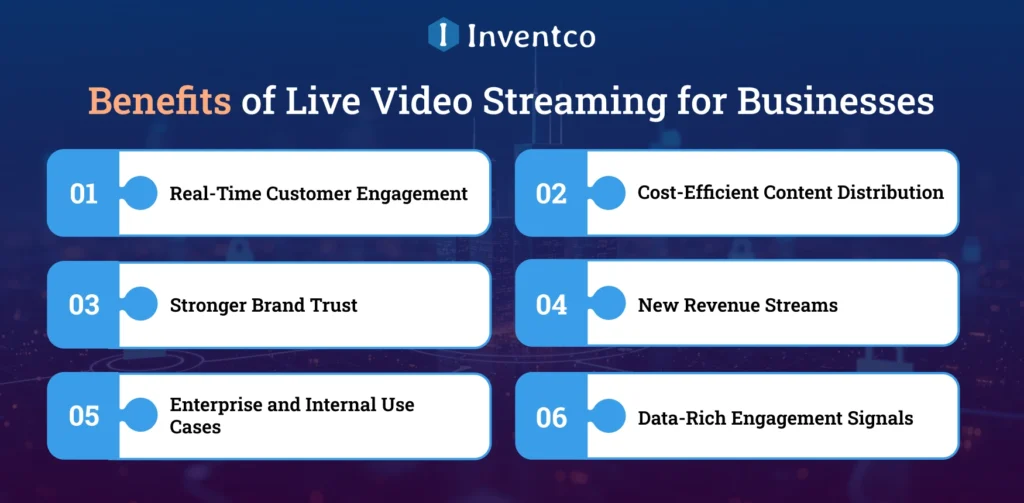
Live video streaming for business has expanded well beyond media and entertainment. Founders exploring this space should recognize where the near-term commercial upside is strongest.
- Real-Time Customer Engagement: Live shopping and product demo streams consistently achieve higher conversion rates than static product pages because viewers can ask questions and see the product in use before making a purchase.
- Cost-Efficient Content Distribution: A single live session, whether it’s a coaching class, a product launch, or a training module, can reach a large audience without the recurring cost of pre-produced video.
- Stronger Brand Trust: Unscripted, real-time video builds credibility in ways polished pre-recorded content often cannot, particularly for healthcare, finance, and education brands operating under compliance scrutiny.
- New Revenue Streams: Live events, ticketed streams, and pay-per-view sessions create monetization opportunities that don’t depend on a full content library.
- Enterprise and Internal Use Cases: Live streaming for business isn’t only customer-facing; enterprises use it for training, town halls, and investor updates, reducing travel and coordination costs at scale.
- Data-Rich Engagement Signals: Live viewer behavior, drop-off points, replay requests, and comment activity give founders sharper product and content decisions than on-demand metrics alone.
For founders evaluating a video streaming business opportunity, live capability is quickly becoming a differentiator rather than a premium add-on, because it turns a content platform into an interactive one.
Common Mistakes First-Time Streaming Founders Make
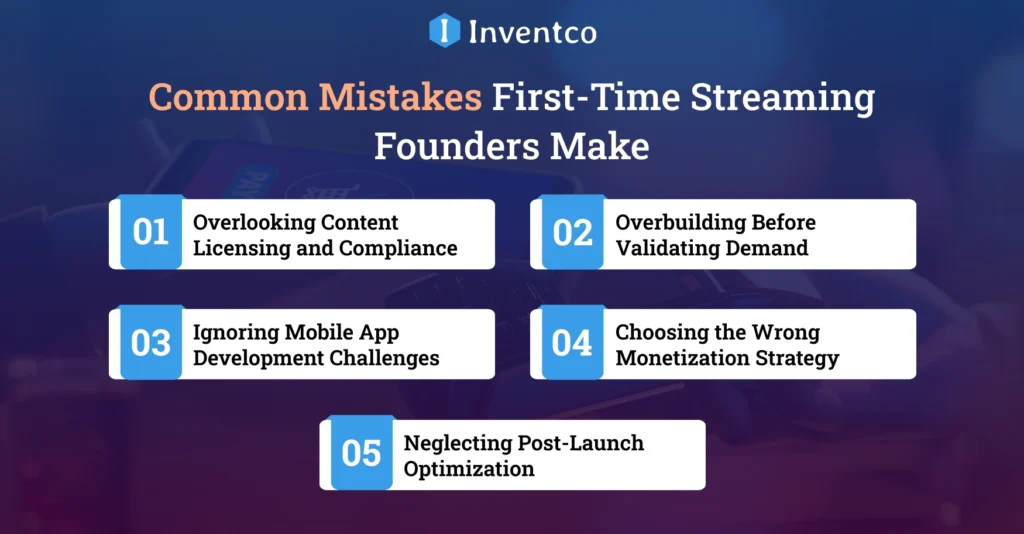
Ignoring major mobile app development challenges, especially as they relate to infrastructure and CDN expenses. Most first-time founders only consider the upfront cost of development. They ignore the costs of bandwidth, content delivery, and cloud infrastructure, which escalate with user growth. Planning early to account for those recurring costs provides a robust operating budget, avoids budget shortfalls, and enables the streaming platform to scale effectively.
- Overlooking Content Licensing and Compliance: Delaying content rights verification or regulatory approvals can postpone launches, increase legal risks, and create unexpected expenses after development is complete.
- Overbuilding Before Validating Demand: Investing in enterprise-grade infrastructure before achieving product-market fit increases costs and reduces flexibility. Start with an MVP and scale based on real user growth.
- Ignoring Mobile App Development Challenges: Failing to test across different devices, operating systems, screen sizes, and network conditions can lead to buffering, crashes, and poor user experiences for a significant portion of your audience.
- Choosing the Wrong Monetization Strategy: Selecting an unsuitable revenue model, such as forcing subscriptions on price-sensitive users or relying heavily on ads for premium audiences, can reduce engagement and limit revenue potential.
- Neglecting Post-Launch Optimization: Launching the platform is only the beginning. Regular analytics, user feedback, performance monitoring, and feature updates are essential for improving retention and driving long-term business growth.
Avoiding these mistakes is less about technical skill and more about sequencing decisions correctly, which is where an experienced technology partner earns its value.
How Inventco Helps Founders Launch Streaming Businesses
Inventco works with founders and investors who require more than a development vendor. Specifically, these clients need a technology partner who understands the platform’s business model. Our teams have built OTT, live-streaming, and hybrid monetization platforms in the entertainment, fitness, education, and enterprise training sectors, with architectures already optimized for CDN efficiency, DRM compliance, and multi-region scalability.
From Our Projects: A fitness content founder approached Inventco with a common problem: a working MVP mobile app that constantly buffered under real-world user load and lacked a clear monetization path.
Our team built a streaming architecture optimized for adaptive bitrate delivery and a CDN configuration tailored to the platform’s regional traffic. We finally added a hybrid subscription-and-pay-per-live model.
In the first full quarter since the platform’s relaunch, reports of buffering decreased significantly, and we saw an increase in paid-tier subscriptions among free-tier users. This validated the founder’s hybrid monetization strategy, which he planned to present to his investors for the next funding round.
Whether you’re validating a video streaming business plan, rebuilding infrastructure that isn’t scaling, or adding live capability to an existing platform, Inventco’s engineering and strategy teams work alongside founders from architecture decisions through post-launch monetization tuning.
Conclusion
Starting a video streaming business in 2026 is still a genuine opportunity, but it rewards founders who treat it as a business-model decision first and a technology build second.
Niche focus, the right monetization model, realistic infrastructure planning, and disciplined post-launch iteration separate the platforms that scale from the ones that quietly stall after launch.
With the right technology partner guiding architecture, compliance, and monetization decisions from day one, founders can move from concept to a production-ready streaming platform without the expensive detours that sink most first-time attempts.
FAQs
Q1. How much does it cost to start a video streaming business in 2026?
Ans. Costs typically range from USD 10,000 for a niche MVP to USD 100,000+ for an enterprise-grade platform with live streaming, DRM, and multi-region CDN support.
Q2. What is the best monetization model for a new streaming platform?
Ans. It depends on the audience. SVOD suits loyal, recurring-viewership audiences; AVOD lowers the entry barrier for price-sensitive viewers; TVOD works well for events; most 2026 launches use a hybrid of two or more models.
Q3. Do I need live streaming capability to launch, or can I start with on-demand only?
Ans. Most founders launch with on-demand video first to validate content and monetization, then add live streaming once there’s a clear use case, such as events, coaching, or live commerce.
Q4. What tools are needed to start an online video streaming business?
Ans. At minimum: a CDN, transcoding and adaptive bitrate infrastructure, DRM, cross-platform player SDKs, a payment gateway, and analytics. Most founders partner with a development team rather than assembling these independently.
Q5. How long does it take to build and launch a streaming platform?
Ans. An MVP typically takes 3 to 5 months depending on feature scope; growth-stage and live-enabled platforms with multi-region infrastructure can take 6 to 9 months.
Q6. Is a video streaming business still a good investment opportunity in 2026?
Ans. Yes, particularly in vertical and hybrid-model niches where content consumption continues shifting away from linear TV, though investors are increasingly evaluating engagement and monetization efficiency over subscriber count alone.

Ajay Bhal
He is an on-demand app solutions expert with 11+ years of experience in business consulting and building scalable, user-centric digital products. He specializes in robust on-demand platforms across industries, combining technical expertise with business-focused strategy to deliver efficient, top notch solutions that drive growth and enhance user experience. You can connect with him on LinkedIn to follow insights.