By 2026 end, incorporating AI chatbots into business processes will be the norm, as they help companies optimise customer experience, automate workflows, and provide round-the-clock service. The latest AI chatbots are based on conversational AI, enterprise AI, and intelligent AI chat systems enabling them to behave like human respondents.
30% of businesses are currently investing in intelligent customer support, lead qualification, and workflow automation chat systems due to the positive ROI. The most advanced conversational AI systems are built on NLP, machine learning, and other AI capabilities.
In a hyper-competitive business environment, AI chat systems are fundamental to remaining competitive. Intelligent chat systems improve customer retention, profit optimization, and operational efficiency.
What is an AI Chatbot?
AI chatbots are automated customer support agents that provide real time responses to customer inquiries. Basic chatbots will still exist in 2026, however, most chatbots will be intelligent, enterprise-grade systems that will be capable of improving customer experience, streamlining business processes, and scaling automated communications.
You can measure gains in business response time, engagement, and efficiency through AI chatbot development. This guide explains the fundamentals of AI chatbot development, what to consider when selecting them, what they cost, and their value to digital businesses.
Before choosing a solution, it’s important to understand the different types of chatbots available for various business models.
AI Chatbot Market Statistics & Growth Outlook (2026)
Here are relevant, 2026-ready market stats you can add to your blog to strengthen authority and SEO:
- The global chatbot market is expected to be valued at around USD 10–11 billion in 2026, up from previous years, with strong growth driven by increased adoption across industries.
- Analysts project the chatbot industry to grow toward USD 27.29 billion by 2030, with a 23.3 % CAGR from 2025 to 2030, reflecting the accelerating adoption of conversational AI solutions.
- The broader conversational AI market, which includes AI chatbots, virtual assistants, and related platforms, is projected to expand from USD 14.79 billion in 2025 to USD 61.69 billion by 2032, growing at roughly 22.6 % CAGR.
How do AI Chatbots Work?
An AI chatbot impersonates humans and executes programmed actions in response to predefined triggers. They respond to questions via a mobile or web application. They function as virtual employees by assisting users as customer service agents would.
The emergence of AI chatbot development services enables development companies to enhance their systems with an added layer of convenience and efficiency by using the bots to mimic two-way conversations.
Many businesses also ask, how to develop a chatbot?, which involves planning, model selection, integration, and testing phases. The conversation is more engaging and higher-quality than that of traditional bots, thanks to the artificial intelligence integrated into online chat.
Advanced AI chatbots use technologies such as machine learning, natural language processing, deep learning, and information databases to deliver realistic responses and more human-like interaction.
To better understand implementation, explore the structured chatbot development process used by leading AI development companies.
Factors to Consider When Choosing an AI Chatbot?
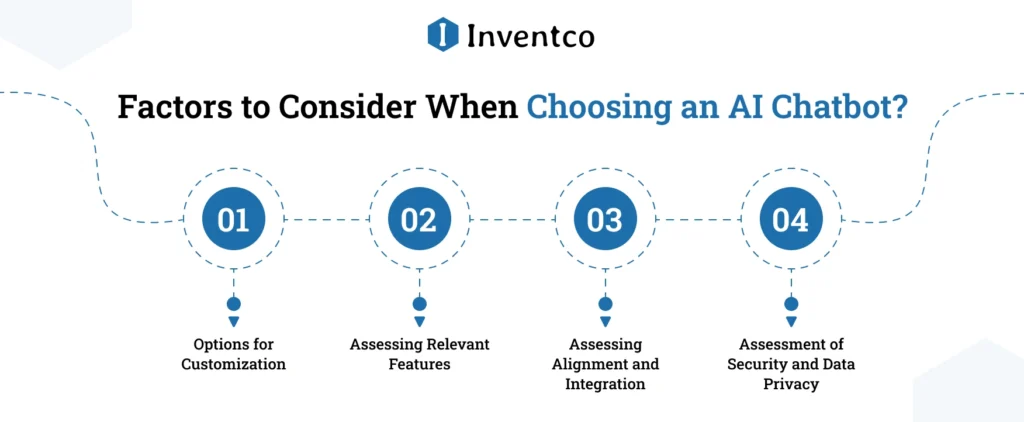
When building AI chatbots, one must analyse several aspects, as various factors affect the efficiency of this technology. The following factors are fundamental when selecting chatbots. Understanding common chatbot implementation challenges can help businesses avoid integration and scalability issues.
1. Options for Customization
One factor in building AI applications is the need to focus on a specific demographic to ensure target audience recognition. Different demographic segments communicate in various ways, which is why fostering communication should include software customization that will allow for user connections and improve user experience.
2. Assessing Relevant Features
Beyond chatbots and AI, there are other important factors to consider, such as the available features and functionalities. AI chatbots that possess natural language processing are better positioned to provide optimal customer assistance. Moreover, operational ease is provided by the integration and scalability attributes as they also help manage the upper levels of users.
3. Assessing Alignment and Integration
Your choice of the AI ChatGPT system is of great importance. The system should align with multiple channels of communication, including social networks, the web, and mobile apps. Integration and compatibility will help in providing stakeholders with an uninterrupted quality experience.
4. Assessment of Security and Data Privacy
When scoping AI development services, protecting data and user privacy is of utmost importance. You should ensure that the chatbot services provider complies with the legal frameworks and regulations of your industry. When developing your Bing AI, avoid using a provider that lacks data encryption and secure data storage systems to protect your customers’ privacy.
Following proven best practices for chatbot deployment ensures higher adoption and long-term performance.
What distinguishes AI Chatbots from AI Writers?
Although both AI chatbots and writers utilize advanced technologies, there are key differences between the two, as discussed below:
1. Interaction
Text-based conversations are the main differentiating feature between AI chatbots and AI writers. While AI chatbots operate within a given framework, usually for procedural answering, they harness pattern recognition to provide a response from a set of predetermined options and do not possess advanced conversational abilities. Contrastingly, AI writers utilize advanced technologies to interpret and interact at a complex level. This includes nuanced contextual understanding and sophisticated natural language processing to successfully address vague and complex tasks with customized solutions based on real-time input.
2. Knowledge Base
Lastly, there is an important distinction in knowledge scope between AI chatbots and AI writers. AI chatbots and writers do not have unrestricted access to the internet. AI chatbots are given access to a particular discipline and industry and are trained with specialized knowledge that is rigid and updated infrequently. AI writers, on the other hand, have access to the internet, can process a wide variety of language models, and can stream data in real-time. Consequently, AI writers are able to make logical deductions based on complex and diverse sets of queries, thus greatly surpassing the capabilities of AI chatbots.
3. Learning and Adaptation
There are very few limitations to the chat software that AI employs as it offers pre-programmed answers. It cannot learn and adapt the same as AI Agents. Adaptation and continuous learning are used by AI agents to personalize an interaction. They are able to learn and use sophisticated techniques, such as transfer and reinforcement learning to grow their knowledge and skills in a variety of areas.
SALLA by Inventco: A Smarter Way to Manage WhatsApp Customer Conversations
SALLA & WhatsApp Chat Support (ChatGPT) builds intelligent customer communication platforms under the Dine by Inventco brand to streamline customer conversations across various businesses. With this app, the business owner can create an account, choose a subscription plan that suits their needs, and manage business documents using the in-app CMS, which holds files in Word and PDF formats.
What makes SALLA unique is the use of WhatsApp Business API for seamless, organized, and structured conversations. With this feature, businesses can offer real-time customer support. The chats are kept in their system, organized by chat history, timestamps, and customer information, which enables personalized follow-ups. With smart automation and chat subscripting, along with other operational chat controls, SALLA assists businesses in enhancing customer support, response, and engagement without operational complexities.
How Much do AI Chatbots Cost?
Several factors influence chatbot development cost, including subscription model, features, customization, and deployment scale. Chatbots that offer simple, predefined conversations are much cheaper than those that support multiple platforms, integrate with CRMs, and offer advanced capabilities such as machine learning and natural language processing.
Currently, building an AI chatbot costs $10,000 to $100,000+, depending on business needs, use cases, and long-term scalability goals. An AI chatbot development company will help you identify the right features to avoid unnecessary expense and produce cost estimates that align with business goals.
Why Choose Inventco for AI Chatbot Development?
With intelligent, scalable, business-ready chatbot solutions, Inventco has earned the title of leading mobile app development company. Our mastery of the field includes business chatbot software that automates processes, improves engagement, and optimizes conversions.
We build bots that are not generic. Our AI chatbots are tailored to the specific needs of the industry they serve, the audience they target, and the growth goals they aim to achieve. Inventco’s seamless integrations with CRM automation, NLP-powered chat capabilities, and multi-platform availability ensure high-quality, cost-efficient chatbots you can count on to support your business’s longevity.
The value of your chat investment decreases with the level of security provided; with robust security features, that value will remain high for an extended period. With post-launch support, prompt pricing, and the ability to take major business transformations, your chatbots will deliver ROI.
Beyond cost, businesses often evaluate how long it takes to build a chatbot, which depends on complexity and integrations.
Conclusion
There are many potential avenues for growth for a company, one using advanced technologies such as AI chatbots, which also improve communication and elevate customer interaction. AI chatbots enhance operational efficiency and reduce manual workloads by automating customer support and lead qualification, and improving response times and personalization of marketing.
They also offer 24/7 support, faster query resolution, and uniform experiences to users across various platforms. To align technology and strategic goals, improve and automate internal processes, and to grow without high operational expenditures, companies need to invest in AI chatbot app development services. Moreover, chatbot analytics offer companies insight into customer behaviors, which allows them to identify and close gaps in performance, enhance quality of service, and improve decision making through data to achieve a successful business in the future.
FAQs
Q1. How much time is needed for implementing an AI chatbot?
Ans. An AI chatbot usually takes 4 to 12 weeks for proper implementation, depending on the technical complexity, scope, and other important requirements.
Q2. How long does it take to develop an AI conversation bot?
Ans. If we talk about a simple bot with minimal features, it can take around 4 to 6 months. On the other hand, a complex version of this technology can take up to 12 months to complete.
Q3. How fast is the AI chatbot industry growing?
Ans. The present global market of AI chatbots was estimated to be more than US$ 7.70 billion in 2024. According to Grand View Research, it will grow at a CAGR of 23.3% from 2025 to 2030.

Jitendra Jain
He is the CEO and Co-founder of Inventco, driving innovation in advanced computing and digital transformation. With deep expertise in modern IT ecosystems, he leads scalable, secure, future-ready solutions. His strategic leadership helps businesses accelerate growth, adopt innovation, and achieve success. You can connect with him on LinkedIn to follow his technology insights.