The global online food delivery market size was estimated at USD 288.84 billion in 2024 and is projected to reach USD 505.50 billion by 2030, growing at a CAGR of 9.4% from 2025 to 2030. Yet despite these numbers, most food delivery platforms are still operating on logic built five years ago: static menus, generic recommendations, and route algorithms that cannot adapt in real time.
The platforms pulling ahead in 2026 are not winning on brand alone. They are winning because they have embedded artificial intelligence into the core of their delivery experience, from the moment a customer opens the app to the second a rider knocks on the door.
For Investors and Founders: Because AI systems are an integral part of food delivery apps, the cost to build an AI food delivery system from scratch is likely between $10,000 and $100,000. Costs will be based on the scope and range of the embedded systems (features), as well as the depth of AI.
This guide breaks down the real costs and value of AI in food delivery apps from a systems perspective. Build and scale the delivery systems your customers want with AI integration features first, and then focus on the other features your customers desire.
Key Takeaways
- The global AI in the food and beverage industry market is expected to exceed $36.5 billion by 2030, with food delivery platforms accounting for a significant share.
- AI use cases in food delivery span demand forecasting, dynamic pricing, route optimization, personalized recommendations, and fraud detection.
- Businesses leveraging AI in food delivery see up to a 30% reduction in delivery times and a 20–25% increase in order conversion rates.
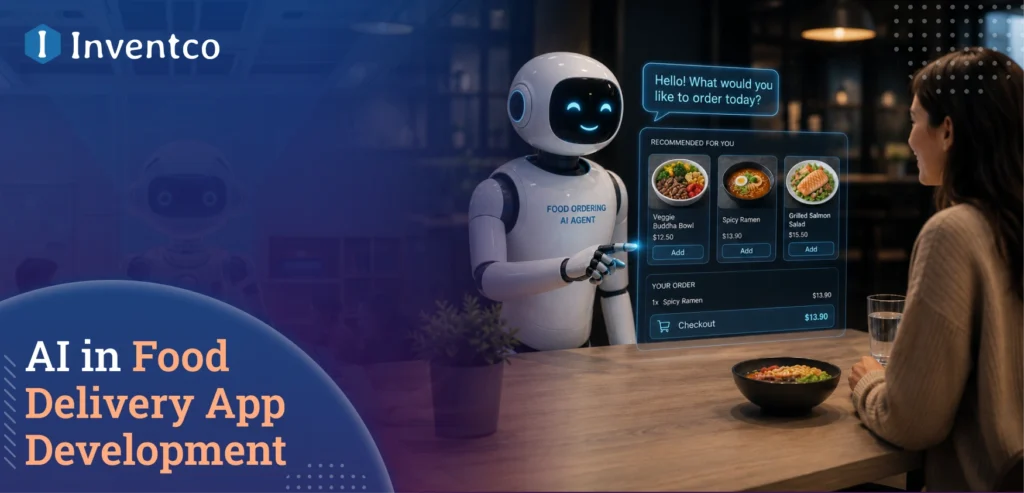
- Generative AI (Gen AI) in the food industry is now being applied to menu personalization, AI-powered chatbots, and dynamic content generation.
- Inventco helps food businesses and delivery startups implement modular, scalable AI systems that align with growth objectives and operational realities.
What Is AI in the Food Industry?
In the context of food delivery specifically, AI operates across three distinct layers:
- Operational Intelligence: AI that optimizes backend logistics: demand forecasting, inventory management, route planning, and delivery time prediction.
- Customer Intelligence: AI that powers the consumer-facing experience: personalized recommendations, dynamic menus, chatbots, and loyalty prediction.
- Business Intelligence: AI that supports strategic decisions: pricing models, churn prediction, fraud detection, and market expansion signals.
The impact of AI in the food industry is measurable and compounding. Platforms that deploy AI at the operational layer reduce delivery costs. Those who deploy it at the customer layer increase lifetime value. Those that integrate both build defensible businesses.
According to MarketsandMarkets, the Artificial Intelligence (AI) market is expected to be valued USD 601.93 billion in 2026 and USD 3,638.08 billion by 2033, with a CAGR of 29.3%. This expansion is being driven by data availability, cloud infrastructure maturity, and rising customer expectations for scalable customisation.
How to Use AI in the Food Industry: Use Cases Across the Value Chain
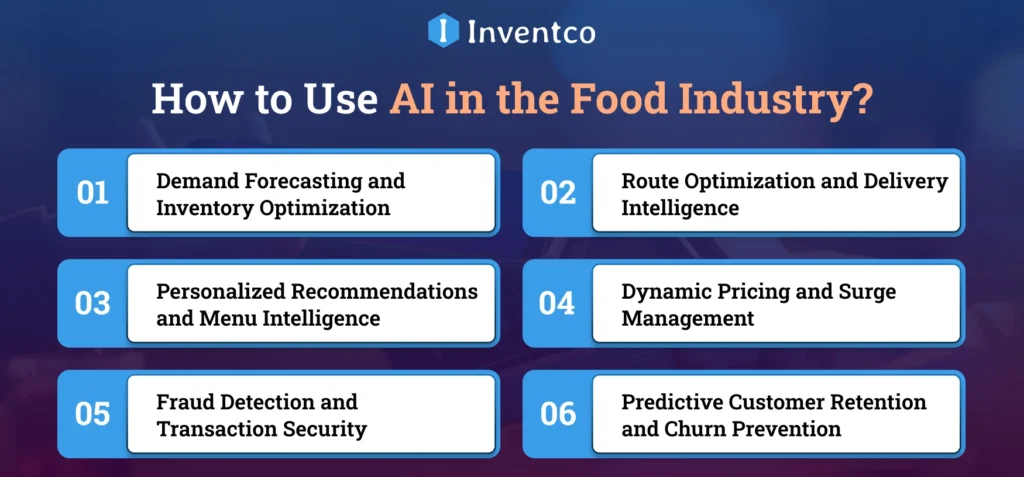
To know how to implement AI in the food industry, one must consider the placement of AI in the given challenges along the food delivery ecosystem. Here are the examples with the most potential for return on investment for food and restaurant delivery-based use cases in 2026.
1. Demand Forecasting and Inventory Optimization
One of the most important use cases for AI in the food industry is demand prediction. Using advanced ML models that incorporate the analysis of historical customer orders, weather patterns, local and national events, and trends for demand changes that are seasonal in nature, predict demand with an accuracy of 93%. This allows restaurant partners to position their inventory ahead of time and avoid waste of food by 20 to 30%.
For delivery platforms, accurate prediction of demand helps allocate drivers effectively, eliminates order rejections, and improves order fulfillment during high-demand time slots.
2. Route Optimization and Delivery Intelligence
In the delivery market, using a standard GPS to map a delivery route is insufficient. Today’s competitive delivery business requires that AI be used to evaluate the multitude of real-time driver locations and the constantly changing traffic conditions and incorporate batch delivery logic to determine the most efficient path to complete all necessary deliveries.
Use of AI-based routing helps delivery platforms lower average delivery time by 15 to 25% and positively impact delivery time, both of which are critical to retention of food delivery customers.
3. Personalized Recommendations and Menu Intelligence
Recommendation systems are prime examples of food-related AI with a notable revenue impact. Such systems evaluate customers’ order histories, navigation patterns, time-of-day orders, eating habits, and even which items are trending to suggest meals that are likely to be purchased.
DoorDash and Swiggy, among other companies, have reported that, on average, AI recommendations are behind more than 35% of order placements.
The application of Gen AI in the food industry has rapidly evolved. Now, it is in the form of personalized user profiles to add contextual suggestions and even dynamically generated menu descriptions and meal bundles.
4. Dynamic Pricing and Surge Management
To balance order and delivery surges, many food delivery companies have begun adopting dynamic pricing models enabled by AI. Where traditional surge pricing methods offer fixed-price discounts, AI controls the pricing for delivery, menu items, and even offers based on real-time demand, driver availability, and marketplace positioning.
This new pricing method has become vital for many food delivery companies that operate in high-density markets with difficult-to-sustain margins.
5. Fraud Detection and Transaction Security
AI in food delivery also plays a critical role in platform integrity. Machine learning models can detect anomalous order patterns, payment fraud, fake reviews, and delivery manipulation in real time, reducing financial losses and protecting platform trust.
For platforms that handle thousands of transactions each hour, rule-based fraud detection methods are no longer useful. An adaptive framework, like AI systems that learn and derive patterns from the transactions, offers a more advanced and precise defense layer.
This ties into mobile app security best practices. AI-driven anomaly detection at the transaction layer is an adequate implementation of security for enterprise-grade food delivery platforms.
6. Predictive Customer Retention and Churn Prevention
AI systems are capable of identifying customers who are at risk of churn based on a host of features. From reduced ordering, decreased session time, and even negative delivery experiences, AI systems can be employed to initiate on-demand retention efforts before the customer completely drifts away.
Considering that delivery systems based on food and beverages operate on a subscription-based model, this usage of AI systems is especially useful for the industry.
AI in Food Delivery: How It’s Transforming the $350B+ Market
The food delivery segment has become one of the most data-intensive verticals in consumer tech. Every order generates signals: what was ordered, when, from where, how long it took, whether the customer rated the experience, and whether they returned. AI is what turns that signal density into a strategic advantage.
| Business Segment | AI Application | Business Impact |
| Last-Mile Delivery | Route optimization, predictive ETD, and real-time traffic analysis | 15 to 25% faster deliveries |
| Customer Experience | Personalized recommendations, AI chatbots, and behavior-based suggestions | 20 to 35% higher conversion rates |
| Restaurant Operations | Demand forecasting, inventory planning, and kitchen preparation optimization | 20 to 30% reduction in food waste |
| Platform Integrity | Fraud detection, anomaly scoring, and risk monitoring | 40 to 60% reduction in fraud losses |
| Pricing Strategy | Dynamic pricing, surge pricing, and promotion optimization | 8 to 15% improvement in profit margins |
| Driver Management | Intelligent dispatching, route planning, and AI-driven incentive optimization | Higher driver retention and operational efficiency |
The platforms winning this market are not simply aggregators of restaurants. They are intelligence platforms that use AI to create increasingly accurate matches between what customers want, what restaurants can deliver, and what riders can fulfill, all within increasingly tight time and cost constraints.
The impact of AI in the food industry at this level is structural. It shifts the competitive advantage from brand scale to data quality and algorithm sophistication, which is why AI architecture decisions made during the mobile app development process have long-term strategic consequences.
What Are the Benefits of AI in Food Delivery Apps?
For founders and investors evaluating food delivery infrastructure, the business case for AI comes down to four compounding advantages:
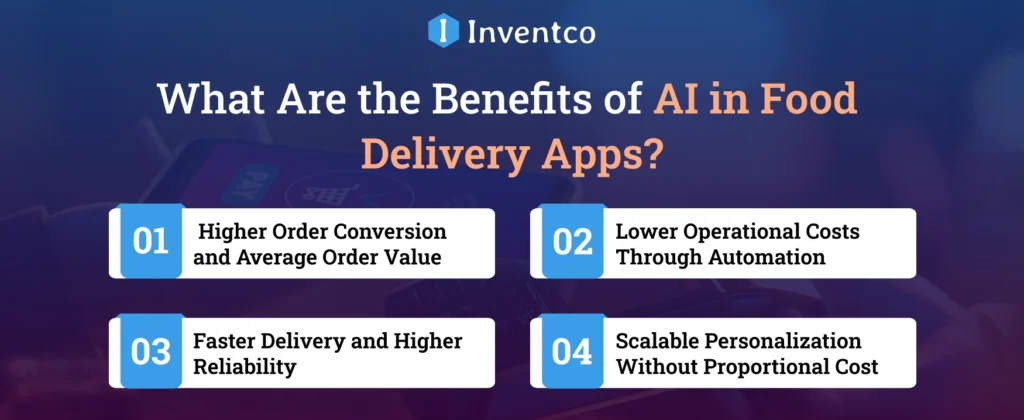
1. Higher Order Conversion and Average Order Value
AI personalization helps delivery app users make decisions faster and creates an increased likelihood that they will place an order. Apps that have trained recommendation systems have noted a 20–25% boost in conversion rates. Average order value also increases by 12–18% through AI meal generation and suggestions, add-on recommendations, and reorder nudges.
2. Lower Operational Costs Through Automation
AI-enabled automated customer support, optimized delivery routes, and automated dispatch reduce the overhead needed for delivery operations. For the delivery platform that processes over 10,000 orders daily, the cost to build a mobile app with AI features is often justified in 12-18 months.
3. Faster Delivery and Higher Reliability
Food delivery apps that integrate AI achieve faster delivery times and more reliable service. The benefits of this for food delivery apps are service ratings, reduced order refunds, and improved order repetition, all of which positively impact food delivery app performance.
4. Scalable Personalization Without Proportional Cost
Traditional personalization required manual merchandising and curation. AI enables platforms to deliver individualized experiences to millions of users simultaneously without increasing headcount. This is the scalability advantage that makes AI investment a capital efficiency story, not just a product story.
Note on Disadvantages of AI in the Food Industry: The challenges must be considered for any valid analysis. Earning trust in food delivery models requires extensive training data, which fledgling platforms may provide in poor quality. Recommendation model biases can also lead to suboptimal visibility for new restaurant partners.
Trust can also evaporate from over-dependence on AI for customer service, given the known and multiple points of failure for such systems. Infrastructure costs add to operational complexity. The answer is the gradual implementation of a modular design: implementing AI in areas where data quality and volume support expenditure, and gradually expanding the capability as the platform matures.
Key AI Features for a Food Delivery Mobile App in 2026
When designing an AI-powered food delivery platform, one should consider the use of AI to solve the most salient customer problems, the features with the highest operational leverage, and the features that create and widen the longest-lasting competitive advantage. Below, you will find the mobile app features that will be core to food delivery platforms that will be AI-first in 2026.
| AI Feature | Function | Priority Level |
|---|---|---|
| Smart Recommendation Engine | Delivers personalized food suggestions based on user preferences, order history, and browsing behavior. | Tier 1 (Core) |
| AI-Powered Route Optimization | Optimizes delivery routes using real-time traffic, weather, and driver availability. | Tier 1 (Core) |
| Predictive Delivery Time (ETD) | Uses AI to estimate accurate delivery times based on kitchen preparation and delivery conditions. | Tier 1 (Core) |
| Demand Forecasting Module | Predicts future order demand to optimize inventory, staffing, and driver allocation. | Tier 2 (Growth) |
| Dynamic Pricing Engine | Automatically adjusts delivery fees, discounts, and promotions based on demand and supply. | Tier 2 (Growth) |
| AI Chatbot & Support Automation | Resolves customer queries, order issues, and refunds using AI-powered conversational support. | Tier 2 (Growth) |
| Fraud Detection Layer | Detects suspicious transactions, fake orders, and payment fraud through AI-driven anomaly detection. | Tier 2 (Growth) |
| Churn Prediction & Retention AI | Identifies users likely to stop ordering and delivers personalized offers to improve retention. | Tier 3 (Scale) |
| Gen AI Menu Descriptions | Generates engaging menu descriptions and personalized food content for different customer segments. | Tier 3 (Scale) |
| Voice & Conversational Ordering | Enables customers to place and reorder food using natural voice commands and conversational AI. | Tier 3 (Scale) |
The mobile app development technology stack that powers these features consists of TensorFlow and/or PyTorch (model training), MLOps (AWS SageMaker or Google Vertex AI), a real-time data streaming solution (Apache Kafka), and API partnerships with routing and mapping providers.
When designing an AI-driven food delivery mobile app, the choice of development technology will be influenced by the desire to create a highly performant native app (Swift/Kotlin) as opposed to a cross-platform app (React Native/Flutter) that will be less performant but launched to market faster. Both approaches are valid; however, the complexity of the AI layer will require the use of a native app architecture at enterprise scale.
From Our Projects
One of our recent projects, ZONE Delivery App, demonstrates how intelligent delivery technology transforms logistics operations. Built as a complete delivery management platform, ZONE connects merchants, customers, drivers, and delivery companies through a unified ecosystem. We developed real-time order tracking, driver assignment, route optimization, integrated communication, and multi-role dashboards to streamline every stage of the delivery journey.
In addition, ZONE provides integrated Local Gateway APIs, which help businesses on platforms like WooCommerce and Shopify, among others, automate delivery requests and order tracking. With QR-based delivery dashboards and management systems, along with real-time notifications, multilingual support, and dedicated mobile applications, ZONE provides an efficient delivery experience that is reliable and scalable, while improving the delivery experience and supporting the businesses that ZONE serves.
How Inventco Helps Food Businesses & Delivery Platforms Implement AI
Inventco’s smart delivery solutions go beyond building intelligent features and include data frameworks, extensible architectures, and continuous enhancements. As an expert in app development, we assist food businesses and delivery platforms in embedding AI along the value chain in a safe and strategic manner that lowers costs and development barriers.
Inventco focuses on modular AI implementation, allowing businesses to deploy features like recommendation engines, route optimization, demand forecasting, and fraud detection independently. This phased approach enables faster launches, easier testing, and measurable ROI before expanding AI capabilities. We also build robust data pipelines, event tracking systems, and scalable architectures that provide reliable inputs for high-performing AI models, ensuring long-term accuracy and efficiency.
Starting with AI strategy and mobile app development, and continuing through post-launch optimization, we provide comprehensive support. Our AI engineers, backend developers, iOS and Android Specialists, React Native developers, and product strategists work in unison. Whether you need an AI-enhanced MVP or are developing an enterprise-scale food delivery system, Inventco’s AI solutions are designed to help you scale your business.
Conclusion
AI’s influence in food delivery development has quickly become more of an industry standard than a competitive edge, as users have come to expect quicker, more tailored, and more dependable ordering experiences. The technology is ready, the data infrastructure is available, and the ROI is clearly supported regarding conversion, retention, and operational efficiency.
For founders and investors, the question is no longer IF you will develop an AI-enabled system, but how you will begin and in what order you will develop the systems. Companies will rapidly develop competitive advantages in the marketplace through their data systems by developing systems in the order of highest-impact use case first, and then AI personalization, and other advanced technologies.
Inventco will help food manufacturers and food service delivery companies deploy accurate systems to meet their needs. If you are trying to imagine the possibilities of an AI-enabled food delivery system for your company, please discuss with us the most valuable data you currently have and the primary user issues you need to address.
FAQ’s
Q. What is the role of AI in the food delivery industry?
Ans. AI improves food delivery through route optimization, personalized recommendations, demand forecasting, dynamic pricing, fraud detection, and automation, enabling faster deliveries, lower costs, and better customer experiences.
Q. What are the benefits of AI in food delivery apps?
Ans. AI increases conversions, reduces delivery times, improves demand forecasting, minimizes fraud, enhances personalization, lowers operational costs, and boosts customer retention, creating stronger business profitability.
Q. Are there any disadvantages of AI in the food industry?
Ans. AI requires quality data, significant infrastructure investment, continuous model training, and careful bias management. Poor implementation can affect recommendations, operational efficiency, and customer trust.
Q. How is Gen AI being used in the food industry?
Ans. Generative AI creates personalized menus, marketing content, customer support responses, meal recommendations, recipes, and nutrition guidance, helping businesses improve engagement and operational efficiency.
Q. How much does it cost to build an AI-powered food delivery app?
Ans. An AI-powered food delivery app typically costs $10,000 to $30,000 for an MVP, while enterprise solutions with advanced AI features exceed $100,000, depending on complexity.
Q. How long does it take to build an AI food delivery app?
Ans. Building an AI food delivery MVP typically takes four to six months. Advanced enterprise platforms with sophisticated AI capabilities generally require nine to eighteen months.
Q. What AI features should a food delivery app prioritize in 2026?
Ans. Prioritize AI recommendations, route optimization, delivery time prediction, demand forecasting, dynamic pricing, fraud detection, and AI customer support to maximize conversions, efficiency, and customer retention.

Jitendra Jain
He is the CEO and Co-founder of Inventco, driving innovation in advanced computing and digital transformation. With deep expertise in modern IT ecosystems, he leads scalable, secure, future-ready solutions. His strategic leadership helps businesses accelerate growth, adopt innovation, and achieve success. You can connect with him on LinkedIn to follow his technology insights.