The food delivery industry is no longer a convenience, it is a critical infrastructure for modern consumer life. The market is projected to grow from USD 350.63 billion in 2026 to USD 728.83 billion by 2034, exhibiting a CAGR of 9.58% during the forecast period. That is not a niche opportunity, it is a category-defining shift in how people eat, order, and expect service.
Most food delivery business founders misjudge the complexity of this field. They think about branding and food selection, but neglect the operational logic and technology that determine whether their business will survive. This market has razor-thin margins. The competition is some of the fiercest in the world, and consumer demands are at an all-time high.
This guide covers the range of complexities that you need to understand to successfully compete in the online food delivery market, including selection of the business model, tech options that provide a business advantage, and more, both to build a food delivery business that withstands the competition and to understand the state of the market in 2026 and beyond.
Key Takeaways
- The global food delivery market is worth over 350.63 billion in 2026 and is growing at a ~9.58% CAGR.
- There are three primary food delivery business models: aggregator, logistics-enabled, and cloud kitchen, each with different capital and margin profiles.
- Profitability in food delivery depends heavily on average order value, delivery density, and platform take rates.
- Building your own food delivery app gives you data ownership, brand control, and long-term competitive advantage.
- The right technology stack, real-time GPS, AI-driven dispatch, and predictive analytics separate scalable platforms from short-lived ones.
- Regulatory compliance, driver retention, and unit economics management are the three most common failure points for new entrants.
What Is a Food Delivery Business? Types and Opportunities in 2026
A food delivery business is a commercial operation that facilitates the movement of prepared food from restaurants or cloud kitchens to end consumers, typically through a digital platform, a mobile app, or a web interface. The business may own the restaurants, the delivery logistics, both, or neither.
In 2026, the food delivery industry is segmented into three systems:
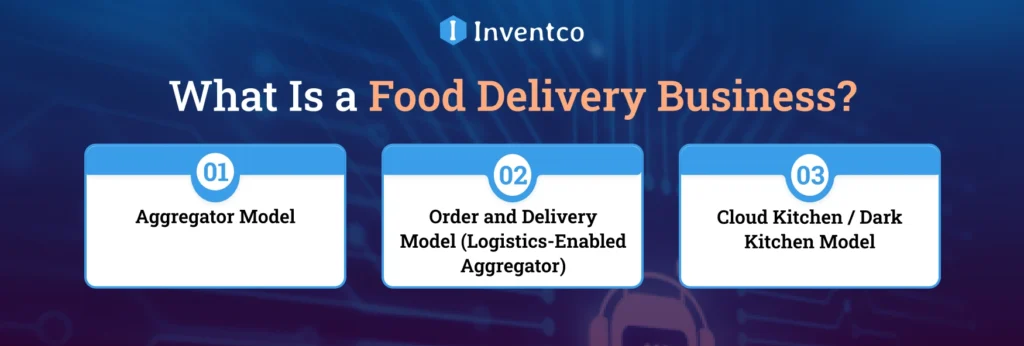
1. Aggregator Model
Companies that connect customers and restaurant partners without delivery or food preparation systems. Revenue is generated from commissions (typically 15–30% per order) and advertising fees from partnered restaurants. Examples include an early-stage DoorDash, Yelp, and Eat24.
2. Order and Delivery Model (Logistics-Enabled Aggregator)
The most prevalent model today in the food delivery business. The platform partners with restaurants and manages the last-mile delivery step, employing either independent contractors or staff. Top food delivery apps like DoorDash, Uber Eats, and Grubhub are examples. Thinner margins, but higher competitive advantages through delivery.
3. Cloud Kitchen / Dark Kitchen Model
There is a completely different approach to this type of system. A single delivery-focused kitchen can cater to multiple delivery brands. Since most businesses operate delivery-only models, they can control the entire operation as well as real estate costs. This model is an excellent choice for food delivery entrepreneurs to experiment with delivery brands at a large scale.
Choosing the Right Food Delivery Business Model
The food delivery business model you choose will define your capital requirements, unit economics, and long-term defensibility. There is no universally right answer, the correct model depends on your market, resources, and competitive positioning.
| Food Delivery Business Model | Capital Required | Estimated Profit Margin | Best For |
| Aggregator Model | Low to Medium | 5% to 15% | Tech-first founders building a marketplace between restaurants and customers |
| Order + Delivery Model | Medium to High | 2% to 8% | Businesses managing both order processing and last-mile delivery operations |
| Cloud Kitchen Model | Medium | 15% to 30% | Food brands, virtual restaurants, and ghost kitchens focused on delivery-only operations. |
| Hybrid Platform Model | High | 10% to 20% | Enterprises building an integrated ecosystem with restaurants, delivery fleets, and multiple revenue streams |
If you are building to scale, the logistics-enabled aggregator with a proprietary app remains the dominant model, it captures both platform value and delivery data. If you are building leaner and faster, a cloud kitchen with a direct-to-consumer app gives you the highest margin per order without dependence on third-party platforms.
How Profitable Is a Food Delivery Business? Realistic Numbers for 2026
Food delivery businesses can be profitable, but many founders don’t pay enough attention to the unit economics in the early stages of the business. Here are the numbers you need to know:
- Average Order Value (AOV): $28–$45 in mature markets, lower in price-sensitive geographies.
- Platform Commission: 15–30% of GMV, depending on restaurant tier and exclusivity.
- Delivery Cost Per Order: $3–$8, depending on fleet model and delivery zone density.
- Customer Acquisition Cost (CAC): $8–$25 in competitive urban markets.
- Contribution Margin at Scale: 4–12% per order after delivery, discounts, and support costs.
How profitable are food delivery businesses? For many operators, profitability at the unit level is attainable in 18 to 24 months, given the delivery density (i.e., the number of orders per delivery zone per hour). Businesses that consistently get 3 to 5 orders per driver per hour tend to become EBITDA positive at scale. When it comes to delivery zones, the contribution margin should be the primary focus, not the revenue.
Food delivery businesses that own the fulfillment process, along with the food prep process, tend to become profitable faster. Some report net margins of 20 to 25% at scale. For those creating a food delivery service business plan, the most advantageous route is to create a model that incorporates both owned kitchen brands and actively listed brands from 3rd party restaurants.
How to Start a Food Delivery Business: Step-by-Step Launch Guide
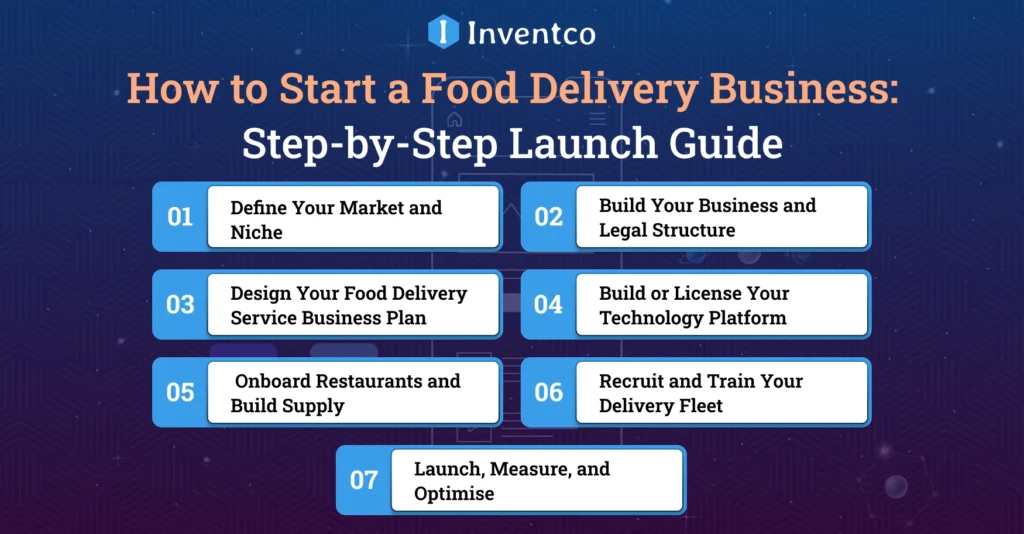
Whether you are launching a hyperlocal food delivery startup or a city-wide platform, the steps below provide a practical framework grounded in what works in 2026.
Step 1: Define Your Market and Niche
First, select a specific city, then select the appropriate demographic, and finally select a category of food delivery service to offer. Food delivery services that cater to a specific neighborhood tend to be more profitable than those that cater to an entire city. Food delivery services should also avoid overlaps in delivery and services with other competitive businesses.
Step 2: Build Your Business and Legal Structure
License and register your entity, acquire food handling and food delivery licenses for your jurisdiction, and develop contracts with your partner restaurants. For cloud kitchen operations, you must consider food safety compliance as a prerequisite, not as an afterthought.
Step 3: Design Your Food Delivery Service Business Plan
A credible food delivery service business plan includes: GMV targets by quarter, delivery zone expansion, milestones for acquiring restaurant partners, drivers, and fleet, unit economics, and timelines for investments in tech. This is the granularity that your potential investors and banks expect.
Step 4: Build or License Your Technology Platform
An app technology stack is the most important business infrastructure. A custom-built food delivery app that includes customer ordering, real-time tracking, and dashboards for restaurants and drivers will provide you with data and optimization. The cost to build a mobile app of this scope and scale typically falls between $10,000 and $100,000, depending on the features and whether it is developed for iOS, Android, or both.
Step 5: Onboard Restaurants and Build Supply
Your supply side determines your demand side. Launch with 15–30 quality restaurant partners rather than 200 mediocre ones. Exclusivity deals and co-marketing arrangements with anchor restaurants in your launch zone significantly reduce early CAC.
Step 6: Recruit and Train Your Delivery Fleet
Whether you take on an employed or a gig-model delivery fleet, focus on the costs of recruitment and retention of drivers and the costs of training delivery staff. Food delivery businesses overlook driver retention and performance incentivization costs, and the impact on business profitability is significant.
Step 7: Launch, Measure, and Optimise
Implement fully functional dashboards displaying delivery time, order accuracy, cancellations, and customer satisfaction. Use these metrics on a weekly, not quarterly, basis to refine dispatch logic, zone coverage, and the mix of restaurants.
The Technology Behind a Successful Food Delivery Business
The food delivery industry is wholly dependent on technology. The platforms that achieved a scalable and profitable business model early on made the right decisions in mobile app development and built the necessary infrastructure to support rapid business scaling without the need for intensive restructuring.
Key components of a scalable food delivery technology stack include:
- Customer App (iOS & Android): Intuitive ordering interface with real-time GPS tracking, payment gateway integration, loyalty features, and personalised recommendations powered by AI.
- Restaurant Partner Dashboard: Order management, menu control, analytics, and availability toggling, accessible on tablet or web.
- Driver App: Turn-by-turn navigation, order status updates, earnings visibility, and delivery zone heatmaps.
- Admin Control Panel: Full operational visibility, zone management, dispute resolution, pricing controls, and performance reporting.
- AI Dispatch Engine: Automated driver-to-order matching based on real-time location, traffic conditions, and predicted prep time.
For entrepreneurs building the first version of their food delivery app with an emphasis on the core functionalities of order placement and real-time tracking of orders and delivery personnel, this can easily be accomplished within a period of 10-14 weeks. In addition, using the right mobile app development frameworks, such as React Native and Flutter for cross-platform mobile app development, can help develop fully functional mobile apps a lot faster without compromising features.
Mobile app development for food delivery services can be significantly complex. Examples of this include the mobile app security architecture that would protect payment and location data, and the app security and data protection controls that would restrict and manage access to food delivery service pricing data. Any mobile app development partner you choose must treat mobile app security as a first-class architecture requirement, not a checkbox at the end of the mobile app development process.
What Are the Challenges in the Food Delivery Business?
Understanding how to start your own food delivery business also means being clear-eyed about what makes this industry difficult. The following mobile app development challenges appear consistently across geographies and business models:
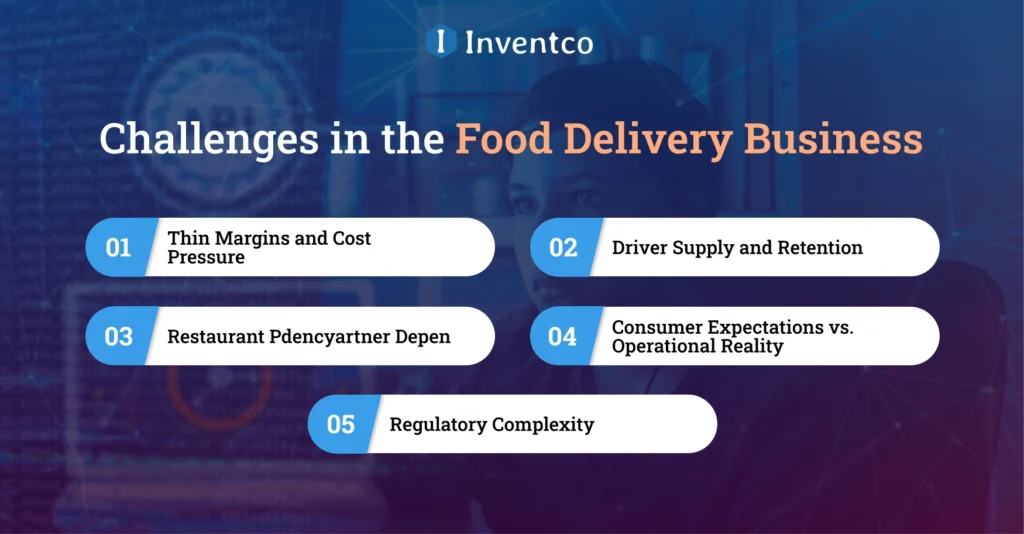
- Thin Margins and Cost Pressure: Delivery costs, platform discounts, and payment processing fees compress margins quickly. Scaling without unit economics discipline accelerates losses.
- Driver Supply and Retention: High driver churn is one of the most operationally disruptive issues. Platforms that invest in driver experience and earnings predictability retain better, deliver faster, and see lower cancellation rates.
- Restaurant Partner Dependency: Over-reliance on a small number of anchor partners creates concentration risk. Diversify supply early.
- Consumer Expectations vs. Operational Reality: Customers expect 30-minute delivery, full menu availability, and flawless order accuracy. Meeting these expectations at scale requires sophisticated logistics, not just marketing.
- Regulatory Complexity: Food safety compliance, gig worker classification laws, and data privacy requirements vary widely by jurisdiction and are tightening in 2026 across most major markets.
What Are the Future Trends of the Food Delivery Business?
The food delivery businesses that will define the next five years are not those replicating today’s model, they are those investing ahead of the following shifts:
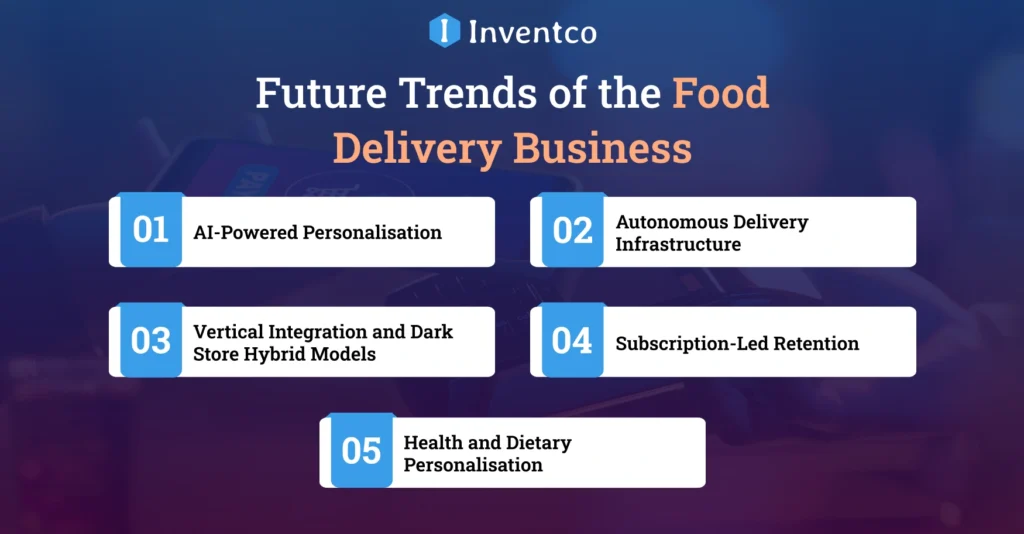
- AI-Powered Personalisation: Predictive ordering, dynamic pricing, and AI-curated meal recommendations are rapidly moving from premium features to baseline consumer expectations.
- Autonomous Delivery Infrastructure: Drone and ground-robot last-mile delivery pilots are expanding in suburban and campus settings. Early investment in infrastructure partnerships will be a meaningful moat.
- Vertical Integration and Dark Store Hybrid Models: Leading platforms are co-locating dark kitchens with quick-commerce dark stores, enabling combined grocery and meal delivery from a single fulfilment point.
- Subscription-Led Retention: Delivery subscription programmes (flat monthly fee for free delivery) are proven retention mechanisms and increasingly the primary loyalty vehicle across the top global platforms.
- Health and Dietary Personalisation: Demand for calorie-tracked, allergen-aware, and medically-tailored meal delivery is growing rapidly, driven by digital health convergence and wearable data integration.
How Inventco Can Help You Build a Food Delivery Business
A food delivery service requires additional elements beyond the food delivery service idea to be successful. These include scalable systems and technology combined with an appropriate development partner. As the best mobile app development company, Inventco helps startups, restaurants, cloud kitchens, and enterprises build high-performance food delivery platforms tailored to their business goals.
Inventco built ZONE Delivery App, a fully customizable delivery management platform, to demonstrate our expertise. ZONE connects delivery people, customers, merchants, and delivery companies using customized mobile apps and web dashboards. ZONE provides delivery companies with order tracking and driver management. ZONE also provides payment management, driver route optimization, third-party app integrations, and supports multiple languages.
Our solutions are comprehensive and include business strategy, UI/UX design, mobile app development, backend development, AI, testing, deployment, and ongoing support. From an MVP mobile app to a comprehensive delivery ecosystem, Inventco has the technology and capability to deliver the solution you really need. Delivering a competitive advantage in the dynamic world of food delivery, our solutions are future-ready and allow you to scale with confidence.
Conclusion
The food delivery industry represents one of the most significant commercial opportunities in the digital economy, but it rewards founders who approach it with clarity, not just ambition. Choosing the right business model, understanding your unit economics, investing in the right technology, and anticipating operational challenges are what separate the platforms that scale from those that stall.
Establishing a food delivery service in 2026 will not be about an app. This service will be a delivery system that connects supply and demand, coupled with a dependable, data-driven service that will ease company traffic and be built to expand. The delivery system will be ready, but will your delivery service be?
FAQ’s
Q. How much does it cost to start a food delivery business?
Ans. Starting a food delivery business typically costs $50,000 to $200,000, depending on your business model, app development, marketing, legal setup, and operational requirements.
Q. Can I run a food delivery business from home?
Ans. Yes. Home-based cloud kitchens and delivery management businesses are possible with proper licenses, regulatory compliance, food safety standards, and an efficient online ordering system.
Q. How profitable is the food delivery business realistically?
Ans. A food delivery business can become profitable within 12 to 30 months, depending on operational efficiency, customer retention, delivery density, pricing strategy, and order volumes.
Q. What technology do I need to start an online food delivery business?
Ans. You’ll need customer and driver apps, restaurant dashboards, admin panels, payment gateways, GPS tracking, real-time notifications, analytics, and scalable cloud infrastructure for operations.
Q. How do I increase food delivery business performance after launch?
Ans. Improve delivery speed, optimize dispatch, personalize customer experiences, launch loyalty programs, retain drivers, analyze performance metrics, and leverage AI to maximize operational efficiency.
Q. What are the most common food delivery business ideas for new founders?
Ans. Popular ideas include cloud kitchens, hyperlocal delivery platforms, corporate meal subscriptions, healthy food services, grocery delivery, ghost kitchens, and multi-brand virtual restaurants.

Jitendra Jain
He is the CEO and Co-founder of Inventco, driving innovation in advanced computing and digital transformation. With deep expertise in modern IT ecosystems, he leads scalable, secure, future-ready solutions. His strategic leadership helps businesses accelerate growth, adopt innovation, and achieve success. You can connect with him on LinkedIn to follow his technology insights.