By 2026, Chatbots utilitarian functionalities, an essential part of virtually every modern business. With the arrival of a new era of Digital Transformation, AI Chatbots are empowering businesses by modernizing traditionally reactive customer service, defensive response times, and overall operational processes, towards a more proactive, and empowering, customer service oriented environment.
Because of this, organizations can and have begun to view Chatbots as a beneficial strategic resource, and not merely a passing fad aimed at improving customer service support and lead qualification automation, providing personalized product suggestions, and automating workflows. Most commonly, decision-makers for organizations want to know what the costs are for developing Chatbots.
The answer to this question is very multi-dimensional; the question is based on the cost Chatbot development based on chatbot complexity, technological considerations (technology stack, number and type of integrations, etc.), your organization’s business model (e.g. scalability concerns), and lastly, your organization’s long-term business model (e.g. maintenance concerns).
In this guide, we have quantified the costs of Chatbot development across the dimensions mentioned above. This guide will provide you with an understanding of what is required to implement a scalable, high-performing Chatbot solution to achieve your business objectives.
Key Takeaways
- By 2026, chatbots will no longer be considered optional. They will be core components of operational infrastructure for any business.
- The cost of chatbot development can range from $5,000 to $ 250,000+.
- The cost of LLM powered, voice-integrated, and hybrid chatbots is in the higher range. However, the level of personalization, automating capabilities, and overall ROI is also of a superior quality.
- The level of customization, technology stack, channels of deployment, integrations of the system, and maintenance after the system goes live are the core cost determinants.
- Total ownership costs are significantly affected by hidden costs such as inference usage, cloud hosting, vector databases, compliance, and continuous model training.
- Development costs can be greatly minimized through building an MVP, using pre-trained AI models, and creating scalable architecture.
- Working with a seasoned development partner facilitates structured execution, budget optimization for the best impact, and business growth in a sustainable way.
Global Chatbot Market Growth
- The global chatbot market was valued at approximately USD 7.76 billion in 2024 and is projected to reach USD 27.29 billion by 2030, growing at a CAGR of 23.3% from 2025 to 2030.
- Another outlook estimates the market will reach around USD 11.45 billion in 2026, further growing to an estimated USD 32.45 billion by 2031 at a 23.15% CAGR.
- The broader conversational AI market, which includes chatbots and intelligent virtual assistants, was valued at USD 11.58 billion in 2024 and is expected to reach USD 41.39 billion by 2030 at a 23.7% CAGR.
Why Should You Invest in Chatbot Development?
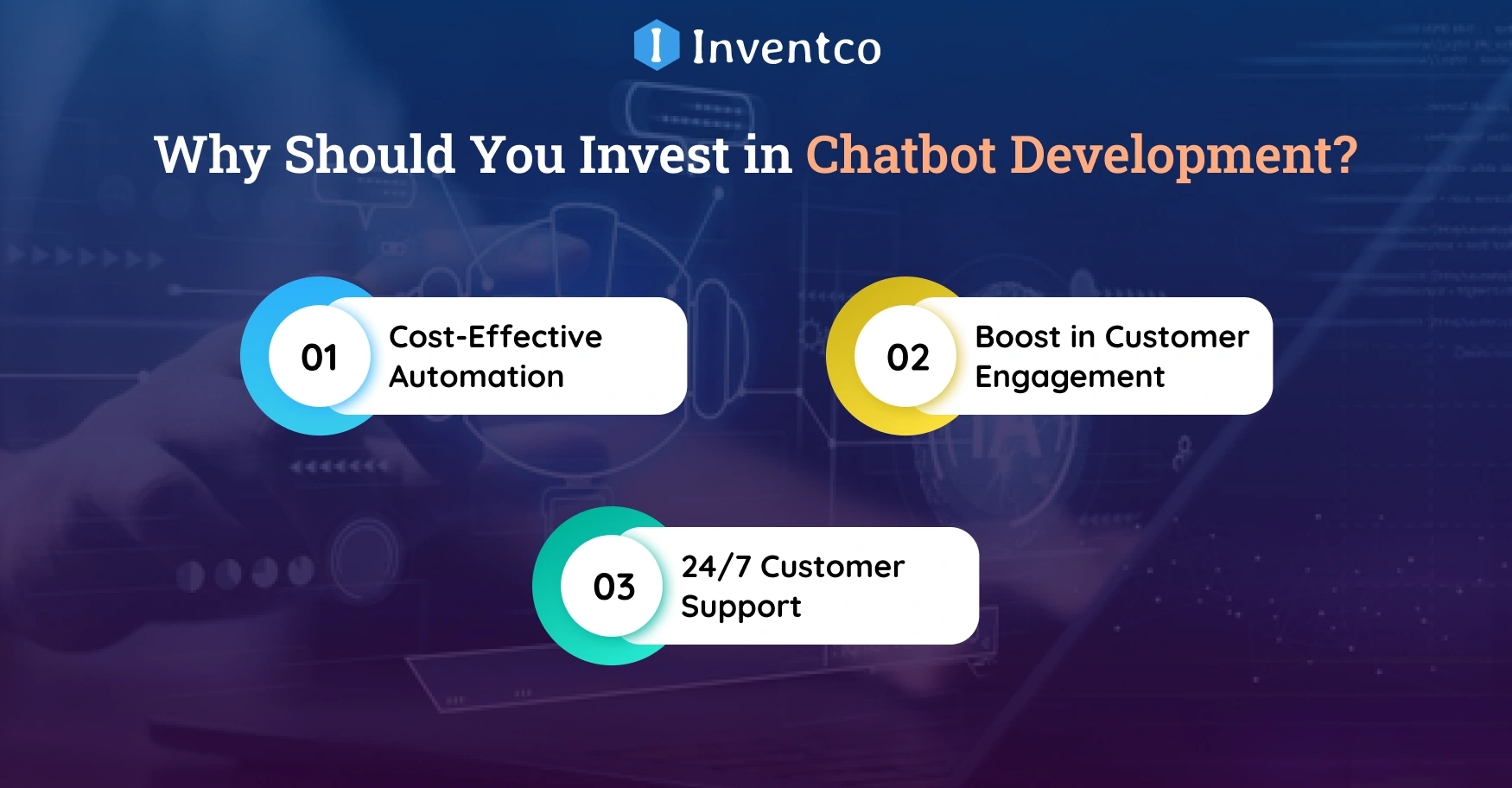
When companies get new chatbots, their operational costs lower, the quality of their customer relationships improves, and customer service initiatives that would require hiring more employees are able to expand. To remain competitive and maintain the quality of customer service, companies’ use of chatbots is now a necessity in the new digital economy.
Cost-Effective Automation
When a company uses chatbots as a customer service technology, less human customer service employees are needed. Chatbots are able to perform human customer service employees’ jobs and as a result cause the company to save money while maintaining customer service quality.
Boost in Customer Engagement
Customer engagement is directly related to the use of active customer service technology. Active customer service technology allows companies to directly personalize customer communication which increases customer engagement.
24/7 Customer Support
Companies can use chatbots to offer customer service 24 hours a day which in turn increases customer satisfaction because instant customer service is available regardless of the time.
Types of Chatbots and Their Cost Implications
In today’s rapidly changing digital landscape, chatbots are being developed for various purposes and to achieve different objectives. Knowing what each type of chatbot does is important for assessing how much it will cost to make a chatbot and what the appropriate level of investment is.
1. Rule-Based Chatbots
Bots based on rules are made to follow specific decision trees and respond with specific scripts. They serve their purpose well with FAQs and simple repeated questions.
Estimated Cost: $5,000 – $10,000
Best For: Small businesses with limited use cases
Limitation: Limited flexibility and no contextual understanding
2. AI-Powered Chatbots
AI-Chatbots, or artificial intelligence chatbots, use natural language processing and machine learning to determine the user’s intent and provide an appropriate response. AI chatbots need to be trained based on user interactions, and the data from those interactions improve the AI over time.
Estimated Cost: $20,000 – $200,000+
Best For: Enterprises requiring automation, personalization, and scalability
Advantage: Context-aware and adaptive responses
3. Hybrid Chatbots
Hybrid chatbots combine rule-based workflows with AI capabilities. They manage structured tasks efficiently while using AI to handle complex or open-ended queries.
Estimated Cost: $30,000 – $70,000
Development Time: 8–12 weeks
Best For: Mid-to-large businesses seeking balance between cost and intelligence
4. Industry-Specific Chatbots
These chatbots are engineered for tailored industries such as healthcare, fintech, real estate, or e-commerce. They include compliance considerations, industry-specific data, and custom workflows.
Estimated Cost: $40,000 – $150,000+
Best For: Regulated or niche industries
Note: Cost varies based on integration complexity and compliance needs
5. Voice-Enabled Chatbots
Voice chatbots can enable a hand-free interaction with the aid of voice recognition and Natural Language Understanding (NLU) via devices or applications.
Estimated Cost: $30,000 – $100,000+
Best For: Healthcare, automotive, fintech, and smart device integration
Consideration: Requires additional voice processing infrastructure
6. Generative AI / LLM-Based Chatbots
These chatbots are integrated with large language models (LLMs), and therefore offer advanced conversational intelligence and the ability to communicate in different languages, and can remember context. They are best-suited for complicated enterprise ecosystems. Many of the top AI chatbots in the market today leverage LLMs, hybrid intelligence, and omnichannel deployment to deliver enterprise-grade automation.
Estimated Cost: $50,000 – $250,000+
Best For: Large enterprises, SaaS platforms, and high-scale customer engagement systems
Advantage: Highly dynamic, scalable, and human-like interaction
Key Factors That Influence Chatbot Development Cost
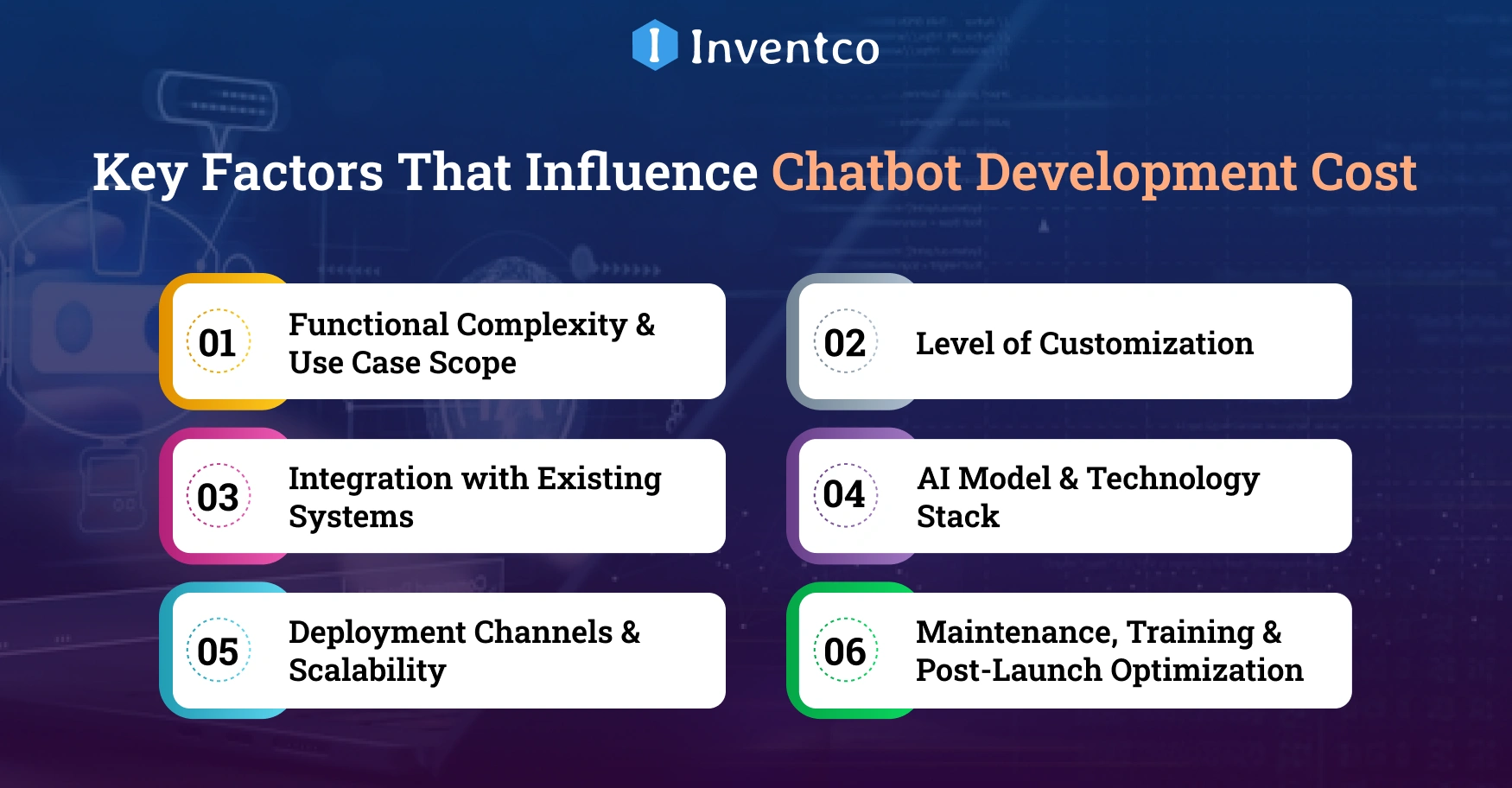
Regarding the chatbot development cost for 2026, it’s a matter of the technical intricacy involved and the importance of long term investment judgments. The chatbot development process plays a crucial role in determining cost, scalability, and long-term ROI. The modern AI chatbot develops strategic digital assets and there are vast numbers of considerations that might dictate the value.
1. Functional Complexity & Use Case Scope
The more advanced the chatbot would have regarding its development cost. Adept FAQ bots that unsuitable for enterprise-grade conversational structures situated for automation, analytics, and optimizing profits would cost more.
2. Level of Customization
Development efforts would be more for the rationale of custom branding, requiring design conversational tone, multilingual deployment, the purpose of compliance, and workflows pertaining to a particular industry. Chatbot solutions that are highly tailored cost more than systems that are template-based or pre-configured.
3. Integration with Existing Systems
The cost for smooth integration would be significantly affected by the CRM, ERP, payment gateways, helpdesk software, and internal databases. There are adverse correlations that exist the complexity of API architecture, data synchronization, and system compatibility directly affect both development time and budget.
4. AI Model & Technology Stack
The choice between rule-based logic, machine learning models, generative AI (LLMs), or hybrid systems plays a major role in pricing. Advanced AI-driven chatbots require training datasets, cloud infrastructure, and ongoing optimization, increasing total investment.
5. Deployment Channels & Scalability
The development and infrastructure expenses associated with scaling deployments on web pages, mobile applications, WhatsApp, social media platforms, voice assistants, and other channels are considerable. Anticipating substantial traffic to these platforms and considering enterprise applications also affects financial constraints.
6. Maintenance, Training & Post-Launch Optimization
The deployment of the chatbot is only the beginning of its ongoing development. Ongoing costs associated with model training, security maintenance, performance monitoring, analytical optimization, and compliance updates are the factors that affect the total costs involved in ownership most significantly. Following best practices for chatbot maintenance, including regular model retraining and performance monitoring, ensures long-term cost efficiency.
Breakdown of Chatbot Development Cost
The breakdown is a perfect place for getting answers to the question, “How much does it cost to develop a chatbot?” On average, the cost can vary between US$ 20,000 and $ 150,000 and may go up. It depends on a variety of factors that we have already discussed in the above section.
| Types of Job | Approximate Cost |
| Payment System | US$ 8,000 |
| Conversational AI | US$ 5,000 |
| Personalization and User Profiling | US$ 7,000 |
| UI/UX Design | US$ 10,000 |
| Quality Assurance | US$ 15,000 |
| Geolocation | US$ 7,000 |
| User Data and CRM Integration | US$ 3,000 |
| Project Management | US$ 12,000 |
| Omnichannel Messaging | US$ 3,000 |
| Total Cost | US$ 70,000 |
Please understand that it is only an approximate cost and includes major features’ costs. It isn’t easier to evaluate the pricing without having the project details. Connect with us to get free consultation and receive a proper quotation.
Hidden Costs to Consider
Many costs related to owning a chatbot other than the costs associated with development will inevitably be ongoing costs. Recognizing these costs helps with the budget, as well as with investment sustainability in the long run. Many hidden expenses stem from common chatbot implementation challenges such as integration gaps, data security compliance, and scalability limitations.
1. Inference & API Usage Costs
Inference costs are the expenses incurred when running an AU model in real time to respond to a prompt. AI powered, or LLM chatbots come with costs associated with tokens, API calls, or a charge based on the amount of time spent computing. The operational costs increase tremendously relative to the amount of conversations that are held.
2. Vector Database & Data Retrieval Infrastructure
Most AI chatbots in the current modern age utilize vector databases. Examples of vector databases are Pinecone and Weaviate, which help AI chatbots fetch and access the context of the conversations that the chatbot has had. The operation of these databases, including hosting, and the additional technological resources, add recurring costs to the chatbot.
3. Cloud Hosting & Scalability Fees
Because cloud technology is used for chatbot hosting, including cloud technology for servers, data, data bandwidth, and the cloud technology that allows the chatbot to scale up and down regarding the current user count, there are numerous, potential, ongoing costs that occur depending on how many users are active.
4. Continuous Maintenance & Model Retraining
Ensuring that the AI model of the chatbot is consistently maintained along with chatbot updates, patch updates to the security of the system, and other optimizations is needed to ensure that the chatbot is functioning at peak levels. If the model is not continuously updated, user satisfaction and the performance of the chatbot is likely to decrease.
5. Security & Compliance Management
There are considerable legal and technological costs involved with data encryption, identification and access control, user-authentication, cyber attack prevention, and the legal enforcement of GDPR and HIPAA compliance, as well as the monitoring associated with these activities.
6. Analytics, Monitoring & Performance Optimization
Operational costs tend to increase when implementing sophisticated analytics dashboards, A/B testing, and user behavior monitoring to improve chatbot ROI.
How to Reduce Chatbot Development Costs?
Chatbot development costs can be minimized without compromising the quality of performance and sustainable scalability through careful planning and optimal technology selection. Understanding how to develop a chatbot strategically, starting from MVP to scalable architecture, can significantly reduce unnecessary expenses.
1. Leverage Pre-Trained AI Models
To be able to cover the biggest use cases like FAQs and lead qualification, it is advisable to start off with an MVP development. This is a good development approach, and balancing costs with time and investing front end to reduce risk.
2. Start with an MVP Approach
Select the most appropriate pricing model since operational use cases (for low-end use cases, pay per interaction vs. subscription-based pricing use cases). This can promote operational cost efficiency in the long run.
3. Choose the Right Pricing Model
Select the most appropriate pricing model since operational use cases (for low-end use cases, pay per interaction vs. subscription-based pricing use cases). This can promote operational cost efficiency in the long run.
4. Optimize Cloud Infrastructure
Cloud platforms that have true auto-scaling and pay-for-what-you-use billing will aid in eliminating the over-provisioning problem. This model allows you to pay only for the computing resources you used and when you used them.
5. Prioritize Smart Integrations
In the early stages of deployment, try to avoid integrations that don’t meet specific needs. Stick to essential integrations like CRM, ERP, or payment solution modules, and once the chatbot scales, integrate other modules.
6. Plan for Scalable Architecture from Day One
Create a flexible architecture for your chatbot that allows adding features through upgrades rather than a total system rebuild. Scalable systems will help mitigate the cost of redeveloping your project in its later stages.
How Can Inventco Help You in Building Your Chatbot?
Inventco is a trusted mobile app development company with proven expertise in AI-driven digital solutions. With extensive experience in custom chatbot development services, our team combines technical proficiency, industry knowledge, and scalable architecture design to deliver intelligent chatbot systems aligned with real business objectives.
Our dedicated AI developers specialize in Natural Language Processing (NLP), Machine Learning, Generative AI, cloud deployment, and secure system integrations—ensuring enterprise-grade performance, compliance, and long-term scalability.
1. Proven Technical Expertise
Inventco follows a structured development lifecycle—from business requirement analysis and architecture planning to model training, testing, and post-deployment optimization. Our rigorous quality assurance protocols ensure consistent performance, security, and reliability.
2. Flexible Engagement Models
We offer adaptable engagement models—fixed cost, dedicated teams, and milestone-based delivery—allowing businesses to align development timelines and budgets with strategic goals.
3. Optimized Cost-to-Performance Ratio
We specialize in the use of third-party AI solutions. We also employ the use of scalable solutions in the Cloud, integrations through the use of APIs, and Cross-Platform development frameworks. When we develop these solutions, we retain the same level of quality and scalability.
4. Proven AI Product Portfolio
Inventco has created applications reliant on artificial intelligence like SALLA & WhatsApp Chat Support, an enterprise-grade conversational platform, and Pocket Chef, an AI-based OCR & recipe suggestion AI Chef. This shows we are capable of developing AI-based applications that are secure, scalable, and performance-driven across various sectors.
Automated intelligence together with business thinking makes sure Inventco will achieve its goal while maintaining an AI product.
Conclusion
An intricate breakdown of the chatbot’s development, particularly the cost, will be factored in before any AI strategy is implemented. Recognizing both the prospective expenses and the operational costs in the foreseeable future are vital to the organization in limiting the financial impact of the strategy on the organization.
Managing technology, developing a flexibility and time scalable framework, a structured and developed integration, and the determination of the required maintenance. This development will enable the organization to restrict operational costs. Managing technology ensures the organization retains operational cost restraints.
A well-placed development focus on acquiring a quality, protection, and usability will ensure the organization a high level of Return on Investment. Development teams with proven experience to ensure operational efficiency and to develop a strategy will provide the organization a competitive advantage.
FAQs
Q1. What is an AI Chatbot?
Ans. An AI chatbot is software that simulates manual conversations by automating interactions using machine learning and natural language processing.
Q2. How much does it cost to build a custom chatbot for my business?
Ans. The cost of custom chatbot development services varies significantly, beginning from US$ 10,000 and going up to US$ 100,000. The final cost depends on the type of chatbot you need and the features of the chatbot.
Q3. How much time does it take to create a Chatbot?
Ans. The time to develop a chatbot depends on the team size and available resources; a typical chatbot development process takes between 4 and 12 weeks.
Q4. Is there a difference in cost between a chatbot for a website and a mobile app?
Ans. Significant differences will exist between developing a chatbot for a site and creating a mobile app. You will need an extra investment needed to build a mobile app’s chatbot development because of the complexity level and platform-specific work.
Q5. How to Choose the best chatbot development company?
Ans. Choosing the right chatbot development company starts with understanding your business goals. You can check out the company’s business portfolio and ask for real use cases and how much experience they have in chatbot development.

Jitendra Jain
He is the CEO and Co-founder of Inventco, driving innovation in advanced computing and digital transformation. With deep expertise in modern IT ecosystems, he leads scalable, secure, future-ready solutions. His strategic leadership helps businesses accelerate growth, adopt innovation, and achieve success. You can connect with him on LinkedIn to follow his technology insights.