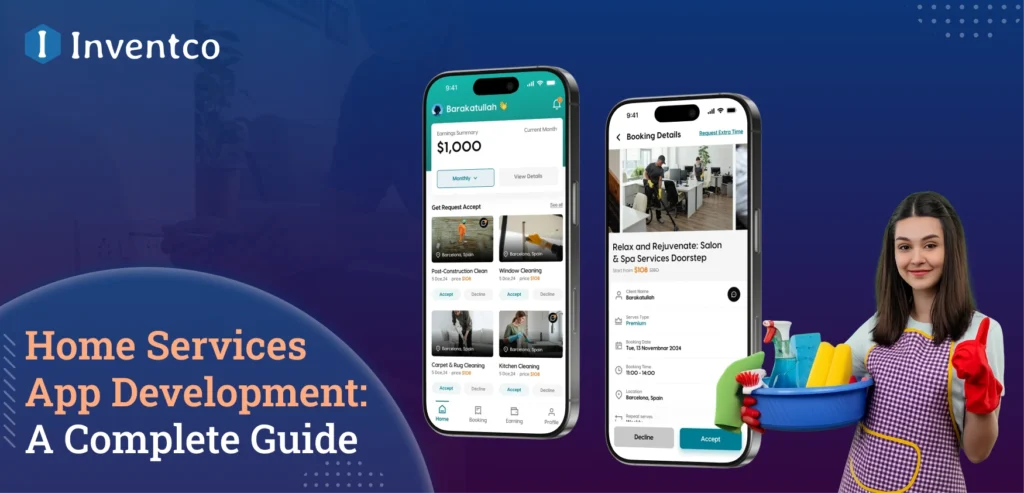
Whether it’s fixing a leaky faucet, servicing an air conditioner, or booking a deep clean, consumers no longer want to spend hours finding a trustworthy professional to do the task. What they want is a platform on their mobile phones where they can pick a suitable appointment time, pay online, and monitor the process in real time.
The businesses have also realized that using phone calls, spreadsheets, and appointments to make reservations will not be feasible. They want confirmation of reservations as well as details regarding costs and payment options.
Due to the increasing need in this industry, numerous start-ups and established businesses are developing applications for home services. This could be service markets that deal with different cities or service providers in different cities.
But creating a platform like that involves a lot more than coding. Everything you decide, be it related to choosing the right business model or improving your booking system, affects the way customers view your brand. Before embarking on your journey to create an on-demand home services app, here you will find out everything about it, ranging from various app types and their features, the development process, costs, and challenges most businesses encounter.
What Is a Home Services App?
A home services app is a type of application where clients have the ability to hire and pay for professional services through digital means without having to call or visit the service centers. From selecting a service to scheduling an appointment, paying for it, and giving reviews after the completion of the task, all happens in the application.
This app is designed to take care of the whole process of service management as opposed to traditional company websites. The consumer has direct communication with the service provider, compares various professionals, rates them, and gets booking updates. The professional uses a dedicated dashboard to manage their earnings and appointments.
These services are beneficial for entrepreneurs because these processes are made much easier compared to those that were conducted manually previously. Instead of scheduling appointments via telephone calls or messages, all of these actions can be conducted in a centralized manner using an admin panel where all the work is completed.
The success of platforms like Handy, Urban Company, and TaskRabbit proves that convenience often matters more to customers than price alone. People are ready to pay for convenience when finding reliable professionals, especially if there is no need to deal with unpredictability anymore.
As customer needs change over time, most companies are now incorporating features like AI-based scheduling, automation, and intelligent suggestions for service within their apps. This trend makes home service app development services increasingly important for companies seeking to remain ahead of the competition.
Types of Home Services Apps You Can Build
The home services industry incorporates a variety of business models, each catering to unique consumer needs. While some businesses focus on a single service category, others build multi-service marketplaces that connect customers with professionals across many trades. Selecting a suitable business model will be determined by several factors.
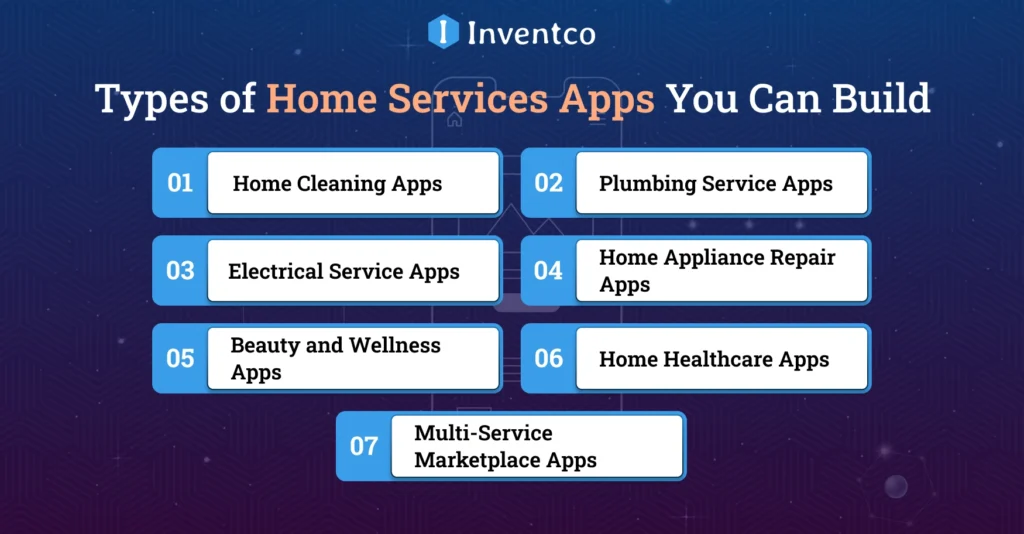
1. Home Cleaning Apps
Cleaning services are one of the most popular services that people book through these on-demand apps. People are able to book appointments not only for general cleaning but also for deep cleaning, carpet cleaning, and move-in and move-out services through these apps. The convenience of being able to choose their own convenient time slots and book certified professionals is the reason why this category is growing at an unprecedented rate within the home service apps.
Apart from that, for the business owners, these apps have created avenues for generating recurring revenue because of the weekly or monthly subscription plans.
2. Plumbing Service Apps
Plumbing emergencies are mostly unexpected events; hence, timing is an important component that determines the success of a plumbing application. Customers do not have to look for plumbers near them and make various phone calls since they will be able to communicate instantly with licensed plumbers to book appointments.
Some of the key features of the application include location tracking of plumbers, upfront pricing, and online payments.
3. Electrical Service Apps
Electrical service apps link customers with qualified electricians for electrical work, installations, and maintenance purposes. Should one be required to install new lighting, fix wiring faults, or restore power after an outage, such apps make things easy for them.
Even business establishments incorporate appointment reminder services, invoice payments, and warranties to instill trust among their customers.
4. Home Appliance Repair Apps
Demand for quick and effective repair services has been on the rise because of reliance on such equipment. Users can use this application to arrange for the relevant technicians to repair their air conditioners, fridges, washing machines, ovens, TV sets, and other domestic appliances.
Customers appreciate the simplicity of comparing service providers, estimating costs of repairs, and even monitoring the arrival of the technicians.
5. Beauty and Wellness Apps
Services related to beauty and wellness have gone past the confines of the salon. Many people have started booking their hairdresser, makeup artist, masseuse, and esthetician directly from their homes. The increasing demand for apps providing on-demand home services has been an effect of this development.
Flexible scheduling, safe payments, and customer reviews are some of the features that need to be included in this type of app.
6. Home Healthcare Apps
The relevance of healthcare services within the sphere of on-demand services is increasing. Nurses, caregivers, physiotherapists, and many other healthcare specialists can be hired using special software without even stepping inside a hospital or a clinic.
It is vital for any company that creates applications for home health care to keep in mind that the issue of data security and communication should be taken into consideration.
7. Multi-Service Marketplace Apps
Instead of limiting themselves to any single type, many companies opt for creating a marketplace that includes several types of services through a single application. The customers will be able to book electricians, plumbers, cleaners, painters, pest control service providers, and other appliance service providers using only one application.
Such an approach works best because it helps in creating a customer for life. Once a person uses the services through one application, there are higher chances that they will continue coming back to the same place for all other kinds of services.
Popular On Demand Home Service Apps
It is not about the amount of services a home services application provides that makes it successful. The best applications stand out due to the way they provide access to the services by making it convenient for the user and eliminating the typical inconveniences of using the services. Quick response, clear pricing, verified professionals, and good customer support are common now.
When developing your own home services application, analysis of existing successful applications will be useful.
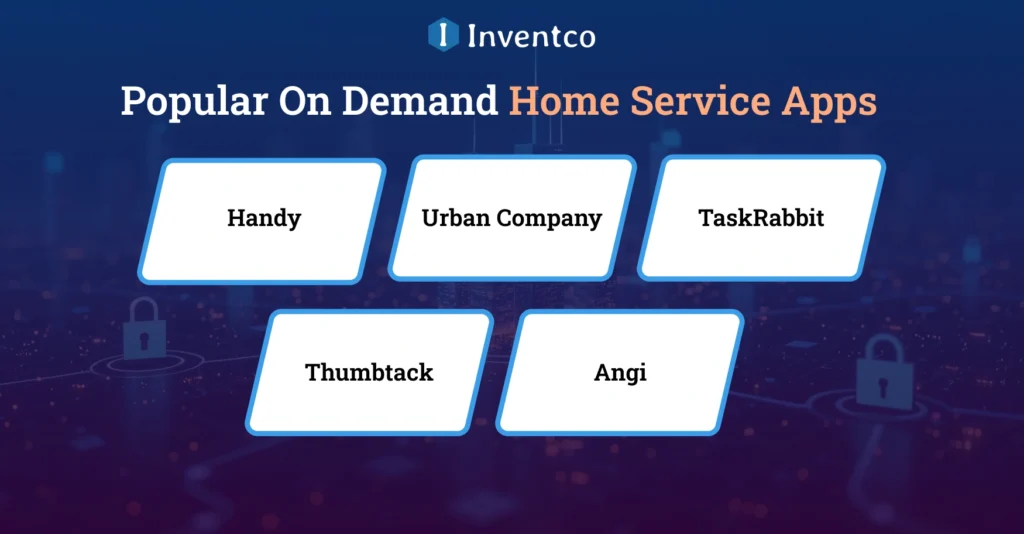
1. Handy
Handy is one of the best-known brands when it comes to home service providers. The service mainly deals with cleaning, assembling furniture, plumbing services, electrical work, and handyman work. It allows you to book your expert in minutes, see the pricing in advance, and pick a time that works for you.
Simplicity in booking is one of the biggest strengths of Handy. Instead of giving you too much choice, it makes sure that the entire booking process is kept simple.
2. Urban Company
Urban Company is a revolution in the market of home services, as it has introduced various categories of services in a single app. Whether it’s beauty care, appliance repair, house cleaning, or plumbing, the app has provided a complete ecosystem for home services.
With the help of professional training, standard pricing, and quality assurance, Urban Company has been able to extend its reach in various countries. On-demand home service app development companies take inspiration from Urban Company’s market platform model.
3. TaskRabbit
It is different when it comes to the area of residential services. TaskRabbit is an online service connecting people with professionals who help them move furniture, mount televisions, assemble things, and organize their houses. It is not just about repairing and maintaining things.
This shows that a focused niche combined with genuine problem-solving can be just as powerful as a broad multi-service model.
4. Thumbtack
Thumbtack allows consumers to find professionals in hundreds of categories, including home improvement, renovations, photography, and health-related services. Instead of giving consumers a choice from a list of set services, it allows them to find the most appropriate professional according to their requirements and compare and contrast different prices.
This business model is especially suitable for regions where consumers like to compare different professionals before making the final decision.
5. Angi
Angi (formerly Angie’s List) has built up a good reputation in helping homeowners find reputable service providers and contractors. This website is preferred for large-scale renovations because it gives priority to customer reviews, certified companies, and cost estimates.
Angi proves that trust and transparency can be important factors that distinguish one company from another in a highly competitive environment when launching personalized home services applications.
Must-Have Features for a Home Services App
The best home service apps don’t succeed because they include every possible feature. They succeed because every feature solves a real problem for the customer, the service provider, or the business itself. When planning your application, the goal should always be to simplify the experience rather than complicate it.
1. Customer Features
The customer journey starts right after opening the app. If customers face difficulties finding services or making bookings, they will not come back. This is why the booking process needs to be seamless throughout the entire journey.
Customers should register within seconds, choose the required service, compare service providers, set preferred dates and times, and make payments without any complications. The presence of live tracking, booking history, and notifications about the booking will make sure that customers stay informed at all times while decreasing support calls.
The reviews and rating feature is another crucial component. Being humans, customers will always check if the person they are inviting to their place has provided good quality services before.
2. Service Provider Features
Although customers represent the user interface of the platform, professionals are those who will provide the experience. Equipping the professionals with the necessary means is equally important to creating an impressive customer interface.
Professional users need a dashboard that helps them manage their bookings, update availability, accept or reject bookings, communicate with customers, and check their earnings. Full visibility for professionals on their daily schedules enables them to be efficient and minimize scheduling issues.
There are various modern platforms that also offer route optimization, invoicing, and analytics. Such solutions not only improve the efficiency of professional users but also create better connections with customers.
3. Admin Panel Features
Every well-operating marketplace has a backend management tool that ensures everything works properly in the system. A business owner should have a full overview of the activities of customers, service providers, bookings, payments, and revenue without using several platforms.
A centralized dashboard enables administrators to approve service providers, keep track of bookings, solve customers’ problems, organize marketing campaigns, and create business reports. The more the platform develops, the more important this information becomes.
In addition, many businesses use artificial intelligence tools to analyze data and predict demand, time slots when bookings are expected to be at a maximum, and allocate technicians.
How to Build a Home Service App
Building a successful marketplace isn’t just about choosing a technology stack. It begins long before development starts. The decisions made during planning often have a greater impact on the final product than the code itself.
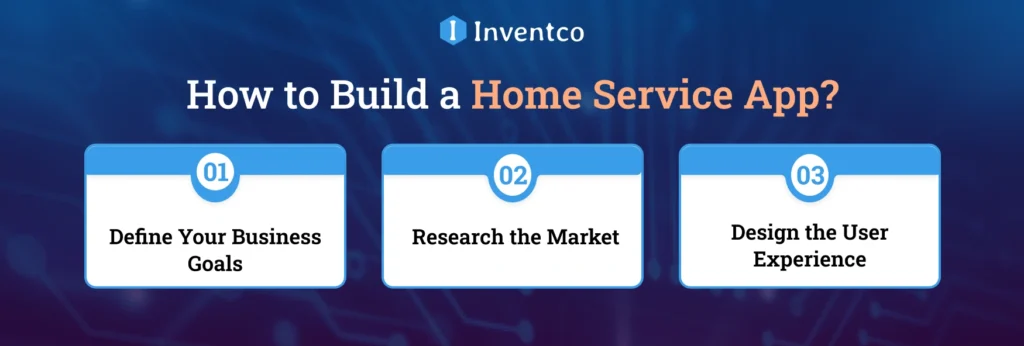
1. Define Your Business Goals
Every product should start with the goal in mind. Even when planning the features and design, it is necessary to comprehend what problem your application is going to solve and for whom it will be built.
Some companies first develop their services in one city and then go to the entire country, whereas some start out with a variety of service types right away. It would be easier not to waste resources on the development process by clarifying your goals early on.
If you are unsure where to begin, understanding the mobile app development process can help you structure your thinking before committing to a roadmap.
2. Research the Market
Competitor analysis does not mean following them blindly. Rather, you need to identify what they are missing.
Take a look at what people write on the forums of platforms such as Handy or Urban Company. More often than not, you will see some issues mentioned repeatedly by dissatisfied customers – booking delays, price fluctuations, and insufficient customer support. Such problems are good areas to set yourself apart.
Market research also entails talking to potential clients and service providers.
3. Design the User Experience
The right design will ensure that even the most complex task seems like a piece of cake to perform. Everything in the design should help customers complete a booking without difficulty.
Instead of cluttering the interface with various elements, pay attention to how you design your navigation system, search capabilities, and checkout procedures. It has been proven that small changes in the design can make big differences in bookings.
In case you are designing the interface, it is quite natural to relate this part to our article on mobile app user interface design.
Home Services App Development Cost
“How much does it cost to develop an app?” is one of the first questions that are raised by people who want to start their projects. While being one of the most important issues to consider, there is no answer that can be applied universally. The nature of your development, its complexity, and the user experience you plan to offer impact the price tag.
As an example, we can mention two projects – the first is about creating a marketplace that works with various services in a number of countries, while the second refers to creating a cleaning service in one specific city. While being home service applications, they are quite different from each other.
It is better to view the cost of development as an investment dependent on various technical and financial factors.
1. The Type of App You Want to Build
The most important determinant of your budget is the kind of platform that you wish to create. A platform with a specific purpose of carrying out plumbing and house cleaning services does not need as many screens and processes as a platform that provides for more service categories.
If you want to build a platform like Handy and Urban Company, then you will need interfaces for your clients, service providers, and administration. The number of panels means a higher cost for the project.
2. Features Have a Bigger Impact Than You Think
It is very common for companies to consider design while doing a cost estimation; however, features have more of an effect on development cost than design considerations.
Building an easy booking process is quite easy. Nevertheless, once you add live tracking for technicians, artificial intelligence recommendations, dynamic pricing, online payments, push notifications, chat, and analytics, the project becomes way more complex.
The main thing is to pay attention to the key features of mobile apps that solve actual customer issues, rather than implementing all of them. Quite a few successful systems were built starting from a minimal set of features.
3. Your Choice of Technology Matters
The technology stack that powers your app affects not only development costs but also scalability going forward. The use of appropriate technology frameworks will enable you to save on maintenance costs and simplify future upgrades.
In the case of new businesses that plan to build their app for both Android and iOS operating systems without having to support two different code bases, cross-platform technology frameworks such as Flutter are increasingly popular. They not only allow you to reduce development times but also ensure consistency of experience across multiple platforms.
For a deeper look at which technologies best suit your use case, the Mobile App Technology Stack guide is a practical starting point.
4. Design Should Never Be an Afterthought
User Experience is usually underestimated in companies. In reality, even if the service is top-notch, people will hardly return to an application that is slow and confusing.
Booking rates and better user retention are often the consequence of focusing on user-friendly navigation, fast booking, and unified visual design. A good interface has a direct effect on company performance, which means it is not only about aesthetics.
It is easy to direct readers to the Mobile App UI Design article if you’re planning to design a product.
5. Plan for Long-Term Growth
Development does not come to an end when your mobile app goes live; instead, it includes updates, optimization, OS compatibility, cloud hosting, and security, among other developments, which form the continuing cost of development.
Organizations that view maintenance as part of their product strategy end up developing their businesses much more steadily than those that view it only in terms of launching it. It is for this reason that it would be good to include post-launch support during budgeting for the initial phase.
Very few companies consider post-launch operations, despite the fact that many companies spend money on the development process alone. Proper maintenance of the application is very important for ensuring the security of the application and ensuring its correct functionality for customers. You can get a clearer idea about how to maintain your app effectively by studying mobile app maintenance.
Challenges of Building a Home Service App
From the outside perspective, all successful marketplaces look very simple, but in fact, they are rather complex systems linking experts, customers, and business processes. Businesses can make better decisions during the development process due to an early understanding of these mobile app development challenges.
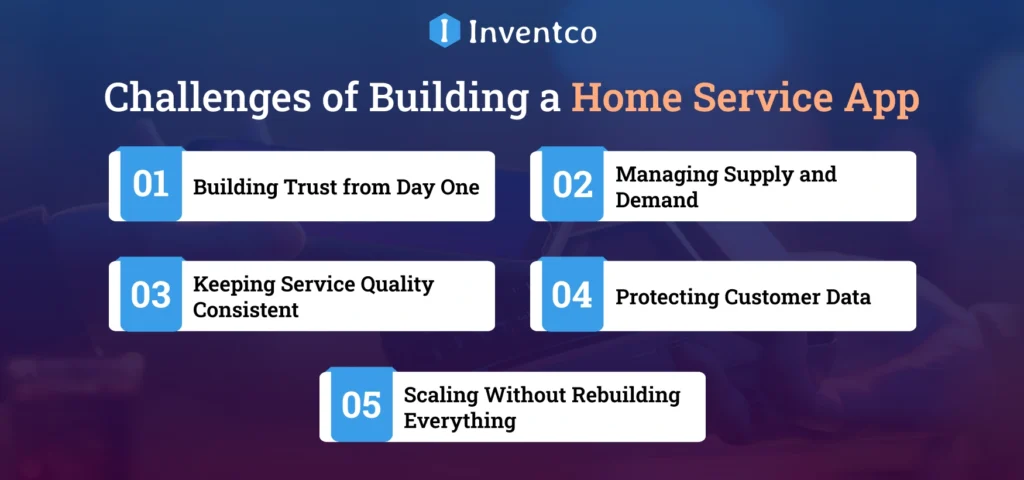
1. Building Trust from Day One
If one does not feel confident about the platform he is using, one does not allow strangers to come to his home. Trust is one of the major factors influencing the success of particular home care agencies as well as the problems some other firms face in keeping their clients.
Trust can be built via verified user profiles, transparent prices, honest customer reviews, secure payment systems, and good customer support services. This list of amenities should now become a standard package for each reservation.
2. Managing Supply and Demand
Striking the right balance between having enough experts online and high customer requests is the most difficult part of managing the marketplace.
On some days, there may be hundreds of customers requesting an electrician, but there are not enough experts online.
Longer waiting times and cancellation rates increase without proper scheduling and effective assignment of technicians.
The customer experience is affected negatively, and eventually this reflects on the reputation of the platform.
Many modern businesses use AI to predict demand and allocate experts better.
3. Keeping Service Quality Consistent
It gets more difficult for you to ensure a high level of service provided by all of your service providers as your organization develops. One poor experience with one of your clients may ruin your carefully-built reputation.
A well-managed marketplace needs to track user experiences, assess the performance of its service providers, and deal with any complaints before they become an issue. The process of quality control evolves with your business.
4. Protecting Customer Data
Customers entrust your app with all kinds of personal details, such as information, addresses, payment details, booking history, etc. Thus, one of the main responsibilities you bear in creating a home service app is security.
Security features like secure authentication, encryption, regular security reviews, and compliance with privacy policies help protect both your customers and your business.
Our article on Mobile App Security Best Practices might be a good reference material for readers who are curious about security features.
5. Scaling Without Rebuilding Everything
While many entrepreneurs may only have an eye out for launching the initial version, not many realize what will happen when the number of bookings shoots up by ten times.
Scalable solutions can handle new categories of services, additional cities, and multiple users at once without having to rework the entire solution from scratch. It is important to make the right architecture decisions right from the beginning to avoid costly development down the line.
Companies interested in home services app development must always think ahead of the MVP app development.
A Real World Approach to Building a Scalable Home Services Marketplace
One of the biggest mistakes businesses make is assuming that a home services app is only a booking platform. In reality, it’s an operational system that has to coordinate customers, professionals, schedules, payments, support, and business analytics at the same time.
A startup approached Inventco with the goal of launching a multi-service marketplace covering cleaning, plumbing, electrical work, appliance repair, and home maintenance. The founders had validated demand through manual bookings, but managing requests over calls and spreadsheets was becoming difficult as the business grew.
Instead of starting with a large feature list, the project focused on the customer journey first. The initial version included service discovery, appointment scheduling, secure payments, provider management, notifications, and a centralized admin dashboard. The objective was simple: make booking a service feel effortless.
Once the platform launched and real customer data became available, additional features were introduced gradually. These included technician availability management, automated booking reminders, performance analytics, and AI-assisted provider allocation. By releasing improvements in phases, the business was able to adapt based on user behaviour rather than assumptions.
The result was a platform that reduced manual coordination, improved booking efficiency, and created a better experience for both customers and service professionals. More importantly, the business gained a scalable foundation that could support expansion into additional service categories and new locations.
This phased approach is often more effective than trying to build every feature before launch. It shortens time to market, lowers initial risk, and allows product decisions to be guided by real customer feedback.

Conclusion
The demand for digital service booking platforms continues to grow because customers increasingly value convenience, transparency, and speed. Whether someone needs a cleaner, plumber, electrician, or appliance technician, they expect to find a trusted professional through a mobile app instead of making multiple phone calls.
Successful home services mobile app development goes beyond creating a booking interface. It requires understanding customer behaviour, building efficient workflows for service providers, choosing scalable technologies, and continuously improving the platform after launch. Businesses that focus on usability, reliability, and long-term operations usually outperform competitors that only focus on launching quickly.
If you’re planning on demand home services app development, start with a clear business model, prioritize the features that solve real problems, and build a foundation that can grow as your customer base expands. The market opportunity is significant, but the platforms that succeed are the ones that deliver a consistently smooth experience for everyone involved.
FAQs
Q1. How long does home services app development take?
Ans: A basic MVP usually takes around three to four months, while a feature-rich marketplace with multiple user panels, payments, tracking, and advanced integrations may take six to nine months or more. The timeline depends on the scope of features, design complexity, and testing requirements.
Q2. What is the best business model for a home services app?
Ans: Many platforms use a commission-based model where the business earns a percentage from every completed booking. Others combine commissions with subscriptions, featured listings, or membership plans to create additional revenue streams.
Q3. Can I build an app similar to Handy or Urban Company?
Ans: Yes. Businesses can develop a marketplace with service discovery, booking, payments, technician management, ratings, reviews, and admin controls. The exact feature set depends on your target audience, budget, and expansion plans.
Q4. Which technologies are commonly used for home services mobile app development?
Ans: Many modern platforms use Flutter or React Native for the mobile frontend, Node.js or Laravel for the backend, PostgreSQL or MongoDB for data storage, and cloud services such as AWS or Google Cloud for hosting and scalability.
Q5. Is AI necessary for a home services application?
Ans: AI is not mandatory, but it can improve operations by helping with technician allocation, customer support, scheduling, demand forecasting, and personalized service recommendations. These capabilities become more valuable as the platform grows.
Q6. How much does it cost to maintain a home services app?
Ans: Maintenance costs vary based on hosting, user traffic, feature updates, security monitoring, and technical support. Most businesses should plan for ongoing maintenance as a regular operational expense rather than a one-time investment.
Q7. What is the first step before building a home service app?
Ans: The first step is validating the business idea. Identify the target audience, service categories, competitor landscape, and revenue model before starting development. This helps avoid unnecessary features and reduces the risk of building a product that doesn’t solve a real market need.

Ajay Bhal
He is an on-demand app solutions expert with 11+ years of experience in business consulting and building scalable, user-centric digital products. He specializes in robust on-demand platforms across industries, combining technical expertise with business-focused strategy to deliver efficient, top notch solutions that drive growth and enhance user experience. You can connect with him on LinkedIn to follow insights.