The global data governance market size was valued at USD 5.38 billion in 2025. The market is projected to grow from USD 5.38 billion in 2026 to USD 24.07 billion by 2034, exhibiting a CAGR of 20.50% during the forecast period. Businesses need to manage the projected 180 zettabytes of data expected to be available worldwide. This projected growth means that for founders and for investors, data will no longer be treated as an output in business, data is the business.
However, companies still take a reactive approach to data management. Data is only prioritized after an incident triggered by failed compliance, an AI training attempt, or a data breach. Global surveys show that almost 70% of companies have experienced a data breach. The cost of getting governance wrong shows up in delayed funding rounds, failed due diligence, and AI models trained on data nobody can fully explain.
Estimations of the cost to build a data governance framework for a small to medium enterprise-grade framework are between $10,000 to $25,000. Estimates for a large framework that targets governance across multiple regions are over $100,000. The cost is based on data, how it is regulated, and the tools used.
This guide will help you understand what a data governance framework is, its importance to the risk and valuation of your business, its core building blocks, how it works, and how to build one that grows with your business.
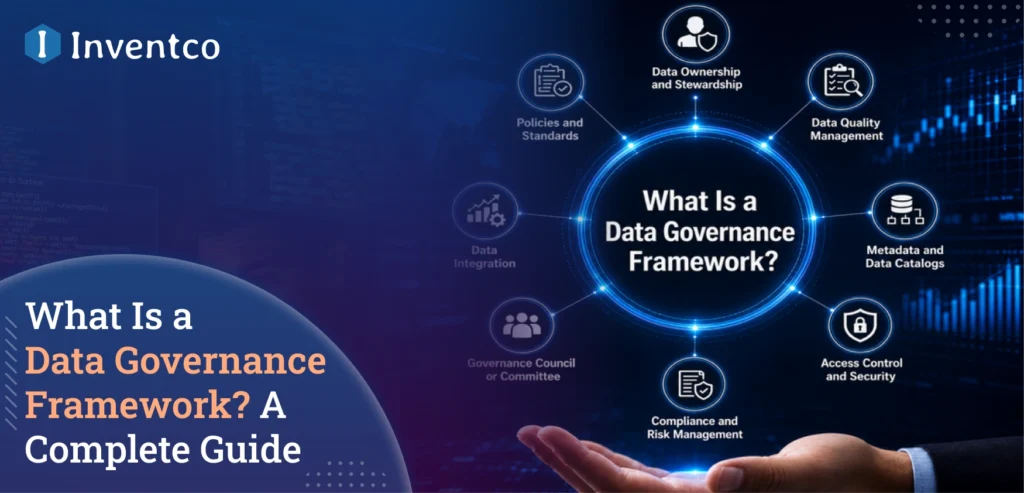
What Is a Data Governance Framework?
Data governance frameworks use policies, standards, roles, and technologies to shape how an organization manages its data. This includes how data is collected, stored, and used. Data governance frameworks focus on four areas of data: ownership, access, integrity, and security.
If you have wondered, “What is a data governance framework?” while considering your company’s preparedness for enterprise sales or a Series B funding round, it is useful to know that this framework is more of an operating model than a software solution.
Data governance frameworks are supported by tools such as data catalogs and data lineage tools. Still, the governance framework is the collection of decisions, responsibilities, and data governance workflows that bring those tools to life. For founders, this distinction matters: buying a governance platform without defining ownership and policy is like buying an ERP system without agreeing on your chart of accounts.
Why Is a Data Governance Framework Important?
Investors are increasingly viewing the level of sophistication in data governance as an indicator of the level of sophistication and discipline in the operation of the organization. A data governance framework that is fully developed and documented will demonstrate an understanding of data assets, data liabilities, and the data governance level of compliance concerning exposed regulations, thereby lessening the time and effort typically required to complete the due diligence process and minimizing risk-related valuation discounts.
Regulatory bodies are aligning their efforts. GDPR, India’s DPDP Act, and industry-specific regulations for banking and healthcare compel businesses to show trust, consent, and accountability, not just good faith.
From the product’s side, every AI or analytics project is as reliable as the data it’s based on. An AI data governance framework makes sure the training data is traceable, bias- checked, and consistent, and this is a priority for the board as much as it is for IT. Governance is no longer a defensive checklist, it actively preserves deal velocity, product trust, and customer credibility.
Core Components of a Data Governance Framework
Every mature data governance framework, regardless of industry, tends to share the same building blocks:
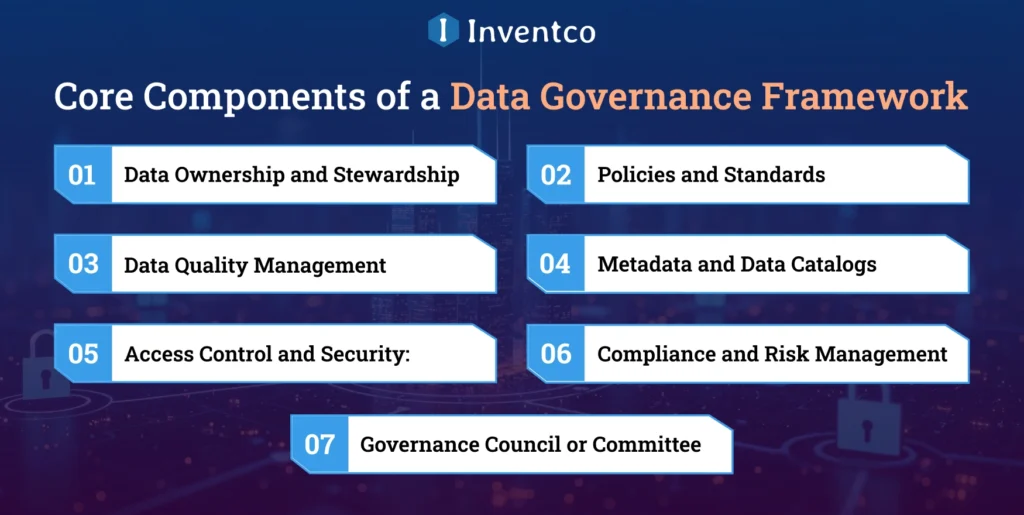
- Data Ownership and Stewardship: Named data owners and stewards are accountable for specific domains (customer data, financial data, product data).
- Policies and Standards: Documented rules for data quality, retention, classification, and acceptable use.
- Data Quality Management: Processes to monitor accuracy, completeness, and consistency across systems.
- Metadata and Data Catalogs: A searchable inventory of what data exists, where it lives, and how it flows.
- Access Control and Security: Role-based permissions aligned to mobile app security and infrastructure security practices, especially where customer-facing apps handle sensitive data.
- Compliance and Risk Management: Mapping of applicable regulations to data handling procedures, with audit trails built in.
- Governance Council or Committee: A cross-functional body, spanning legal, IT, and business leadership, that resolves policy conflicts and prioritizes initiatives.
Together, these components form what most practitioners mean by the general data governance framework definition: a system that connects people, policy, and technology around a single source of truth.
Typical Cost Tiers for a Data Governance Framework
Much like the cost to build a mobile app varies with complexity, data governance investment depends on business size, compliance needs, and scope, typically ranging from $10,000 to $100,000+.
| Tier | Best For | Typical Investment |
| Starter / SME | Startups and small businesses implementing governance for a single data domain | $10,000 to $25,000 |
| Growth | Growing organizations managing multiple data domains and preparing for audits or funding | $25,000 to $60,000 |
| Enterprise | Large enterprises operating across multiple regions or regulated industries such as BFSI and healthcare | $60,000 to $100,000+ |
How Does a Data Governance Framework Work?
In practice, a data governance framework operates as a continuous cycle rather than a one-time project. It begins with discovery, cataloging every data source across cloud, on-premises, and third-party systems, followed by classification based on sensitivity and business value. Ownership is then assigned at the domain level, and policies are codified into workflows that systems can actually enforce, not just documents that sit in a shared drive.
Data governance frameworks incorporate classification and accessibility measures of data into frameworks. This incorporates a governance model that governs new data as it is ingested, as opposed to retrofitted governance. An organization that implements an AI-first governance model incorporates governance models that govern AI training datasets, model governance, and artificial intelligence model drift.
The council maintains data quality and revises policies to reflect business needs. This creates a governance model that operates like a routine. This seamlessly incorporates governance into engineering cycles and operations, which is something teams are already doing by tracking shifts and changes in applications. Therefore, integrating governance into existing operations is a valuable use of time and resources.
Key Benefits of Implementing a Data Governance Framework
The benefits of implementing a data governance framework build on one another over time. The initial rewards of implementing the framework tend to have an operational focus. Teams eliminate the duplication of efforts to identify the accurate data point. With governed data, business teams no longer have to resolve the discrepancies in data that is documented in self-managed spreadsheets. The data governance framework also helps teams build comprehensive, traceable records to support internal and external audits.
For organizations with an active or planned mobile app, data governance supports the business justification of additional mobile app features. With a data governance framework, product teams are more confident in the data and behavioral data that support product decisions.
From an investment standpoint, well-maintained and traceable data supports more rapid financial and technical due diligence. This has a direct positive impact on the valuation of an organization. With the increasing regulatory scrutiny, data governance also helps organizations manage the reputational risk of biased and unreliable model outputs of AI.
Common Challenges in Data Governance
Even well-resourced teams run into predictable friction. Ownership ambiguity is the most common: data crosses departmental lines faster than accountability does, and without a named steward, quality issues get deprioritized indefinitely.
Legacy systems and disconnected tools create challenges for implementing a cohesive big data governance framework because tracking data lineage needs to connect app frameworks for both decades-old systems and modern cloud data warehouses.
Change is often met with resistance, especially in an environment with a “compliance first” mentality. Good governance leadership focuses on revenue opportunities to present less resistance to the adoption of governance frameworks.
The lack of investments in change management impacts the adoption of governance. Standards change, but frameworks become “business as usual” without the training to understand the why behind the change, resulting in a decrease in framework adoption.
Best Practices for Building an Effective Data Governance Framework
Founders asking how to create a data governance framework should start narrow and prove value before scaling. Begin with one or two high-impact domains, customer data or financial data are common starting points, rather than attempting an organization-wide rollout in one phase.
Assign named owners early, even before tooling is finalized, since accountability is the harder problem to retrofit. Choose data governance framework tools that integrate with your existing stack rather than forcing a parallel system; most modern platforms plug directly into cloud data warehouses and BI tools.
Tie governance metrics to business outcomes, data quality scores, audit readiness, and time-to-insight so leadership sees governance as a performance lever, not overhead. And build in a regular review cadence, since a data protection governance framework that isn’t revisited against new regulations or new data sources will drift out of compliance within a year.
Data Governance Framework vs. Data Management vs. Data Architecture
These three terms are frequently used interchangeably, which creates confusion at the leadership level. Data governance defines the policies, ownership, and accountability, essentially the rules of the road.
Data management is the operational execution of those rules: the day-to-day work of storing, integrating, and maintaining data. Data architecture is the technical blueprint, the systems, pipelines, and infrastructure that data management runs on.
| Aspect | Data Governance | Data Management | Data Architecture |
| Primary Focus | Policies, ownership, accountability, and compliance | Day-to-day data operations and lifecycle management | Technical design of data systems, platforms, and infrastructure |
| Key Question | Who owns the data and who is accountable for it? | How is data collected, stored, secured, and maintained? | How does data move across systems and applications? |
| Owned By | Governance council, Chief Data Officer (CDO), or data leadership | Data management, IT, and database administration teams | Data architects, engineering teams, and solution architects |
| Main Goal | Ensure data quality, security, compliance, and business trust | Keep data accurate, available, and operational | Build scalable, secure, and efficient data ecosystems |
| Examples | Data ownership policies, access controls, and compliance standards | Data integration, backups, cleansing, ETL processes | Data warehouses, data lakes, cloud architecture, data pipelines |
A useful way to frame it for a board or investor conversation: architecture is the road itself, management is the traffic system running on it, and governance is the law that decides who is allowed to drive, at what speed, and with what documentation.
Industries That Benefit Most from Data Governance
Some data governance frameworks, such as a bank’s data governance framework, are further along than others. This is a result of data governance and protection regulations, as well as trust requirements, being greater in some sectors. Banks are often required to have data lineage and data access controls due to requirements of regional data governance laws and the Basel Accords.
Healthcare organizations process patient data within compliance security frameworks like HIPAA. For these organizations, the intersection of patient data governance and compliance frameworks will see similar challenges. Multi-tenant architectures mean that customer data is being processed in various jurisdictions. As a result, many Enterprise SaaS companies require an Enterprise Data Governance framework.
Retail and e-commerce companies are able to govern customer data in order to create personalized and targeted customer journeys while remaining compliant with data protection and privacy laws. Companies that develop mobile applications to process payments or handle health or location data are governed by the same requirements as the data they process.
Future Trends in Data Governance
Data Governance will be a more automated and integrated function of data management. There will be less reliance on manual processes, such as tagging and cataloging, due to advancements in AI and other related technologies. Additionally, the governance of AI and the data it consumes will become a standard practice.
Data sovereignty and a growing concern for the protection of data will increasingly require organizations to implement data residency requirements. As more no-code and low-code solutions are adopted, governance frameworks will be created to manage the data created by business teams outside of the IT departments.
Why Choose Inventco for Data Governance Solutions?
Inventco works with founders and enterprise teams to design data governance frameworks that hold up under investor due diligence and regulatory scrutiny, without slowing down product velocity.
We combine governance strategy with delivery. We design access controls linked to the mobile apps’ security and track data lineage across both cloud and legacy systems. Our approach ensures that regulatory governance flexibility aligns with your app development frameworks and roadmaps. It avoids the need to address governance as a separate issue to be integrated post facto.
We take the same consultative, business-first approach to your project as we have for enterprise-focused fintech, healthcare, and SaaS clients, whether you are formalizing governance for an upcoming funding round or upgrading an existing enterprise-focused MVP mobile app.

Conclusion
A well-designed data governance framework is no longer optional for organizations that want to scale with confidence. It creates a foundation for trusted data, stronger compliance, better decision-making, and AI readiness while reducing operational and regulatory risks. Whether you are a startup preparing for growth or an enterprise managing complex data ecosystems, governance ensures your data remains secure, accurate, and business-ready.
At Inventco, we help businesses build scalable data governance frameworks that align with their mobile app technology stack, goals, and compliance requirements. From strategy and implementation to ongoing mobile app maintenance, our experts ensure your governance program supports innovation, strengthens customer trust, and delivers long-term business value.
FAQ’s
Q1. What is a data governance framework in simple terms?
Ans. It is the set of policies, roles, and processes that determine who owns, accesses, and is accountable for an organization’s data, supported by tools that enforce those rules consistently.
Q2. What are examples of a data governance framework?
Ans. Common data governance framework examples include DAMA-DMBOK, the DGI framework, and custom frameworks built by consulting partners that combine governance councils, data catalogs, and access controls tailored to a specific industry.
Q3. Can consultants help build data governance frameworks?
Ans. Yes. Experienced consulting partners help define ownership models, select tools, and align frameworks to industry-specific regulations, which is often faster and lower-risk than building governance capability entirely in-house from scratch.
Q4. How is an AI data governance framework different from a traditional one?
Ans. An AI data governance framework extends traditional governance to cover training data lineage, model bias monitoring, and explainability requirements, which sit outside the scope of most legacy governance programs.
Q5. How long does it take to implement a data governance framework?
Ans. A focused, single-domain rollout can show measurable results within three to four months, while an enterprise-wide framework across multiple business units typically takes nine to eighteen months to mature fully.
Q6. Do small businesses need a data governance framework?
Ans. Yes, though scoped differently. Even early-stage companies benefit from basic ownership and access policies, since retrofitting governance after a funding round or enterprise deal is significantly more expensive than building it in early.

Sandeep Agrawal
Sandeep Agrawal is the visionary CTO at Inventco, bringing innovation to life through his technical expertise. With a passion for cutting-edge technologies, Sandeep leads the team in developing robust solutions. His dedication and continous efforts to pushing the boundaries of what’s possible defines his role as a transformative and innovative force in the tech industry. You can connect with him on LinkedIn to follow insights.