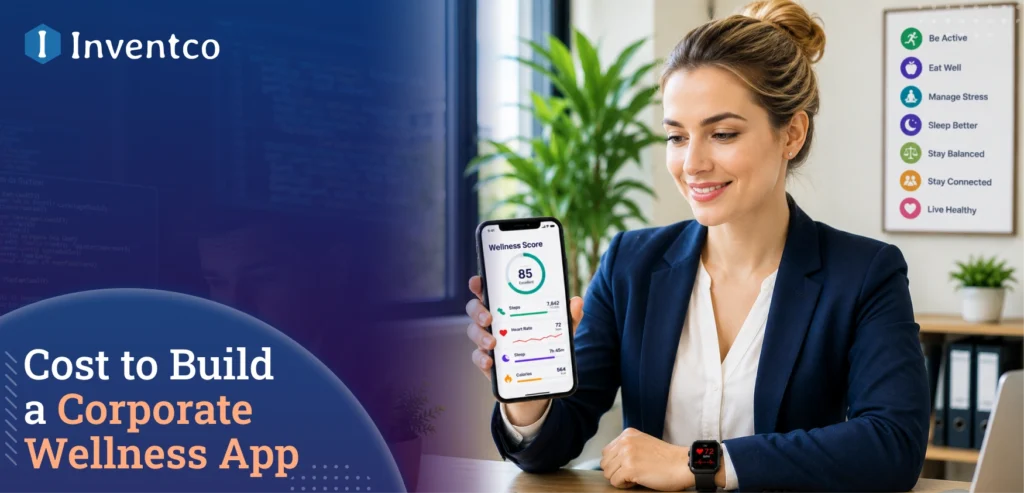
Employee burnout, rising healthcare premiums, and the shift to hybrid work have moved corporate well-being from an HR line item to a boardroom priority. Market data highlights the scale of this shift: the global corporate wellness market is valued at roughly $72.73 billion in 2026 and is projected to climb to $138.37 billion by 2035, growing at a compound annual rate of 7.36%, with North America alone accounting for more than 40% of global revenue.
Much of this growth is being driven by AI-powered personalization, digital mental health support, and wearable integration, highlighting the growing role of mobile apps in modern corporate wellness programs. The growing role of AI in the fitness industry is also influencing how wellness platforms personalize recommendations, track progress, and engage employees. Instead of relying solely on traditional wellness newsletters and resources, organizations are increasingly using mobile platforms to deliver personalized, accessible, and trackable employee wellness experiences.
Many organizations still manage employee wellness through disconnected tools, a fitness benefit here, an EAP platform there, and separate systems for rewards or health tracking. This fragmented approach can make it difficult for employees to stay engaged and for HR teams to measure overall program performance. A corporate wellness app brings these experiences together in a single platform.
So, how much does it cost to build one? In 2026, a corporate wellness app can range from around $10,000 for a focused MVP to $100,000+ for an enterprise-grade platform with advanced features such as wearable integrations, AI-powered coaching, and multi-country compliance. The final cost depends largely on the features, integrations, technology stack, compliance requirements, and development approach.
This guide breaks down what a corporate wellness app actually is, the features that make it worth using, a realistic step-by-step build process, a transparent app development cost breakdown, and the compliance groundwork you cannot afford to skip so you can plan your investment with the same rigor you’d apply to any other enterprise-scale product decision.
Key Takeaways
- The global corporate wellness market is projected to reach $138.37 billion by 2035, and digital, app-based delivery is the fastest-growing segment within it.
- Corporate wellness app development cost typically ranges from $10,000 for an MVP to $100,000+ for an enterprise platform with wearables, AI coaching, and multi-region compliance.
- The features that drive real engagement are health risk assessments, wearable and EAP integrations, gamified incentives, and manager-facing analytics dashboards – not just step counters.
- HIPAA, GDPR, and SOC 2 alignment are non-negotiable from day one, not a post-launch retrofit, since these apps handle sensitive personal health data.
- Choosing an employee wellness app development company with healthcare-grade security experience reduces both build risk and long-term compliance liability.
What Is a Corporate Wellness App?
A corporate wellness app is a mobile or web-based platform that lets employers deliver, track, and measure employee health and well-being programs from a single, branded interface. Instead of employees juggling a fitness tracker app, a separate mental health portal, and an HR benefits site, everything sits inside one experience: physical activity, nutrition, mental health support, financial wellness, and preventive care all reporting back into a single analytics layer that HR and benefits teams can act on.
This distinguishes a true corporate wellness platform from a consumer fitness app. Consumer apps optimize for individual habit change; corporate wellness apps optimize for organizational outcomes: lower absenteeism, better retention, reduced insurance claims, and measurable participation across departments and locations. That difference in objective is exactly why the underlying architecture, integrations, and compliance requirements look very different, and why treating this as “just another fitness app” is the most common and costly planning mistake we see.
While corporate wellness platforms cover a broader range of employee needs, their fitness component often follows the same principles involved in creating a fitness app, including activity tracking, personalized goals, and user engagement.
Key Features of a Corporate Wellness App
The mobile app feature set is where most wellness apps either earn daily engagement or get uninstalled within a month. The table below outlines the core capabilities we recommend prioritizing, based on what actually drives sustained employee participation across the enterprise programs we’ve built.
| Feature | Why It Matters |
|---|---|
| Health Risk Assessment (HRA) | Establishes a baseline health profile per employee and personalizes recommendations from day one. |
| Fitness & Activity Tracking | Syncs steps, workouts, and vitals from wearables like Fitbit, Yuka, Apple Watch, and Garmin for real-time engagement. For wellness programs that include one-to-one coaching, features commonly found in personal trainer app development can also support trainer-led fitness experiences. |
| Mental Health & EAP Integration | Connects employees to teletherapy, guided meditation, and crisis support directly inside the app. |
| Nutrition & Habit Coaching | Provides personalized nutrition guidance, meal recommendations, and habit-building nudges based on individual health goals and preferences. |
| Gamification & Leaderboards | Team challenges, streaks, and point-based rewards convert one-time sign-ups into daily active users. |
| Incentives & Rewards Engine | Ties program participation to insurance premium discounts, gift cards, or PTO credits. |
| HR & Admin Analytics Dashboard | Gives teams a real-time view of participation, engagement trends, and program ROI by department. |
| Telehealth & Appointment Booking | Lets employees schedule preventive screenings or therapy sessions without leaving the app. |
| Push Notifications & Smart Nudges | Behavioral prompts timed around user activity patterns to sustain long-term engagement. |
| Multi-Language & Multi-Region Support | Essential for distributed and global workforces operating under different regulatory regimes. |
It’s also worth noting that these mobile app feature decisions should be made before design begins, not during development. Retrofitting core capabilities after the UI is locked is one of the most expensive mistakes we see in wellness app projects.
How to Build an Employee Wellness App: Step-by-Step
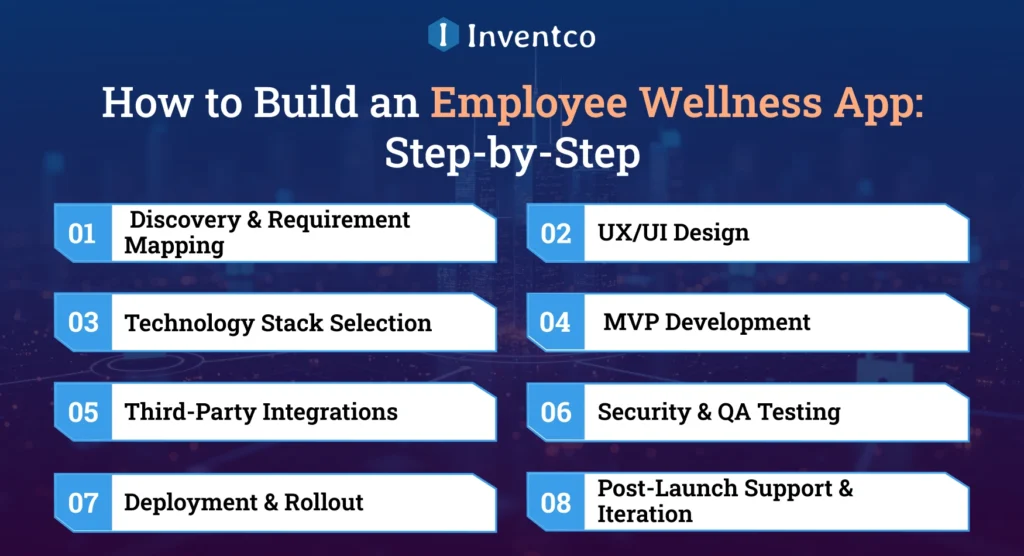
Building a mobile app follows the same disciplined process as any enterprise-grade product, with a few wellness-specific checkpoints layered around data sensitivity and third-party health integrations.
1. Discovery & Requirement Mapping
Every successful corporate wellness app starts with a clear discovery phase. Identify your target workforce, understand the health challenges you want to address, and define measurable business objectives. This is also the right stage to explore AI capabilities and understand how AI can enhance mobile app development. Gather requirements from HR teams, employees, and stakeholders to determine essential features. During this stage, plan integrations with existing HRIS, insurance providers, payroll systems, and Employee Assistance Programs (EAPs). A well-defined roadmap minimizes development risks, prevents costly changes later, and ensures the final solution aligns with both employee wellness goals and organizational priorities.
2. UX/UI Design
A corporate wellness app should encourage employees to return every day, making intuitive UX/UI design a critical success factor. Create an intuitive mobile app prototype with mobile app wireframing, personalized dashboards, and an effortless onboarding process that helps users achieve their first meaningful action within minutes. Accessibility, responsive layouts, and engaging visual elements improve adoption across diverse employee groups. Incorporating motivational features like progress tracking, wellness challenges, and personalized recommendations also increases long-term engagement and enhances the overall user experience.
3. Technology Stack Selection
Selecting the right mobile app technology stack is essential for building a scalable, secure, and future-ready corporate wellness app. Choose development frameworks that support both iOS and Android while enabling seamless integration with wearable devices, HR platforms, telehealth services, and third-party APIs. A modern backend infrastructure should efficiently handle user authentication, health data processing, analytics, and cloud storage. Investing in a flexible architecture from the beginning reduces technical debt, simplifies future upgrades, and supports long-term business growth.
4. MVP Development
Building a Minimum Viable Product (MVP) allows businesses to validate their corporate wellness app before investing in advanced functionality. Focus on essential features such as Health Risk Assessments (HRA), activity tracking, personalized wellness goals, and a basic rewards system. Launch the MVP app with a limited user group, gather feedback, and analyze real engagement data to understand employee behavior. This iterative approach minimizes development costs, accelerates time-to-market, and helps prioritize future enhancements based on actual user needs instead of assumptions.
5. Third-Party Integrations
Third-party integrations significantly enhance the functionality and value of a corporate wellness app. Connect wearable devices like Fitbit, Apple Watch, and Garmin for real-time activity tracking, while integrating HRIS platforms such as Workday and ADP to simplify employee management. Secure connections with insurance providers, telehealth platforms, and Employee Assistance Programs (EAPs) enable employees to access healthcare services without leaving the app. Well-documented APIs ensure reliable data synchronization, scalability, and a seamless user experience across multiple systems.
6. Security & QA Testing
Corporate wellness apps handle sensitive personal and health information, making security and quality assurance essential before deployment. Implement end-to-end encryption, secure authentication, role-based access controls, and compliance with relevant healthcare and data privacy regulations. Conduct mobile app testing, penetration testing, vulnerability assessments, performance testing, and usability testing to identify and eliminate security risks. Thorough quality assurance ensures stable performance across devices while protecting employee data, strengthening user trust, and reducing the risk of costly app security incidents after launch.
7. Deployment & Rollout
A structured deployment strategy helps organizations introduce the corporate wellness app with minimal disruption. Instead of launching company-wide immediately, roll out the application department by department or location by location. This phased approach allows support teams to resolve onboarding issues, monitor adoption rates, and gather employee feedback before expanding the rollout. Training HR teams and communicating the app’s benefits effectively also encourage participation, improve user satisfaction, and increase the overall success of the wellness program.
8. Post-Launch Support & Iteration
Launching the app is only the beginning of a successful corporate wellness program. Continuous monitoring, app maintenance, and feature updates are essential to keep employees engaged over time. Analyze user behavior, participation rates, and wellness outcomes through analytics dashboards to identify opportunities for improvement. Regularly introduce new challenges, personalized recommendations, security updates, and feature enhancements based on employee feedback. Ongoing iteration helps maintain engagement, improves ROI, and ensures the app continues to meet evolving workforce needs.
Understanding the full mobile app development process upfront and where the common mobile app development challenges show up is what separates wellness apps that launch on budget from those that don’t.
How Much Does It Cost To Build A Corporate Wellness App?
The cost to build a corporate wellness app typically ranges between $10,000 and $100,000+, depending on the app’s features, third-party integrations, security requirements, and regulatory compliance. The table below highlights the most common development tiers and their estimated investment.
| Tier | Scope | Estimated Cost |
| MVP / Basic | HRA, activity tracking, push notifications, basic admin dashboard, single platform (iOS or Android) | $10,000 – $25,000 |
| Mid-Tier | Wearable integration, gamification, rewards engine, cross-platform framework apps, HR analytics dashboard | $25,000 – $50,000 |
| Advanced | Mental health/EAP integration, telehealth booking, AI-driven personalization, multi-language support | $50,000 – $80,000 |
| Enterprise | Multi-region compliance, HRIS/insurance integrations, advanced analytics, dedicated infrastructure, white-labeling | $80,000 – $100,000+ |
Beyond the tier itself, four factors most often move the final number: the number of third-party integrations (each wearable, EAP, or insurance API adds discovery and testing time), the depth of compliance work required across regions, the number of platforms and languages supported, and whether you need custom AI-based learning versus rules-based recommendations.
Founders comparing vendor quotes should also weigh the total cost to build a mobile app against the specific complexity of a health-data product, a wellness app is rarely priced the same as a generic consumer utility, and any quote that ignores compliance work is likely underscoping the project.
It also helps to view this investment in the context of broader app development trend data: enterprises that treat wellness apps as strategic retention infrastructure rather than a cost center consistently see stronger long-term ROI than those optimizing purely for the lowest bid.
Compliance & Data Privacy in Corporate Wellness Apps
Because a corporate wellness app processes protected health information, biometric data, and sometimes financial wellness details, compliance has to be architected in from the first sprint, not added before launch. At minimum, plan for:
- HIPAA compliance for any U.S. deployment handling protected health information, including business associate agreements with third-party integration partners.
- GDPR alignment for organizations with employees in the EU or UK, covering explicit consent, data minimization, and the right to erasure.
- SOC 2 Type II readiness to satisfy enterprise procurement and security review requirements before a large employer will sign a contract.
- End-to-end encryption for data at rest and in transit, with role-based access controls limiting who inside HR can view individual health records.
- Anonymized reporting options so employers see aggregate participation trends without exposing individual employee health data critical for trust and adoption.
Skipping this groundwork doesn’t just create legal exposure, it directly suppresses adoption. Employees are far less likely to engage honestly with health assessments or mental health tools if they don’t trust how the data is stored and who can see it.
How Inventco Can Help You in Building Corporate Wellness App Development?
Inventco works with founders, HR-tech investors, and enterprise benefits teams to design and build corporate wellness platforms that hold up under real compliance scrutiny and real daily usage, not just a demo. Our teams handle the full lifecycle: discovery, HIPAA/GDPR-aligned architecture, wearable and EAP integrations, and post-launch analytics, so you’re not assembling five different vendors to get one working product.
A relevant example is Dunnnit, a personal growth and challenge-based platform developed by Inventco. The app combines fitness, mindfulness, creativity, and lifestyle challenges with progress tracking, gamification, community engagement, and rewards. Its challenge-based approach shows how wellness-focused digital platforms can use personalized goals, habit building, and engagement features to encourage consistent user participation.
If you’re evaluating the best fitness app development company, look for a partner who can show compliance-grade security work, not just clean UI screens, that distinction is what determines whether your app scales past the pilot stage.
Conclusion
Corporate wellness is no longer a perk, it’s a measurable lever for retention, productivity, and healthcare cost control, and the market’s trajectory toward $138 billion by 2035 confirms employers are backing that shift with a real budget.
Building the right app means treating it with the same rigor as any core enterprise product: clear feature prioritization, a realistic development process, transparent cost planning, and compliance built in from day one rather than bolted on.
Whether you’re a founder building a wellness-tech product or an enterprise leader replacing a patchwork of vendors, the investment pays back fastest when you hire corporate wellness app developers who understand both the engineering and the regulatory stakes involved.
FAQ’s
Q1. How long does it take to build an employee wellness app?
Ans. An MVP typically takes 1-2 months, while a full-featured enterprise platform with multiple integrations and compliance certifications can take 7-10 months from discovery to launch. Factors such as features, integrations, platform choice, and complexity can significantly affect the time required to develop an app.
Q2. What features should a corporate wellness app include at minimum?
Ans. At a minimum, plan for a health risk assessment, activity tracking, push notifications, and an HR-facing analytics dashboard – these four cover the core engagement and reporting loop most programs need on day one.
Q3. Is HIPAA compliance required for a corporate wellness app?
Ans. Yes, if the app handles protected health information for U.S. employees. GDPR applies similarly for EU-based workforces, and both should be architected in from the start rather than retrofitted after launch.
Q4. How do I choose the right employee wellness app development company?
Ans. Prioritize a partner with demonstrated healthcare-grade security experience, prior HRIS and wearable integration work, and a transparent, milestone-based development process rather than the lowest-cost bid.
Q5. How Much Does Corporate Wellness App Maintenance Cost?
Ans. Mobile app maintenance can cost around 15–25% of the development cost annually, covering updates, bug fixes, security, and performance.
Q6. Can an existing wellness app be integrated with our current HR or insurance systems?
Ans. Yes. Most modern wellness platforms are built with API-first architecture specifically so they can connect to HRIS platforms like Workday or ADP, along with insurance carrier systems, without requiring a rebuild.

Ajay Bhal
He is an on-demand app solutions expert with 11+ years of experience in business consulting and building scalable, user-centric digital products. He specializes in robust on-demand platforms across industries, combining technical expertise with business-focused strategy to deliver efficient, top notch solutions that drive growth and enhance user experience. You can connect with him on LinkedIn to follow insights.