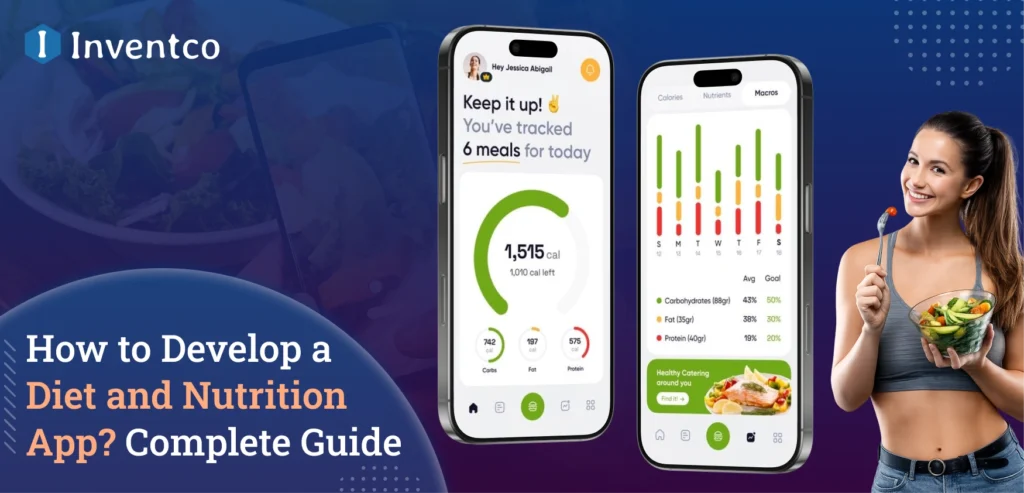
The digital health market is changing. Instead of generic advice, consumers increasingly expect personalized, practical nutrition guidance designed to their individual needs. The global diet and nutrition apps market size was valued at USD 2.14 billion in 2024 and is expected to reach USD 4.56 billion by 2030, growing at a CAGR of 13.4% from 2025 to 2030. This is due to the combination of an increase in the prevalence of obesity and lifestyle diseases and the greater awareness of the need for health among the global population.
For founders and investors, this represents an opportunity to engage consumers in a fast-growing digital health ecosystem. This offers the potential for highly profitable subscription-based app monetization models with excellent customer retention. From B2C fitness apps targeting everyday consumers to B2B clinical nutrition platforms serving hospitals and enterprise wellness programs, the addressable market spans multiple verticals.
A good idea alone does not build a successful app, and the development of a nutrition app is even more complex with the appropriate combination of regulatory features, artificial intelligence, and infrastructure. The cost of ai app development can fall anywhere between $10,000 and $100,000, depending on a variety of factors.
This guide will help decision-makers in every phase of the development process, including the selection of technologies stack, estimation of costs, and the benefits of engaging with an experienced nutrition app development firm in order to enhance the time-to-market value.
Key Takeaways
- Diet and nutrition apps range from calorie trackers to AI-powered personalized nutrition platforms.
- Core features include food databases, macro tracking, meal planning, wearable sync, and AI-driven meal suggestions.
- Nutrition app development cost typically ranges from $10,000 to $100,000+, depending on complexity.
- Inventco delivers end-to-end diet and nutrition tracking app development with HIPAA-compliant infrastructure.
What Is Diet and Nutrition App Development?
Developing diet and nutrition apps is a type of health app development that helps users track food intake, monitor and log nutrition data, plan daily or weekly meals, and set personalized health goals. These apps combine health tech, data tech, and behavioral science.
Unlike generic fitness apps, nutrition tracking app development requires integration with comprehensive food databases, real-time macro and micronutrient analysis, wearable device connectivity, and increasingly, AI-driven personalization engines. Modern nutrition apps are clinical-grade products, not simple calorie counters.
For investors and app developers alike, this category has significant monetization opportunities. These include subscriptions, integration of dietitians, corporate wellness programs, and white-label products for health care and insurance companies.
Types of Diet and Nutrition Apps You Can Build
Before committing to a development roadmap, founders must align the product type with the target audience and revenue model. Here are the primary categories shaping the nutrition app landscape in 2026:
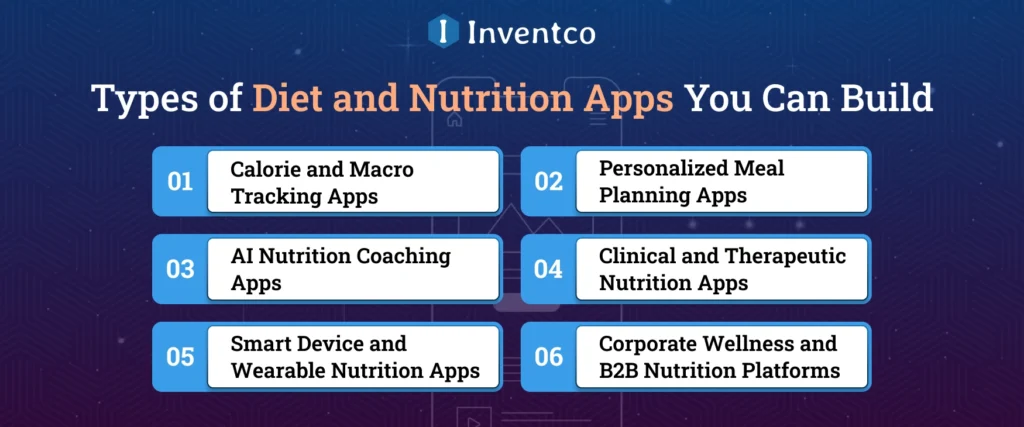
1. Calorie and Macro Tracking Apps
Target Audience: General consumers, fitness enthusiasts, and people managing their weight
The original category of nutrition apps. Users log their food or scan barcodes to track calories and macronutrients. Apps like Yuka are the market leaders. The next generation of these apps will use AI to recognize food, eliminating the need for users to manually enter their meals.
2. Personalized Meal Planning Apps
Target Audience: Premium Wellness, Chronic Disease Clientele, Health-focused adults
These apps design weekly meal plans using user health goals, dietary restrictions and lifestyle habits. Using AI, these apps build and adjust meal plans to reflect user progress, giving rise to a more engaging meal planning app compared to traditional, stagnant diet plans.
3. AI Nutrition Coaching Apps
Target Audience: Premium Wellness Consumers, Corporate Wellness Programs
AI-powered nutrition coaching is becoming one of the most promising ideas for fitness apps. These apps are designed using LLMs, computer vision (to identify foods), and behavioral nudges to provide scalable, real-time nutrition coaching, thus reducing the need for dietitians.
4. Clinical and Therapeutic Nutrition Apps
Target Audience: Healthcare Providers, Hospitals, Insurance Companies, and Pharmaceutical companies
Clinical and Therapeutic Nutrition Apps are designed for patients who require specialized nutrition support as part of managing conditions such as kidney disease, diabetes, eating disorders, or cancer. These apps are HIPAA compliant, clinically validated, and integrate with EHRs/EMRs, therefore, they are able to command significantly more lucrative contracts.
5. Smart Device and Wearable Nutrition Apps
Target Audience: Tech-forward Consumers, Fitness Enthusiasts, and Performance-Focused Individuals
This segment is experiencing rapid growth and focuses on developing smart device apps that integrate with wearables such as the Apple Watch, Garmin, Oura Ring, continuous glucose monitors, and smart kitchen scales to provide real-time optimized nutrition based on an individual’s metabolic state.
6. Corporate Wellness and B2B Nutrition Platforms
Target Audience: Enterprises, Insurance Providers, HR Platforms
These are white-label nutrition platforms designed for corporate wellness programs, combining personalized nutrition support with broader corporate wellness app development initiatives. They can help organizations provide employees with accessible wellness resources while creating recurring B2B revenue opportunities.
Must-Have Features in a Diet and Nutrition Tracking App
Features of mobile apps directly determine development complexity, cost, and time to develop an app. Below is the architecture decision-makers need to evaluate when scoping a nutrition app development project:
| Feature Category | Key Features | Business Value |
|---|---|---|
| Food Database & Logging | Barcode scanning, AI-powered food recognition, 10M+ food database, manual food logging, restaurant meal estimation | Simplifies food tracking, increases user engagement, and reduces manual effort for daily logging. |
| Macro & Micronutrient Tracking | Calorie counting, protein, carbs, fats, vitamins, minerals tracking, real-time nutrition progress dashboard | Delivers personalized nutrition insights and helps users stay aligned with their health goals |
| Personalized Meal Planning | Goal-based meal plans, AI-generated weekly schedules, dietary preference filters, and customizable nutrition plans | Improves user retention through tailored experiences while creating premium subscription opportunities |
| AI Nutrition Coach | Conversational AI chatbot, personalized meal recommendations, goal adjustments, behavioral coaching, nutrition guidance | Creates a competitive advantage by offering intelligent coaching and premium AI-powered services |
| Wearable & Health Device Integration | Apple Health, Google Fit, Fitbit, Garmin, continuous glucose monitor (CGM) integration, calorie burn synchronization | Enhances recommendation accuracy with real-time health data from connected fitness devices |
| Recipe & Grocery Integration | Healthy recipe builder, automatic grocery list generation, grocery delivery API integration, ingredient-based meal suggestions | Improves convenience while unlocking affiliate marketing and grocery commerce revenue streams |
| Progress Analytics Dashboard | Weight tracking, nutrition trend analysis, macro adherence reports, nutrient deficiency insights, weekly/monthly performance reports | Encourages long-term engagement by visualizing progress and reinforcing healthy habits |
| Dietitian Marketplace (Optional) | Verified nutritionist profiles, appointment scheduling, in-app messaging, video consultations, shared meal tracking. | Diversifies revenue through professional consultations while building trust and clinical credibility |
| Smart Notifications & Habit Tracking | Meal reminders, hydration alerts, streak rewards, achievement badges, personalized health notifications | Boosts daily active users (DAUs), improves retention, and strengthens long-term habit formation |
| Security & Compliance | End-to-end encryption, HIPAA/GDPR compliance, biometric authentication, secure cloud data storage | Protects sensitive health data, ensures regulatory compliance, and builds user and investor confidence |
How to Develop a Diet and Nutrition App: Step-by-Step Process
Though it is important to build quality nutrition applications, having a fast time-to-market is equally important when following the mobile application development process. The following steps are the method that Inventco uses during each collaboration with a client.
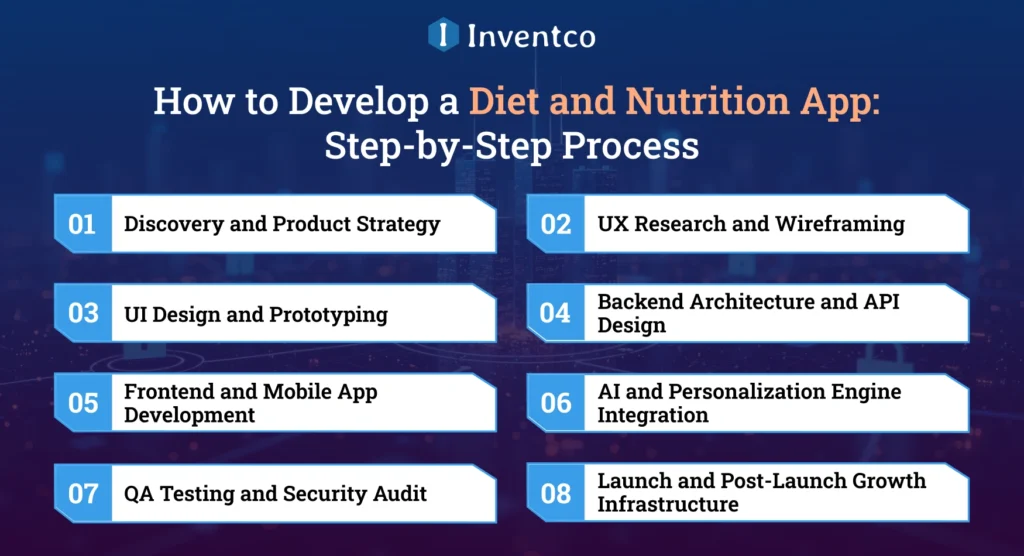
Step 1: Discovery and Product Strategy
Successful nutrition applications focus on the business model and not on the features. For this reason, the first step is a competitive analysis of nutrition applications, target audience, the business model, legal compliance (GDPR/HIPAA), and platform selection (Android vs iOS). If budget and development efficiency are priorities, cross-platform development can be considered. As a result, the first draft of the Product Roadmap (PRD) is created.
Step 2: UX Research and Wireframing
Nutrition applications are based on daily user habits. Therefore, the architecture of the user experience must simplify the food logging process to 30 seconds or less. During the design stage, teams create mobile app wireframes to map out key screens and user flows before moving into usability testing.
Step 3: UI Design and Prototyping
High-fidelity design translates app wireframes into a visual system, color language, data visualization components (progress rings, macro charts), food photography guidelines, and micro-interaction design. A clickable mobile app prototype is validated with target users before a single line of code is written.
Step 4: Backend Architecture and API Design
This step is vital. Decisions on the mobile app technology stack have implications for the ceiling of vertical scalability and the ease of integration. The backend must include an API layer for the dietary data (USDA FoodData, Edamam, or an in-house-developed database), an interface to engage AI/ML services, encrypted storage of user data, and APIs of third-party health platforms. For optimal future flexibility and ease of integration, the backend must accommodate an unrestrictive design for RESTful and GraphQL APIs.
Step 5: Frontend and Mobile App Development
This stage focuses on the choice of mobile app development frameworks. The alternatives chosen will be cross-platform technologies (React Native) or native technologies (Swift, Kotlin). The choice will impact the parity of features, the ability to meet performance benchmarks, and the extent of integration with wearables. The core sprints relate to the creation of the authentication process, the food logging UI, the construction of the macros dashboard, meal planning, and push notification implementation.
Step 6: AI and Personalization Engine Integration
For nutrition apps aimed at premium users, AI can add a more personalized layer to the experience. Computer vision can help recognize foods from photos, while NLP can support conversational nutrition coaching. Recommendation engines can also use a user’s dietary preferences, eating patterns, goals, and progress to suggest relevant meals or adjustments. These AI capabilities in mobile app development can help turn a basic food-tracking app into a more adaptive nutrition platform that responds to how each user’s needs change over time.
Step 7: QA Testing and Security Audit
Mobile app testing at this step involves an exhaustive mobile app security assessment as described, data encryption validation, HIPAA compliance audit (for clinical products), API stress testing, and cross-device compatibility. Nutritional data accuracy testing is also conducted against validated dietitian benchmarks.
Step 8: Launch and Post-Launch Growth Infrastructure
Before launching your mobile app, App Store Optimization, analytics (Mixpanel, Firebase), and A/B testing, along with phased rollout, are set up. After launch, retention metrics are the focus, along with iteration of features based on user behavior data and lessons learned from the MVP mobile app regarding the next development cycle.
Tech Stack for Nutrition App Development
Technology selection should align with scalability requirements, team expertise, and the integration ecosystem. Below is the recommended stack Inventco deploys across nutrition app engagements:
| Technology Layer | Recommended Technologies | Why It Matters |
| Frontend & Mobile Development | React Native, Flutter (cross-platform), Swift (iOS), Kotlin (Android) | React Native and Flutter reduce development costs by 30 to 40%, while native frameworks deliver superior performance for wearable and platform-specific features. |
| Backend & API Development | Node.js, Python (Django/FastAPI), Ruby on Rails | Python is ideal for AI and machine learning integrations, whereas Node.js supports high-concurrency, real-time application performance. |
| Database | PostgreSQL, MongoDB, Redis | A hybrid database architecture enables fast food searches, efficient user activity storage, and low-latency caching for better scalability. |
| AI & Machine Learning | TensorFlow, PyTorch, OpenAI API, Claude API, AWS Rekognition | Supports food image recognition, conversational AI nutrition coaching, and intelligent meal recommendations. |
| Food & Nutrition APIs | USDA FoodData Central, Edamam Nutrition API, Open Food Facts, Nutritionix | Provides reliable nutritional information, branded food databases, restaurant menu data, and clinically accurate food insights. |
| Wearable & Health Integrations | HealthKit, Google Health Connect, Fitbit API, Garmin Connect IQ, Dexcom API, Libre API | Enables synchronization of fitness, biometric, glucose, and activity data to deliver personalized nutrition recommendations. |
| Cloud Infrastructure | AWS (EC2, RDS, S3, Lambda), Google Cloud Platform (GCP), Microsoft Azure | AWS is preferred for scalable, HIPAA-eligible healthcare infrastructure with support for global deployment and high availability. |
| Security & Compliance | AES-256 Encryption, OAuth 2.0, JWT Authentication, AWS KMS, HIPAA, GDPR Compliance | Protects sensitive health information through enterprise-grade security, encryption, and regulatory compliance. |
| Analytics & Performance Monitoring | Firebase Analytics, Mixpanel, Segment, Sentry, Datadog | Tracks user behavior, application performance, crashes, and infrastructure health to support continuous optimization. |
Diet and Nutrition App Development Cost: What to Expect
The cost to develop a diet and nutrition app can range from $10,000 to $100,000+ depending on several factors, including the feature set, AI capabilities, supported platforms (iOS, Android, or cross-platform), third-party API integrations, security requirements, and the location of your development team. Whether you’re building a simple calorie tracker or an AI-powered nutrition platform, the overall budget can vary significantly.
The table below provides a mobile app development cost estimate:
| Project Type | Estimated Cost | What’s Included | Best For |
| Basic MVP | $10,000 to $25,000 | User registration, calorie and macro tracking, food database integration, meal logging, basic dashboard, and single-platform support | Startups validating an idea or launching an MVP |
| Mid-Level App | $25,000 to $60,000 | Personalized meal plans, wearable integrations, recipe management, push notifications, an admin panel, and cross-platform development | Growing health and wellness businesses looking to scale |
| Advanced AI-Powered Platform | $60,000 to $100,000+ | AI nutrition coach, food image recognition, dietitian consultations, advanced analytics, wearable ecosystem, enterprise-grade security, and multi-platform support | Enterprises, healthcare providers, and funded health-tech startups |
Note: These estimates typically include UI/UX design, frontend and backend development, quality assurance, testing, deployment, and project management. Ongoing operational expenses such as cloud hosting, AI model usage, third-party API subscriptions, mobile app maintenance, and feature updates generally range between $500 and $5,000 per month, depending on application scale and user traffic.
Key Factors That Influence Development Cost
- AI and food recognition capabilities: Adding AI-powered nutrition coaching or image-based food recognition can increase the budget by $10,000 to $30,000.
- Healthcare-grade compliance: Implementing HIPAA- or GDPR-ready security and compliance features can add $8,000 to $20,000, depending on regulatory requirements.
- Food database APIs: Services like Edamam, Nutritionix, and similar nutrition APIs may cost $200 to $2,500 per month, depending on API usage.
- Wearable integrations: Supporting platforms such as Apple Health, Google Health Connect, Fitbit, and Garmin increases both development time and integration complexity.
- Cross-platform development: Using React Native or Flutter can reduce development costs by approximately 30% to 50% compared to building separate native iOS and Android applications.
If you’re planning a nutrition app, starting with an MVP allows you to validate your concept, gather user feedback, and expand features over time while keeping initial development costs under control.
Why Choose a Professional Nutrition App Development Company?
The preference for digital fitness app development has attracted a wider range of development companies. However, very few possess the capability to handle the technical and regulatory complexities of nutrition app development.
Here is what will differentiate specialist vendors from commodity development shops:
- Regulatory experience: HIPAA-compliant architecture, GDPR data handling, and clinical-grade data security are not skills that generalist developers acquire on client projects. Mistakes here are expensive, legal liability, data breach costs, and app store removal risk are all real outcomes.
- Food database expertise: Integrating nutritional data is a complex system that ranges from something like USDA and proprietary data, and also needs to include solutions to capture data for regional and international restaurants and branded food.
- AI integration capability: Trust can be gained from users with the accuracy of an ML model, and an agency’s ability to integrate a food photo recognition feature, along with NLP-based coaching and recommendations engines, depends on how deep the agency is in ML engineering.
- Mobile app development challenges: Several integrations of wearables, real-time data sync, and the ability to perform background processes in a battery-efficient and offline architecture are challenges that nutrition app development teams have that knowledgeable teams will anticipate as opposed to discover.
- Post-launch infrastructure: Nutrition apps have a high Day 30 churn risk. A mobile app development partner with product thinking rather than purely technical execution is crucial for product development to embed retention mechanics from day one.
From Our Projects
Inventco has experience building fitness apps and wellness platforms focused on personalized experiences, progress tracking, and user engagement. One example is Dunnnit, a personal growth app featuring customized challenges, reminders, progress tracking, rewards, and gamification.
The platform helps users build consistent habits across areas such as fitness, mindfulness, careers, and hobbies. These same principles can be applied to nutrition apps through features such as personalized goals, habit tracking, progress monitoring, and engagement-focused experiences. We also understand the growing role of AI in fitness app development, particularly in areas such as personalized recommendations, progress analysis, and adaptive user experiences.
How Inventco Can Help You in Diet and Nutrition App Development?
Inventco focuses on building wellness and healthcare apps that incorporate AI and advanced technology. Our team can build your MVP or an advanced nutrition platform and cover the whole development process, integrating your ideas of healthcare into designs, developing the product, performing quality testing, and offering support after deployment.
We develop intelligent nutrition apps with features like AI meal recommendations, food image recognition, personalized diet plans, wearable integrations, and secure cloud infrastructure. Our expertise in HealthKit, Google Health Connect, and enterprise-grade security helps create reliable, data-driven solutions that deliver personalized user experiences while meeting industry compliance standards.
With a product-first approach, Inventco helps businesses build scalable nutrition apps that drive engagement, improve retention, and support long-term growth. From startup ideas to enterprise wellness platforms, we deliver solutions designed to evolve with your business and changing user needs. Connect with our team to share your project requirements.
Conclusion
The diet and nutrition app market in 2026 rewards precision-built products over feature-bloated platforms. Users have higher expectations, app stores have tighter quality thresholds, and the cost of acquiring and retaining a user makes product-market fit a commercial imperative, not just a validation exercise.
Founders and investors who are looking to capitalize on this market need to have a partner that understands retention and the other business factors that will distinguish successful apps from mediocre apps built on core nutrition plans.
FAQ’s
Q1. How long does it take to develop a diet and nutrition app?
Ans. A basic nutrition app takes 3 to 6 months, while advanced AI-powered platforms with wearable integrations and premium features typically require 9 to 12 months.
Q2. What is the cost of nutrition app development?
Ans. Nutrition app development typically costs between $10,000 and $100,000+, depending on features, AI integration, supported platforms, third-party APIs, and compliance requirements.
Q3. What technology stack is best for nutrition app development?
Ans. React Native or Flutter, Python, PostgreSQL, AWS, TensorFlow, and OpenAI APIs provide a scalable, secure, and AI-ready technology stack for nutrition app development.
Q4. Is HIPAA compliance required for a nutrition app?
Ans. HIPAA compliance is required only when your app handles protected health information. Consumer wellness apps may instead require GDPR and strong data security measures.
Q5. Can I integrate AI features into my nutrition app?
Ans. Yes. AI can power food recognition, personalized meal planning, nutrition coaching, and smart recommendations, creating engaging user experiences while improving long-term retention and outcomes.
Q6. What is the difference between a nutrition app and a diet app?
Ans. Nutrition apps provide comprehensive nutrient analysis and personalized guidance, while diet apps mainly focus on calorie tracking, weight management, and achieving specific fitness goals.
Q7. How do I monetize a diet and nutrition app?
Ans. Popular monetization models include subscriptions, dietitian consultations, in-app purchases, affiliate partnerships, corporate wellness programs, advertising, and white-label solutions for healthcare organizations.
Q8. What are the major challenges in diet and nutrition app development?
Ans. Common challenges include maintaining accurate food and nutrition data, protecting user health information, simplifying food logging, integrating wearable and health data, and providing personalized recommendations. Nutrition apps also need to address scalability, performance, regulatory requirements, and other mobile app development challenges.

Jitendra Jain
He is the CEO and Co-founder of Inventco, driving innovation in advanced computing and digital transformation. With deep expertise in modern IT ecosystems, he leads scalable, secure, future-ready solutions. His strategic leadership helps businesses accelerate growth, adopt innovation, and achieve success. You can connect with him on LinkedIn to follow his technology insights.