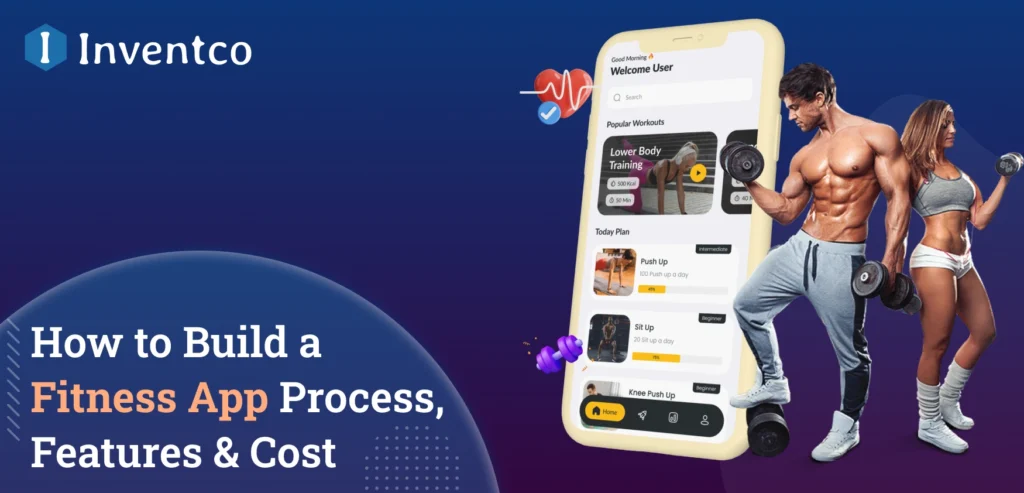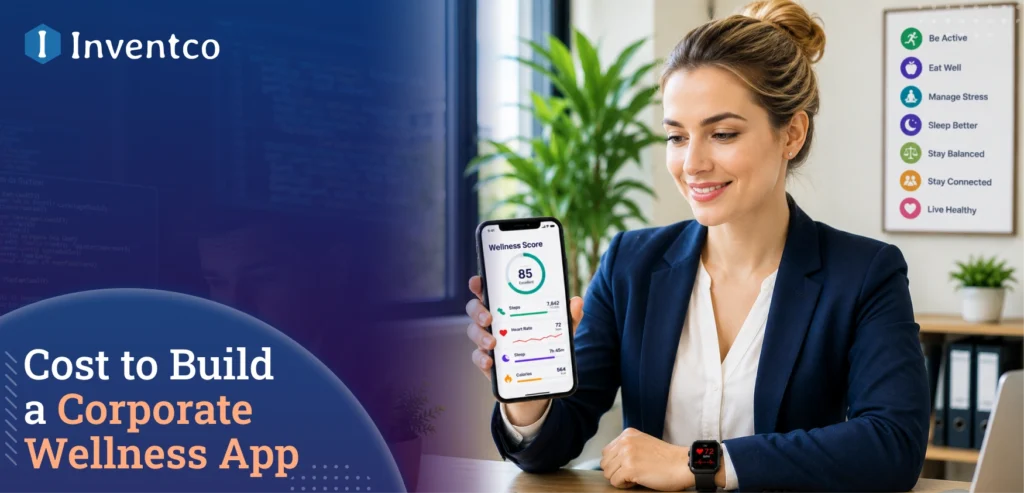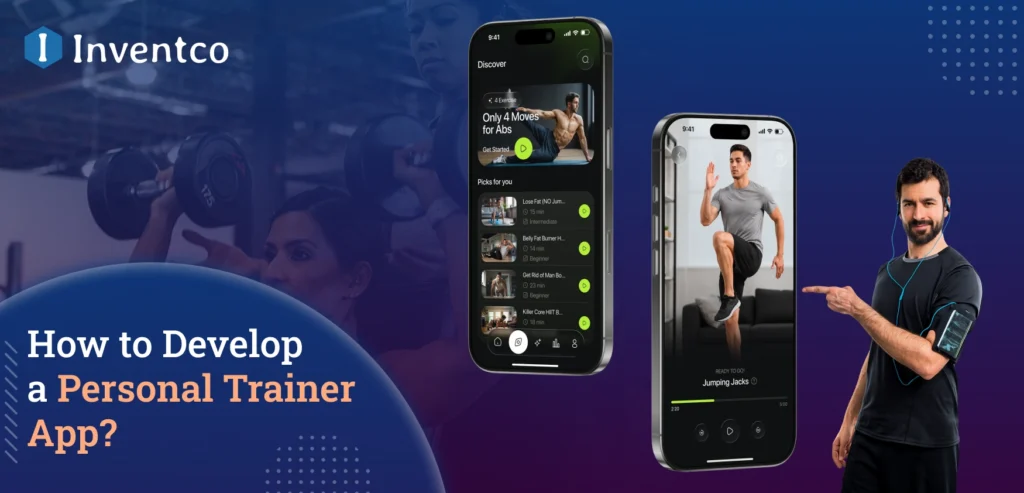
The global fitness apps market size was valued at USD 12.1 billion in 2025 and is projected to grow from USD 13.9 billion in 2026 to USD 33.6 billion by 2033, at a CAGR of 13.4% from 2026 to 2033. Behind this surge is a fundamental behavioral shift: fitness consumers increasingly prefer digital, on-demand coaching over fixed gym schedules. Personal trainers are going where the demand is, and for most of them, that destination is a mobile app.
But here is the business reality founders need to understand: a generic fitness app is no longer a differentiator. Investors and operators looking at personal trainer mobile app development in 2026 are asking sharper questions: how does the platform retain users beyond week three? How does AI personalize coaching at scale? Can the app generate recurring revenue without a static subscription model?
These examples, in practice, are questions that pertain to the business viability of the application. Whether you are a certified personal trainer developing a client acquisition tool, a fitness startup looking for Series A traction, or an enterprise operator interested in a white-label solution, personal trainer app development requires a technology partner with expertise in the fitness industry as well as scalable product development.
This guide covers everything you might want to know about developing personal trainer apps. It explains development processes, the significance of 2026, the influence of artificial intelligence, features, the entire development cycle, MVPs, cost estimates, tech stacks, and Inventco’s method of developing fitness products.
Key Takeaways
- The global fitness app market is projected to exceed $35 billion by 2030, creating a high-ROI entry window for founders.
- AI-powered personal trainer apps now deliver adaptive workouts, real-time form analysis, and behavioral nudges, eliminating the need for a human coach available 24/7.
- MVP-first development reduces time-to-market and validates product-market fit before full-scale investment.
- Personal trainer app development cost ranges from $10,000 to $100,000+ based on complexity, AI features, and platforms.
- Choosing the right mobile app technology stack and development partner directly impacts app performance, scalability, and long-term maintenance cost.
What Is Personal Trainer App Development?
Personal Trainer App Development refers to the comprehensive design, building, and launching of a web or mobile app that permits certified personal trainers, or AI-based coaching apps, to offer training, nutrition, and even coaching, and assist with communications at scale.
At its core, a personal trainer app bridges three stakeholder needs:
- Personal trainers or fitness coaches need an app to provide workouts to their clients and to generate income from clients who wish to receive workouts without having to meet them in person.
- Fitness clients need a fitness app that provides structure and feedback, and that offers a motivational feature to hold them accountable to their fitness goal.
- Business operators and investors need the app to be scalable and customizable and to have features that allow the app to be profitable.
The development scope of a personal trainer app typically spans:
- Cross-platform mobile app development (iOS + Android)
- Admin dashboards for trainer management
- AI/ML engine integration for personalization and form analysis
- Wearable and health API integrations (Apple Health, Google Fit, Garmin)
- In-app payment, subscription management, and monetization infrastructure
- Video delivery systems for on-demand and live coaching
Modern personal trainer mobile apps go beyond basic workout logging systems. These apps require enterprise-level product architecture to support thousands of concurrent users and integrate advanced AI and scaling business models.
Why Invest in Personal Trainer Mobile App Development in 2026?
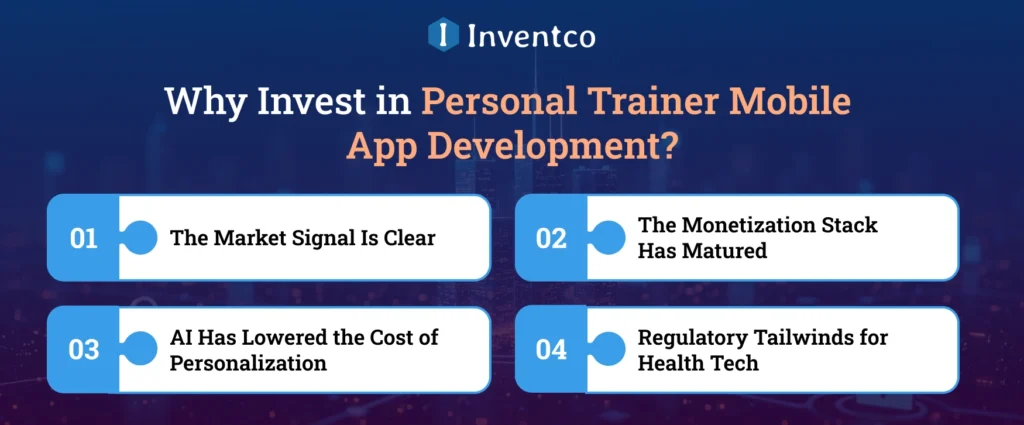
Timing matters in product strategy. In 2026, several converging forces make personal trainer app development one of the highest-ROI digital product categories for founders and investors.
The Market Signal Is Clear
The global digital fitness market is estimated to grow 22% year on year between 2023 and 2025. Hybrid fitness behaviors have become cemented since the pandemic, and users want digital fitness resources even if they use a traditional gym. Companies such as Trainerize and PT Distinction have hundreds of thousands of users, but the market is still available for areas like senior fitness and sports performance, as well as workplace wellness and fitness apps in different languages.
The Monetization Stack Has Matured
In 2026, personal trainer mobile apps are not restricted to a single subscription. The mobile app space offers a wide revenue stream from premium and freemium subscriptions to corporate wellness engagements, trainer marketplace commissions, and bundled content subscriptions with AI coaching. This diversifies revenues and strengthens the business model of personal trainer mobile apps.
AI Has Lowered the Cost of Personalization
Traditionally, participants in a coaching model of AP development faced a trade-off between scale and personalization. Delivering quality 1-on-1 coaching to 10,000 participants was not possible. The development of AI Personal Trainer Apps has changed that. Gaining the economic advantage of scale does not exclude high-quality 1-on-1 coaching. Machine Learning models now offer personalized coaching that is adaptive and instant.
Regulatory Tailwinds for Health Tech
More health and wellness digital platforms are finding their way into insurance and corporate benefit plans. Digitizing a compliant, data-secure platform enables the sales potential for enterprise B2B markets previously unavailable to fitness apps. Mobile app security and HIPAA compliance are no longer optional; they are enterprise sales requirements.
AI Personal Trainer App Development: What Has Changed in 2026
The advancements in AI fitness app development in 2026 compared to previous years are substantial. The capability of AI has shifted from a reactive state to a proactive state. The difference is quite striking and is summarized below.
1. From Static Plans to Dynamic Adaptation
Earlier AI systems assigned a workout plan based on an intake form and updated it weekly. Today’s AI engines analyze real-time biometric data, session performance, sleep patterns, and even user mood signals to dynamically adjust intensity, volume, and exercise selection within the same session. This is not a feature, it is the core product value proposition.
2. Computer Vision for Form Analysis
Real-time pose estimation is now achievable using on-device computer vision to assist in evaluating form. Users can now have their form when executing an exercise (like the squat or deadlift) corrected, even in the absence of a physical trainer. While this was possible in 2021, it was only a dream. This has now become a standard expectation for 2026 premium fitness apps.
3. Conversational AI Coaching
Integrating a large language model gives the ability for in-app chat coaching that is now available 24/7. Users can get articulate and context-aware answers for exactly why their sessions have fewer sets, why a substitution was chosen for a gym-unavailable exercise, or a host of other helpful responses. This improves the user experience while simultaneously lessening the burden on the trainer.
4. Predictive Churn and Engagement Systems
These AI in fitness app systems are capable of predicting customer churn 7 to 10 days in advance by analyzing app session frequencies, behavioral progress, etc. Automated engagement workflows are high-ROI features coming to the 2026 AI Personal Trainer App Stacks.
Key Features of a Personal Trainer App
The mobile app features that define a high-performing personal trainer platform break into two categories: foundational features that establish functionality and AI-powered capabilities that create competitive differentiation.
Core Features of a Personal Trainer App
| Feature | Description | Business Impact |
|---|---|---|
| User Onboarding & Profile | Fitness goals, health history, and activity level intake | Reduces drop-off in the first 48 hours |
| Workout Plan Builder | Trainer-assigned or AI-generated structured workout programs | Delivers core product value |
| Exercise Library | Video-guided exercise database with detailed instructions | Reduces trainer support requests |
| Progress Tracking | Weight, reps, body measurements, and photo logs | Increases retention through visible progress |
| Client-Trainer Messaging | In-app chat and check-in system | Eliminates dependency on WhatsApp and external tools |
| Nutrition Tracking | Macro and calorie logging, meal plans, and food database integration | Boosts daily active user engagement |
| Scheduling & Booking | Session booking, calendar sync, and automated reminders | Reduces no-shows and increases customer lifetime value (LTV) |
| Video Workouts | On-demand and live-streamed training sessions | Creates additional content monetization opportunities |
| Payment & Subscriptions | In-app billing, package management, and Stripe/PayPal integration | Provides core revenue infrastructure |
| Push Notifications | Workout reminders, streak alerts, and milestone celebrations | Drives user retention and engagement |
Advanced Feature of a Personal Trainer App
These capabilities separate a commodity fitness app from a defensible, high-retention product:
- AI Adaptive Workout Engine: Adjusts session variables in real time based on performance data and recovery metrics.
- Computer Vision Form Checker: Uses the device camera for real-time posture and movement analysis during exercises.
- Predictive Fitness Scoring: Forecasts user progress toward goals with confidence intervals based on adherence data.
- LLM-Powered Coaching Chat: Contextual, trainer-persona AI assistant available 24/7 for queries, motivation, and plan adjustments.
- Wearable Data Fusion: Aggregates Apple Watch, Fitbit, Garmin, and Whoop data for holistic session insights.
- Churn Prediction & Re-engagement Automation: Identifies at-risk users and triggers targeted retention flows.
- Voice-Guided Workouts: Hands-free audio coaching during sessions with real-time cues.
- Nutrition AI: Meal recommendations, food recognition via camera, and macro auto-calculation.
How to Develop a Personal Trainer App: Step-by-Step Process
Understanding how to develop a personal trainer app requires viewing it as a product development lifecycle, not just a coding project. Here is the mobile app development process Inventco follows across fitness and health tech engagements:
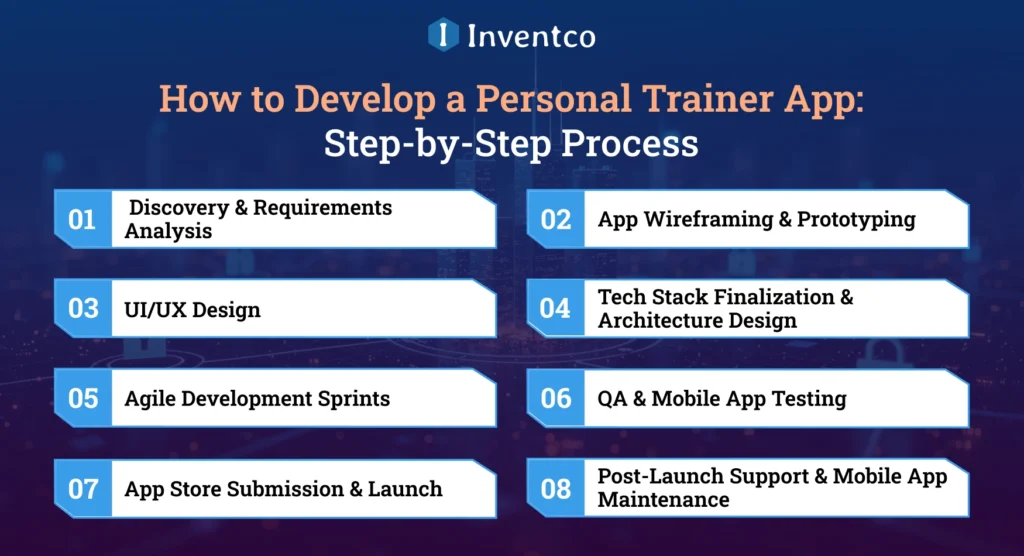
Step 1: Discovery & Requirements Analysis
While developing a fitness app, the objective of this phase is to analyze current competitors to the client’s tech, create user personas for the target audience, list desired app features, decide the projected income streams, determine the app’s monetization strategy, and, in some cases, work to satisfy government regulations on tech use. This phase usually lasts for two to three weeks.
Step 2: App Wireframing & Prototyping
The next step is the creation of low-fidelity mobile app wireframes and App Prototypes, which are used by the stakeholders and potential clients to test the virtual structure and present solutions to structural issues. This step is very important since it can be done to correct the app’s structure in less than a day, and yet takes weeks to achieve once the app has been fully developed.
Step 3: UI/UX Design
The design phase is one of the most critical stages of developing a mobile app. During this phase, UI/UX layouts, color schemes, typography, and component libraries are developed to create a seamless and engaging app experience. The design is also used to implement user onboarding sessions that include game-like interactions and training sessions.
Step 4: Tech Stack Finalization & Architecture Design
The selection of the mobile application framework and the design of the backend, databases, and third-party APIs happen before any production code is written. This selection impacts the performance, scalability, and future costs of maintaining the mobile application. Refer to Section 10 for our suggested tech stack.
Step 5: Agile Development Sprints
Development proceeds in two-week sprints with working software delivered at the end of each cycle. The mobile app development process uses a backend-first approach, APIs and data models before UI, ensuring the product scales from day one. Mobile app testing runs in parallel with development, not after.
Step 6: QA & Mobile App Testing
This includes functional testing and performance, security, and compatibility testing across devices and OS versions. Mobile app security testing is critical for health and fitness apps that work with user biometric data. Testing also includes performance benchmarking to ensure apps load and respond in a timely manner.
Step 7: App Store Submission & Launch
The submission process for both the App Store and Google Play includes an app review. Our team manages metadata write-up, screenshot design, App Store Optimization, and compliance documentation. Preparation for launch includes the setup of app data, analytics, crash reporting, and channels for user feedback.
Step 8: Post-Launch Support & Mobile App Maintenance
Launching is not finishing. Mobile app maintenance includes OS update compatibility, bug triage, performance monitoring, and feature iteration based on user behavior data. The cost of mobile app maintenance for the first year is typically 15–20% of the original development cost. Predictive maintenance workflows can reduce the cost significantly.
Personal Trainer App MVP Development: What to Build First
For founders validating a new concept or established trainers launching their first digital product, MVP mobile app development is the right starting point. An MVP is not a stripped-down app. It is a focused product that delivers the core value proposition to a defined user segment with enough quality to generate meaningful feedback.
From Our Projects
In developing the FitSmart Fitness Workout App, we prioritized functionality that delivered core value. Rather than incorporating advanced or complex functionality, the MVP was centered around users having the ability to create their own personalized fitness plans. This goal management and progress tracking functionality relied on user feedback for further development, subsequently minimizing the risk of development and maximizing the expected value of the application.
Personal Trainer App MVP Feature Set
| MVP Feature | Purpose | Can Be Added Post-MVP |
| User Registration & Profile | Enables user onboarding and account creation | Advanced biometric and health data intake |
| Workout Plan Assignment | Delivers personalized workout programs and core product value | AI-powered adaptive workout engine |
| Progress Tracking (Manual) | Supports habit formation and user retention | Wearable device and fitness tracker integration |
| In-App Messaging | Facilitates communication between clients and trainers | AI-powered coaching and chatbot assistance |
| Basic Payment Integration | Enables monetization from launch | Subscription tiers, upselling, and premium packages |
| Push Notifications | Encourages engagement and workout consistency | Predictive reminders and personalized nudges |
| Exercise Library (Core) | Provides workout instructions and training guidance | Expanded video library and voice-guided coaching |
MVP mobile app development for a personal trainer platform typically takes 10 to 16 weeks and costs $10,000 to $35,000, a fraction of the full-product investment, with the ability to raise on traction rather than theory.
How Much Does It Cost to Build a Personal Trainer App?
The personal trainer app development cost is not a single number, it is a function of scope, geography of the development team, feature complexity, and the AI capabilities you choose to integrate. Here is how the cost breaks down across development tiers:
| Development Tier | Scope | Estimated Cost Range | Development Timeline |
| MVP / Basic | Core workout planning, progress tracking, and client-trainer messaging | $10,000 – $30,000 | 10–16 weeks |
| Mid-Range | Comprehensive feature set with basic AI capabilities and support for a single platform (iOS or Android) | $30,000 – $60,000 | 16–24 weeks |
| Advanced / AI-Powered | AI-driven recommendations, computer vision form correction, and dual-platform deployment | $60,000 – $100,000 | 24–36 weeks |
| Enterprise / White-Label | Multi-tenant architecture, custom branding, advanced analytics, and enterprise-grade scalability | $100,000+ | 36+ weeks |
Cost Drivers to Understand
- AI & ML Integration: Real-time pose estimation and adaptive engines add $15,000–$30,000 to the base cost.
- Platform Choice: A cross-platform app using React Native or Flutter costs 30–40% less than two separate native builds.
- Video Infrastructure: Live streaming and on-demand video delivery require CDN setup and encoding services that add recurring infrastructure costs.
- Wearable API Integrations: Each hardware integration (Apple Health, Fitbit, Garmin) adds development time and testing overhead.
- Compliance & Security: HIPAA-adjacent data handling, encryption, and audit logging add cost but are required for enterprise B2B sales.
- Mobile App Maintenance Cost: Budget 15–20% of development cost annually for ongoing maintenance, updates, and mobile app security patches.
Decision-Maker Note: The cost to build a mobile app is only one dimension. The more important metric is cost per retained user at 90 days. A $25,000 MVP that retains 60% of users at month three generates more investor value than a $70,000 full-feature app with 20% retention. Build for the right outcome, not the right feature count.
Popular Personal Training Apps in the Market
Understanding what works in market-leading personal trainer platforms is essential for founders defining their own product. Here are the apps that have established category benchmarks:
| App | Core Positioning | Key Differentiator | Business Model |
| Trainerize | Personal training and coaching platform | Client management, workout delivery, and nutrition coaching tools | SaaS subscription for trainers and fitness businesses |
| TrueCoach | Remote personal training platform | Streamlined trainer workflows and client accountability features | Monthly SaaS subscription for coaches |
| Future | Premium online fitness coaching | Dedicated 1:1 human coach paired with Apple Watch integration | Premium subscription (approximately $199/month) |
| Caliber | Personalized strength training app | Certified coach matching and evidence-based coaching programs | Freemium model with premium coaching plans |
| Fitbod | AI-powered workout planning app | Machine learning-based workout recommendations and load optimization | Freemium with annual subscription plans |
| Whoop | Wearable fitness and recovery platform | Continuous biometric monitoring with AI-driven coaching insights | Hardware purchase plus recurring subscription |
| FlexIt | Virtual fitness and personal training platform | Live one-on-one and group fitness sessions on demand | Pay-per-session and membership subscriptions |
Building a personal trainer app like Trainerize development does not mean copying Trainerize. It means understanding the SaaS mechanics, trainer onboarding flows, and client management infrastructure that made Trainerize scalable, and identifying the white space they have not filled.
Tech Stack & Compliance for Personal Trainer App Development
Choosing the right mobile app technology stack is a foundational architecture decision that affects every subsequent sprint, every future hire, and the long-term mobile app maintenance cost of the platform.
| Technology Layer | Technology Options |
|---|---|
| Frontend (Mobile) | React Native, Flutter, Swift, Kotlin |
| Backend | Node.js, Django, Ruby on Rails, Go |
| Database | PostgreSQL, MongoDB, Firebase |
| AI/ML Engine | TensorFlow, PyTorch, MediaPipe, OpenAI API |
| Video Infrastructure | AWS Kinesis, Agora, MUX |
| Cloud Infrastructure | AWS, Google Cloud, Microsoft Azure |
| Push Notifications | Firebase Cloud Messaging (FCM) |
| Payments | Stripe, PayPal, RevenueCat |
| Wearable Integrations | Apple HealthKit, Google Fit, Garmin Connect |
| Testing & QA | Jest, Detox, Appium, TestFlight |
| Analytics & Monitoring | Mixpanel, Amplitude, Firebase Analytics |
| Security | AES-256, SSL/TLS, OAuth 2.0, OWASP |
Compliance Considerations
- HIPAA Proximity: While pure fitness apps may not be covered entities, handling biometric, health, and nutrition data requires HIPAA-adjacent protocols for any platform targeting corporate wellness or healthcare-adjacent markets.
- GDPR: European user data requires explicit consent flows, data portability, and the right to erasure, all of which must be architected, not retrofitted.
- App Store Health & Fitness Guidelines: Apple and Google both have specific requirements for apps claiming health benefits, requiring disclosure and, in some categories, medical review.
- Mobile App Security: End-to-end encryption of health data, secure authentication, and regular penetration testing are non-negotiable for enterprise client acquisition.
How Inventco Can Help You in the Personal Training App Development Journey
Inventco is a top fitness app development company. We provide a comprehensive solution. We utilize a seamless blend of product strategy augmented with UX design, AI, and mobile app development to engage users in fitness experiences that maximize business engagement and sustain growth with a retention-focused, revenue-driven approach.
Inventco’s expertise can be showcased by exploring the development of FitSmart, an app for fitness and workout preparation. From the initial step of strategy through UX/UI design, our expertise covered the entire development cycle to ensure that users can easily set fitness goals, prepare a customized workout, and track their workout progress through a user-centered mobile solution.
Our personalized and business-model-focused mobile application development offers workout planning, progress tracking, advanced coaching through wearables and AI, and subscription management. To lessen your risk, we prioritize the development of a minimum viable product.
Inventco provides a complete and future-proof fitness solution, focusing on security and scalability. Our expertise and knowledge of the fitness space and technology will allow your team to launch AI-driven fitness solutions right from the first idea and through the development of a minimally viable product.
Conclusion
The combination of AI, the state of the market, and the development of new monetization structures makes 2026 the ideal year for developing personal trainer apps. In this regard, the founders and investors who choose a solid technology partner, disciplined MVP, and a scalable product architecture will shape personal trainer apps for the next five years.
The market will not wait. Trainerize, Future, and Caliber are not standing still. Neither are the AI-native entrants entering the space with significantly lower cost structures and faster iteration cycles.
Your personal trainer app needs to be more than functional. It needs to retain users past day 30, generate revenue across multiple touchpoints, and scale without a proportional increase in operational cost. That is the standard the market now demands, and the standard Inventco builds to.
FAQ’s
Q. How long does it take to develop a personal trainer app?
Ans. MVP development typically takes 10 to 16 weeks. A full-featured personal trainer app with AI capabilities and dual-platform support takes 24 to 36 weeks. The timeline depends on feature scope, team size, and the complexity of third-party integrations.
Q. How much does it cost to build a personal trainer app?
Ans. Personal trainer app development cost ranges from $10,000 for an MVP to $100,000+ for an enterprise-grade, AI-powered platform. The primary cost drivers are AI/ML integration, video infrastructure, wearable API support, and cross-platform development.
Q. What features are essential for a personal trainer app?
Ans. Core features include workout plan management, progress tracking, in-app messaging, video workouts, payment integration, and push notifications. Differentiated features include AI adaptive workout engines, computer vision form analysis, LLM coaching chat, and predictive churn systems.
Q. What is the best tech stack for personal trainer app development?
Ans. React Native or Flutter for cross-platform mobile development, Node.js for backend, PostgreSQL for database, MediaPipe and OpenAI APIs for AI features, and AWS for cloud infrastructure represent the recommended stack for most personal trainer app builds in 2026.
Q. Should I start with an MVP or a full product build?
Ans. Unless you have validated product-market fit with a paying user base, start with an MVP. Personal trainer app MVP development lets you generate traction, iterate on real user feedback, and raise investment on demonstrated retention, not projections.
Q. How do I monetize a personal trainer app?
Ans. The most effective mobile app monetization models for fitness platforms combine a freemium-to-premium upgrade path, tiered subscription plans, trainer marketplace commissions, corporate wellness contracts, and AI coaching upsell modules. Building revenue infrastructure from the MVP stage avoids costly retrofits later.

Jitendra Jain
He is the CEO and Co-founder of Inventco, driving innovation in advanced computing and digital transformation. With deep expertise in modern IT ecosystems, he leads scalable, secure, future-ready solutions. His strategic leadership helps businesses accelerate growth, adopt innovation, and achieve success. You can connect with him on LinkedIn to follow his technology insights.