The global education technology market is on a trajectory that few industries can match. The global education technology market size was valued at USD 187.0 billion in 2025 and is projected to grow from USD 213.2 billion in 2026 to USD 437.5 billion by 2033, at a CAGR of 10.8% from 2026 to 2033.
The fusion of AI development, remote learning, and mobile technology will be the core driving factor of this growth. What was once a supplementary digital experience, a PDF on a screen, a pre-recorded video, has evolved into something far more sophisticated: intelligent, responsive, and personalized learning ecosystems.
There is no debate as to what has prompted this evolution. The inclusion of Artificial Intelligence is now foundational, not an optional feature. From learning systems that personalize pathways and adjust based on learning to the inclusion of generative AI that builds lessons and provides assessments and feedback, the development of education technology apps has been disruptive.
For EdTech founders and investors, the integration of AI in their products is a given. The issues to be resolved will be the cost and implications of doing so. Whether creating a new AI education app or augmenting an already existing app, knowing the core app features that will allow you to execute the app idea, the proper app technology stack, and the costs associated with creating a mobile app will allow you to better position your app in the education technology market.
This blog outlines the factors that will help you confidently decide if AI-powered learning is right for you. This includes the AI business case for learning, development costs, mobile security, and the type of tech partner who will implement a secure solution.
Key Takeaways
- AI enables personalized learning experiences.
- Generative AI helps create educational content faster.
- AI-powered analytics improve student performance tracking.
- Intelligent tutoring systems provide real-time support.
- Development costs typically range from $10,000 to $100,000+.
- AI enhances accessibility, engagement, and scalability.
Why AI is Becoming the Backbone of Modern Education Apps
Traditional e-learning platforms, static content libraries, instructor-led sessions, and linear assessments were built for a different era. Today’s learner expects immediacy, personalization, and relevance. A generic LMS with a standardized curriculum is not going to compete with an adaptive learning platform that leverages AI to ascertain user learning behaviors.
This transition is supported by data. HolonIQ reports that in 2024, the investment in AI-based learning technology surpassed $6 billion, and generative AI for the development of educational apps was nearly 40% of the roadmaps for new features for the leading platforms. Google, Microsoft, and Amazon have poured billions of dollars into educational AI infrastructure to establish a foothold in the marketplace, not as a loss leader.
Here is what is fundamentally different when you build a mobile app powered by AI for education:
- Personalization at Scale: AI tailors content, pace, and assessments to individual learners without human intervention, making it viable for millions of concurrent users.
- Real-Time Performance Intelligence: Predictive analytics identify struggling learners before they drop out, enabling proactive support.
- Content Efficiency: Generative AI dramatically reduces curriculum development costs by auto-generating quizzes, summaries, flashcards, and study guides.
- Accessibility and Reach: NLP and voice-powered interfaces break down language and literacy barriers, expanding your addressable market globally.
How AI is Transforming Education App Development
The transformation is not theoretical. Across verticals- K-12, higher education, corporate training, and professional upskilling- AI is replacing rigid architectures with dynamic, data-driven learning environments.
Here is a look at the primary ways AI is reshaping educational app development with AI:
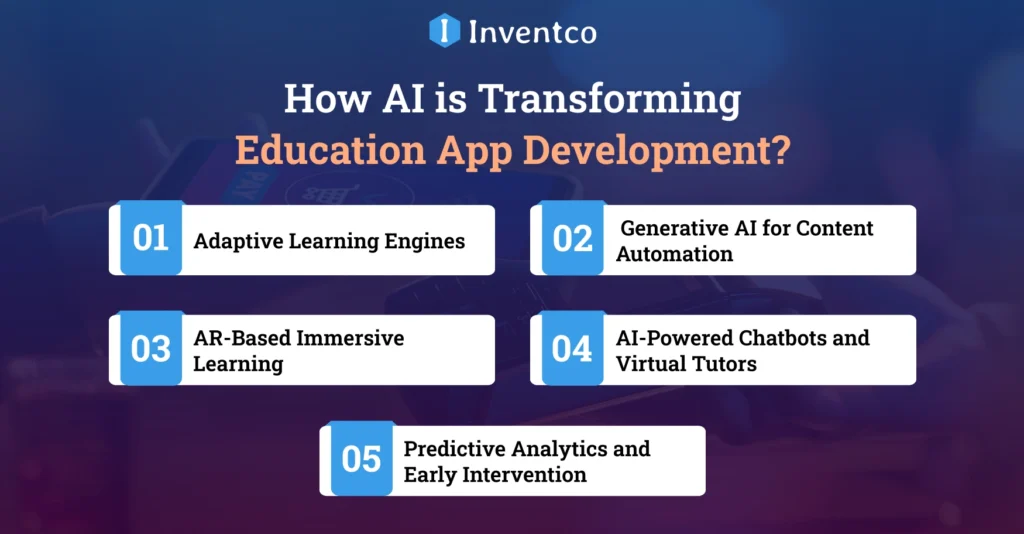
1. Adaptive Learning Engines
Adaptive learning is a prominent, powerful AI capability of EdTech. These learning engines use machine learning to adjust the content based on the difficulty, order, and format that align with the competency of the learner. The critical business impact of adaptive learning is higher user engagement, course completion, and learning outcomes. These adaptive learning outcomes improve retention and reduce churn on a subscription basis.
2. Generative AI for Content Automation
Generative AI in education app development is transforming one of the most resource-intensive aspects of EdTech: content creation. Modern platforms can automatically generate lesson summaries, practice quizzes, dialogue simulations, personalized explanations, and even complete course outlines from existing source material.
For startups, this can reduce content creation time by up to 70%, accelerate time-to-market, and significantly lower curriculum development costs. For enterprise EdTech platforms serving multiple industries, generative AI enables rapid content expansion while maintaining quality, without requiring proportional increases in content teams or operational overhead.
3. AR-Based Immersive Learning
The introduction of Augmented Reality (AR) to educational app development is creating new ways of learning that static media cannot even imagine. Medical students can now traverse virtual 3D media to view models of human anatomy. Engineering students can build 3D media to simulate components of machines.
Learning History can now be done by visiting media of reconstructed environments. Recent studies have shown that this type of educational media can improve learning retention by 60%, which is a substantial improvement when compared to traditional 3D media.
4. AI-Powered Chatbots and Virtual Tutors
Having access to a tutor 24/7 has been a challenge in the educational sector. AI-integrated virtual tutors can provide solutions here at a much lower cost than human tutors. These systems, enclosed in a single mobile app, can answer questions, explain concepts, provide guided practice, and deliver motivational nudges.
Due to this, platforms focused on B2C consumers have an excellent competitive edge. For corporate training platforms, this helps to lower the need for live corporate trainers and helps facilitate asynchronous learning while still providing support.
5. Predictive Analytics and Early Intervention
Detecting predictors of dropping out of a platform has one of the greatest values for AI applications in education. By analyzing behavioral signals, session duration, response accuracy, content skip rates, and login frequency, AI models flag at-risk learners before they disengage.
For EdTech founders who have a subscription or an outcome-based revenue model, this is a must-have feature to protect revenue. Institutions that have adopted predictive interventions have noted a retention increase in the range of 20-35%.
Benefits of AI in Education Apps: A Business Perspective
The conversation about artificial intelligence apps in education often gravitates toward learner outcomes. But for founders and investors, the business benefits are equally compelling.
- Scalability Without Proportional Cost Growth: AI enables you to serve 10x the learners without 10x the headcount, fundamentally improving your unit economics.
- Data-Driven Product Decisions: Every interaction within an AI education app generates actionable behavioral data, informing content strategy, feature prioritization, and pricing models.
- Premium Positioning: AI-powered personalization commands higher subscription tiers. Platforms offering adaptive learning consistently outperform generic LMSs in pricing power.
- Faster Time-to-Market for Content: Generative AI compresses curriculum development cycles from months to days, enabling faster market entry and iteration.
- Lower Customer Acquisition Cost Through Outcomes: When AI delivers measurable learning outcomes, word-of-mouth and institutional referrals drive organic growth, reducing paid CAC over time.
- Global Market Accessibility: Multilingual NLP and voice interfaces allow a single platform to serve diverse global markets without full localization teams.
Top AI Features Transforming Educational Apps
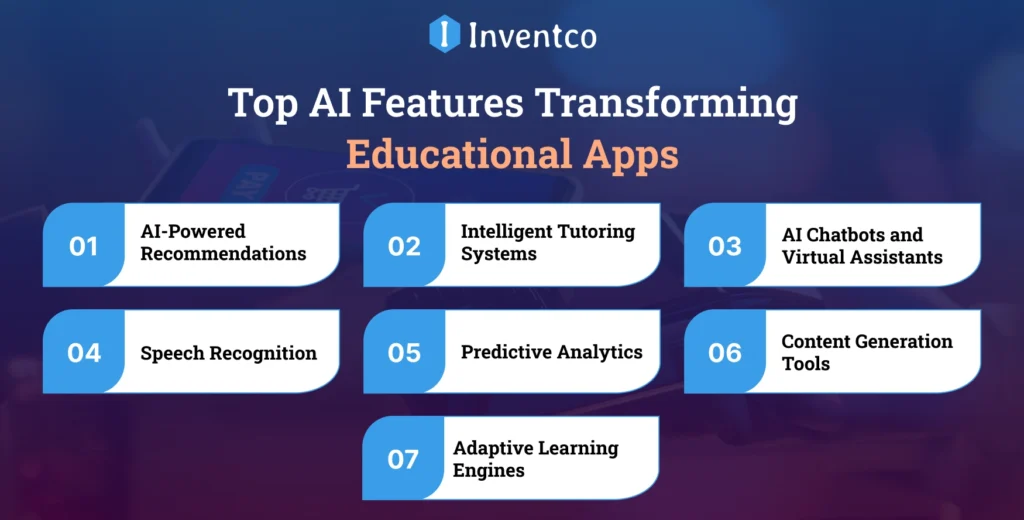
AI in education apps focuses on user engagement, learning outcomes, and accessibility through personalization, intelligent automation, predictive insights, and adaptive experiences.
1. AI-Powered Recommendations
AI-based recommendation systems suggest courses, study aids, and learning pathways to students based on the analysis of learning behaviors and preferences. These systems help students remain focused and improve retention while learning.
2. Intelligent Tutoring Systems
The personalization of guidance through the provision of feedback and support that is adaptable to the progress of the learner is the focus of intelligent tutoring systems. This provides an improved one-on-one tutoring experience.
3. AI Chatbots and Virtual Assistants
AI chatbots and virtual assistants provide user support in a timely manner. Automated responses to learning and course-related questions assist learners in overcoming basic learning obstacles and guide learners through their learning journeys.
4. Speech Recognition
Educational systems can integrate speech recognition for learning activities, language practice, and accessibility. This transforms spoken language into text, ensuring inclusivity.
5. Predictive Analytics
The use of predictive analytics in learning helps institutions establish new learning patterns, forecast learning outcomes, and identify barriers to learning to implement solutions that enhance learning and assist user success.
6. Content Generation Tools
AI-driven content systems produce assessments and quizzes, as well as learning materials, lesson plans, and teaching resources. This lessens the burden of administrative tasks and improves the relevance and timeliness of educational offerings.
7. Adaptive Learning Engines
Adaptive Learning systems create personalized education by modifying learning pathways, the level of content, and the pace of learning for each individual student.
These mobile app Features help educational platforms remain competitive while delivering measurable learning outcomes.
Use Cases of AI in Education App Development
Artificial intelligence is revolutionizing educational tools by offering the ability to customize learning, use advanced automation, and process data analytics worldwide for learning in schools, universities, corporate learning, and skill enhancement applications.
1. K-12 Learning
AI systems can identify student patterns and utilize that data to develop systems that will adjust the difficulty of tasks as well as customize them. AI systems augment student learning by providing support at the level of difficulty that best suits the student.
2. Higher Education
At the university level, more educators are using AI to create virtual tutors, automate student assessments, design personalized learning tracks, and facilitate learning by boosting student engagement, which, in turn, helps reduce the time-consuming administrative tasks of educators.
3. Corporate Training
AI systems are more personalized for employees and are designed to track employee skill development and suggest courses. AI systems within corporate training programs offer employees the skills and training necessary to carry out their learning tasks.
4. Language Learning
AI speech and language systems assist learners in enhancing their communication skills and fluency by offering customized feedback after engaging in simulated learning experiences that require active participation.
5. Exam Preparation
Adaptive learning systems that employ AI analyze performance, develop study plans, determine gaps in knowledge, and offer targeted recommendations to improve study efficiency for the purpose of passing the exam.
AI Education App Development Cost in 2026
The cost to build a mobile app for the education sector typically ranges from $10,000 to $100,000+, depending on project complexity, AI capabilities, and business requirements.
A basic MVP with core learning features and AI integrations generally costs between $10,000 and $25,000, while a mid-level platform ranges from $25,000 to $60,000. Advanced AI-powered education apps with personalized learning, predictive analytics, and scalable infrastructure can exceed $100,000.
Key cost factors include AI model integration, custom feature development, mobile app technology stack selection, cloud infrastructure, mobile app security measures, third-party integrations, and comprehensive mobile app testing.
Future Trends of AI in Education Beyond 2026
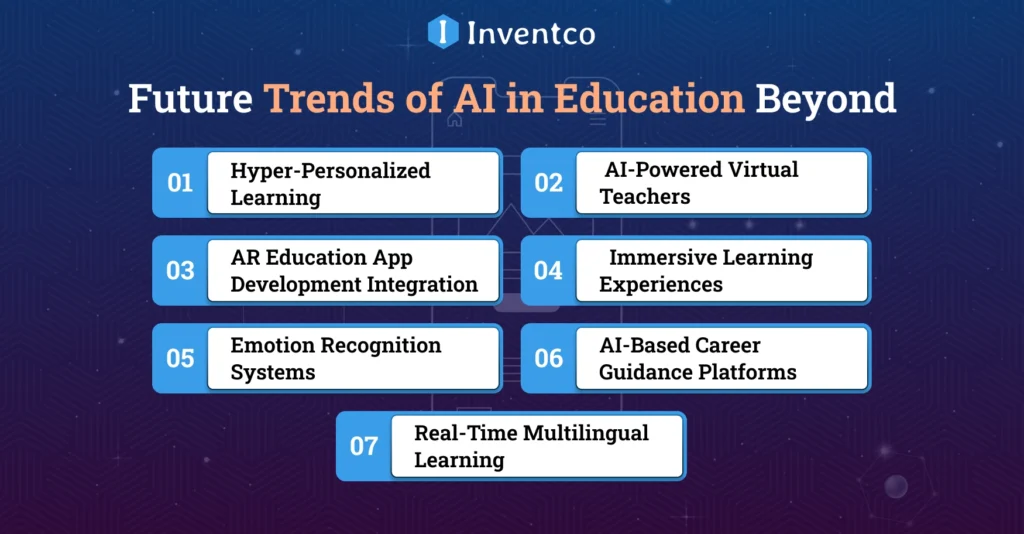
As AI technologies continue evolving, education apps will become more personalized, immersive, intelligent, and accessible, reshaping how learners acquire knowledge globally.
1. Hyper-Personalized Learning
AI will personalize learning by analyzing learning behavior and the strengths and weaknesses of the learner in real time to provide the most appropriate recommendations and learning materials in the most efficient way.
2. AI-Powered Virtual Teachers
Advanced AI Tutors will be able to answer questions and explain difficult learning concepts to provide Instant Support and help students learn more easily and affordably.
3. AR Education App Development Integration
The combination of AR and AI in education app development will enable students to participate in immersive educational experiences that incorporate digital elements and interactive learning within the real world.
4. Immersive Learning Experiences
Complex subject materials can be difficult to understand and learn. Teaching, learning, and Training exercises using a combination of AI and immersive virtual environments can simplify experiential learning.
5. Emotion Recognition Systems
Learning and training applications can be designed to recognize user frustration and disengagement through an analysis of user emotions. This can be used to create adaptive and therefore more effective educational environments.
6. AI-Based Career Guidance Platforms
AI can create adaptive career counseling solutions that recognize user skills and/or qualifications and provide recommendations for learning and/or certification opportunities that are aligned with career pathways and the demands of the labor market.
7. Real-Time Multilingual Learning
AI-based language translation and processing will facilitate learning in a seamless multilingual environment and enable individuals to access and create learning content and collaborate in different languages in real time.
Integrating AR and AI education apps will create engaging blended learning systems for the digital and physical learning environments.
How Inventco Helps You Build an AI Education App
Inventco offers its clients in the education and investment sectors the ability to design and build customized, scalable AI education solutions. Our process begins with strategic planning and product discovery to align desired educational and business outcomes with the most applicable AI solutions.
Our mobile app development services cover every aspect of the app development process, including the integration of AI models, the design of UI/UX, and the development of mobile and web applications.
Our focus is the delivery of secure, high-performance, and user-centric educational solutions that deliver personalized learning experiences and that are in compliance with applicable regulations and standards.
Whether you want to build a mobile app for K-12 education, higher learning, corporate training, or language learning, our experts provide end-to-end support, including performance optimization, maintenance, and future scalability to help your platform achieve long-term success.

Conclusion
AI is quickly becoming the backbone of digital education. With a range of educational technology, from learning-enhanced personalization, intelligent tutoring, learning path predictive analytics, and automated learning content generation, AI is altering the workings of educational technology. Companies looking to the future by developing educational technology with AI today will benefit from greater and long-lasting profitability and a bigger competitive edge.
The organizations that are the first to use recent advancements in learning technologies, particularly the development of AI, generative AI, and AR education apps, will be the best positioned for future success in the global learning marketplace. The rapid changes in learning technology will present both opportunities and challenges, but the first movers will reap the greatest rewards.
FAQ’s
Q. What is AI in education app development?
Ans. AI in education app development refers to integrating artificial intelligence technologies into educational platforms to improve learning experiences, personalization, and automation.
Q. How is AI transforming education app development?
Ans. AI enables adaptive learning, intelligent tutoring, predictive analytics, and personalized content recommendations.
Q. How much does it cost to develop an AI education app?
Ans. Development costs typically range between $10,000 and $100,000+, depending on complexity and features.
Q. What role does generative AI play in education?
Ans. Generative AI helps create educational content, quizzes, summaries, assessments, and learning materials efficiently.
Q. How does AR education app development work with AI?
Ans. AR and AI work together to create immersive and interactive learning experiences that improve engagement and knowledge retention.

Jitendra Jain
He is the CEO and Co-founder of Inventco, driving innovation in advanced computing and digital transformation. With deep expertise in modern IT ecosystems, he leads scalable, secure, future-ready solutions. His strategic leadership helps businesses accelerate growth, adopt innovation, and achieve success. You can connect with him on LinkedIn to follow his technology insights.