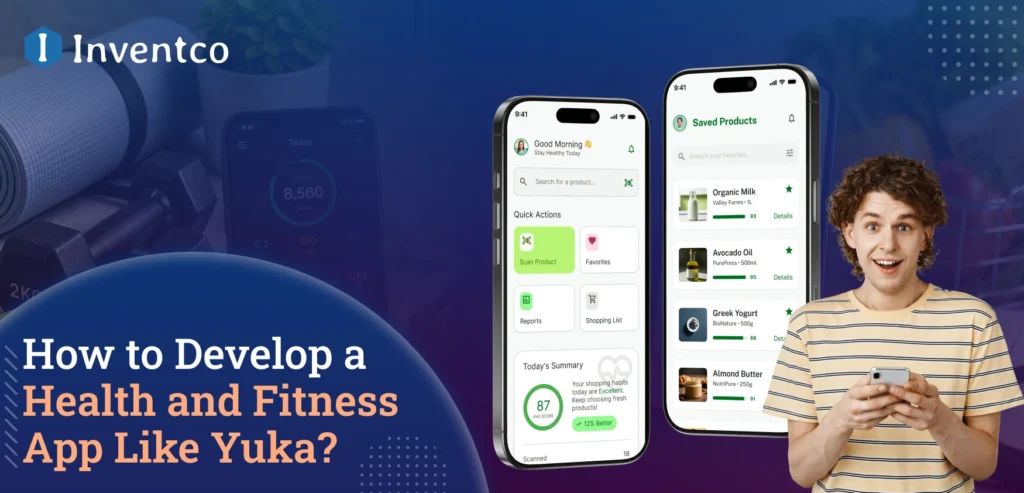
Shoppers don’t trust labels anymore. They trust the apps that decode them. That’s exactly why Yuka became one of the most popular food-scanning apps in the world. With a quick barcode scan and an easy-to-understand health score, consumers can instantly evaluate food and cosmetic products before buying them. As demand for ingredient transparency, personalized nutrition, and healthier lifestyles continues to grow, entrepreneurs and health-tech startups are increasingly looking to build apps like Yuka and tap into this rapidly expanding market.
The global health and wellness apps market size was valued at USD 11.27 billion in 2024 and is projected to grow at a compound annual growth rate (CAGR) of 14.9% from 2025 to 2030. Within this rapidly expanding market, food transparency apps have emerged as one of the fastest-growing segments. Users of apps want more than a food product’s nutritional label or a food product’s advertising claim. Users want actionable and useful insight and the information they need in order to make confident and healthy decisions.
Yuka was the first app to capture this industry. Yuka was able to create a successful app with a simple value proposition. Users scan a barcode and receive a health score. This clarity and simplicity reward Yuka with a loyal customer base. Users of Yuka scan multiple products in stores, aisles, and at home.
Building a Yuka-like application in 2026 for entrepreneurs, startups, and investors entails much more than capitalizing on the mobile app market. It would be part of a scalable health-tech platform combining consumer data, personalization, and the stickiness of health-focused recurring daily user engagement. As demand for ingredient transparency and preventive health solutions continues to rise, food scanner apps are becoming increasingly valuable assets in the digital health ecosystem.
This guide will give you the business model and mobile app framework for building an app like Yuka, the essential components, the tech stack, the development framework, the approximation for the monetary investment, and a plan to build a thriving food health transparency app.
Key Takeaways
- The global health and wellness app market is projected to reach $18.8 billion by 2030, and food scanner apps are among its fastest-growing segments.
- Yuka’s success is built on three pillars: instant barcode scanning, transparent ingredient scoring, and clean UX, all replicable with the right tech partner.
- A Yuka-like MVP can be developed for $10,000–$25,000; a full-featured product with AI scoring and personalization ranges from $60,000–$100,000+.
- The recommended tech stack includes Flutter or React Native for cross-platform development, Node.js or Python for the backend, and TensorFlow Lite for on-device AI scoring.
- Monetization is multi-layered: freemium subscriptions, B2B brand partnerships, affiliate e-commerce, and white-label licensing offer strong long-term revenue diversification.
- Key competitors like Think Dirty, Fooducate, and Open Food Facts each leave specific gaps, differentiation through AI personalization, broader product coverage, or regional databases is where your edge lies.
What is the Yuka App and why is it So Successful?
Yuka was launched in France in 2017. It is a mobile app that allows users to scan food and cosmetic products in order to obtain an instant health score with a value between 0 (poor) and 100 (excellent). The app also provides a calculation and analysis of additives and nutritional content, along with the risks of each ingredient.
Yuka has a user base of 54 million in 16 countries, which was no accident. Yuka solved the real problem of the average consumer who doesn’t possess the knowledge of nutrition to decipher ingredient lists but is concerned with the contents of their diet. Yuka provides this knowledge in an instant with no effort.
What Makes Yuka’s Model Work
- Radical Simplicity: The simplified score uses a color-coded system to convey complex data in three scans. Yuka app users are spared overwhelming dashboards, and the app experience is simplified without the use of nutritional jargon.
- Trust Through Transparency: Yuka is transparent about its scoring system. Scores utilize the food Nutri-Score and a risk-based ingredient analysis for cosmetics. This greatly improves their brand trust.
- Independence as a USP: Yuka has no ad space, no sponsorships, no manufacturer contracts. Misinformed consumers heavily appreciate this independent positioning.
- Habit Loop Design: With such a useful app, it’s easy to see why it is part of the daily routines of many consumers. The retention of this product far exceeds that of most health and wellness-based apps.
- Revenue Without Advertising: Yuka monetizes through a premium subscription tier, offering offline access, advanced ingredient search, and a personal product database, proving that health-conscious users will pay for genuine value.
From a founder’s perspective, Yuka is not just an app, it is a trust-based consumer data platform with recurring revenue, defensible positioning, and a clear path to B2B expansion.
Why Build an App Like Yuka in 2026? Market Opportunity
The timing for entering this space has arguably never been stronger. Several converging macro trends are creating a structural tailwind for food transparency and health scanning apps. Market Signals Worth Noting
- Consumer Health Awareness is at an All-Time High: Post-pandemic behavioral shifts have permanently elevated consumer interest in ingredient quality, clean labels, and nutritional honesty. A 2024 NielsenIQ report found that 73% of global consumers actively check ingredient lists before purchasing packaged food.
- Regulatory Momentum: The EU’s Farm to Fork Strategy and the FDA’s increased focus on front-of-pack labeling are accelerating consumer education and demand for tools that decode that information.
- Cosmetics is an Untapped Frontier: The global clean beauty market is expected to reach $22 billion by 2027. Food scanner apps that expand into cosmetics, supplements, and household products have a significant runway.
- AI is Now Practical at Scale: On-device ML models, large-scale food databases via open APIs, and affordable cloud infrastructure mean the technical barriers to building a Yuka-quality product have dropped significantly.
- B2B Monetization Layer: Brands are increasingly willing to pay for anonymized consumer insights, ingredient benchmarking data, and product reformulation guidance. This B2B layer is where significant EBITDA can be generated.
If you are an investor or founder looking for a scalable, defensible, and mission-driven product in the health-tech vertical, building an app like Yuka in 2026, with modern AI capabilities and a sharper mobile app monetization model, is a well-timed strategic move. Explore emerging fitness app development ideas that complement food transparency to build a full wellness ecosystem.
Key Features of an App Like Yuka
Building a Yuka-like app means engineering for three layers: the core scan experience, the data intelligence layer, and the user engagement layer. Here is a breakdown of the features that matter.
Core Features (MVP-Critical)
- Barcode & QR Code Scanner: Real-time scanning using the device’s camera with support for EAN-8, EAN-13, UPC-A, and UPC-E formats. Speed and accuracy are non-negotiable, a scan should return results in under two seconds.
- Product Health Score & Grading: A clear numerical score (0–100) with color-coded visual feedback. Scores should break down by nutritional quality, additives, allergens, and contaminants.
- Ingredient Analysis Engine: Each ingredient is flagged with a risk level, a plain-English explanation of its effects, and a data source citation. Users need to trust what they are reading.
- Alternative Product Suggestions: When a product scores poorly, the app should surface healthier alternatives available nearby or on the user’s preferred retail platform. This is where affiliate revenue lives.
- Product Search (Manual): Not all barcodes are scannable. A manual product name or brand search with autocomplete ensures coverage for edge cases.
- Scan History & Favorites: A personal log of scanned products allows users to track purchases and revisit items they have saved.
Advanced Features (Post-MVP / Premium Tier)
- AI-Powered Personalization: Dietary preference settings (vegan, gluten-free, keto, diabetic-friendly) that dynamically adjust scoring weights based on individual health profiles. This is where AI in fitness and wellness app development becomes a genuine differentiator.
- Cosmetics & Personal Care Scanning: Expanding beyond food to scan shampoos, moisturizers, sunscreens, and cleaning products, a feature that dramatically expands your total addressable market.
- Offline Mode: Premium users can scan products without an internet connection, a key selling point for areas with poor connectivity or international travelers.
- Brand & Retailer Comparison: Side-by-side product comparison across brands in the same category. Highly shareable content that drives organic growth.
- Push Notifications & Smart Reminders: Personalized alerts about recalled products, reformulated items in the user’s history, and weekly health insights.
- Admin Dashboard: A backend control panel for managing the product database, reviewing flagged items, and monitoring app analytics. Critical for the ops team and for B2B client reporting.
Understanding the full scope of mobile app features before you write a single line of code will save you significant rework costs during the build phase.
How to Develop a Health and Fitness App Like Yuka: Step-by-Step
Creating an app like Yuka involves structured, repetitive, and strategic development steps. Here is the step-by-step mobile app development process:
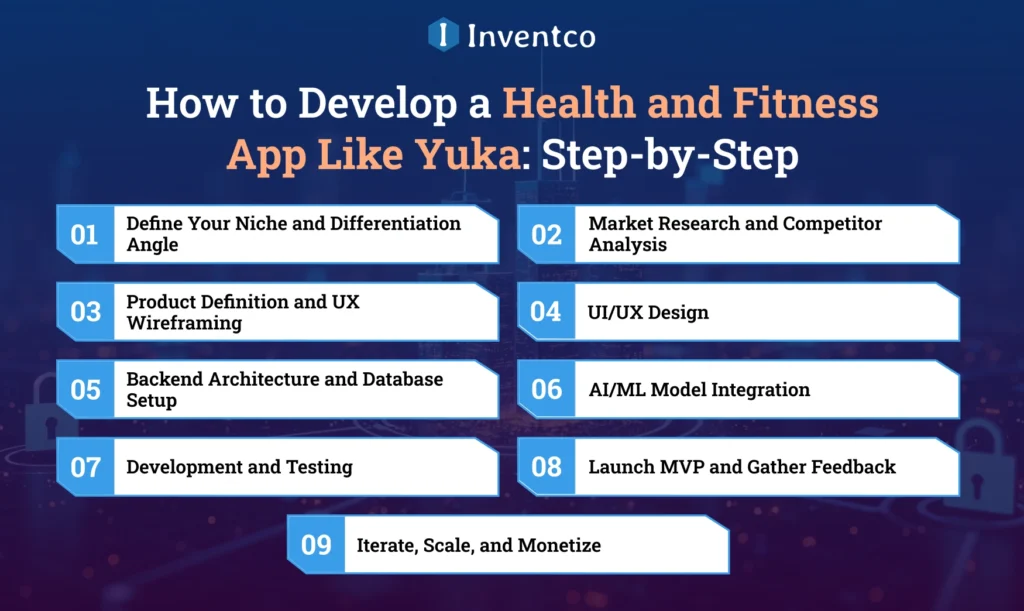
Step 1: Define Your Niche and Differentiation Angle
Determine your app’s market value before proceeding with the design or development of a mobile app. What will your app do to outperform Yuka? Options may include customizing your app to specific regions where Yuka has poor database coverage, choosing food categories (supplements, baby food, pet food), or user segments (elite athletes, pregnant women, or people with chronic conditions).
Step 2: Market Research and Competitor Analysis
Analyze the strengths and weaknesses of Yuka, Think Dirty, Fooducate, and Open Food Facts. Create your mobile app prototype based on things that people actually need and not your guesses. Provide surveys and interviews to potential users, and read the app store reviews for your competitors to find what they are complaining about.
Step 3: Product Definition and UX Wireframing
Clearly define the scope of the MVP mobile app. Adding features lengthens the time and costs for the build. App wireframes should be created for each of the critical user flows: onboarding, food scanning, presenting results, setting up a profile, and upgrading to a subscription.
Step 4: UI/UX Design
Yuka was successful because a complex design was not needed. Yuka has a color-coded score circle with a simple ingredient list. Your system’s design will do the same for complex nutritional data. Incorporate UI patterns for native iOS and Android design, as well as dark mode support and accessibility standards.
Step 5: Backend Architecture and Database Setup
This mobile app development step involves greater complexity. Building a backend system that can support thousands of concurrent requests and a database of millions of food products, as well as a mobile app tech stack that can grow without requiring a complete redesign. It’s critical to specify your API contracts as early as possible.
Step 6: AI/ML Model Integration
The ingredient scoring engine is your Intellectual Property. Whether you start with a rules-based system and score ingredients that way, or a trained ML model, the logic should be transparent, instructive, and justifiable. AI is no longer an optional enhancement for fitness and health apps. It is the main component that drives engagement and app retention.
Step 7: Development and Testing
Work in short sprints with continuous integration. Mobile app testing should be integrated early and often throughout the development process. Testing should include unit tests, integration tests, performance tests, and testing on real devices for both iOS and Android.
Step 8: Launch MVP and Gather Feedback
Launch your MVP mobile app to a select beta audience of 500 to 2000 users, ideally from your target audience. Collect data on in-app behavior to help inform your development efforts on future builds rather than relying on your assumptions.
Step 9: Iterate, Scale, and Monetize
The primary focus of mobile app development in this stage is to optimize. Premium features can be added, product databases can be extended, and B2B partnerships can be established. Additionally, consider white label licensing within retail and wellness brands.
Tech Stack for Building a Food Scanner App Like Yuka
The right technology decisions at the start of your build protect your investment at scale. Here is the recommended tech stack for a Yuka-like application:
| Category | Recommended Technologies | Why It Matters |
|---|---|---|
| Frontend (iOS) | Swift, SwiftUI | Native performance and a seamless iOS user experience |
| Frontend (Android) | Kotlin, Jetpack Compose | Modern Android development with better performance and maintainability |
| Cross-Platform Development | Flutter, React Native | Faster development cycle with a shared codebase across platforms |
| Backend | Node.js, Python (Django/FastAPI) | Scalable APIs, efficient data processing, and high performance |
| Database | PostgreSQL, MongoDB | Supports structured user data and flexible scan history storage |
| Barcode & QR Scanning | ZXing, Google ML Kit Barcode Scanning, Scandit | Accurate and fast product identification across multiple barcode formats |
| Food & Ingredient Database | Open Food Facts API, USDA FoodData Central | Access to millions of verified food products and ingredient records |
| AI & Machine Learning | TensorFlow Lite, Google ML Kit | Real-time ingredient analysis, health scoring, and personalized recommendations |
| Cloud Infrastructure | AWS, Google Cloud Platform (GCP) | High availability, auto-scaling, and global performance optimization |
| Push Notifications | Firebase Cloud Messaging (FCM), Apple Push Notification Service (APNs) | User engagement through reminders, alerts, and personalized updates |
| Analytics & User Insights | Mixpanel, Amplitude | Track user behavior, feature adoption, and conversion funnels |
| Authentication & Security | Firebase Authentication, OAuth 2.0 | Secure login with support for social sign-in and account protection |
| CI/CD & Deployment | GitHub Actions, Fastlane | Automated testing, continuous integration, and faster releases |
| Data Security & Compliance | SSL/TLS, AES-256 Encryption, GDPR-Compliant Storage | Protects sensitive user data and ensures regulatory compliance |
Your mobile app development framework choice, Flutter vs React Native for cross-platform, will significantly impact development speed and team availability. Both are production-ready for this use case, the right choice depends on your team’s existing expertise and long-term platform roadmap.
How Much Does it Cost to Build an App Like Yuka?
The cost to build a mobile app like Yuka can range from $10,000 to $100,000+, but it can vary significantly based on scope, feature complexity, team location, and whether you are building an MVP or a full-featured product. Here is a realistic breakdown:
| Development Component | Estimated Cost (USD) | Timeline |
| UI/UX Design & Prototyping | $1,500 – $5,000 | 2–4 weeks |
| Barcode & QR Scanning Engine | $2,000 – $8,000 | 2–5 weeks |
| Food Ingredient Database Integration | $1,500 – $6,000 | 2–4 weeks |
| AI/ML Health Scoring Engine | $5,000 – $20,000 | 4–8 weeks |
| User Profile & Personalization | $2,000 – $8,000 | 2–5 weeks |
| Backend API & Cloud Infrastructure | $4,000 – $15,000 | 3–6 weeks |
| Admin Dashboard | $2,000 – $6,000 | 2–4 weeks |
| QA, Testing & Security Audit | $2,000 – $8,000 | 2–5 weeks |
Key Cost Variables
- Development Team Location: Teams in India typically deliver at $25–$50/hour vs $100–$200/hour in North America or Western Europe, without compromising quality when working with established firms.
- Database Licensing: Using open-source databases like Open Food Facts reduces upfront cost significantly, building a proprietary database adds $15,000–$40,000+ to the budget.
- AI Complexity: A rule-based scoring system is far cheaper to build than a trained ML model. Start with a rule-based system and train your model on real user scan data post-launch.
- Ongoing Maintenance: Budget 15–20% of your initial build cost annually for mobile app maintenance, security patches, OS updates, and database expansion. Refer to detailed mobile app maintenance cost breakdowns before finalizing your financial model.
For founders looking to validate the concept before full investment, an MVP mobile app focused purely on barcode scanning and basic ingredient grading can be production-ready in 12–16 weeks.
Estimated Total Cost by Project Scope
| Project Type | Estimated Cost (USD) | Timeline |
| Basic MVP | $10,000 – $25,000 | 2–4 months |
| Mid-Market Application | $25,000 – $60,000 | 4–8 months |
| Advanced AI-Powered Application | $60,000 – $100,000+ | 8–12+ months |
Top Apps Like Yuka: Competitors to Study Before You Build
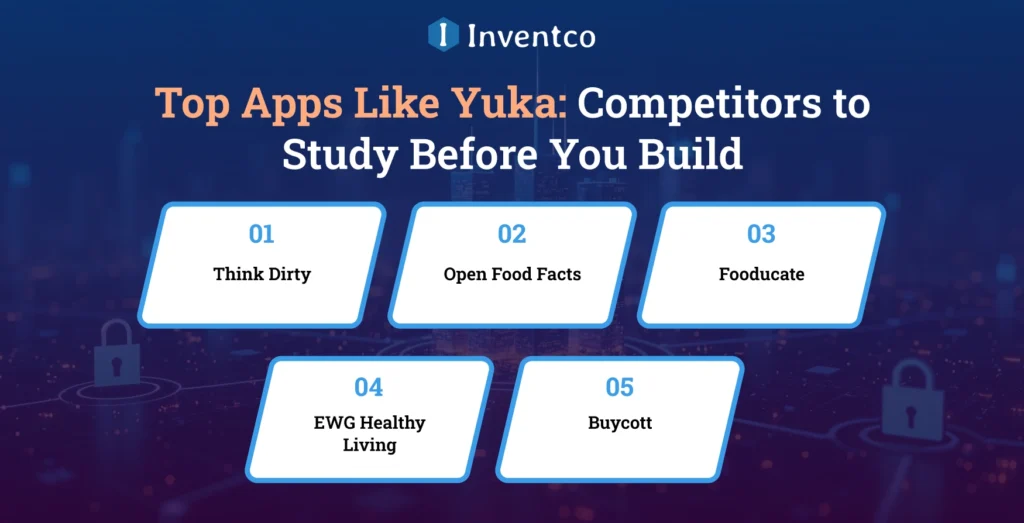
Analyzing competitors is an essential step when you develop a mobile app. Here are the top apps like Yuka:
Think Dirty: Think Dirty scans personal care and cosmetic products for potentially dangerous ingredients. The only drawback is that they do not cover food. Highly adopted in North America.
Open Food Facts: Open Food Facts is a highly comprehensive food database that is open-source and maintained by contributors across the globe. Where it lacks is an AI score and usability. In its current state, it serves users everywhere.
Fooducate: Fooducate aims to create healthier choices by grading nutrition and providing food recommendations that would help users achieve their goals. The only downside is that their user interface has design issues that need to be fixed. Their audience is goal-oriented individuals in the US.
EWG Healthy Living: EWG Healthy Living is an app that prioritizes ingredients, health, and product safety. In comparison to other apps, their database is small, which limits their coverage. The app is mainly used in the US.
Buycott: Buycott is an app that helps users make informed purchasing decisions based on the ingredients, ethics, and sustainability of the product. Again, there is a lack of ingredient analysis. The app is adopted in the US and Europe.
Don’t try to replicate Yuka in 2026, try to outperform it in a specific dimension: better AI personalization, broader product category coverage, stronger regional database depth, or a sharper B2B monetization layer. Understanding the competitors will help you identify and think through unexplored opportunities.
Monetization Strategy for Your Yuka-Like App
A well-designed mobile app monetization strategy for a food scanner app should layer multiple revenue streams rather than relying on a single model. Here is what works:
1. Freemium Subscription Model
Users are given free access to the basic version of the scanner and its features. A Premium tier of $2.99 to $4.99 per month or $24.99 per year is offered to unlock the app’s offline mode, ingredient filtering, personal health profiles, and premium insights. Yuka earns good revenue from this model as the free version of the app is very helpful, and users upgrade to Premium to receive more features, thereby enhancing their user experience.
2. B2B Brand Intelligence
Food manufacturers, retailers, and wellness brands will pay for consumer perception data, ingredient benchmarking, and product reformulation consultations. Anonymized, aggregated scan data can create a very successful B2B layer and bring in a lot of recurring revenue, without touching the consumer experience.
3. Affiliate and E-Commerce Integration
When a product is offered as a healthier alternative, the recommendation can include an affiliate link to Amazon, iHerb, or a direct brand store. This can drive significant revenue at a sustainable scale and address the customer’s trust.
4. White-Label Licensing
Once the core product is placed in the market, other scanning platforms for retail grocery chains, pharmacy brands, and corporate wellness programs may want a branded version of competing platforms. This can be a licensed product of a proven scanning core product placed on the market. $50,000–$200,000+ per client can be the revenue model.
5. In-App Data Services
Premium users who want to export their scan history, generate personal nutrition reports, or connect their data to health platforms like Apple Health or Google Fit represent an additional monetization touchpoint.
How Inventco Can Help You in Your Journey
Developing an application similar to Yuka requires knowledge of artificial intelligence, mobile development, and health technology innovations. At Inventco, we offer a large array of mobile app development services, including consulting on your ideas to improve and validate the market for your product before launching and scaling it.
Inventco’s talented and experienced teams will create pathways for premium user experiences, construct systems for feature-rich barcode scanning and ingredient analysis, and design AI-based health scoring and personalization systems. Inventco also constructs the cloud and admin systems for a seamless user experience.
To ensure a reliable product is brought to market, security, compliance, and quality assurance are incorporated into the development stages. Inventco also offers services for your product post-launch to bring new features to life and to ensure the performance of your application is of the highest standard for your growing user base.
Inventco will assist you in making dreams of a successful mobile application a reality, whether you are in the process of developing a minimum viable product (MVP) or are in the process of scaling a health application.
Conclusion
Consumer demand for food transparency and health scanning apps is mainstream and not a niche market. The regulatory environment is growing in favor of this space, coupled with proven monetization models and a large B2B expansion opportunity.
Yuka proved these concepts, and the next generation of these applications is currently being developed. These will be apps that are smarter and more personalized and offer broader features and sharper monetization. The opportunity to establish a strong competitive position in this industry will not last.
For founders and investors considering a build in this vertical, a solid market opportunity, a validated product archetype, and the right build partner make this one of the least risky opportunities in health-tech. Partner with Inventco to build a mobile application that will not only stand toe to toe with Yuka but will also set the stage for the next evolution in health transparency tech.
FAQ’s
Q. How long does it take to develop an app like Yuka?
Ans. An MVP focused on barcode scanning, basic ingredient scoring, and user profiles can be built in 12–16 weeks. A full-featured product with AI personalization, cosmetics coverage, and a B2B dashboard typically takes 8–14 months, depending on scope and team size.
Q. What database does an app like Yuka use for food products?
Ans. Open Food Facts is the most commonly used open-source food product database, with over 3 million products across 200 countries. It can be supplemented with the USDA FoodData Central API, regional retail databases, and proprietary product entries crowdsourced from users.
Q. How does Yuka make money without showing ads?
Ans. Yuka generates revenue primarily through a freemium subscription model. Premium users pay for offline access, advanced ingredient filtering, and personal health profiles. The app does not accept advertising or brand sponsorships, which is central to its trust positioning.
Q. Is it possible to build a Yuka clone, or should I build something original?
Ans. A direct clone is not advisable; beyond legal risk, it offers no market differentiation. The stronger business move is to identify a specific gap Yuka does not address: a particular geography, product category, user segment, or AI capability, and build toward that edge.
Q. What is the cost to build an app like Yuka?
Ans. Costs range from $10,000–$25,000 for an MVP to $60,000–$100,000+ for a full-featured product. Variables include team location, AI complexity, database strategy, and whether you are building for a single platform or both iOS and Android simultaneously.
Q. Do I need AI to build a food scanner app?
Ans. Not for your MVP. A rules-based ingredient scoring system is sufficient to launch and validate the concept. AI becomes important in the growth phase for personalized scoring, dietary profiling, alternative product recommendations, and predictive health insights.

Jitendra Jain
He is the CEO and Co-founder of Inventco, driving innovation in advanced computing and digital transformation. With deep expertise in modern IT ecosystems, he leads scalable, secure, future-ready solutions. His strategic leadership helps businesses accelerate growth, adopt innovation, and achieve success. You can connect with him on LinkedIn to follow his technology insights.