Every year, billions of euros in GDPR fines are issued, and those numbers are increasing every year. Since the General Data Protection Regulation was put in place in May of 2018, the total sum of fines has gone over 7.1 billion euros, with over 1.2 billion euros in 2025 alone.
Ireland’s Data Protection Commission fined TikTok EUR 530 million in a single ruling. LinkedIn was hit with EUR 310 million. The European regulators have made it very clear that data privacy is non-negotiable and that the protection of data will no longer be enforced solely against the Big Technology companies.
What makes this trend significant for founders and business leaders is the expanding scope of enforcement. Finance, healthcare, SaaS, e-commerce, and enterprise technology firms are now firmly on regulators’ radars. If your software involves any data of European users, no matter where your company is based, you are legally and ethically obligated to have GDPR compliance.
This urgency is reflected in the global GDPR compliance software market as well. The market was valued at approximately USD 3.37 billion in 2025, and it is projected to grow to over 28 billion dollars by 2035, at a compound annual growth rate of 23%. Building software that is compliant with GDPR is no longer a legal requirement but a strategic business choice to protect your company, your users, and your finances.
This guide covers everything decision-makers need to know about GDPR compliance software development: what compliance means at a technical level, the key requirements your software must meet, the essential features to build, the development process, cost benchmarks ranging from $10,000 to $100,000+, and the future trends shaping the regulatory technology landscape. Whether you are building a new platform or modernizing an existing one, this guide provides the strategic clarity to move forward with confidence.
Key Takeaways
- GDPR non-compliance carries fines up to 4% of global annual turnover or EUR 20 million.
- The GDPR compliance software market is projected to hit USD 28 billion by 2035.
- Businesses outside the EU must comply if they process data of EU residents.
- Privacy-by-design must be embedded from day one of software development.
- AI-powered automation is transforming how businesses manage real-time compliance monitoring.
- Custom GDPR compliance software costs range from $10,000 to $100,000 or more.
- Industries from healthcare to fintech are accelerating GDPR software adoption rapidly.
GDPR Compliance Market: Key Statistics
The data privacy market has reached a critical inflexion point. Here are the most authoritative figures business leaders need to benchmark their compliance investments:
- The Global GDPR Compliance Software Market size was USD 3.37 Billion in 2025 and is projected to reach USD 4.17 Billion in 2026, expanding further to USD 28.43 Billion by 2035, registering a strong CAGR of 23.78% during the forecast period (2026–2035).
- GDPR enforcement continues to intensify worldwide, with regulators issuing more than EUR 7.1 billion in total fines since 2018, highlighting the growing financial risks of non-compliance for businesses handling user data.
- In 2025 alone, organizations faced approximately EUR 1.2 billion in GDPR penalties, demonstrating how data privacy regulations are becoming stricter across industries and global markets.
What is GDPR Compliance Software Development?
GDPR compliance software development involves the design, implementation, and upkeep of systems with the GDPR in mind. Development in this area is more than the deployment of a cookie policy banner on a site. GDPR Compliance software development requires the implementation of sufficient data privacy controls, frameworks of consent, audit controls, and breach notification mechanisms.
GDPR compliance solutions satisfy and simplify unending regulatory requirements. These include the management of data access requests, the overall management of data processing activities, the management of data transfer requests, and the overall management of privacy-related activities.
The goal of developing GDPR compliant software is the implementation of a design approach to the app development process that has data privacy as the overall goal. Each point where data can be accessed, be it for the purpose of data storage or its destruction, should have an approach that has data privacy as the ultimate goal. This should be the case for data access frameworks, control frameworks, and data encryption standards.
For businesses constructing customer-facing platforms, building enterprise applications, or developing systems for the healthcare domain, the information becomes clear when considering a GDPR-compliant software development partner. It is a matter of developing elegance, achieving praise, and earning customer and stakeholder trust for the foreseeable future.
Why Businesses Need GDPR Compliance Software?
As data ecosystems grow more complex and regulators become more sophisticated, manual compliance management is no longer viable. Here is why investing in a structured GDPR compliance strategy backed by dedicated software is a business-critical decision:
- Avoid Catastrophic Financial Penalties: With cumulative GDPR fines exceeding EUR 7.1 billion, the financial exposure is real and growing. Compliance software automates the documentation and enforcement mechanisms that protect organizations from regulatory action.
- Build User Trust and Brand Equity: Over 92% of organizations subject to GDPR requirements report that demonstrating compliance strengthens customer confidence. A transparent data handling framework becomes a competitive differentiator, particularly in B2B and enterprise sales cycles.
- Streamline Operational Efficiency: GDPR compliance services embedded in software automate repetitive tasks, such as consent tracking, data mapping, and access request processing, reducing the internal burden on legal and compliance teams while minimizing human error.
- Enable Secure Business Scalability: As your user base grows and data volumes increase, manual compliance processes break down. Scalable GDPR compliance technology solutions grow alongside your platform, ensuring regulatory integrity at every stage of business expansion.
- Support Cross-Border Data Operations: For businesses operating across jurisdictions, particularly those with users in both the EU and the US, GDPR compliance software provides a unified framework for managing international data transfers under mechanisms such as Standard Contractual Clauses (SCCs).
Key GDPR Compliance Requirements
Understanding the regulatory framework is the foundation of any effective GDPR compliance guide. Here are the eight core requirements that must be reflected in your software’s architecture and operational processes:
- Lawful Basis for Data Processing: Every instance of data processing must have a legal basis. This could be consent, a legitimate interest, a necessity for the performance of a contract, or a legal obligation. Your software must be able to document, store, and display this justification when required.
- Explicit and Informed Consent Management: Consent must be freely given, specific, informed, and unambiguous. Systems must enable granular consent capture, timestamped records, and easy withdrawal mechanisms, with no pre-ticked boxes or bundled permissions.
- Data Subject Rights Fulfilment: Everyone has the right to access, correct, delete, and restrict their data. Under GDPR, these actions must be carried out within 30 days of the request, thus the need for automated workflows.
- Privacy by Design and by Default: Privacy must be the core of any product and not an afterthought. Default privacy settings must offer the greatest protection to the user with the least amount of data usage.
- Data Processing Activity Records (Article 30): Controllers and processors must document and maintain an accurate record of all processing activities, which must include the purpose for processing, the data categories, the retention periods, and any recipients.
- Data Protection Impact Assessments (DPIAs): Formal DPIAs are mandatory before processing high-risk activities involving large-scale systematic monitoring and profiling. The DPIA workflow and documentation should be facilitated through the use of the software.
- Breach Notification and Response: Data breaches affecting EU residents must be reported to the relevant supervisory authority within 72 hours of discovery, and affected individuals must be notified without undue delay. Automated breach detection and notification tools are essential.
- Third-Party Vendor and Processor Management: A Data Processing Agreement (DPA) should be in place for any third-party processing data on your behalf. The software for GDPR compliance must monitor these contracts and evaluate vendor risks, and will highlight contractual deficiencies.
Essential Features of GDPR Compliance Software
A robust GDPR compliance software platform is built on a well-defined feature set that addresses every dimension of the regulation. Here are the 10 capabilities that define enterprise-grade compliance software:
- Consent Management Platform (CMP): A centralized module for the collection, maintenance, and management of end-user consent across digital contact points, sites, mobile apps, and application programming interfaces (APIs). Must include support for granular consent categories, versioning, and full audit trails per the GDPR compliance checklist.
- Data Mapping and Inventory: An automated engine of data discovery and classification that identifies the locations of personal data across your systems, flows of data across applications, and the third-party data actors. The foundation of a compliant GDPR data architecture.
- Data Subject Request (DSR) Management: A process that employs automation to receive, verify, route, and respond to access, deletion, data portability, and objection requests sent by data subjects within the regulatory timeframe of thirty days.
- Privacy Policy and Notice Management: A dynamic content management system that sustains updated privacy notices, cookie policies, and user-facing documentation. Incorporates policy change alerts and a user consent workflow.
- Data Protection Impact Assessment (DPIA) Workflow: A module for assessment and documentation of DPIAs, which includes risk scoring and incorporates a workflow for approval by stakeholders and integration of the data inventory.
- Vendor and Third-Party Risk Management: A module for assessment and registry of all data processors and sub-processors under the Data Processing Agreement (DPA) and data transfer mechanisms, with risk-scoring and alerts when vendor contracts require updating or reassessment.
- Breach Detection and Incident Management: Real-time monitoring and alerting for potential data breaches, coupled with a structured incident response workflow that automates the 72-hour notification process to supervisory authorities and affected individuals.
- Audit Logging and Compliance Reporting: Provides a series of logs related to Data Processing and Compliance Decision Making that are immutable and time-stamped. Enables the generation of reports and dashboards for the auditors and internal governance that meet the requirements of the Regulators.
- Role-Based Access Control (RBAC): Granular access permissions that ensure only authorized personnel can view, process, or export personal data. Supports least-privilege principles and integrates with enterprise identity management systems.
- AI-Powered Regulatory Intelligence: Machine learning models that monitor regulatory updates, automatically flag compliance gaps, and recommend corrective actions. This transforms GDPR compliance from a reactive obligation into a proactive governance capability.
GDPR Compliance Software Development Process
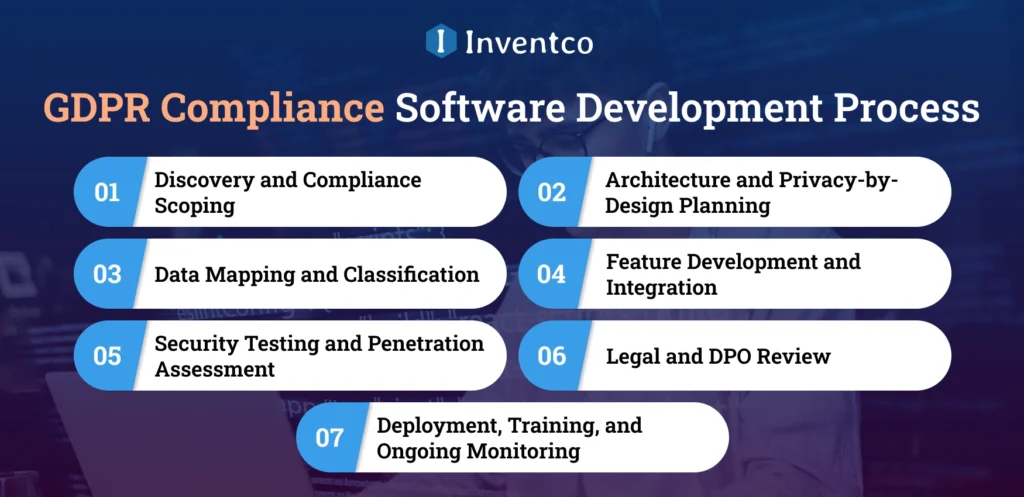
Creation of GDPR-ready software requires collaboration between the legal, compliance, product, and engineering teams. Below, we explain the key steps, phase by phase, of a mature development process for the creation of this software.
- Discovery and Compliance Scoping: Assess your existing data ecosystem, identify regulatory obligations specific to your industry and geography, and define the technical and operational scope of compliance requirements. This phase produces a detailed GDPR compliance checklist tailored to your platform.
- Architecture and Privacy-by-Design Planning: Design the system architecture with data minimization, purpose limitation, and access control principles embedded from the start. Define encryption standards, data residency requirements, and API security app frameworks.
- Data Mapping and Classification: Optimize the identification and cataloging of personal data flows throughout your IT landscape using automated data discovery tools. The foundation of Article 30 Records and DPIA priorities is built from this effort.
- Feature Development and Integration: Build compliance modules for consent management and DSR, breach notifications, DPIA, and audit logging. Integrate them seamlessly with your CRM, ERP, and cloud infrastructure.
- Security Testing and Penetration Assessment: Conduct comprehensive security testing, including vulnerability scans, penetration testing, and data flow audits to validate that the software performs as intended under adversarial conditions.
- Legal and DPO Review: Validate the controls against your obligations by engaging your Data Protection Officer and legal counsel to ensure that your user documentation is legally compliant.
- Deployment, Training, and Ongoing Monitoring: Deploy with full team training, configure real-time monitoring, and schedule compliance reviews with your software updates to accommodate changes in the regulations.
How Much Does It Cost to Build Software with GDPR Compliance?
Investment in GDPR compliance software development varies significantly based on platform complexity, the depth of integration required, and whether you are building from scratch or layering compliance onto an existing system. Here is a practical framework for development costs:
| Engagement Type | Estimated Cost Range | Best For |
| GDPR Compliance Audit and Strategy | $10,000 – $30,000 | Early-stage startups needing a compliance baseline |
| Consent Management and DSR Module | $25,000 – $80,000 | Businesses with existing platforms needing compliance overlays |
| Mid-Tier Custom Compliance Platform | $80,000 – $180,000 | SaaS and eCommerce companies with complex data flows |
| Enterprise-Grade GDPR Compliance Software | $180,000 – $350,000+ | Healthcare, finance, and large-scale enterprise platforms |
| AI-Powered Compliance Automation Suite | $250,000 – $500,000+ | Global enterprises requiring real-time regulatory intelligence |
Ongoing maintenance, including regulatory updates, security patches, staff training, and DPO support, typically adds 15–25% of the initial build cost annually. The cost of non-compliance, by contrast, remains orders of magnitude higher, making this investment straightforward to justify.
GDPR Compliance Software vs Traditional Security Solutions
Many organizations mistakenly assume that existing cybersecurity infrastructure, firewalls, endpoint protection, and data encryption are sufficient for regulatory compliance. It is not. Here is how purpose-built GDPR compliance software differs from traditional security tools:
| Dimension | Traditional Security Solutions | GDPR Compliance Software |
|---|---|---|
| Primary Focus | Threat prevention and perimeter defence | Rights management, consent tracking, and regulatory compliance |
| Consent Management | Not typically included | Built-in consent collection, tracking, and audit trails |
| Data Subject Rights (DSR) | Manual handling or third-party dependency | Automated DSR workflows for access, deletion, and portability requests |
| Regulatory Reporting | Limited security logs and alerts | Real-time compliance dashboards and regulator-ready reporting |
| Breach Notification | Detection-focused with manual escalation | Automated 72-hour GDPR breach notification workflows |
| Vendor Risk Management | Basic third-party security monitoring | DPA management, vendor risk scoring, and compliance tracking |
| Compliance Posture | Reactive approach focused on cybersecurity threats | Proactive continuous monitoring for GDPR compliance requirements |
| Data Governance | Limited visibility into the personal data lifecycle | Centralized data mapping, classification, and retention management |
| Audit Readiness | Requires manual evidence collection | Automated audit trails and compliance documentation |
| Scalability | Focused on infrastructure protection | Designed for evolving global privacy regulations and multi-region compliance |
The distinction is strategic: traditional security tools protect your infrastructure from external threats, while GDPR compliance software governs how personal data is handled, processed, and protected across the full data lifecycle, which is precisely what regulators examine during investigations.
Common GDPR Compliance Challenges
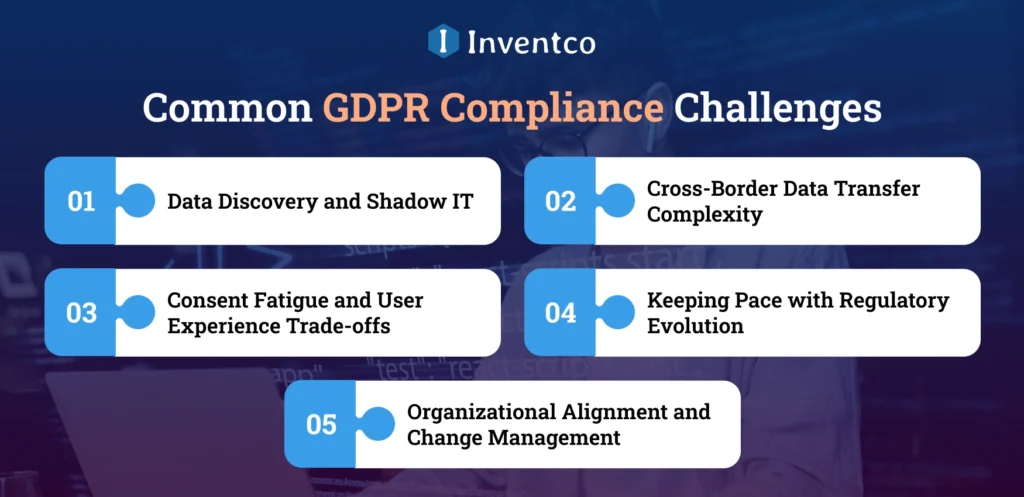
Even well-resourced organizations encounter significant friction in building and maintaining GDPR compliance. Understanding these development challenges upfront allows development teams to architect more resilient solutions:
- Data Discovery and Shadow IT: Identifying all data processing activities, particularly in complex enterprise environments with legacy systems, third-party SaaS tools, and shadow IT deployments, remains one of the most technically demanding aspects of compliance.
- Cross-Border Data Transfer Complexity: Managing lawful data transfers between the EU and non-EEA countries, particularly the US, involves navigating mechanisms such as Standard Contractual Clauses and monitoring adequacy decisions in a dynamic, frequently changing landscape.
- Consent Fatigue and User Experience Trade-offs: Building consent interfaces that are legally compliant, yet user-friendly requires careful UX design. Overly complex consent flows increase abandonment rates; overly simplified ones attract regulatory scrutiny.
- Keeping Pace with Regulatory Evolution: GDPR regulations, guidance from the European Data Protection Board, and national supervisory authority interpretations continue to evolve. Compliance software must be designed with agility in mind to absorb regulatory changes without major re-engineering.
- Organizational Alignment and Change Management: Technical compliance tools are only as effective as the people and processes surrounding them. Many compliance failures stem from inadequate staff training, unclear ownership, and poor cross-functional coordination, not software deficiencies.
Industries Using GDPR Compliance Software
While GDPR applies across all sectors, several industries face heightened enforcement risk and are investing most aggressively in compliance technology solutions:
- Healthcare and Life Sciences: Patient data is among the most sensitive categories under GDPR. Healthcare providers, medical device manufacturers, and clinical research organisations require deeply integrated compliance architectures that intersect with other regulatory frameworks such as HIPAA and MDR.
- Financial Services and Fintech: Banks, insurers, and payment processors deal with a lot of personal financial data. Complying with GDPR for this sector translates to compliance with other regulations like PSD2, MiFID II, and AML, thus creating a multi-regulatory compliance environment.
- SaaS and Enterprise Technology: Cloud software firms that serve European enterprises must provide GDPR compliance documentation to demonstrate compliance as part of procurement and vendor assessments. Otherwise, they will lose sales.
- E-Commerce and Retail: Online retailers amass transactional data, browsing data, and payment data. Managing compliance with retention policies and targeted marketing is a concern.
- Education and EdTech: Both platforms with student data, and especially those providing services to minors, are required by GDPR to have prior parental consent, comply with data sharing policies, and minimize data. The EdTech sector has the fastest-growing market for compliance.
Future Trends in GDPR Compliance Technology Solutions
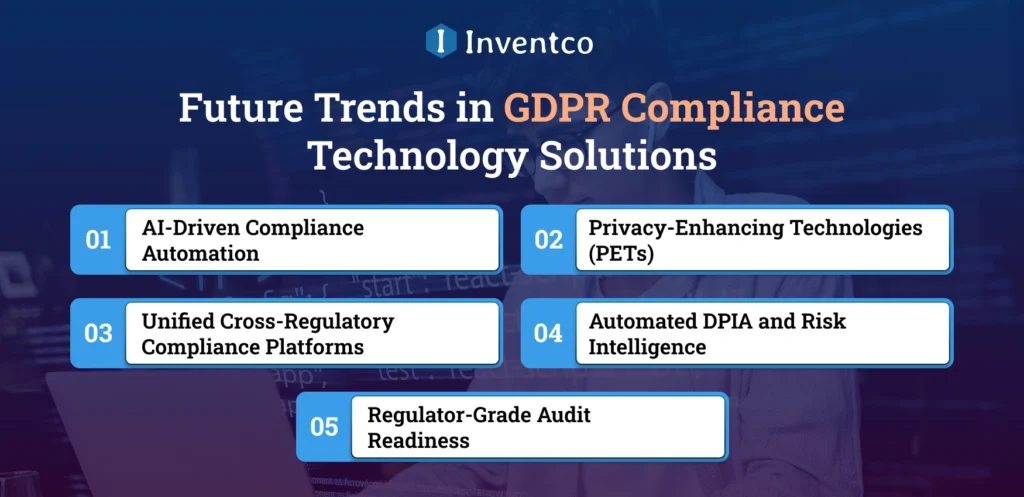
The regulatory technology landscape is rapidly changing as artificial intelligence and other technologies evolve, enforcement actions grow, and the amount of information hosted by cloud-native frameworks grows. The following are the most important development trends affecting the technology for GDPR compliance in 2026 and beyond.
- AI-Driven Compliance Automation: Machine learning models are transforming compliance from a periodic audit exercise into a continuous, real-time governance capability. AI tools automatically classify data, detect consent anomalies, flag regulatory changes, and recommend corrective actions, dramatically reducing manual overhead.
- Privacy-Enhancing Technologies (PETs): Privacy and data protection will be enhanced at the architectural level, helping reduce GDPR exposure as enterprises increasingly adopt privacy-enhancing technologies (PETs). GDPR exposure will be reduced given the protection offered by the PETs and privacy enhancements via differential privacy, federated learning, and other encryption and analytics techniques.
- Unified Cross-Regulatory Compliance Platforms: The increase in the demand for integrated compliance solutions that manage a multitude of regulatory requirements through a consolidated control layer will be driven by the incorporation of a regulatory framework for GDPR, CCPA, HIPAA, DPDP, and other regulatory compliance approaches.
- Automated DPIA and Risk Intelligence: New predictive risk intelligence technologies are expected to trigger Data Protection Impact Assessments (DPIAs) during the assessment of new processing activities and risk documentation. This will integrate compliance within Product Development and shift the focus from compliance to the post-launch phase.
- Regulator-Grade Audit Readiness: The increasing technical sophistication demanded by the supervisory authority will shift enterprise procurement to a greater focus on compliance software with the capability to produce operational logs and evidence of the full lifecycle justification of every processing decision.
Why Choose Inventco for GDPR Compliance Software Development?
Developing GDPR-compliant software involves more than just having a technical skill set. It necessitates an understanding of regulatory law, enterprise architecture, and product scalability. Inventco has this combination and brings this understanding to every engagement.
- Deep Regulatory and Technical Expertise: Our team has a well-formed understanding of GDPR regulations and the compliance process, Data Protection Impact Assessments, and continually evolving supervisory authority guidance. Inventco ensures that every technical decision is legal.
- Privacy-by-Design as a First Principle: From the first architectural drawing and throughout the development process, Inventco ensures that your product will have compliance app features integrated.
- End-to-End Development and Integration: Inventco constructs the complete development life cycle, following the initial compliance scoping and data mapping, within your current technology, from feature development and mobile app testing to monitoring the product after it is launched.
- Industry-Specific Compliance Frameworks: Your industry-specific compliance architecture is tailored to your industry and is far beyond a standard GDPR checklist. This is applied to products in the healthcare industry, fintech, or SaaS enterprise products.
- Scalable, Future-Ready Architecture: Regulatory systems will continue to shift, and your compliance requirements will follow accordingly. Inventco products sustain your compliance guarantee and your business interests over the long-term while decreasing the financial and resource burden of extensive re-engineering.
From helping early-stage startups establish a compliant data foundation to assisting enterprise organizations in modernizing legacy systems to meet current GDPR compliance requirements, Inventco is the best technology partner that translates regulatory complexity into practical, scalable software solutions.

Conclusion
GDPR compliance is no longer a legal formality, it is a foundational pillar of responsible, sustainable business operations in the digital economy. With regulators issuing over EUR 7.1 billion in cumulative fines, average breach notifications exceeding 400 per day, and the compliance software market on course to reach USD 28 billion by 2035, the strategic and financial case for purpose-built GDPR compliance software has never been stronger.
The businesses that will lead their sectors in the coming decade are those that treat data privacy as a product value, not a compliance burden. By investing in the right GDPR compliance technology solutions today, founders and investors are not just protecting their organisations from regulatory risk. They are building the trust infrastructure that powers long-term growth.
If you are ready to build a mobile app that puts data privacy at its core, Inventco is here to help you do it right.
FAQ’s
Q1. What is GDPR compliance, and who does it apply to?
Ans. GDPR compliance means aligning your data handling practices with the General Data Protection Regulation. It applies to any organization that processes the personal data of EU residents, regardless of the organization’s geographic location. This includes businesses in the US, Asia, and beyond that serve European users.
Q2. What is the difference between GDPR compliance software and general data security tools?
Ans. Traditional security tools focus on protecting infrastructure from external threats. GDPR compliance software specifically addresses regulatory obligations, including consent management, data subject rights fulfillment, breach notification, vendor risk tracking, and audit reporting, which are distinct from cybersecurity controls.
Q3. How much does GDPR compliance software development cost?
Ans. Costs range from approximately $10,000 for a compliance audit and basic consent management module to $350,000 or more for a fully custom enterprise-grade platform with AI-powered regulatory intelligence. The investment depends on platform complexity, data volume, and the depth of integration required.
Q4. Is GDPR compliance required for US-based companies?
Ans. Yes. If a US-based company processes the personal data of EU residents through a website, app, or any digital service, it must comply with GDPR. This is commonly referred to as GDPR compliance in the US context, and regulators have actively pursued enforcement against non-EU companies, including significant fines against American and non-European firms.
Q5. What are the most important features of GDPR compliance software?
Ans. The most critical features include a consent management platform, automated data subject request workflows, data mapping and inventory tools, breach detection and notification capabilities, DPIA management, vendor risk tracking, and regulator-ready audit reporting. AI-powered compliance intelligence is increasingly becoming a standard expectation.
Q6. How long does it take to build GDPR compliance software?
Ans. Development timelines vary based on scope. A focused consent management and DSR module can be delivered in 8–16 weeks. A full enterprise compliance platform with AI capabilities typically takes 6–12 months from scoping to deployment. Ongoing maintenance and regulatory updates are continuous post-launch commitments.
Q7. What happens if a business fails to comply with GDPR?
Ans. Penalties can reach up to EUR 20 million or 4% of global annual turnover, whichever is higher. Beyond financial penalties, organizations face reputational damage, mandatory processing restrictions, and in some cases, complete suspension of data processing activities. Enforcement actions are increasingly targeting industries beyond Big Tech, including healthcare, finance, and education.

Sandeep Agrawal
Sandeep Agrawal is the visionary CTO at Inventco, bringing innovation to life through his technical expertise. With a passion for cutting-edge technologies, Sandeep leads the team in developing robust solutions. His dedication and continous efforts to pushing the boundaries of what’s possible defines his role as a transformative and innovative force in the tech industry. You can connect with him on LinkedIn to follow insights.