The global fantasy sports market is projected to reach USD 42.37 billion by 2026, and growth shows no signs of stopping. Mordor Intelligence forecasts that it will almost double to USD 80.31 billion by 2031, rising at a 13.66% CAGR. That growth is being pulled forward by one force more than any other: artificial intelligence. Platforms that formerly competed only on scoring systems and league variation are now competing on something much more difficult to replicate: how correctly they can predict player success, how personally they can communicate with each user, and how efficiently they can keep players returning contest after contest.
For founders and investors considering this space, that shift changes the entire product calculus. A fantasy sports app is no longer a static roster-drafting tool, it is a live data product, and AI is what makes that product intelligent. The cost to build a fantasy sports mobile app with competitive AI-based fantasy sports app development capability typically ranges from $10,000 for a focused MVP to $100,000 or more for an enterprise-grade platform with real-time prediction engines; the range is heavily influenced by the depth of the AI integration and the markets in which you intend to launch.
This article breaks down why AI in fantasy sports has become non-negotiable for serious operators, the specific ways platforms are using it today, what it realistically costs to build these capabilities, and how a technology partner like Inventco can help you move from concept to a scalable, revenue-ready launch.
Key Takeaways
- Industry research pegs 47–54% of fantasy sports platforms as actively integrating AI-based analytics into their product roadmaps.
- AI in fantasy sports spans five operational layers: player projections, lineup optimization, real-time in-game insight, fraud and fair-play detection, and churn prediction.
- Mobile accounts for 65.43% of fantasy sports transactions, which makes on-device AI performance a genuine competitive differentiator, not a backend detail.
- Building an AI-based fantasy sports app development project realistically costs between USD 10,000 and USD 100,000+, depending on whether you are validating an MVP or launching a full predictive platform.
- Data infrastructure, not the AI model itself, is usually the cost founders underestimate most.
Market Stats and Insights
Before deciding how much of your roadmap to dedicate to AI, it helps to look at where the money and the users are actually moving. The numbers below reflect the current shape of the market heading into the second half of 2026.
- The fantasy sports market is projected to grow from USD 42.37 billion in 2026 to USD 80.31 billion by 2031, at a CAGR of 13.66%.
- The global AI in Sports market is expected to increase from USD 12.7 billion in 2026 to USD 49.9 billion by 2033, growing at a CAGR of 21.6%.
- The Sports Analytics market is forecast to reach USD 31.14 billion by 2034 from USD 7.03 billion in 2026.
The pattern across nearly every report is consistent: growth is no longer coming from adding more leagues or sports. Instead, it is driven by platforms that can process data faster and personalize decisions better than the competition. This is exactly the gap AI in fantasy sports is designed to close.
Why Is AI Becoming Core to Fantasy Sports Platforms?
Three converging pressures are pushing AI fantasy sports from a nice-to-have into a baseline requirement.
- Rising acquisition costs demand better retention: Duopoly marketing spend in North America alone now exceeds USD 1.2 billion annually, pushing the average customer acquisition cost to USD 300–350 per user. At that price, a platform cannot afford to lose a user after one bad contest experience, AI-driven personalization and predictive recommendations are what convert a first-time entrant into a repeat player.
- Real money is on the line, so accuracy and fairness both matter: Accuracy of the AI’s projection is imperative for the integrity of the trusted perceptions of the platform. With regard to judging fairness and data use, regulators are placing more scrutiny on various jurisdictions; AI is becoming more essential for detecting fraud and anomalies.
- Mobile-first behavior compresses decision windows: With 5G technology, the latency is almost negligible. AI will need to produce recommendations in the same duration as the user will have to complete the task. In this case, the user will have seconds or less to set their fantasy sports lineups.
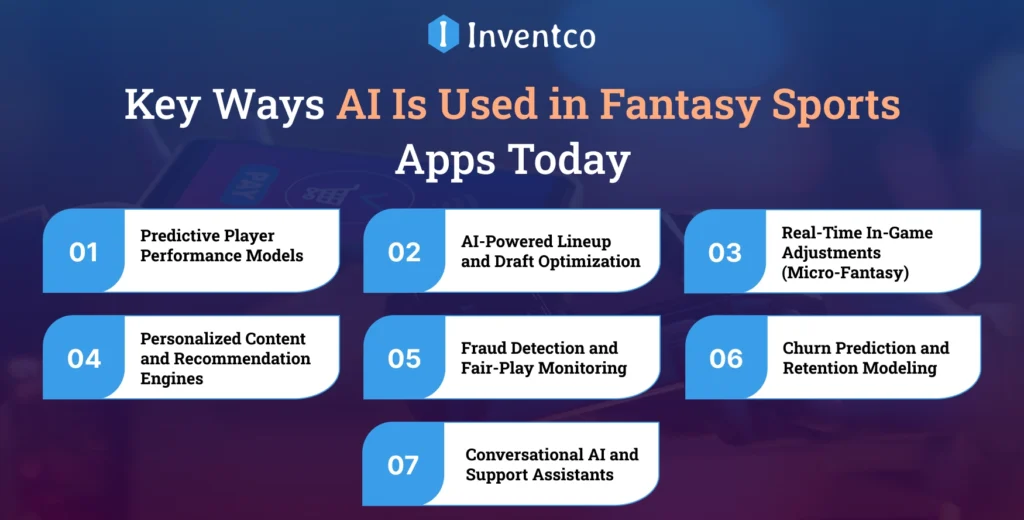
Key Ways AI Is Used in Fantasy Sports Apps Today
1. Predictive Player Performance Models
Machine learning models trained on historical stats, matchup data, weather, injury reports, and even social sentiment now generate player projections that update continuously rather than once before kickoff. This is the foundation nearly every other AI feature builds on.
2. AI-Powered Lineup and Draft Optimization
Instead of manually comparing dozens of players, users get algorithm-assisted lineup suggestions that balance projected points against salary cap constraints, turning what used to be a research-heavy task into a guided decision.
3. Real-Time In-Game Adjustments (Micro-Fantasy)
Live, prop-style contests that adjust mid-game depend on millisecond data ingestion. AI models continuously re-score win probability and player impact as the game unfolds, which is what makes short-duration, in-game contests viable at all.
4. Personalized Content and Recommendation Engines
Push notifications, contest suggestions, and content feeds are increasingly tailored to an individual’s play history and risk appetite, rather than broadcast to the entire user base, directly improving conversion on promotional spend.
5. Fraud Detection and Fair-Play Monitoring
Anomaly detection of player accounts and collusion or bot patterns protects the integrity of the system and future regulatory efforts as predictive models of player behavior become increasingly useful.
6. Churn Prediction and Retention Modeling
Platforms now score users on churn probability and trigger targeted retention offers before a user disengages, rather than reacting after they leave, a meaningfully more efficient use of marketing budget.
7. Conversational AI and Support Assistants
Natural-language assistants can work 24/7, managing frequently asked questions and rule clarifications, as well as general account support. This dramatically decreases support costs and encourages users to remain in the application rather than seek answers elsewhere.
How to Build AI-Based Fantasy Sports App Development Features?
Turning these capabilities into a working product means making deliberate choices long before any code is written. Founders considering a mobile app development process for a fantasy sports platform will likely plan for four different layers.
- Data Ingestion Layer: Reliable, low-latency sports data APIs feed player stats, injury updates, and live game events into your system in real time.
- Modeling Layer: The ML pipelines that generate projections, optimize lineups, and score churn/fraud risk are typically a mix of proprietary models and fine-tuned open frameworks.
- Experience Layer: The app itself, where mobile app features like AI recommendations, live scoring, and personalized feeds need to feel instant, not delayed.
- Trust Layer: Robust mobile app security covering payment data, KYC, and fraud monitoring, since fantasy platforms handle both money and personal data.
In terms of technology, the majority of competitive platforms are using a modern mobile app technology stack. This includes, for example, the combination of cross-platform solutions such as React Native or Flutter, coupled with ML Service offerings based on the Python programming language, and a Cloud Infrastructure for elastic and on-demand data solutions, e.g., AWS or GCP.
There is a lot of variation in Mobile App Development frameworks, however, they should be able to integrate seamlessly with the data pipeline, and hence this decision should be made in collaboration with a technology partner rather than in isolation.
Some Mobile App Development challenges in this space include the difficulty in obtaining high-quality and real-time sports data, low latencies for AI model execution when participating in contests, and legal compliance for multiple jurisdictions or states.
Most founders start with an MVP mobile app in one sport or a single compliance region. This helps prove core AI features. The app is then expanded to other sports and regions after retention metrics are met. This is a much lower-risk model than launching a comprehensive multi-sport platform on day one. Below is a realistic view of what this investment looks like at different levels of AI maturity:
| Tier | Best For | Core AI Capabilities | Investment Range |
| MVP AI Fantasy Sports App | Founders validating a niche league or region | Rule-based projections, basic recommendation engine, standard leaderboards | $10,000 to $25,000 |
| Mid-Tier AI Fantasy Platform | Operators scaling across multiple sports/leagues | ML-based player projections, dynamic lineup optimization, personalized push content, churn scoring | $25,000 to $60,000 |
| Advanced Enterprise AI Fantasy Platform | Multi-region DFS operators and investor-backed scale-ups | Real-time micro-fantasy engines, live in-game AI adjustments, fraud/fair-play detection, generative AI assistants | $60,000 to $100,000+ |
What’s Next: The Future of AI in Fantasy Sports
The next wave of innovation is already visible in early-stage platforms and patent filings across the industry:
- Generative AI assistants that explain lineup logic conversationally (“Why is this player recommended?”) rather than just displaying a score.
- Hyper-personalized contest curation, where the platform assembles contest formats around an individual’s risk tolerance and play history, rather than offering a one-size-fits-all list.
- Wearable and biometric data integration, layering athlete recovery and performance signals into projections as data-sharing agreements with leagues mature.
- Blockchain-verified fairness gives users a transparent, tamper-proof record of scoring and payouts, particularly relevant as regulatory scrutiny increases.
- Voice and AR interfaces for setting lineups and viewing live stats hands-free during game broadcasts.
None of this replaces the fundamentals, accurate data, fast infrastructure, and a trustworthy platform. It simply raises the bar for what “competitive” looks like, which is exactly why the planning decisions founders make now will determine how easily they can adopt these capabilities later.
How Inventco Can Help You with Building an AI-Powered Fantasy App Development
Inventco possesses 10+ years of expertise in mobile app development and the capability of building AI-integrated platforms that are secure, scalable, and advanced in mobile app features.
Having built interactive wager platforms like the Wager App, where users can build their own wagers, participate in contests, and place real-time wagers with their friends on sports and entertainment, politics, and other cross-domain areas (even wager in crypto), gives us the knowledge to create user engagement systems while incorporating secure transactions, high-performance backend systems, and fair-play systems/wagering systems.
We specialize in building smart, user-centric fantasy sports platforms with features like Player Predictive Analytics, Personalized Team Suggestions with Player Picks, Automated Contest Creation and Management, Fraud Prevention, and real-time Analytics on Contest Performance.
Our development process is milestone-based and focuses on the meticulous planning and execution of each project phase, from product definition to backend development, testing, and launch. Whether you are building your MVP fantasy sports app or your full-scale, multi-league fantasy sports app, Inventco has the expertise to deliver a robust app that provides your users with a competitive edge over other fantasy sports apps and allows your business to grow.

Conclusion
AI has become a core part of modern fantasy sports platforms, helping businesses deliver smarter predictions, personalized experiences, and real-time insights. As the global fantasy sports market moves toward USD 80.31 billion by 2031, companies that embrace AI can improve user engagement, increase retention, and create a stronger competitive advantage in an increasingly crowded market.
Founders and investors should prioritize building AI tools to augment gameplay, bolster fair play, and sustain future growth. The greater opportunity is not whether AI will be incorporated, but how rapidly the correct AI measures can be embedded to keep a competitive edge.
FAQs
Q. How does AI transform fantasy sports apps?
Ans. AI transforms fantasy sports apps by generating continuously updated player projections, optimizing lineups against salary caps, personalizing content and contest recommendations, and detecting fraud or unfair play, turning a static drafting tool into a responsive, data-driven experience.
Q. What does AI-based fantasy sports app development typically cost?
Ans. Costs generally range from USD 10,000 for a focused MVP with basic AI recommendations to USD 100,000+ for an enterprise-grade platform with real-time prediction engines, depending on the number of sports supported, data licensing needs, and geographic scope.
Q. How is AI used for daily fantasy sports specifically?
Ans. In daily fantasy sports, AI is used for same-day player projections, live in-game scoring adjustments, dynamic salary-cap-based lineup suggestions, and rapid fraud detection, all of which need to operate within the compressed timeframe of a single day’s contests.
Q. Is AI required to launch a competitive fantasy sports app in 2026?
Ans. It isn’t legally required, but with 47–54% of platforms already citing AI-driven analytics as core to their roadmap, launching without it puts a new platform at a meaningful retention and personalization disadvantage against established competitors.
Q. How long does it take to build an AI-powered fantasy sports MVP?
Ans. A focused, single-sport MVP with core AI recommendation features typically takes 4–6 months to build and launch, depending on data integration complexity and the scope of AI features included in the first release.

Sandeep Agrawal
Sandeep Agrawal is the visionary CTO at Inventco, bringing innovation to life through his technical expertise. With a passion for cutting-edge technologies, Sandeep leads the team in developing robust solutions. His dedication and continous efforts to pushing the boundaries of what’s possible defines his role as a transformative and innovative force in the tech industry. You can connect with him on LinkedIn to follow insights.