Seattle is no longer just the home of Amazon and Microsoft. It has grown into one of the most competitive technology ecosystems in North America, a city where startups scale fast, enterprises demand innovation, and consumer expectations are perpetually ahead of the curve.
Yet many businesses operating here still rely on off-the-shelf software or generic app templates that were never designed for their specific market, workflow, or customer base. The result? Missed engagement opportunities, operational bottlenecks, and a growing gap between what the business offers and what its customers actually need.
Custom mobile app development in Seattle bridges exactly that gap. Whether you are a founder building a product from scratch or an investor evaluating a technology roadmap, the decision to invest in a purpose-built mobile application is less about keeping up with trends and more about securing long-term business viability. In a city where the pace of change is relentless, a custom mobile app is not a luxury, it is infrastructure.
Key Takeaways
- Custom mobile apps give Seattle businesses a measurable edge through personalization, automation, and brand differentiation.
- Industries from healthcare to logistics are leveraging app development to improve operational efficiency and customer experience.
- Choosing the right mobile app development company in Seattle requires evaluating experience, design capability, and local market knowledge.
- ROI from custom apps comes from multiple directions: increased retention, automation savings, higher transaction values, and reduced churn.
- Inventco combines technical depth with local market expertise to help Seattle founders and investors build apps that scale.
Market Stats and Data: Seattle’s Mobile-First Business Landscape
Understanding why custom mobile app development matters in Seattle requires a clear look at the market conditions shaping the city’s business environment.
- The global mobile application market was valued at $330.61 billion in 2025 and is projected to exceed $1.23 trillion by 2035, driven by app-based services and digital transformation.
- The mobile app market is also expected to grow from $330.02 billion in 2026 to over $1.01 trillion by 2034, with a CAGR of 15.1%, highlighting sustained enterprise and consumer demand.
- The global app economy generated 110.5 billion downloads and $150.5 billion in revenue in 2025, reinforcing both the scale of demand and the monetization potential across industries.
For Seattle businesses, these numbers translate directly into competitive pressure. The question is not whether mobile apps matter, the data makes that clear. The question is whether a generic solution is sufficient or whether a custom-built application is what your growth strategy actually requires.
The Growing Demand for Mobile Apps in Seattle’s Business Ecosystem
Seattle’s business environment has several characteristics that make a mobile-first strategy particularly important.
1. A Tech-Savvy Consumer Base
Seattle is among the most connected cities in the country and consistently ranks among the top cities for mobile usage. Seattle’s consumers are the fastest to adapt to mobile solutions and the fastest to leave a business when they encounter poor mobile experiences.
2. A Dense Startup Culture
Seattle has a flourishing startup ecosystem, with strong accelerators and abundant venture capital. Seattle’s top universities produce a great workforce, but largely undifferentiated. Within the first few months of operations, firms must adapt a mobile-first strategy to differentiate themselves.
3. Enterprise Transformation Demand
Seattle’s retail, healthcare, logistics, and financial services are modernizing their operations and business flows. Mobile apps are the centerpiece of their operations and business flows, shaping their operations and user services.
4. On-Demand Economy Growth
The Pacific Northwest has sustained growth in the on-demand economy for food delivery, services, and on-demand healthcare. In this case, on-demand healthcare apps are used for the delivery of on-demand, custom healthcare services. To meet on-demand service requirements, mobile apps require real-time, seamless user experiences, which custom development delivers best.
Top Reasons Businesses in Seattle Need Custom Mobile App Development
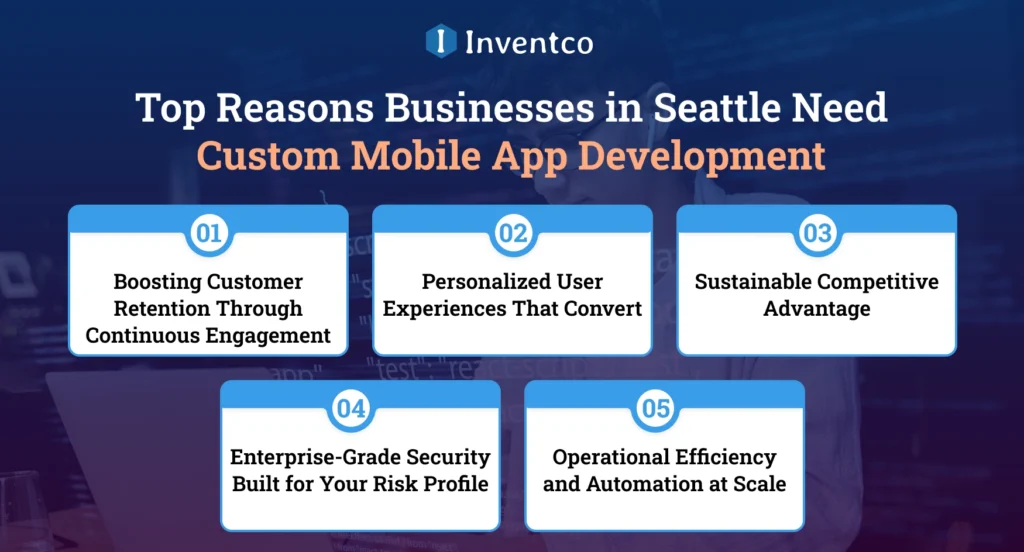
Custom mobile application solutions are critical for sustained growth in Seattle’s mobile-first economy. Mobile apps help improve customer loyalty, operational efficiency, and scalability for long-term growth.
1. Boosting Customer Retention Through Continuous Engagement
There are various methods for evaluating the overall effectiveness of mobile apps. A customer engagement app’s goal is to ensure customers complete future purchases. Apps are more effective than traditional websites because they provide enhanced interaction and a stronger sense of presence for customers. Mobile apps remain a constant presence for customers and provide operational value to the business.
Custom apps enable Seattle’s businesses to employ engagement strategies directly correlated to their customer engagement metrics. Uniquely designed loyalty programs and interfaces are the most effective models for ensuring consistent, repeat engagement when coupled with a customized content feed.
Retaining existing customers is less expensive than winning new customers. The cash flow improvement from reduced customer attrition covers the app development costs.
2. Personalized User Experiences That Convert
Corporations use apps to provide a better customer experience by creating mobile solutions that retain behavior and structure to improve the consumer journey. Custom mobile application solutions in Seattle help create a journey that helps customers retain and helps the organization improve operational efficiency.
Mobile apps can heighten customer loyalty when localized. Seattle has a high degree of cultural engagement and diversity. Mobile apps that include regional preferences and language options compromise connectionless localization and are still better than apps that don’t consider the locals.
3. Sustainable Competitive Advantage
In Seattle’s competitive environment, the hardest-to-imitate businesses are those that offer bespoke products. A custom-built mobile app that aligns with your unique workflows and encapsulates your customer data and your value aesthetics is a strong competitive advantage, as it is difficult, if not impossible, to replicate.
Often, apps built on existing mobile app development platforms are products that the customer has little to no control. Partnering with one of the top mobile app development companies in Seattle brings the opportunity to control such an asset for the customer. As the amount of users’ data grows, the app’s functionality matures, and users build habits with the app, the app’s value will grow.
4. Enterprise-Grade Security Built for Your Risk Profile
Your industry determines the level of security your application requires. Mobile apps built with security controls in Seattle can offer the most advanced architecture to meet your security and regulatory needs. This can encompass:
- End-to-end encryption for sensitive data in transit and at rest
- Multi-factor and biometric authentication
- HIPAA, PCI-DSS, and SOC 2 compliance frameworks built in from the start
- Role-based access control for internal applications
- Custom audit logging for regulated industries
With custom mobile apps, Seattle mobile app developers can help your business implement the most advanced traffic security controls to best mitigate your security and regulatory needs.
5. Operational Efficiency and Automation at Scale
Custom mobile applications can serve both customer engagement and operational purposes. Businesses that develop customer mobile applications and integrate them with internal systems (e.g., ERP, CRM, inventory, HR) can effectively automate operational workflows, reduce manual data entry, and enhance real-time operational business intelligence.
Take, for example, a logistics company based in Seattle that develops a custom application to automate driver dispatch from the app, track deliveries with real-time updates, manage customer exception deliveries, and push delivery updates to customers from a single platform. The savings from eliminating manual coordination, not to mention the immediate improvement in customer satisfaction from real-time operational visibility, provide a good estimate of the return on investment.
Industries in Seattle Benefiting From Custom Mobile Apps
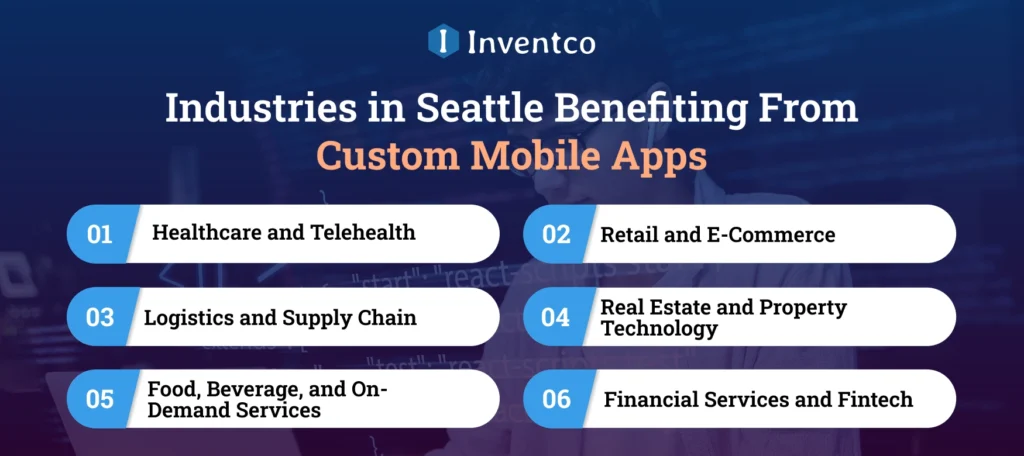
Seattle’s economy spans multiple high-growth sectors where mobile technology is not optional but critical to creating efficiencies, driving engagement, and generating revenue.
1. Healthcare and Telehealth
Seattle has a robust healthcare sector, and the shift toward digital health accelerated significantly after the pandemic. Custom mobile apps enable healthcare providers to offer telehealth services, patient portals, appointment management, medication tracking, and secure provider-patient communication, all within a HIPAA-compliant framework.
2. Retail and E-Commerce
Mobility is a must for Seattle’s retailers, from small boutiques to larger multi-regional chains, to compete with national players. Custom mobile apps enable retailers to offer a branded mobile shopping experience, an in-app loyalty program, augmented reality try-on, and personalized shopping recommendations, thereby increasing cart size and customer repeat purchases.
3. Logistics and Supply Chain
Custom apps with real-time data processors and deep backend integration address problems in fleet management, optimized hauling, real-time tracking and control of inventory and hauling, and driver communication.
4. Real Estate and Property Technology
Seattle has one of the most highly active real estate markets in the nation. Property technology apps for real estate agents, property managers, and technology buyers in the market offer tools for virtual document tours, market analytics, and the transaction process.
5. Food, Beverage, and On-Demand Services
Seattle has a well-documented food culture and a strong demand for on-demand services. Food and beverage businesses create custom apps to manage orders, customer loyalty, and delivery logistics in ways third-party apps do not.
6. Financial Services and Fintech
Many companies in Seattle are developing personal finance, business banking, and investment management products. Fintech mobile applications are complicated. On-demand, secure, and flexible mobile apps require extensive, sophisticated development. Compliance demands that many applications in this space are purpose-built.
Key Features Businesses Should Include in a Custom Mobile App
The features that belong in your app depend on your business model and user needs, but several capabilities consistently deliver high ROI across industries:
- Personalization Engine: Behavioral data and user preferences drive the app experience dynamically
- Push Notification Infrastructure: Segmented, triggered notification logic for re-engagement
- Offline Functionality: Apps that function without live connectivity and sync when restored
- Analytics and Event Tracking: Define exactly which events to track and how to surface that data
- Integrated Payment Processing: Apple Pay, Google Pay, and stored payment methods
- Biometric Authentication: Face ID and fingerprint login reduce friction and increase trust
- Real-Time Data Sync: Live inventory levels, appointment availability, or delivery status
How Custom Mobile Apps Help Seattle Businesses Increase ROI?
There are many ways for mobile applications to generate direct and indirect revenue. For this reason, it is important to take a broad view of app ROI rather than relying on a single metric. Here are a few ways to earn direct revenue through mobile applications.
1. Direct Revenue Contribution
Mobile apps can generate revenue through in-app purchases, subscriptions, and e-commerce sales. Also, businesses with apps report a bounce in the average order value of their customers due to the added ease of mobile purchases.
2. Customer Lifetime Value Uplift
Customer satisfaction increases through custom apps as a direct result of the prompted engagement. Also, longer customer lifetimes result from lower churn.
3. Operational Cost Reduction
Processes such as scheduling, invoicing, inventory updates, and customer communications can be done with ease and efficiency through custom apps. These apps can result in a bump up in cost savings through decreased labor costs.
4. Data Asset Creation
Custom apps allow for customer interaction to be stored. This behavioral data should be captured and stored, and it acts as a differentiator for improved product and marketing decisions.
5. Brand Equity and Perceived Value
Investments in custom apps show customers and investors that a company is customer-first and truly cares, thereby increasing belief in the company. From custom apps, businesses also see a stronger positive perception of the company.
Challenges Businesses Face Without a Custom Mobile App
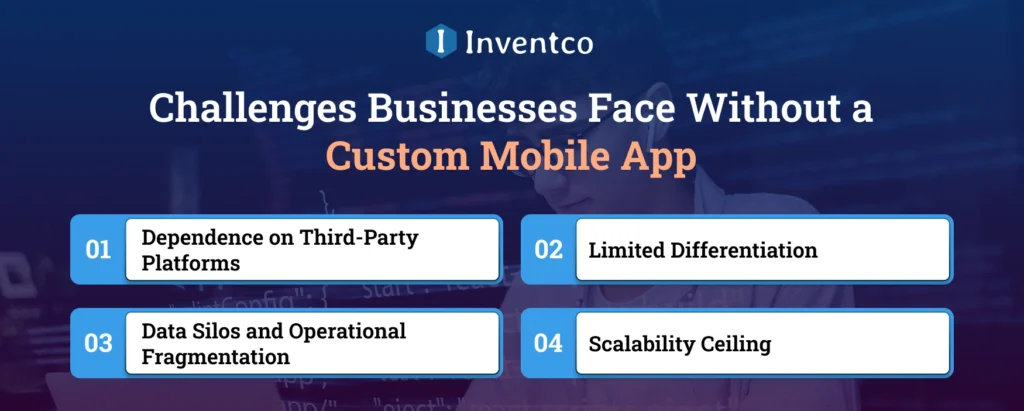
The costs of not investing in a custom mobile application are less visible but equally real:
1. Dependence on Third-Party Platforms
Businesses relying on marketplace apps or generic SaaS tools cede control over their customer relationships, data, and user experience to a platform they do not own. When platform policies change- and they do- the business absorbs the impact without recourse.
2. Limited Differentiation
When your digital experience looks and functions like everyone else’s, the only remaining differentiators are price and location, both of which are weak long-term competitive strategies.
3. Data Silos and Operational Fragmentation
Without a unified application layer, business data lives across disconnected tools: CRM, POS, logistics software, and communication platforms. The result is manual reconciliation, delayed decision-making, and an inability to develop the comprehensive customer view that modern marketing and product strategy require.
4. Scalability Ceiling
Generic tools are designed for the average business. As your business scales in transaction volume, geographic reach, or product complexity, generic tools hit functional and performance ceilings. Custom development scales with the business.
How to Choose the Right Custom Mobile App Development Company in Seattle?
The choice of development partner is as important as the choice to build an app. That’s why developing the right skills to assess them is important:
1. Assess Their Portfolio for Relevant Experience
Find a development company with verifiable experience with apps in your field or use cases. Seattle’s iOS app development for a healthcare firm is fundamentally different from development for an e-commerce or logistics application. Request a demonstration of the apps they’ve developed and, if possible, touch base with their former or current clients.
2. Evaluate Design Capability Separately From Engineering
Some development studios have excellent designers but mediocre engineers, and vice versa. Judge each one individually. Review their UI/UX portfolio to see whether they have conducted user research, applied interaction design, and employed creative design approaches.
3. Understand Their Development Process
An experienced mobile app development company in Seattle should be able to describe a defined app development process to you in distinct steps that would include, among other things, defining an MVP, iterative development sprints, QA and testing, and post-launch activities.
4. Confirm Their Knowledge of the Local Market
Building for Seattle users, rather than generic North American users, is entirely different. Knowledge of the local market, consumer behavior, competitors, and the legal environment positively influences many product-related decisions that, in the hands of a distant developer, would be wrong at best.
5. Evaluate Post-Launch Support Capability
Don’t treat an app like a one-and-done project. An app requires consistent support through maintenance, new app features, performance evaluations, and constant security improvements. Ensure the development partner you select can support the app even after the launch.
6. Clarify IP Ownership and Code Transparency
After the development engagement, you should have code ownership, data, and the resulting intellectual property. Try to secure this as a guarantee before any deal is signed. Confirm that you can access the codebase and that it is documented so that another team can work on it, if necessary.
How Inventco Is Helping Business Owners in Seattle Increase ROI?
Inventco is a Seattle-focused mobile app development company built for businesses of all sizes looking to use technology as a real growth driver. Our approach is grounded in measurable business outcomes, not just technical delivery.
Before writing a line of code, we invest time in understanding your market position, revenue model, operational constraints, and growth objectives. Our team brings experience across the industries where Seattle businesses compete: healthcare, logistics, retail, fintech, and on-demand services.
Our structured development process ensures predictability, quality, and alignment at every stage:
- Discovery and Strategy: Market analysis, user research, competitive benchmarking, and product roadmap definition.
- UX and Wireframing: User flow mapping, wireframe development, and prototype validation before any engineering begins.
- MVP Definition: Scope the minimum viable product with precision.
- Agile Development: Iterative sprint-based development with regular client check-ins and demo sessions.
- QA and Security Testing: Comprehensive functional app testing, performance benchmarking, and app security audit before release.
- Launch and Distribution: App Store and Google Play submission, go-to-market coordination, and launch support.
- Post-Launch Iteration: Analytics review, user feedback integration, and continuous feature development.
The result is not just an application; it is a scalable digital asset that compounds in value as your business grows.

Conclusion
Seattle’s business landscape rewards organizations that invest ahead of the curve. Custom mobile app development has become a proven lever for increasing customer retention, reducing operational costs, building proprietary data assets, and creating competitive differentiation that’s genuinely difficult to replicate.
Businesses that treat mobile development as a strategic priority, rather than a cost to minimize, consistently build solutions that are more defensible, scalable, and positioned for long-term value creation.
If you are evaluating a mobile app investment for your Seattle business, the conversation starts with clarity: What problem does this need to solve? Who is the user? What does success look like in 12 months and in 36?
Inventco is ready to work through those questions with you. Schedule a consultation with our mobile app development team today and take the first step toward building something that matters.
FAQ’s
Q1. How much does custom mobile app development cost in Seattle?
Ans. Custom mobile app development in Seattle typically ranges from $10,000 to $100,000+, depending on complexity, features, platforms, and integrations. Advanced enterprise solutions with scalability and security requirements can exceed this range significantly.
Q2. How long does it take to develop a custom mobile app?
Ans. Development timelines vary by scope. MVP apps take 12 to 20 weeks, while complex applications require 6 to 12 months. Iterative development with phased releases ensures faster validation and scalability.
Q3. Should I build for iOS, Android, or both?
Ans. Choosing iOS, Android, or both depends on the target market. Cross-platform frameworks like React Native or Flutter enable faster development, lower costs, and consistent experiences across devices, while efficiently maintaining a single codebase.
Q4. What is the difference between a custom mobile app and a white-label solution?
Ans. A white-label app is a pre-built solution customized with your branding, offering faster deployment but limited flexibility. A custom app is tailored to provide control, scalability, features, and long-term competitive advantage.
Q5. How do I know if my business is ready for a custom mobile app?
Ans. Your business is ready if it has a defined audience, a value proposition, and operational capacity to support ongoing updates. Consulting experienced developers helps validate readiness, refine scope, and align technology with business goals.

Jitendra Jain
He is the CEO and Co-founder of Inventco, driving innovation in advanced computing and digital transformation. With deep expertise in modern IT ecosystems, he leads scalable, secure, future-ready solutions. His strategic leadership helps businesses accelerate growth, adopt innovation, and achieve success. You can connect with him on LinkedIn to follow his technology insights.