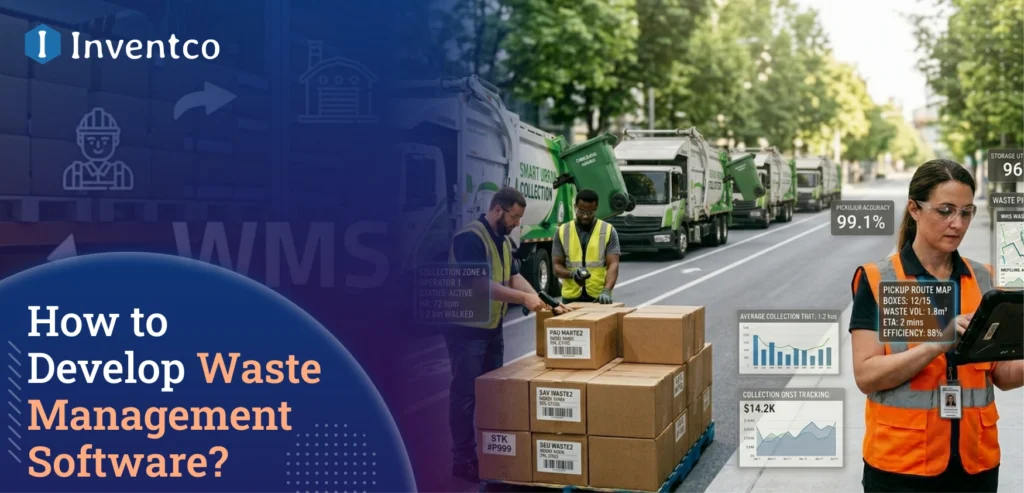
Every day, waste collection vehicles follow the same fixed routes, whether bins are full or not. Drivers carry paper-based logs. Dispatch teams manage scheduling through spreadsheets. Billing cycles slip by weeks. All the while, municipalities and private haulers absorb costs that modern technology could eliminate.
This is not a niche problem. It is a global operational crisis hiding in plain sight.
The world generates over 2.24 billion metric tons of waste annually, with that number on track to reach 3.88 billion by 2050. As urban populations grow and environmental regulations tighten, the gap between what legacy waste systems can handle and what modern operations demand has become impossible to ignore.
For founders and investors watching this space, the signal is clear: waste management is undergoing a fundamental digital transformation, and custom software development for waste management is at the center of it.
This guide walks you through everything you need to know, what this software actually does, why businesses are investing in it, how to build it step by step, what it costs, and which technologies are powering the next generation of waste management software solutions.
Key Takeaways
- The global waste management software market is valued at approximately $11.97 billion in 2026, growing at a CAGR of 8.4%, projected to reach $21.8 billion by 2035
- Building a custom waste management software solution costs between $10,000 and $1,00,000+, depending on complexity, features, and team location
- AI, IoT, and cloud platforms are the three primary technology drivers reshaping the industry
- Route optimization software alone reduces fuel costs by 15–25% for most operators, one of the fastest and clearest ROI generators in the industry
- Over 55% of global waste management firms now deploy at least one software-based system for tracking or optimization
- The development process follows 9 core stages: discovery, market research, architecture, design, MVP, full development, testing, deployment, and maintenance
- Industries from healthcare to construction to municipal government are all active buyers of custom waste management solutions
Market Stats and Data: Understanding the Opportunity
Before you invest in waste management software development, understanding the market size and trajectory you are entering is essential. The numbers make a compelling case.
- The global waste management market was valued at $1,497.17 billion in 2025 and is projected to reach $2,365.14 billion by 2033, growing at a 6% CAGR, according to Grand View Research.
- World Bank reports that global waste generation reached 2.24 billion metric tons annually, with projections crossing 3.8 billion tonnes by 2050, highlighting long-term demand pressure on infrastructure and systems.
- North America accounts for approximately 33.2% of global market share, driven by strict regulatory frameworks, high per capita waste generation, and advanced service ecosystems
- According to Fortune Business Insights, the smart waste management market alone is expected to grow at a CAGR of over 18%, driven by IoT, AI-driven routing, and the adoption of data analytics.
What Is Waste Management Software?
Waste management software is a category of purpose-built digital platforms designed to automate, optimize, and manage the end-to-end lifecycle of waste, from collection and routing through disposal, recycling, compliance, and billing.
Unlike general enterprise software, these platforms are built specifically for the operational realities of waste services: unpredictable collection volumes, variable routing demands, fleet maintenance needs, regulatory reporting requirements, and multi-stakeholder communication across municipalities, residents, businesses, and disposal facilities.
A comprehensive waste management software solution typically covers the following functional areas:
- Operational Management: Scheduling waste pickups, dispatching vehicles, managing crew assignments, and tracking collection status in real time
- Route Optimization: Using GPS and AI to generate dynamic, fuel-efficient collection routes that adapt to actual bin fill levels rather than fixed schedules
- Fleet Management: Monitoring vehicle health, maintenance cycles, driver behavior, and fuel consumption across an entire fleet
- Billing and Invoicing: Automating service charges, generating invoices, managing payment collections, and integrating with accounting systems
- Regulatory Compliance: Tracking hazardous waste manifests, generating compliance reports, and managing documentation required by environmental regulations
- Analytics and Reporting: Providing dashboards and data insights on waste volumes, operational efficiency, carbon emissions, recycling rates, and service quality
- Customer and Resident Portals: Enabling self-service scheduling, complaint management, real-time pickup tracking, and communication for end users
The most advanced AI-powered waste management software platforms integrate predictive analytics, IoT sensors, and machine learning-driven optimization, enabling the anticipation of waste volumes before bins overflow rather than simply reacting after the fact.
Why Businesses Are Investing in Waste Management Software Development in 2026?
The case for digital investment in this space has never been stronger, driven by four converging forces that are reshaping how waste operations are run globally.
1. Regulatory Pressure Is Intensifying
Across the world, there are growing pressures to manage waste in compliance with regulations. In the USA, the Environmental Protection Agency (EPA) mandates that waste be managed in compliance with regulations. In the European Union, the Circular and Critical Economy Act mandates that compliance data be generated and shared to demonstrate that waste is managed in compliance with the law. Manual systems are inadequate for managing data in an ever-increasing world.
2. Urban Waste Volumes Are Outpacing Operational Capacity
Over 9 billion people are predicted to live in cities by 2050. This leads to an increased strain on the environment. Urban operators of waste management systems have shrinking budgets. In 2020, waste management systems required scalable solutions to handle growing volumes of waste. This is no longer the case.
3. ESG and Sustainability Commitments Are Creating Demand
Public companies, institutional investors, and governments are required to drive change in Environmental, Social, and Governance (ESG) waste management. The data to prove that waste management goals and ESG goals are met is inefficient, effective, and scalable. This allows changes to waste management systems to be justified.
4. The ROI Is Clear and Measurable
These efforts are not examples of speculative technology investments. Route optimization can reduce fuel expenses by 15-25%. SailLogic has also shown a potential 40% reduction in automated billing processing. In many municipalities, IoT-enabled smart bins reduce collection trips by up to 30%. For fleet, billing, compliance, and operations, there are tangible returns on investments for purpose-built waste management software.
Industry Insight
As many as 65% of all waste management start-ups now opt to base their primary software systems on cloud computing. More than 30% savings have been achieved by small- and midsize operational players in a cloud computing environment, for automated scheduling and reporting, among other improvements.
Types of Waste Management Software Solutions
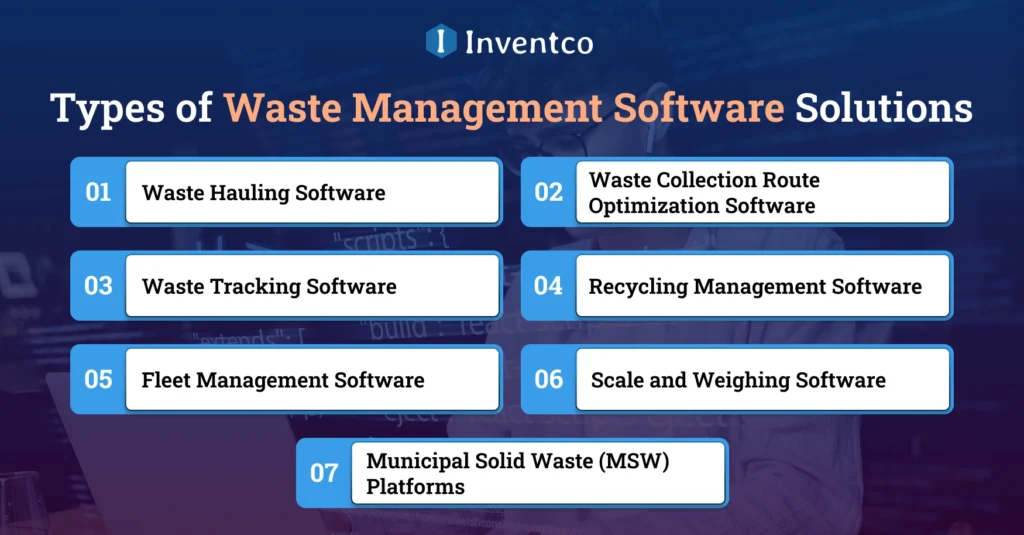
Not all waste management software is built the same. The right type of solution depends on your target customer, the problem you are solving, and the operational context you are designing for.
1. Waste Hauling Software
This type of software caters to a waste-hauling private entity and is useful to them for dispatch management, driver communication, customer scheduling, billing cycle control, and basic route planning. This software’s purpose is to increase service reliability and streamline hauling and collection processes.
2. Waste Collection Route Optimization Software
This software aims to devise the best possible data-driven, fuel-efficient collection routes. This is done using a combination of realtime traffic data, collection history, bin sensor IoT devices, and GPS tracking. At the same time, the software optimizes collection for efficiency, reduces emissions, and minimizes operational costs.
3. Waste Tracking Software
This software provides a hazardous waste-tracking solution with traceability from creation to disposal. This software provides the operator with complete lifecycle visibility and helps maintain compliance with regulators by providing Chain-of-Custody documentation and audit-ready records.
4. Recycling Management Software
This software tracks sorting and tracking efficiency, the material removed, contamination, and the recyclers’ performance. This software enables optimizing various aspects of recycling operations, including sustainability, while meeting corporate and legal compliance requirements and demonstrating positive outcomes.
5. Fleet Management Software
This software manages waste collection vehicles by enabling maintenance planning and scheduling, telematics, fuel usage tracking, and driver behavior monitoring. Each of these aspects, in addition to ensuring compliance with a myriad of regulations, helps improve fleet performance and reduce downtime.
6. Scale and Weighing Software
Whether the weighing systems are truck-mounted or located at facilities, this software supports automated data capture of waste weight. Thus, it enhances billing accuracy, report accuracy, and compliance with landfill and waste disposal documentation regulations.
7. Municipal Solid Waste (MSW) Platforms
All-inclusive systems that empower local governments to oversee the management of varied waste streams, coordinate contractors, facilitate communication with the public, and report to environmental agencies. These platforms are designed to scale, optimize the quality of service offered to customers, and meet regulations and sustainability targets across communities.
How to Build Waste Management Software: Step-by-Step Development Process
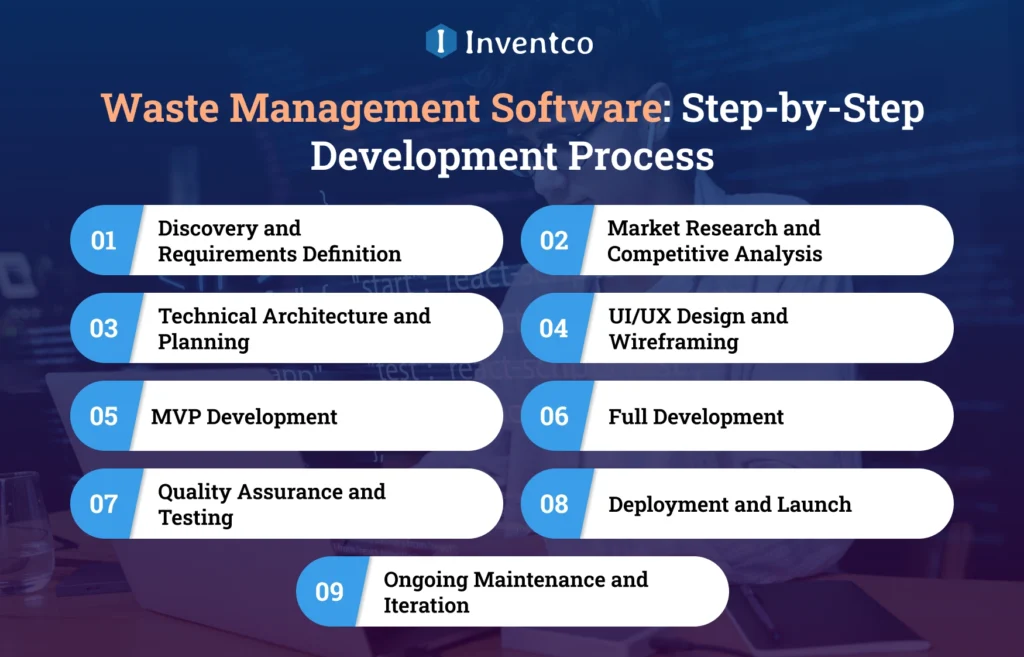
Building a robust waste management software solution is a structured process. Rushing any stage increases the risk of costly rework. Here is how experienced development teams approach it.
Step 1: Discovery and Requirements Definition
Before writing a single line of code, you need a deep understanding of the problem you are solving and who you are solving it for. This phase involves stakeholder interviews with operators, dispatchers, drivers, billing teams, and compliance officers. You are mapping current workflows, identifying pain points, and defining what the software must do to create measurable value. Key outputs include a functional requirements document, user personas, and an initial feature priority list.
Step 2: Market Research and Competitive Analysis
Understanding what existing waste management software solutions already offer, and where they fall short, helps you identify your positioning. Are you building a more affordable alternative to enterprise platforms like AMCS or SAP Environmental Compliance? A specialized tool for a specific waste category? A mobile-first solution for smaller haulers? Your answers here shape your feature strategy and go-to-market approach.
Step 3: Technical Architecture and Planning
With requirements in place, the development team defines the technical architecture—covering cloud infrastructure (AWS, Azure, or GCP), database design, API strategy, IoT integration, and mobile vs. web delivery. This is also where you decide between monolithic and microservices architecture. For most modern waste management platforms, microservices are preferred because they enable independent scaling of components such as route optimization and billing without impacting the entire system.
Step 4: UI/UX Design and Wireframing
Waste management software is used by people with widely varying technical comfort levels, from office-based administrators using full desktop dashboards to truck drivers checking assignments on mobile devices in variable weather conditions. Good UX design accounts for all these contexts. This phase produces app wireframes, interactive prototypes, and design specifications. For mobile interfaces used by field workers, large tap targets, offline functionality, and simplified workflows are essential, not optional.
Step 5: MVP Development
Rather than building every feature simultaneously, experienced teams build a Minimum Viable Product first. The MVP approach focuses on delivering the core functionality that validates your business hypothesis, route management, basic scheduling, and billing, for example, before investing in advanced AI analytics or IoT integration. This approach reduces financial risk and gets real-world user feedback into the product early, when changes are still inexpensive to make. An MVP typically takes 3 to 5 months to build.
Step 6: Full Development
With an MVP validated, you expand the platform’s feature set across parallel development tracks: front-end development for web and mobile interfaces, back-end development for server logic and database management, and integration development for GPS, IoT sensors, payment gateways, and third-party APIs. Real-time data synchronization and offline functionality for field workers with intermittent connectivity are among the most common technical challenges at this stage.
Step 7: Quality Assurance and Testing
Waste management software handles financially and legally significant processes, billing, compliance reporting, and hazardous waste tracking. Quality failures here are costly. Comprehensive app testing covers functionality (does every feature work as specified?), performance (does the system handle peak load?), security (is data protected?), usability (can drivers use this with one hand in a moving vehicle?), and integration testing (do all connected systems communicate correctly?).
Step 8: Deployment and Launch
Cloud-based deployment, the dominant choice for new waste management platforms, offers the scalability to handle thousands of vehicles and collection points simultaneously, with remote accessibility and lower IT infrastructure costs. Mobile app security essentials during deployment include encrypted data transmission, role-based access controls, and compliance with regional data privacy regulations. These must be designed in from the architecture phase, not bolted on after launch.
Step 9: Ongoing Maintenance and Iteration
Software is not a one-time investment. After launch, you need a maintenance strategy covering bug fixes, performance monitoring, OS compatibility updates, security patches, and feature additions based on user feedback. Mobile app maintenance typically runs 15 to 20% of the original development budget annually. Planning for this from the start is part of responsible financial modeling for any founder or investor in this space.
How Much Does Waste Management Software Development Cost?
Cost is the question every founder asks early, and every investor asks before writing a check. The honest answer is that developing waste management software can cost $10,000 to $1,00,000+, but it depends significantly on what you are building. Here is a realistic breakdown.
Basic ($10,000 – $40,000)
Covers core functionality required to launch quickly, including scheduling, simple route planning, invoicing, and customer profile management. Ideal for startups or small operations, this tier focuses on operational digitization, reducing manual work, and improving service visibility without complex integrations or advanced analytics.
Mid-Complexity ($40,000 – $70,000)
Adds operational intelligence with GPS tracking, fleet management, automated billing workflows, analytics dashboards, and a customer portal. Designed for scaling businesses, this tier improves real-time decision-making, enhances customer experience, and streamlines operations through data-driven insights and semi-automated system processes.
Advanced Enterprise ($70,000 – $1,00,000+)
Built for large-scale operations, this tier includes AI-driven route optimization, IoT-enabled monitoring, predictive analytics, multi-region deployment, regulatory compliance systems, and ERP integration. It enables end-to-end automation, enterprise-grade scalability, and advanced forecasting to optimize costs, performance, and compliance across complex logistics ecosystems.
Key Cost Drivers
Understanding what moves the needle on cost helps you make smarter scoping decisions before you commit to a budget.
- Feature Scope: The primary driver. Every additional module, IoT integration, AI analytics, multi-language support, and third-party API connections add development hours and testing cycles.
- Platform Strategy: Native iOS and Android development costs more than cross-platform (React Native/Flutter) but delivers better performance. Most waste management platforms deploy a cross-platform mobile with a web dashboard.
- Team Location: Development teams in North America and Western Europe typically charge $100–200/hour. Teams in India, Eastern Europe, and Southeast Asia charge $25–75/hour while delivering comparable quality, making this one of the most impactful financial decisions you will make.
- AI and IoT Complexity: Real-time analytics, sensor data pipelines, and machine learning models add significant development hours and require specialized engineering talent.
- Ongoing Maintenance: Budget 15–20% of the original build cost annually for bug fixes, OS updates, security patches, and feature additions.
- Cost Planning Tip: A well-scoped MVP built for $10,000 to $40,000 is almost always a better investment than a $1,00,000+ build that has not been validated by real users. Start lean, validate your core assumptions, then expand the feature set based on evidence, not guesswork.
Key Features of Waste Management Software Development
The feature set you build determines both the value you deliver and the cost you incur. Here are the must-have and advanced app features for any serious waste management platform.
Core Operational Features
- Smart Scheduling and Dispatch: Automated job assignment based on vehicle capacity, driver availability, location, and service type. Replaces phone calls and manual allocation with a system that handles thousands of assignments simultaneously.
- Real-Time GPS Tracking: Live vehicle location visibility for dispatchers, with status updates that let customer service teams answer service queries accurately.
- Waste Collection Route Optimization: Dynamic routing that adjusts to actual bin fill levels, traffic conditions, and collection priorities. This single feature typically generates the fastest and clearest ROI for operators.
- Fleet and Asset Management: Vehicle health monitoring, maintenance scheduling, fuel tracking, and compliance with commercial vehicle regulations.
- Billing and Invoicing Automation: Generating accurate invoices based on actual services rendered, with integration into accounting platforms like QuickBooks or SAP.
- Compliance and Reporting: Automated generation of the regulatory reports required by local, state, and federal environmental agencies, reducing compliance risk and administrative burden simultaneously.
Advanced Features
- IoT Smart Bin Integration: Connecting ultrasonic fill-level sensors in bins to the scheduling engine, so collection trips are triggered by actual need rather than calendar dates.
- AI-Powered Predictive Analytics: Machine learning models that forecast waste generation patterns by location, time, season, and event, enabling proactive rather than reactive operations.
- Customer and Resident Portal: Self-service interface for scheduling, payment, service requests, and pickup tracking. Reduces inbound call volumes while improving customer satisfaction.
- Mobile Driver App: Offline-capable app for drivers with turn-by-turn navigation, job checklists, photo documentation, and signature capture. Large interface elements and minimal data entry are essential for field usability.
- Analytics Dashboard: Centralized operational intelligence covering route efficiency, fuel consumption, recycling rates, service levels, and carbon footprint, supporting both operational decision-making and ESG reporting.
- Multi-Language and Accessibility Support: Essential for platforms deployed across regions or serving diverse resident populations.
Advanced Technologies Powering Modern Waste Management Software Solutions
The limitless potential of transformative technologies in waste management is defined by four main technologies. There is no choice but to understand them when developing or investing in this field.
1. Artificial Intelligence and Machine Learning
Smart management of operations in the field of waste has seen a significant transformation with the introduction of AI Development. The algorithms for route optimization offer smart management with a nice level of flexibility. The predictability of smart technologies now enables highly adaptable operations management. This flexibility has led to significant savings in fuel management. The AI management of operations in the field of waste provides significant flexibility in turnaround, with assurance of fuel savings and operational management.
2. Internet of Things (IoT)
With smart technologies, waste management now offers greater flexibility and significant fuel savings. The smart management of waste now delivers significant fuel savings through advanced technologies and optimized operational controls. The impact of smart technologies in waste management now enables management to achieve significant savings. Waste management technologies now have a significant impact through smart waste management, operational flexibility, and substantial savings.
3. Cloud Computing
With cloud-based waste management platforms, operators can scale and deploy their systems more easily. The cloud enables the simultaneous monitoring of large fleets and multiple collection points. It also allows field operators to monitor in real time via their smartphones and eliminates the large initial investment in server installations. Today, over 65% of emerging businesses are adopting cloud technologies to build scalable and flexible digital solutions. Our cloud development services simplify system management, strengthen security, improve performance, and support seamless integration, helping businesses accelerate digital transformation while building reliable, future-ready applications.
4. Blockchain for Waste Traceability
Blockchain development for waste tracking and trade is in the early stages. The use of Blockchain in trade waste management enables a permanent, tamper-proof audit trail of waste from the originator to final disposal, providing the transparency demanded by continuity and regulatory concerns. For the waste management developer who understands both emerging technologies and compliance, this offers a good early-mover opportunity, as pilot adoption is 12% in the developed world.
5. GPS and GIS Integration
Advanced waste collection management can be achieved with GIS. This area of waste management involves analyzing collection operations, mapping coverage, identifying gaps, optimizing depots, and analyzing and visualizing collection density. While physical GIS provides the tools for real-time collection, without the use of GIS systems, route optimization is nearly impossible. Together, these are waste management software systems.
Tech Stack for Waste Management Software Development
Choosing the right technology stack is a foundational decision that affects performance, scalability, and long-term app maintenance costs. Here is a recommended stack for a modern, full-featured waste management platform.
| Layer | Technologies |
| Front-End (Web) | React.js / Vue.js, Mapbox GL / Google Maps API, D3.js / Chart.js |
| Mobile App | React Native / Flutter (cross-platform); Swift / Kotlin (native) |
| Back-End | Node.js / Python (Django/FastAPI), Microservices architecture, REST / GraphQL APIs |
| Database | PostgreSQL (structured data), MongoDB (sensor/compliance logs), Redis (caching) |
| Cloud Infrastructure | AWS / Google Cloud / Azure, Docker + Kubernetes, Auto-scaling |
| IoT Integration | MQTT protocol, AWS IoT Core / Azure IoT Hub, Firebase real-time sync |
| AI / ML | TensorFlow / PyTorch, Python (scikit-learn, pandas), Route optimization engines |
| Security | OAuth 2.0, AES-256 encryption, Role-based access control (RBAC) |
Waste Management Software Solutions Across Industries
One of the strongest arguments for custom waste management software development is that the problem is not confined to one sector. Every major industry generates waste, and each has operational requirements that generic solutions do not fully address.
- Municipal Government: City governments manage residential collection, recycling programs, bulky item pickup, and public space cleaning. They need multi-contractor management, resident communication portals, council reporting, and compliance documentation at scale.
- Healthcare and Medical Facilities: Hospitals and clinics handle regulated medical waste, sharps, pharmaceuticals, and biohazardous materials, requiring strict chain-of-custody documentation and compliance with healthcare environmental regulations.
- Manufacturing and Industrial: Manufacturing facilities generate significant process waste, packaging, and hazardous materials. Industrial waste tracking software helps them manage disposal contracts and demonstrate regulatory compliance.
- Construction and Demolition: Construction sites generate debris, concrete, metals, and hazardous materials across continuously changing locations. Mobile-first solutions with flexible waste categorization are the dominant need here.
- Retail and Commercial: Retail chains and commercial property managers need centralized reporting, vendor management, and cost allocation by property, capabilities that generic billing software does not provide.
- Hospitality and Food Service: Hotels, restaurants, and food manufacturers deal with organic waste, packaging, and cooking oil recovery. Solutions that integrate organic waste tracking and grease trap management specifically serve this sector.
- Recycling Facilities: Material Recovery Facilities need software that tracks incoming material volumes, sorting efficiency, contamination rates, and sale values by material type, a specialized data set that general platforms handle poorly.
How Can Inventco Help Your Business with Waste Management Software Development?
As a leading software development company, we know that building a successful waste management software solution requires more than coding ability. It requires a deep understanding of the operational workflows you are digitizing, the regulatory environment in which your customers operate, and the technology architecture that will scale with your business as it grows.
At Inventco, we bring that combination of domain knowledge and technical capability to every engagement. Our approach to custom waste management software development begins with a thorough discovery process that understands your business model, your target customer, and the specific operational problem you are solving before we write a single line of code.
From there, we design and build solutions across the full stack: mobile applications for field workers that perform reliably under real-world conditions, administrative dashboards that give operators genuine operational intelligence, IoT integrations that connect sensor data to scheduling engines, and AI capabilities that move your platform from reactive to predictive.
Whether you are building an MVP to validate a market hypothesis or a full-scale enterprise platform to serve municipalities and commercial operators simultaneously, we structure our engagement to match your stage and risk tolerance.
What We Offer: End-to-end custom waste management software development, from product strategy, wireframing, and prototyping through full-stack development, QA, deployment, and ongoing maintenance. We are a technology partner, not just a development vendor.
Conclusion
The primary challenges for the waste management industry have shifted to digital ones, which means smart waste management is the way to go for companies that want to lead the industry. The businesses that automate data reporting for their operations will gain a competitive advantage, ensure optimal performance, and guarantee accountability.
In the field of digital logistics for waste management, the situation for entrepreneurs is promising. An enormous market, currently valued at $11.97 billion, is expected to grow at an annual rate of 8.4% and comprises large segments of manual and paper-based workflows. For investors, the return on investment is expected to be positive. Route optimization, automated billing, and smart scheduling, among other digital solutions, allow for improvements and savings that operators can quantify pre-contract.
Development is complex, but with the right people, approach, and plan, you can enter the market quickly. Start with an MVP that is operationally feasible for the customer you are targeting. Implement AI and smart IoT only where required. Partner with a waste management company that can help you translate the complexities and nuances of operational challenges to fit the field workers with a smart waste management solution.
The market is growing. The technology is ready. The question is whether your team is positioned to build the solution this space needs.
FAQ’s
Q1. What is waste management software?
Ans. Waste management software is a purpose-built digital platform that automates and optimizes the collection, tracking, disposal, and reporting of waste. It replaces manual scheduling, paper-based compliance tracking, and disconnected billing processes with integrated, data-driven workflows.
Q2. How much does waste management software development cost?
Ans. Waste management software development costs range from $10,000 for a basic MVP or starter solution to $1,00,000+ for advanced AI-powered enterprise platforms. The primary cost drivers are feature complexity, platform strategy, degree of AI and IoT integration, and development team location.
Q3. How long does it take to build waste management software?
Ans. Development timelines range from 3 to 5 months for a well-scoped MVP to 9 to 18 months for a full-featured enterprise platform. An MVP-first approach significantly reduces time-to-market and financial risk.
Q4. What technologies are used in modern waste management software?
Ans. Modern platforms are built on AI/machine learning, IoT sensors, cloud infrastructure (AWS/Azure/GCP), GPS/GIS, and mobile frameworks such as React Native or Flutter. The most competitive solutions combine all of these to deliver real-time, predictive operational intelligence.
Q5. What is the ROI of investing in waste management software?
Ans. Key ROI drivers include 15 to 25% fuel cost reduction from route optimization, 40% reduction in billing processing time from automation, up to 30% reduction in unnecessary collection trips from IoT monitoring, and a significant reduction in compliance risk through automated regulatory reporting.

Ajay Bhal
He is an on-demand app solutions expert with 11+ years of experience in business consulting and building scalable, user-centric digital products. He specializes in robust on-demand platforms across industries, combining technical expertise with business-focused strategy to deliver efficient, top notch solutions that drive growth and enhance user experience. You can connect with him on LinkedIn to follow insights.