Starting in 2026, customer engagement and managing operational costs will require intelligent automation and not just simple process changes. AI-driven chatbots will allow businesses to automate and simplify workflows for operational support and personalized, instant customer engagement interactions on a large scale.
Today’s chatbots can take customers through multiple steps, answer their questions, and keep things simple and straightforward. Still, many executives want to know how long it will take to build a chatbot.
There are many differentiating factors, such as how complex the chatbot is, other technologies it needs to be integrated into, what kind of AI it needs to have, regulations, and how the chatbot will be used in the future.
This is a guide to chatbot development timelines, other factors that will impact how long the development process will take, and how long it will take to develop various types of chatbots. This will help you plan for AI development in your organization.
Key Takeaways
- Starting in 2026, chatbots will be customer engagement tools requiring operational automation and scalable support.
- The development time for a chatbot is dependent on sophistication of the AI, the level of integration, regulations, and future scalability.
- Creating a menu-style chatbot can take between 1 to 3 weeks, whereas developing AI, ML, or a hybrid version can take several weeks to several months.
- The timeline for developing enterprise chatbot solutions increases even further as features such as NLP, machine learning, omnichannel, as well as, CRM/ERP integrations are added to the chatbot.
- Defining your goals, combating your tech, designing the conversation, training, and testing are all parts of a structured development cycle that will help create predictable timelines/performances for your chatbot.
- The budget that allocates development time will determine the chatbot’s complexity and overall quality.
- Using methods such as MVP, no-code platforms, and pre-trained AI frameworks will lead to great quality in a cost-efficient development process that will take a significantly reduced amount of time.
- The right AI development partner will offer structured development, quick release, secure integration, and true flexibility.
Chatbot & Conversational AI Market Growth
- The global chatbot market is expected to grow from about USD 9.30 billion in 2025 to USD 11.45 billion in 2026, and further to around USD 32.45 billion by 2031 at a CAGR of 23.15 % — highlighting accelerating adoption of automated conversational tools.
- According to Grand View Research, the global chatbot market size was valued at approximately USD 7.76 billion in 2024 and is projected to reach USD 27.29 billion by 2030, growing at a 23.3 % CAGR from 2025 to 2030.
- The broader conversational AI market, which includes chatbots and intelligent virtual assistants, was estimated at USD 11.58 billion in 2024 and is expected to expand to USD 41.39 billion by 2030, with a 23.7 % CAGR — reflecting strong enterprise demand for AI-driven engagement solutions.
The rapid expansion of the conversational AI market has led to the emergence of several top AI chatbots that offer enterprise-grade automation, omnichannel deployment, and advanced contextual intelligence.
What is an AI Chatbot?
An AI chatbot is a software application powered by Natural Language Processing (NLP) and machine learning that enables businesses to automate conversations, answer queries, and deliver personalized interactions across digital channels. Unlike traditional scripted bots, modern AI chatbots understand context, intent, and user behavior to improve engagement and operational efficiency.
Key Factors That Influence Chatbot Development Time
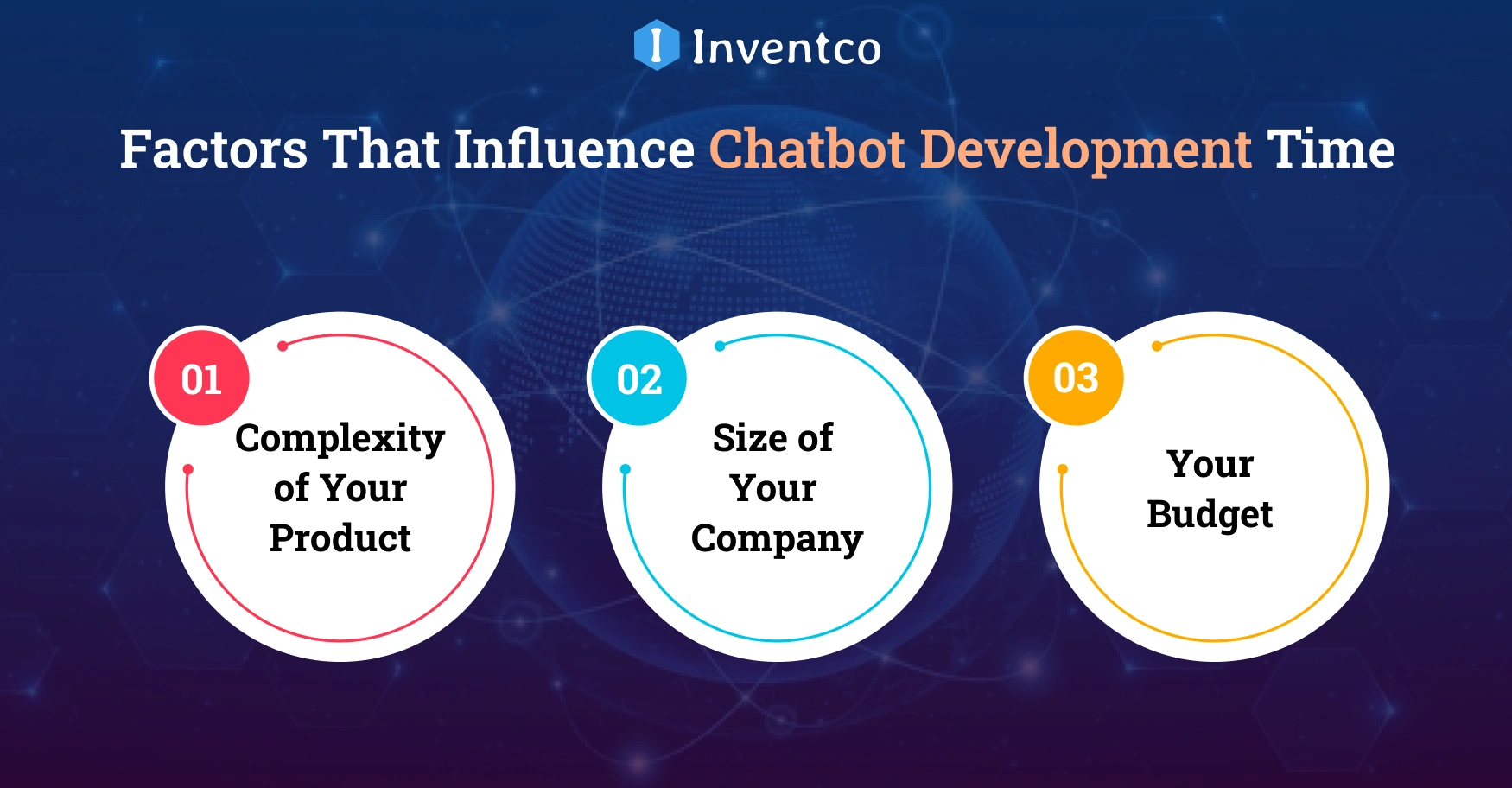
Several factors impact the chatbot development lifecycle, from your bot’s features and functionality to the size of your organization. A well-developed chatbot can effectively streamline your customer engagement and organizational efficacy.
While estimating the chatbot development time, consider the following factors:
1. The Complexity of Your Product
A simple chatbot development will take a shorter period than a complex one. A simple bot will focus on basic mechanisms, while a complex chatbot with advanced features focuses on natural language understanding.
2. The Size of Your Company
The chatbot development process involves the size of the organization. If you develop bots for a small organization, managing all aspects of chatbot creation will be much easier. However, if you have a larger company with various departments and segments, then more coordination will be involved in bot creation. For the larger companies, the bot creation time will be higher.
3. Your Budget
When considering how long it takes to build a chatbot, you need to remember your budget. If you have a minimal budget, you have to develop a bot with limited functionality and features. If you have a large budget, then a more complex chatbot can be developed, and hence, the time to develop the chatbot will increase.
In addition to technical factors, organizations must consider common chatbot implementation challenges such as data security compliance, integration conflicts with legacy systems, user adoption resistance, and AI training limitations. These challenges can extend development timelines if not addressed early in the planning phase.
Average Time to Develop Different Types of Chatbots
When talking about chatbot development timelines, you should consider the types of chatbots. The chatbot creation time will vary according to your desired chatbot technologies. Here are some chatbot technologies that you should gather knowledge about.
1. Menu-Based Chatbots
Menu-based chatbots are the most commonly implemented chatbot mechanisms for businesses. They are designed on decision-tree type logic, and the bot will be displayed as a menu of buttons to the users. Then the user can pick one category from the list that aligns perfectly with their queries. Menu-based chatbots work excellently to answer FAQs.
Average time to develop: Menu based chatbot development services take 1 to 3 weeks for basic implementation.
2. Rule-Based Chatbots
Keyword-recognition chatbots are also known as rule-based chatbots. Rule-based chatbots are the best solution for businesses that know which queries the bot may receive. These bots use the if-then logic principle to simplify conversational automation.
Average time to develop: A chatbot development company takes a few weeks to a few months (1-3 months) to develop rule-based chatbots with advanced functionalities.
3. Machine Learning Bots
Machine language bots are the most advanced bot technologies in the present day. ML bots combine artificial intelligence and machine learning technologies to make conversations with customers. Machine Learning chatbots can learn and develop further with time.
Average time to develop: Chatbot development services can take a few weeks to several months to develop machine learning bots.
4. Hybrid Chatbots
Hybrid bots are designed on a blend of AI and rule-based bot technologies to offer the best customer assistance for businesses. The best part about hybrid chatbots is that they enable you to use a chatbot for live chat with customers. This means a hybrid bot can revive real-life conversations with customers based on their queries.
Average Time To Develop: Depending on the complexity of the bots, it may take 4 to 12 weeks to develop hybrid chatbots.
Chatbot Development Timeline: Phase-by-Phase Breakdown
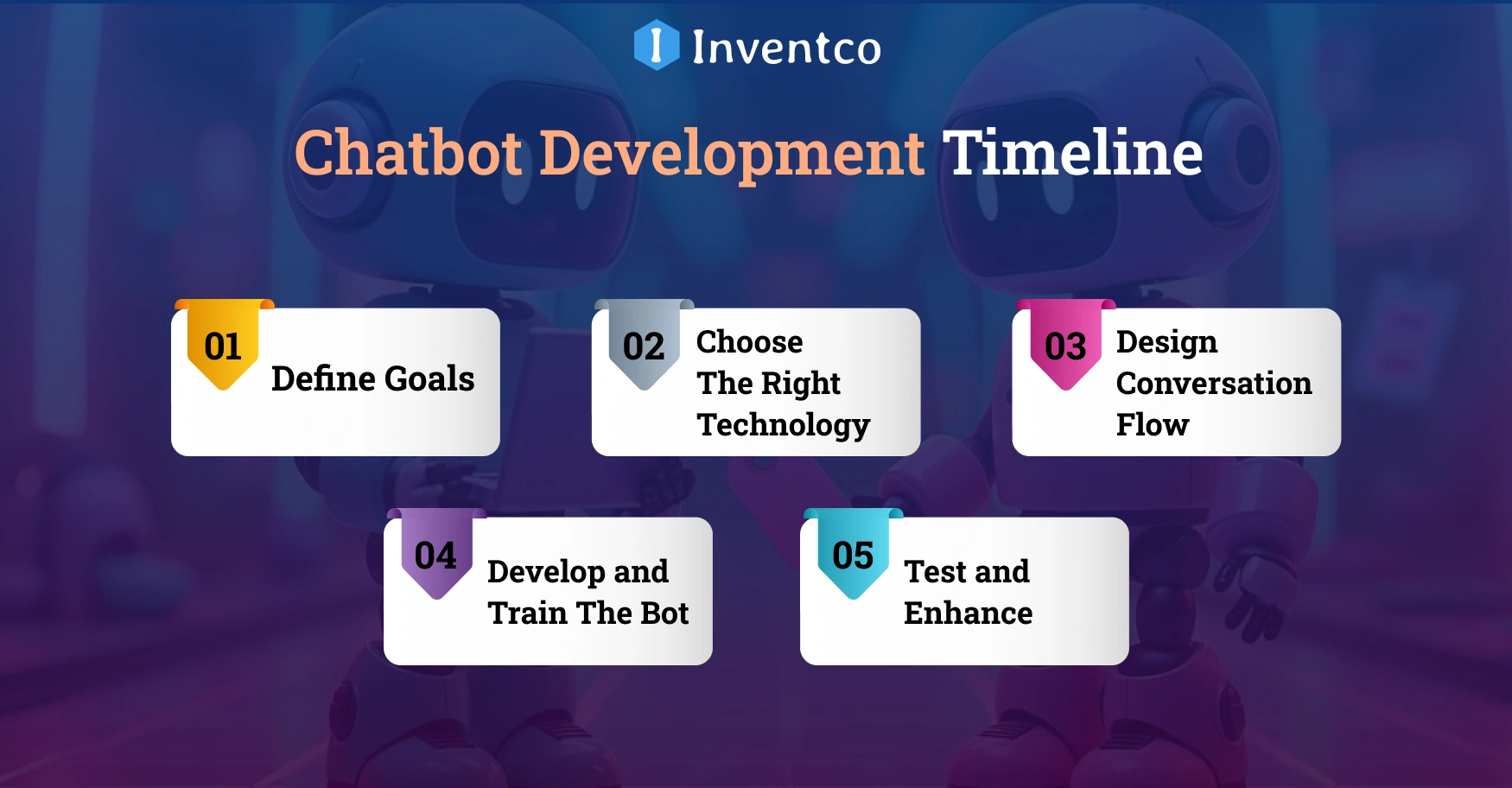
Want to know how to develop a chatbot? Developing a chatbot involves several essential steps to meet your desired objectives. Here is a phase-by-phase breakdown of each step:
Step 1: Define Goals
- First, you need to understand the objective of the chatbot.
- Then, you need to specify your target users, industries, and common queries that your bot may receive.
Step 2: Choose The Right Technology
- Decide on which platform your bot will perform on, like web, mobile, or messaging app, etc.
- Choose appropriate NLP frameworks (Rasa, IBM Watson)
Step 3: Design Conversation Flow
- You need to figure out the users’ intention to interact with the bot.
- Focus on creating a natural language conversational approach.
Step 4: Develop and Train The Bot
- You need to develop the backend to support features such as database integration, customer queries, etc.
- Using relevant data, train the bot to improve accuracy.
Step 5: Test and Enhance
- You need to perform diligent testing to ensure reliability.
- You can consider user feedback and upgrade the chatbot’s responses over time.
Following best practices for chatbot development, such as iterative testing, user feedback loops, scalable architecture design, and compliance validation, ensures faster deployment while maintaining performance quality and long-term reliability.
How to Speed Up Chatbot Development Without Compromising Quality?
To speed up chatbot development without compromising quality, you can consider the following factors.
- Use a No-Code Chatbot Technology: A no-code chatbot platform will allow you to develop a chatbot without coding. This initiative will reduce chatbot development time.
- Start with a Simple MVP: You can start with a simple MVP (minimum viable product), which will focus on one use case. This initiative helps you launch your bot quickly.
Time vs. Cost: What To Expect?
Are you confused about how long it takes to build a chatbot and what the chatbot development cost is? Here, you may get your solution.
The time and cost required for chatbot development, as well as the process involved, depend entirely on the bot’s complexity. For example, you can build simple rule-based bots within a few weeks, while an AI chatbot development service for e-commerce may take several months to develop a bot.
More complex bots with advanced features will take more time and cost more, and vice versa. So, before stepping through the door, you need to carefully evaluate your needs and budget.
Inventco’s Proven Expertise in Enterprise AI Chatbot Solutions
Selecting a partner for chatbot development is not merely about reviewing service offerings. It involves considering a partner’s ability to execute and deliver focus areas, as well as technical depth and demonstrable impact. Inventco is a scalable, secure, high-performance partner that has delivered AI applications in the field to demonstrate its commitment.
SALLA & WhatsApp Chat Support is an enterprise-grade conversational AI platform that helps businesses improve customer communication by automating customer interactions and integrating the WhatsApp Business API. It enables real-time AI-driven responses, workflow management, chat history tracking, and human-agent transfer, demonstrating our capacity to develop production-ready AI engagement platforms.
Also, Pocket Chef is an AI-based recipe recommendation app developed by Inventco that integrates our expertise in OCR, AI-driven personalization, and cloud scalability. It uses OCR to identify scanned ingredients and recommend recipes, showcasing our ability to integrate AI and data processing with user-friendly design.
These workflows demonstrate Inventco’s expertise with Natural Language Processing (NLP), Machine Learning, Generative AI (GenAI), cloud computing, and API integration. Our portfolio gives experience in building AI systems that achieve real business results, and establishes credibility, technical expertise, and reliability in the AI chatbot development industry.
Conclusion
The chatbot development process is an exciting initiative and learning approach. Chatbot implementation in your business enhances customer engagement and streamlines operations. However, deciding how long it takes to build a chatbot depends on several factors. So, when predicting the time, you should also consider your requirements and budget. With the right expertise, chatbot development can be straightforward.
FAQs
Q1. What is an AI chatbot?
Ans: An AI chatbot is a program that is trained to have human-like responses. AI chatbot stimulates human conversation, leads generation, and customer service for your business.
Q2. How long does it typically take to build a chatbot from scratch?
Ans: Chatbot creation from scratch may take 4 to 12 weeks, depending on your desired bot’s personality.
Q3. What industries benefit the most from chatbot solutions?
Ans: Several industries notably benefit from a chatbot solution, including banks, healthcare, e-commerce, insurance, education, and more.
Q4. Can a chatbot be developed faster using templates or frameworks?
Ans: Yes. By using templates or frameworks, the chatbot development process can be accelerated. Both these options streamline chatbot creation by reducing extensive coding.

Jitendra Jain
He is the CEO and Co-founder of Inventco, driving innovation in advanced computing and digital transformation. With deep expertise in modern IT ecosystems, he leads scalable, secure, future-ready solutions. His strategic leadership helps businesses accelerate growth, adopt innovation, and achieve success. You can connect with him on LinkedIn to follow his technology insights.