Each app founder faces a single most important question: “How do I convert user engagement into profit?” For 2026, success in mobile app monetization won’t be a matter of trial and error; it will be a proven, systematic growth strategy powered by data and analytics, as well as changes in consumer behavior.
If you’re a startup still figuring out your product-market fit, or an enterprise looking to expand your digital revenue streams, learning effective app monetization strategies is crucial. Successful monetization is not about bombarding your users with pop-up ads or using other gimmicks. It is about creating smart revenue models, built around the users, that enhance profit while maintaining a good user experience and building trust and retention.
Be strategic about it. Offer your users value, show them how useful it is, and then add features that users will pay for. Think about a coffee shop, which may also serve its signature drink. They want to build engagement before they build conversions- just a strong app.
In its State of Mobile 2026 Report, Sensor Tower noted that 2025 marked the first possible plateau in App downloads, but in-app purchase revenue on iOS and Google Play continued to rise by 167 billion, representing a 10.6% increase from the previous year.
Key Takeaways
- Mobile app monetization in 2026 is moving toward a structured, data-driven growth strategy rather than trial and error.
- Revenue from in-app purchases reached $167 billion in 2025, a 10.6% year-over-year increase, and download growth is slowing, according to Sensor Tower’s State of Mobile 2026.
- The rise of in-app purchases in non-gaming apps, compared with gaming apps, illustrates the growth of subscription, freemium, utility, and other similar monetization strategies.
- Of the total revenue from mobile apps, almost 48.85% comes from in-app purchases.
- Revenue from subscriptions is also increasing, with a double-digit compound annual growth rate (CAGR). This means recurring revenue strategies will be necessary during the 2020s
- The mobile applications market is estimated to surpass $378 billion by 2026 and is expected to exceed $1 trillion over the next 10 years. This illustrates a consistent long-term approach towards monetization.
- Choosing the right monetization model depends on app type, user behavior, audience tolerance, and long-term business objectives.
- Common monetization challenges include ad fatigue, pricing misalignment, platform restrictions, privacy concerns, and the growth-versus-revenue balance.
- The most successful apps continuously test, refine, and evolve their monetization strategy, turning engagement into sustainable, scalable revenue over time.
Mobile App Monetization Market Stats (2026)
- Non-gaming apps are driving monetization growth. Revenue from in-app purchases in non-gaming apps has surpassed that in gaming apps, for the first time, leading to success in subscription, freemium, and utility-driven revenue models.
- Subscription models are rapidly gaining share: In-app purchases accounted for nearly 48.85% of total mobile app revenue in 2025, while subscription-based revenue is growing at the fastest rate (over 16% CAGR through 2031), showing how recurring revenue streams are becoming essential.
- Revenue from in-app purchases and paid apps across Google Play and iOS reached $167 billion in 2025. This reflects a 10.6% year-over-year increase in overall monetization from app downloads on the Google Play and iOS app stores. This shows that monetization for Google Play and iOS growth apps is increasing.
- Monetization strategies and the growth of the app market support each other. The global mobile app market is projected to exceed $378 billion in 2026 and is predicted to surpass $1 trillion within the next 10 years. This indicates monetization in the app market, which will likely continue unless the market collapses.
What Is Mobile App Monetization?
Mobile app monetization turns an app’s popularity into a profitable venture. Monetization is like setting up an online store. Each app is a store that offers value, convenience, as well as entertainment, and creating a revenue stream is about determining what you can charge for and what you can offer for free.
Mobile apps can be monetized through the following methods: Mobile apps can monetize through the following methods:
- In-app advertising: Displaying advertising to make money.
- In-app purchases: Selling virtual goods or enhancements.
- Subscriptions: Charging users for additional benefits on a monthly or yearly basis.
- Freemium apps: Giving users free basic access but charging for premium access.
- Paid apps: Charging users a fee to download the app.
For sustained success, selecting the most suitable monetization strategy should reflect both the mobile application development cycle and user expectations.
Why Is Mobile App Monetization Important?
Creating a clear mobile app monetization process lays the foundation for a successful app. It is about more than just profit. It is about sustaining your app, expanding your business, and creating value for your users over time.
► Massive Revenue Potential
Mobile apps are a burgeoning industry. They are expected to generate more than 935 billion dollars in 2026. Revenue does not come only from downloads, it also comes from monetization strategies, subscription services, in-app purchases, and advertising. Even if your app captures a small portion of this market, the revenue potential is enormous.
► Sustain Your App’s Growth
Mobile applications must be continuously updated to remain relevant. However, developing and promoting an app can be a substantial financial burden. Having a clear, well-defined monetization strategy can help alleviate some of these costs and ultimately enable further development and upgrades to the app. If there isn’t adequate monetization, the app will very likely become defunct and be outdated.
► Improve User Retention and Experience
Smart Monetization retains users. Freemium payment models offer users value and fund features that improve the overall experience. Smart Monetization Strategies of Great Apps: Pays for Everything. Users built Netflix, Spotify, and also Candy Crush.
Mobile app monetization will keep your app relevant, drive growth, and generate revenue. With premium app monetization strategies, your startup will become a major player in the app economy.
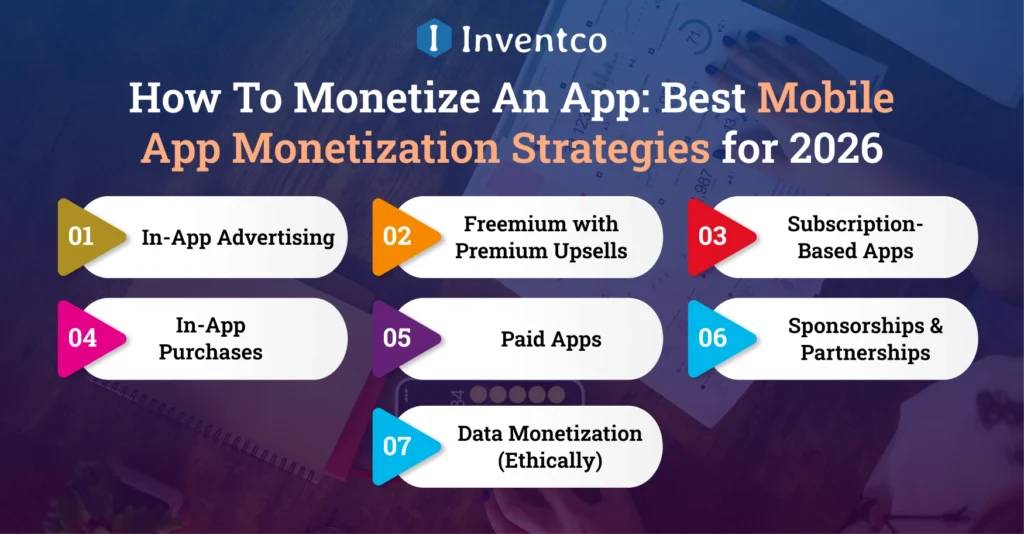
How To Monetize An App: Best Mobile App Monetization Strategies for 2026?
Now, let’s get down to business: the part where all your hard work starts paying you off with some credit in your bank account. You created a star app that rules the industry, with a fine-tuned user experience, and launched it with pride. Now it’s time to turn your app into a serious revenue machine.
Here are the top mobile app monetization strategies you shouldn’t overlook in 2026.
1. In-App Advertising
One of the most common app monetization methods is in-app advertising, which is also one of the most successful strategies, especially for free-to-download apps. This monetization method keeps your app accessible while creating a steady income from third-party advertisers.
How it works:
The in-app advertising monetization method displays ads directly within your app in various formats to encourage users to click on them.
Here are some common In-app advertising types:-
- Banner Ads: Small, usually at the top or bottom.
- Interstitial Ads: Full-screen ads between transitions.
- Video Ads: Short clips users watch (often voluntarily).
- Rewarded Ads: Users get in-app perks in exchange for watching ads.
Example Apps:
- Facebook: Their huge ad engine produced over $117 billion in income through a complex in-app ad system.
- Candy Crush: Blends rewarded ads and banners, letting users choose to watch ads for extra lives or perks; smooth and useful.
Revenue Potential: Apps that have a strong user base and high sessions on a daily basis can earn anywhere from $10,000 to $100,000+ per month, based on the impressions, click-through rates, and regional reach.
Key Insight: Balance is everything. Flooding your app with ads can drive users away. The best apps offer ad experiences that are relevant, quick, and flexible.
2. Freemium with Premium Upsells
The app monetization feature gives users access to basic mobile app features at no cost, while carefully nudging them toward a premium version, whether for features or content, to improve usefulness and offer exclusive benefits.
How it works:
In this monetization model, users install your app for free, but when they use your app and want to access a premium feature, tool, or content, they pay.
Example App:
- Spotify: Offers free music with ads, but premium users enjoy offline listening, no ads, and better-quality sound.
Why it works: It builds trust, allows people to discover, and gives them the power to pay when they see real value.
Best for: Productivity apps, health apps, and tools where new features offer improved usefulness.
3. Subscription-Based Apps
One of the most famous and standard mobile app monetization methods is Subscriptions. You can understand this: with this model, you can generate ongoing income and long-term customer relationships by charging a fixed amount on a monthly, quarterly, or yearly basis.
How it works: Users pay a monthly, weekly, or yearly fee to access material, features, or services.
Example Apps:
- Netflix: Monthly streaming subscriptions.
- Calm & Headspace: Mental wellness apps with hidden premium material behind subscriptions.
- Canva Pro: Design tools with extra files and themes.
Revenue Potential: This method can generate regular income for you with a loyal user base. Even small monthly payments from a growing user base multiply quickly.
Pro Tip: Offer a free trial to boost sales and let users test the seas before committing.
4. In-App Purchases
In-app purchases are a popular app monetization strategy in the modern app development process. Whether you have a gaming app and users want more power-ups, the in-app purchase monetization method is the best fit for you. If you are running a learning app, the exclusive content in-app purchase is for you, as it gives users the option to buy what they want, when they want.
How it works: Users make one-time purchases inside the app for features, virtual goods, customization, or premium content.
Example Apps:
- Clash of Clans: Players spend money on gems, troops, and improvements.
- Duolingo: Offers streak-freezing boosts and extra lessons through IAPs.
Why it’s effective: It creates micro-transactions, small, frequent payments that feel low-stakes but earn high-volume income.
Best for: Gaming apps, educational tools, lifestyle apps, and content-heavy apps.
5. Paid Apps
One of the less popular mobile app monetization models, the Paid App can still be successful, especially if your app offers niche value or an exceptional offline experience.
How Paid App Monetization Works: In this strategy, users pay once to download or want to access the app, and with that, the users have a free app, no in-app purchases, just pure product, which gives some value.
Example Apps:
- Minecraft: A one-time purchase app that continues to dominate app store charts.
- Procreate (iOS): A design app loved by artists and professionals worldwide.
Revenue Potential: In this method, you can earn directly from the app download, but the catch is convincing users that the upfront cost is worth it.
Key Tip: Use a compelling landing page, demo video, and top-notch reviews to make your case.
6. Sponsorships & Partnerships
In this modern app monetization industry, everyone chooses to go on the Ad network route, but you can also select one of the finest monetization methods, which is Sponsorships and partnerships. You can directly collaborate with the brand to monetize your app; this monetization method is ideal for niche audiences or community-based platforms.
How it works: By collaborating with brands, they will pay you to feature them on your app to attract your user base. They offer a co-branded experience or promote their services on your app.
Example: A fitness app might partner with a health supplement brand to offer exclusive discounts or content.
Why it Works: Your app can be monetized without overwhelming your users with irrelevant ads, while keeping brand alignments clean and relevant.
Best For: This monetization model is best for Influencer apps, fitness and wellness platforms, lifestyle apps, or anything with a passionate user base.
7. Data Monetization (Ethically)
One of the most controversial, but if this monetization model is done transparently and ethically, it would be the best mobile app monetization and can add incredible value for you.
How It Works: In this monetization process, you can analyze aggregated user behavior (not personal info) to provide market insights to third parties, or you can also improve your app performance and personalization to make your app more user-friendly.
Revenue Potential: Data insights are hot commodities in industries like advertising, retail, and product development. Some analytics can fetch high value when anonymized and bundled correctly.
Necessary: Always disclose how data is collected and used. Prioritize privacy compliance (GDPR, CCPA), and let users opt in or out.
Bonus: Hybrid Monetization Models
Who says you have to stick to just one?
Hybrid models combine multiple strategies to spread revenue streams and reduce risk. Example combo? Freemium + in-app ads + subscriptions.
Example App: YouTube does it all: ads for free users, in-app purchases (Super Chat, etc.), and a premium subscription.
Why it’s powerful: Not all people behave the same, some will pay for premium, others click ads, and some just want it for free. A mixed method helps you cater to everyone while increasing app profits.
Choosing the right mobile app monetization strategy is all about knowing your audience, app type, and long-term goals. Whether it’s in-app purchases, ads, subscriptions, or a mixed model, the right approach can turn your app from a download into a digital business.
Which Monetization Model Is Best for Your App?
Wondering how to monetize your mobile app in a way that fits your unique concept? You are not the only one who thinks about this.
The reality is that no single strategy fits all. The best method relies on your app type, your users, and the value you give to your app.
Here are quick monetization matchmakers to help you figure out which mobile app monetization model is best for your app and maximize your output.
| App Type | Best Monetization Model(s) |
| Gaming Apps | In-app purchases + in-app advertising |
| Educational Apps | Subscriptions + freemium |
| Productivity Tools | Freemium access + premium subscriptions |
| News & Media | Display ads + subscription-based content |
| Niche/Specialized | Paid downloads + brand sponsorships |
Tips for Choosing the Right Model:
- Know Your Audience: Are your users ad-tolerant, or do they prefer clean, premium experiences?
- Understand User Behavior: Will they pay upfront, or do they need time to warm up?
- Focus on Value Delivery: The more value your app offers, the more monetization flexibility you have.
Finally, the best way to monetize your mobile app is to match your revenue strategy with your user journey.
Start your revenue model with one strategy and test it if it does not fit. Change your mobile app’s revenue model, and, one thing more, don’t be afraid to mix monetization strategies as your app grows.
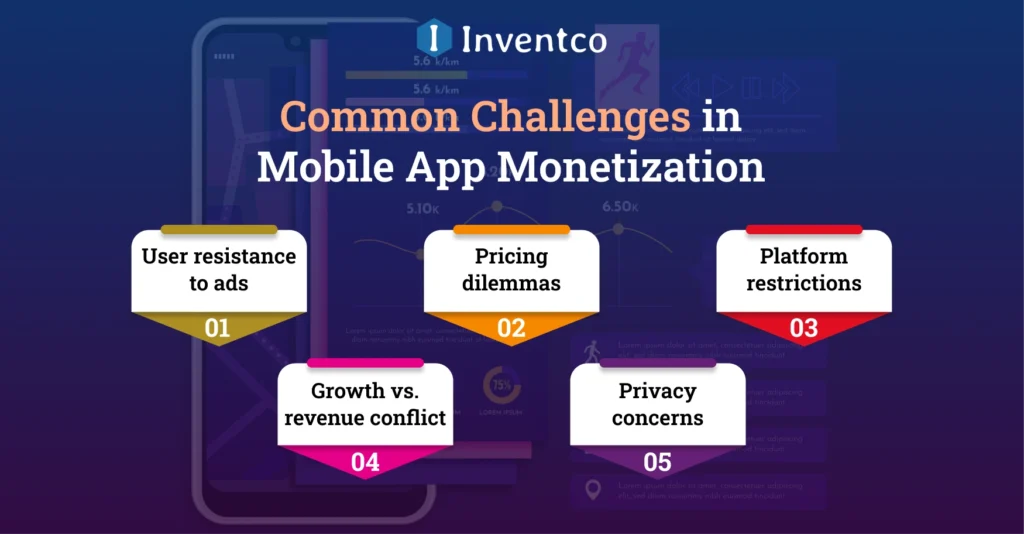
Common Challenges in Mobile App Monetization
Let’s be honest, mobile app monetization is not as simple as walking in a playground. Even the top apps can hit speed bumps when it comes to turning users into revenue.
Here are some of the most common Monetization challenges to watch out for:
- User resistance to ads: Intrusive ads can ruin the experience and drive users away.
- Pricing dilemmas: Price it too high, and buyers hesitate. Too low, and you’re leaving money on the table.
- Platform restrictions: Apple and Google play by their own rules, fees, policies, and approval processes, which can impact your strategy.
- Growth vs. revenue conflict: Over-monetizing too soon can hurt user growth and long-term engagement.
- Privacy concerns: With greater awareness, users expect openness and control over how their data is used.
Pro Tip: Stay up to date on best practices for mobile app monetization. You can test different models for your app, and don’t be afraid to switch models. Every app has its own status and is different from others, which also face several app development challenges, so make sure to balance revenue and user experience.
Famous Apps & Their Monetization Strategies
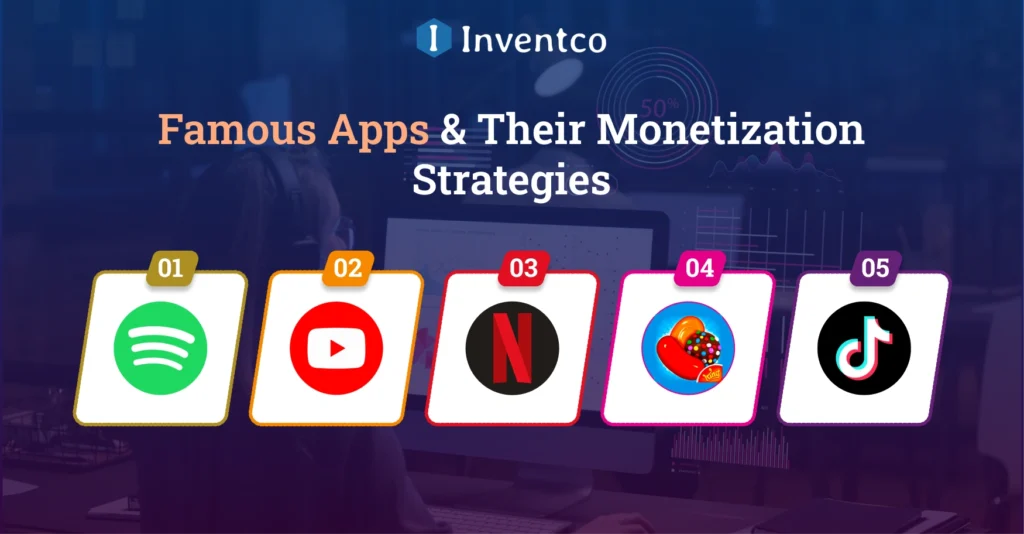
Want to hack mobile app monetization for your business app? Let’s see some of the famous apps and their monetization models.
1. Spotify
Spotify is one of the most famous music streaming apps across the globe, and it uses a freemium model where users get basic features for free, but if you want to listen without interruptions, you need to subscribe to ad-free music and premium features.
2. YouTube
YouTube is one of the most famous and most recognizable entertainment and video streaming platforms. It uses a combination of advertisements and YouTube Premium subscriptions for an ad-free experience and exclusive content.
3. Netflix
Netflix is one of the finest video streaming apps for watching movies and web series. It runs on a subscription-only model, which offers unlimited access to its massive content library. For those aiming to build an app like Netflix, its monetization model is a gold standard, prioritizing user retention, content quality, and recurring revenue.
4. Candy Crush
Candy Crush is one of the most famous games that is popular among children as well as adults. It offers a free download but gives an in-app purchase option for extra lives, boosters, and more.
5. TikTok
TikTok is one of the most famous short-form video-sharing social media platforms, which uses monetization methods through a mix of ads, in-app purchases, and brand sponsorships.
Each of these famous apps customizes its monetization model to match user behavior, industry & app development trends, and the needs of the users. The key is picking what works best for your audience and app.
Top App Monetization Platforms to Know
Choosing the right monetization platform is essential if you want to turn your app into a revenue generator. You can use these tools to keep the experience smooth and scalable while managing ads, subscriptions, and user data.
Below are the 10 top app monetization platforms for 2026:
| Platform | Best For | Key Features |
| Google AdMob | In-app ads | Global reach, smart analytics, seamless integration |
| Apple Search Ads | iOS user acquisition | Premium ad placement within the App Store |
| Facebook Audience Network | Broad audience targeting | Leverages Meta’s user data for highly targeted ads |
| Unity Ads | Mobile games | Built for game developers, easy Unity integration |
| AppLovin | Ad management & user acquisition | Robust tools for ad placement and UA tracking |
| IronSource | Full-scale monetization | End-to-end solution for managing in-app ads and revenue |
| RevenueCat | In-app subscriptions | Cross-platform subscription tracking & billing |
| OneSignal | Notifications + monetization | Push notification tools with engagement and monetization strategies |
| AdColony | Video ads | High-quality, interactive video ad formats |
| MoPub (by Twitter) | Ad mediation | Advanced mediation to optimize ad network performance |
Pro Tip: Choose platforms that match your app type, user behavior, and revenue goals. The right stack can seriously boost both your bottom line and user experience.
Monetize Your Mobile App Like a Pro with Inventco Expertise
Our monetization services for mobile applications stay way ahead of the marketplace because we take into account the customer journey and the barriers to our customers’ success, rather than simply placing ads or charging fees with no regard for the long-term customer relationship.
As an experienced mobile app development company, Inventco evaluates your product category, audience segmentation, engagement metrics, and competitive landscape before recommending a monetization framework. Whether the strategy involves subscription models, in-app purchases, freemium structures, advertising integrations, transaction-based revenue, or hybrid monetization models, every decision is grounded in measurable performance indicators.
In contrast to the constant changes in app marketplaces, Inventco enables continuous improvement in revenue performance through integrated analytics within the app, tracking the conversion funnel, retention metrics, and monetization features.
Your app revenue will increase significantly without sacrificing end-user satisfaction or brand trust. Achieving a structured Monetizing Parliament will offer a foundation for the long term.
Wrapping Up
In 2026, mobile application monetization will focus on developing a structured, data-driven framework that balances profitability and user experience. Your model may focus on subscription, in-app purchases, advertising, freemium, or hybrid monetization streams, but the keys to success will always be a balance, continuous mobile app testing, and app store optimization.
Balance in monetization is about a refined, holistic system that accounts for the multiple factors at play. Behavioral analytics, performance tracking, system adaptations, and market trend analyses will be crucial in sustaining revenue. Applications that respond to user insights will always outperform those that ignore them.
Reduced risk, increased reward, and greater monetization potential come from the right strategic thinking paired with skilled implementation. A simple monetization framework will turn your application from a digital creation into a digital revenue machine.
FAQ’s
Q1. How do you monetize an app without annoying ads?
Ans. It is easy to ditch the pop-ups and go for subscription models, freemium updates, or in-app purchases. You’ll keep users happy, and you’ll make money with your app.
Q2. What are the best mobile app monetization models for educational apps?
Ans. For educational apps, try a mix of subscriptions, freemium content, and optional premium lessons. It’s all about balancing value with accessibility.
Q3. How much does it cost to create an app?
Ans. The cost to create an app varies; basic apps might cost $1,000-$25,000, while complex ones can go up to $ 1,00,000+, depending on features and platforms.
Q4. What’s the best way to monetize an app in 2026?
Ans. In 2026, it’s all about flexible app monetization strategies, a mix of freemium, subscriptions, and non-intrusive ads to maximize ROI while keeping users hooked.
Q5. How can Inventco help me monetize my app?
Ans. Inventco brings hands-on expertise in choosing the right app monetization strategy for your niche, from development to growth. We help turn downloads into dollars.
Q6. How does app monetization work on Android?
Ans. Android app monetization is handled through tools such as Google AdMob, Google Play in-app purchases, and subscription models, all managed via the Play Console.
Q7. How much time does it take to develop an app?
Ans. Depending on complexity, it can take anywhere from 2 to 6 months to create a mobile app, faster if you team up with experienced pros like Inventco, of course.

Jitendra Jain
He is the CEO and Co-founder of Inventco, driving innovation in advanced computing and digital transformation. With deep expertise in modern IT ecosystems, he leads scalable, secure, future-ready solutions. His strategic leadership helps businesses accelerate growth, adopt innovation, and achieve success. You can connect with him on LinkedIn to follow his technology insights.