Your sales team is drowning in spreadsheets. Your support reps can’t see what the marketing team sent last week. Your investors are asking why conversion rates are flat despite a growing pipeline. Sound familiar?
The development of a custom CRM can solve all of the above challenges. They are challenges that businesses of all sizes experience. The global CRM market was valued at $101.41 billion in 2024. Market projections say that by 2032, the global market will be $262.74 billion. The market will grow at a rate of 12.6% per year.
That growth isn’t driven by curiosity. It’s driven by businesses that have realized off-the-shelf tools like Salesforce or HubSpot, while powerful, often come with bloated features, high licensing fees, and limited flexibility for unique workflows.
That’s where custom CRM software development comes in. The custom CRM development cost in 2026 typically ranges between $10,000 and $1,00,000+, depending on your feature requirements, development team location, platform complexity, and integration needs.
For startups interested in a mobile CRM development solution and for large enterprises interested in all-in-one development and integration solutions, having an understanding of the CRM development costs is vital.
This guide provides a comprehensive understanding of the types of CRM systems, their cost breakdowns, the cost factors that influence small business costs for CRM systems, and the most effective ways to reduce costs for CRM systems and implementation while maintaining high standards.
Key Takeaways
- Custom CRM development cost ranges from $10,000 to $100,000+ depending on scope, features, and team location.
- The type of CRM, operational, analytical, or collaborative, has a direct impact on the overall CRM development cost.
- Small businesses can build a functional CRM starting at $10,000–$30,000 with the right feature prioritization.
- Partnering with an experienced development firm like Inventco significantly reduces time-to-market and hidden implementation costs.
- The cost to develop a CRM system includes design, development, QA, integrations, and ongoing maintenance, not just initial build.
What is the Role of Custom CRM Software?
Understanding custom CRM software is necessary before exploring the numbers associated with custom software. The features that a company requires for CRM software strongly correlate with the cost associated with developing the CRM software.
A Customer Relationship Management (CRM) system helps businesses build and manage the relationships they have with prospects, clients, and partners. Unlike custom CRM systems, subscribed CRM systems lack tool integration, flexibility, and scalability.
Key Business Functions a Custom CRM Supports:
- Centralized Contact & Lead Management: Every interaction, deal stage, and communication history stored in one place, accessible across mobile app features and desktop.
- Sales Pipeline Automation: Custom stages, triggers, and scoring models aligned to your actual sales motion, not a generic template.
- Marketing Campaign Integration: Connect email, SMS, social, and ad platforms to attribute revenue accurately and reduce cycle times.
- Customer Support & Ticketing: Resolve issues faster with automated routing, escalation rules, and SLA tracking.
- Analytics & Reporting Dashboards: Real-time visibility into team performance, deal velocity, and customer health scores.
- Third-Party Integrations: APIs for ERP, billing, helpdesk, mobile app technology stack components, and logistics, all connected natively.
The distinction matters: Off-the-shelf CRMs give you 80% of what you need. A custom CRM gives you 100% of what your business actually requires. And for enterprise and growth-stage founders, that 20% gap is often where competitive advantage lives.
How Much Does It Cost to Build a CRM System in 2026?
The most honest answer is: it depends. But that’s not a helpful answer on its own, the cost to build a mobile app can range from $10,000 – $100,000+, so here’s a structured breakdown that maps investment tiers to real outcomes.
| Investment Tier | Estimated Cost | Best Suited For | What You Get |
| Starter | $10,000 – $25,000 | Startups and small to medium-sized businesses | Core contact management, basic sales pipeline tracking, customer records, and limited third-party integrations |
| Growth | $25,000 – $60,000 | Mid-market businesses and scaling organizations | Advanced workflow automation, reporting and analytics, API integrations, customer engagement tools, and mobile app capabilities |
| Enterprise | $60,000 – $100,000+ | Large enterprises and multi-location organizations | Fully customized CRM platform, enterprise-grade mobile app security, multi-region support, advanced BI dashboards, custom integrations, and scalable infrastructure |
Note: Costs above reflect typical engagement models with experienced development partners. Freelancer-assembled teams may quote lower, but the cost of CRM implementation mistakes, rework, and security vulnerabilities often far exceeds initial savings.
Different Types of CRMs and Their Estimated Cost
Not all CRMs are built equal. The type of system you build determines the architecture, mobile app technology stack, development timeline, and ultimately the CRM software development cost. Here’s a comparison:
| CRM Type | Best For | Core Features | Estimated Cost Range |
| Operational CRM | Sales, marketing, and customer support teams | Lead management, workflow automation, email and SMS campaigns, customer support ticketing | $15,000 – $50,000 |
| Analytical CRM | Data-driven enterprises and investors | Advanced reporting, predictive analytics, customer segmentation, business intelligence dashboards | $30,000 – $80,000 |
| Collaborative CRM | Multi-department organizations and distributed teams | Shared customer records, team collaboration tools, document sharing, cross-functional workflows | $20,000 – $60,000 |
| Strategic CRM | Relationship-focused businesses and enterprises | Customer lifetime value tracking, loyalty management, retention programs, enterprise integrations | $40,000 – $100,000+ |
| Campaign CRM | Marketing agencies and D2C brands | Multi-channel campaign management, A/B testing, conversion tracking, social media integrations | $10,000 – $35,000 |
| Industry-Specific CRM | Healthcare, fintech, real estate, logistics, and other specialized sectors | Compliance management, industry-specific APIs, custom workflows, mobile applications, advanced security | $50,000 – $100,000+ |
Pro Insight: Many businesses start with an Operational CRM and layer in Analytical capabilities as data matures. This phased approach helps manage the average cost of CRM software while ensuring the system scales with business growth.
Key Factors That Affect Custom CRM Development Cost
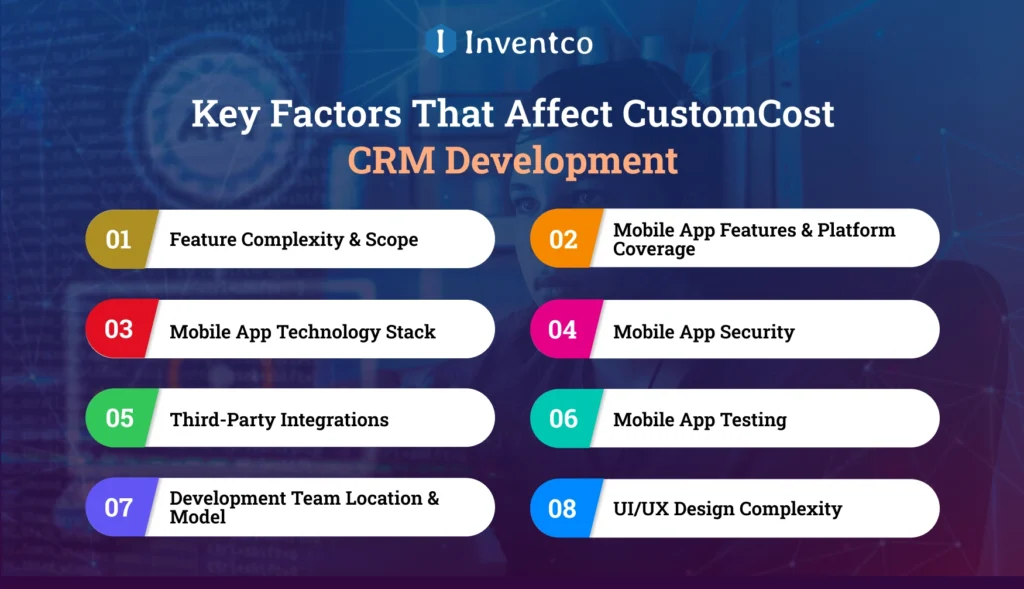
Understanding the cost to develop a CRM system requires looking beyond just features. Here are the primary variables that move the budget needle:
1. Feature Complexity & Scope
Basic lead tracking is inexpensive. AI-powered deal scoring, multi-channel campaign engines, or real-time dashboards with predictive analytics, those add high cost. Define your MVP app scope before engaging any development partner.
2. Mobile App Features & Platform Coverage
If your CRM needs to run on mobile devices, and most modern CRMs do, you’ll need to factor in mobile app features like offline sync, push notifications, role-based access, and responsive UI. Expanding from web to iOS and Android typically adds 30–40% to the base cost to build a mobile app layer.
3. Mobile App Technology Stack
The mobile app technology stack your team chooses has a compounding effect on cost and scalability. React Native or Flutter offer cross-platform efficiency. Swift (iOS) or Kotlin (Android) native builds offer performance but at a higher resource cost. Backend choices, Node.js, Python, or Java, also impact performance and long-term maintenance budgets.
4. Mobile App Security
When building enterprise-grade CRM software, app security cannot be compromised. Implementing role-based access controls, encrypted data transmission, secure authentication protocols, audit logging, and data masking adds to the budget but protects sensitive business information and customer data.
5. Third-Party Integrations
The more your CRM connects with other tools, ERP systems, payment gateways, email platforms, WhatsApp Business APIs, or logistics providers, the more complex (and costly) the development. Budget $2,000–$10,000 per integration, depending on API complexity.
6. Mobile App Testing
Skipping thorough mobile app testing is how businesses end up with CRMs that crash during product demos or expose sensitive data. Functional testing, regression testing, performance benchmarking, and mobile app security testing should account for 20–25% of your total development budget.
7. Development Team Location & Model
Onshore teams (US, UK, Australia) typically charge $100–$200/hour. Eastern European teams range from $50–$90/hour. South Asian teams (India) average $25–$50/hour. Inventco’s hybrid model delivers senior-level expertise at competitive rates without compromising delivery quality.
8. UI/UX Design Complexity
A CRM that people actually use requires exceptional UX. Complex dashboards, custom data visualizations, and intuitive mobile interfaces require dedicated design investment, typically $5,000–$20,000 depending on scope.
CRM Software Cost for Small Businesses: What to Expect
The cost of CRM Software for small businesses can be more accessible than you think. With some focused scoping and by using a phased development strategy, small businesses can build functional, scalable CRMs that don’t have a large price tag.
Most small businesses allocate budgets of between $10,000–$30,000 for a first version of their custom CRM. The priority focus for small businesses should be to create a self-funding system, and then to create small improvements to that system.
What a $10,000–$30,000 CRM Includes:
- Contact and company database with custom fields
- Basic sales pipeline with drag-and-drop deal stages
- Email and activity logging
- Role-based access for team members
- Mobile-responsive web access (no dedicated mobile app)
- Standard reporting and export
What You Add at the $30,000–$60,000 Range:
- Dedicated mobile app (iOS + Android) with key mobile app features
- Workflow automation and trigger-based notifications
- CRM integrations with accounting or marketing tools
- Advanced analytics and custom dashboards
- Enhanced mobile app security with RBAC and encryption
The question of how much it costs to develop a CRM ultimately comes down to this: a small business CRM is a focused tool. An enterprise CRM is an ecosystem. You don’t need to build the ecosystem on day one.
5 Proven Ways to Reduce Your CRM Development Cost
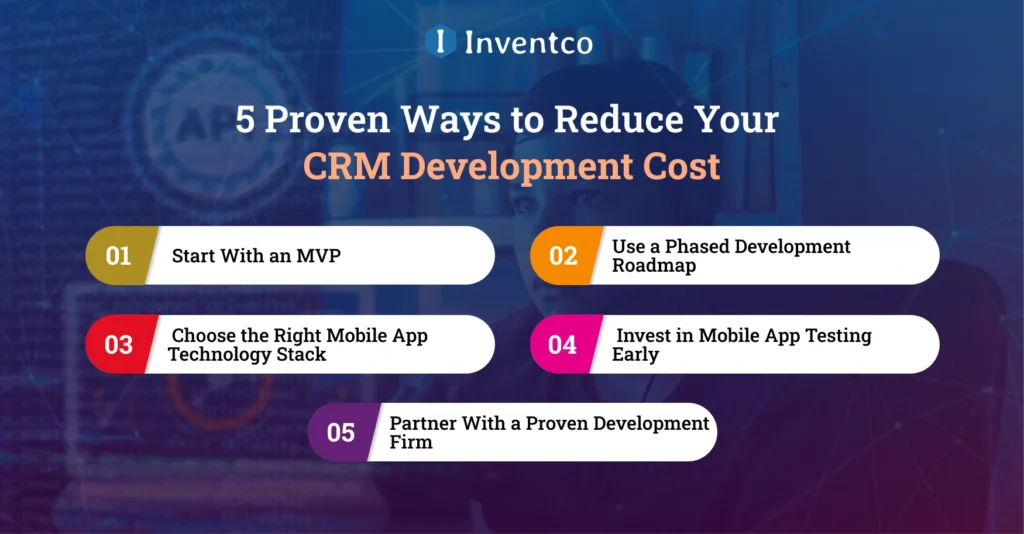
The goal of cutting costs for CRM development isn’t about eliminating work. It’s about spending discretionary time and resources in an efficient way.
1. Start With an MVP
In the first phase of developing a mobile app, you should focus solely on the core features needed to launch. An MVP approach reduces time-to-market and allows real user feedback to guide feature investment, instead of assumptions that cost money to reverse later.
2. Use a Phased Development Roadmap
A phased development approach will segment your CRM Roadmap into the initial build of the core data layer, followed by the automation layer, then the analytics layer, and finally, the mobile layer. This approach will help generate positive ROI and support the development budget for the build.
3. Choose the Right Mobile App Technology Stack
Selecting a cross-platform framework like React Native for your mobile layer instead of separate native builds can reduce the cost to build a mobile app component by 30–40%. Your mobile app technology stack choice at the architecture stage is one of the highest-leverage decisions you’ll make.
4. Invest in Mobile App Testing Early
Catching bugs during mobile app testing in development costs a fraction of what it costs post-launch. Automated testing frameworks (Jest, Detox, Appium) reduce ongoing QA spend while improving system reliability.
5. Partner With a Proven Development Firm
The cost of poor UX, security issues, and other CRM implementation mistakes far outweigh the savings of a less experienced provider. A development partner that has industry knowledge will build your project faster and more securely with a far better long-term ROI.
How Inventco Helped a Startup Build Their Custom CRM
A startup with rapid growth was struggling with the management of leads, customers, and sales using spreadsheets and multiple tools. The growth of the company was making it harder to manage opportunities, follow-ups, and views of sales results. All of this was hurting the revenue growth of the company and harming the customer experience.
Inventco created a custom CRM for the startup’s sales and business operations workflow. The custom CRM had sales automation and analytics, customer follow-up and engagement tools, and easy ways to manage sales and customer leads. To help the sales and business teams access the CRM on mobile, Inventco created a custom secure mobile app using a CRM integrated with mobile role security, data security, and secure third-party connections.
Using a modern tech stack of React Native, Node.js, PostgreSQL, and AWS, Inventco created a custom CRM that helped the sales and business teams of the startup improve customer and sales engagement, helped the startup improve lead conversions, and helped the startup improve its sales and business operations for future growth.
Conclusion
The question isn’t really how much it costs to build a CRM system. The real question is: what is the cost of not having one?
The businesses you will compete against in 2026 are those that have unified, intelligent CRM systems. They will be far more successful than businesses that rely on disconnected tools and data. Knowing the crm software development cost makes it easy to save yourself the losses you would incur from not having a tool that gives you faster, clearer data and access to the growth you are seeking.
If you are deciding on your first CRM system or if you are replacing an outdated CRM system that your team has outgrown, Inventco will bring the engineering knowledge, business insight and irrefutable delivery to your project.
FAQ’s
Q1. What is the average cost of CRM software development in 2026?
Ans. The average cost of CRM software development ranges from $10,000 for a basic starter CRM to $100,000+ for a fully custom enterprise-grade platform. The final figure depends on feature complexity, mobile requirements, integration needs, and your development team’s location and experience.
Q2. How much does CRM implementation cost on top of development?
Ans. CRM implementation cost, covering data migration, team training, configuration, and go-live support, typically adds 15–25% to the base development budget. Planning for this upfront avoids budget surprises and ensures your team actually adopts the system from day one.
Q3. Can a small business afford a custom CRM?
Ans. Absolutely. CRM software cost for small businesses starts at $10,000–$25,000 for an MVP-scoped build. With phased development, small businesses can start lean and expand the system as revenue and user adoption grows.
Q4. How long does it take to build a custom CRM system?
Ans. A starter CRM typically takes 8–12 weeks. A mid-market system with automation and mobile app features requires 4–6 months. Enterprise-scale CRMs with full analytics, mobile app security, and multi-region deployment typically take 6–10 months from discovery to go-live.
Q5. What mobile app technology stack is best for CRM development?
Ans. For mobile-first CRM builds, React Native or Flutter are preferred for cross-platform efficiency. If performance and hardware access are critical, native Swift (iOS) and Kotlin (Android) are the stronger choices. Backend stacks like Node.js, Python (Django/FastAPI), or Java are all viable, selection should align with your existing infrastructure and team expertise.
Q6. Does mobile app security affect CRM development cost?
Ans. Yes, and it should. Building mobile app security into the CRM from day one, including RBAC, encryption, MFA, and audit logging, increases initial development cost by 10–20%. But the cost of a security breach, regulatory fine, or customer trust loss is exponentially higher. This is a non-negotiable investment, not a line item to cut.

Jitendra Jain
He is the CEO and Co-founder of Inventco, driving innovation in advanced computing and digital transformation. With deep expertise in modern IT ecosystems, he leads scalable, secure, future-ready solutions. His strategic leadership helps businesses accelerate growth, adopt innovation, and achieve success. You can connect with him on LinkedIn to follow his technology insights.