
Quick Answer
Building an event management app typically costs between $10,000 and $100,000+ in 2026. Basic apps with registration and schedules start near $10,000–$25,000. Mid-tier apps with networking, live polls, and push notifications run $25,000–$60,000. Enterprise-grade apps with AI matchmaking, analytics dashboards, and multi-event support cost $60,000–$100,000+.
The global events industry crossed the $1.5 trillion mark in 2025, and a growing share of spend now runs through a mobile-first approach instead of phone calls, spreadsheets, and printed badges. Event organizers, from boutique conference planners to enterprise experience teams, are under pressure to deliver seamless registration, real-time engagement, and measurable ROI from a single connected event app. That pressure silently shifted the founders’ question from “Should we build an event app?” to “How much will it actually cost to build an event app, and how much time it takes to develop an app?”
When investors and event app founders think about the cost of developing a modern event app, they should expect to spend $10,000 for an event MVP app or as much as $100,000 for an enterprise AI system with advanced analytics and the ability to run numerous simultaneous events.
There is a huge difference in event app development cost well beyond basic construction versus customization, backend complexity, the line between automated vs. manual event app experiences, and the feature set selection.
This guide breaks down what actually drives event app development cost in 2026, the features that matter most to attendees and sponsors, an accurate event app development timeline, and the hidden costs to develop an event management app that most agencies don’t mention upfront. We will then take a look at how Inventco developed CoHost, a real event-based application for engaging conference users on a large scale.
Key Takeaways
- Event app development cost in 2026 ranges from $10,000 to $100,000+, driven primarily by feature complexity and platform scope.
- Networking tools, live engagement features, and AI matchmaking are now baseline expectations, not premium add-ons.
- Backend mobile app architecture and third-party integrations, payment gateways, CRM, and badge printing typically account for the largest share of the budget.
- Hidden costs, including post-launch maintenance and scalability testing, can add 15–25% to initial estimates.
- A phased, MVP-first approach lets founders validate demand before committing to a full enterprise build-out.
What Is an Event Management App?
A digital event platform that centralizes the planning, marketing, and real-time execution of events, including conferences, trade fairs, corporate offsites, and exhibits, is known as an event management app. Organizers and participants communicate using a single, integrated system instead of managing registration spreadsheets, email bombing, and printed agendas.
For participants, this usually entails digital tickets and registration, customized calendars, speaker & session details, and networking resources. Dashboards for monitoring attendance, collecting comments, and assessing participation in real time are what it means for organizers.
Because event ROI is increasingly determined by engagement data rather than just ticket sales, the most competitive event management apps in 2026 also include gamification, AI-based matching, and sponsor visibility capabilities.
As event apps are now an essential part of the event’s revenue plan rather than just a nice-to-have convenience, this change is particularly significant for entrepreneurs and investors. Event organizers utilize in-app analytics to support pricing for the event the next year, and sponsors now want measurable impressions and lead data from the app itself.
This changes the development cost calculation since you are creating a tiny data platform that must function reliably under a shortened, high-stakes deadline rather than merely a schedule viewer.
Event App Development Cost Breakdown (2026)
The event app development costs can fall mostly into 3 tiers, based on how much of the attendee journey and organizer workflow you want the event management app to handle:
| Tier | Cost Range | What’s Included |
| Basic (MVP) | $10,000 – $25,000 | Registration, digital ticketing, event agenda, push notifications, basic check-in |
| Mid-Tier | $25,000 – $60,000 | Networking tools, live polls & Q&A, social feed, gamification, sponsor visibility |
| Enterprise | $60,000 – $100,000+ | AI-powered matchmaking, real-time analytics dashboards, multi-event management, custom integrations |
Basic (MVP) – $10,000–$25,000
A basic or MVP event app gives the core user experience without polished features. It usually includes event registration, digital tickets, agendas, push notifications, and basic event mobile app features. This tier is ideal for small conferences, workshops, seminars, and one-day events that need a consistent digital event experience.
Mid-Tier – $25,000–$60,000
A mid-tier event app includes interactive elements that increase participant engagement and involvement. Mobile app features like networking tools, live polls, Q&A sessions, social feeds, gamification, and sponsor exposure are all popular features. These options work well for conferences, trade exhibitions, corporate events, and engagement-focused meetings.
Enterprise – $60,000–$100,000+
Enterprise event mobile applications are planned for large-scale events and organizations that handle sophisticated guest experiences. AI-powered matching, real-time analytics dashboards, multi-event management, custom integrations, and powerful admin tools are some of the available features. This category is suitable for event organizers, worldwide conferences, exhibits, and organizations that host several events.
MVP vs. Full-Featured App: Which Should You Build First?
Many founders don’t require all features on launch day, and implementing them all at once is the single most common cause of event app budget overruns. The starting event mobile app includes registration, tickets, and a live agenda, allowing you to ensure that participants will use the event app before investing in AI matching or a custom analytics dashboard. AI integration in mobile app development can be done at a later stage.
The trade-off is speed of differentiation. If your event’s primary value proposition is networking or sponsor involvement, removing such capabilities from version one may undermine the reason attendees downloaded the app in the first place. A viable middle ground is to start with a mid-tier design that includes key engagement capabilities, then add enterprise-grade analytics and matching after you have a complete event cycle of use data to justify the expenditure.
Key Factors That Influence Event App Development Cost
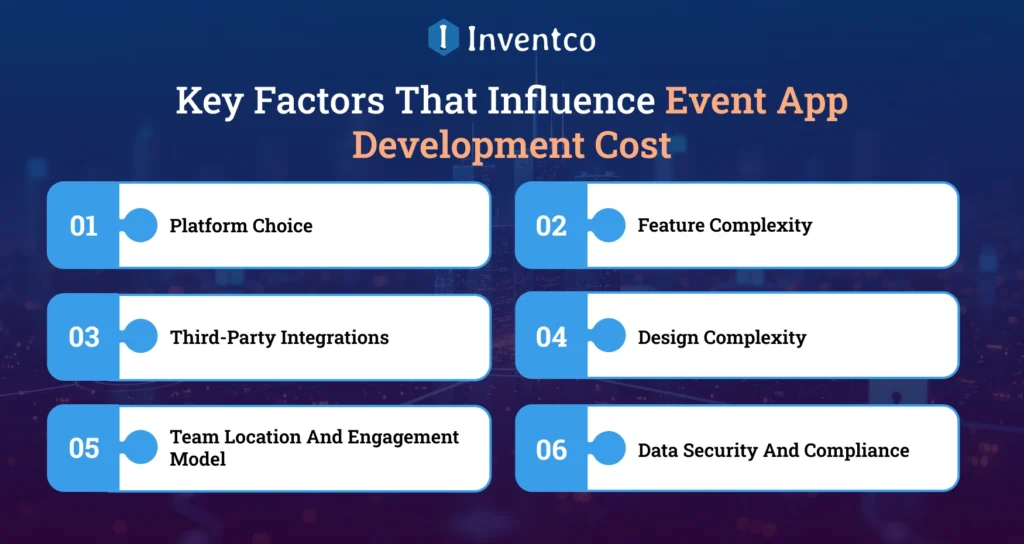
- Platform Choice: Native iOS/Android development typically costs more than a single cross-platform build in Flutter or React Native, but can offer better performance for graphics-heavy features.
- Feature Complexity: Networking modules, AI-powered matchmaking, and gamification require more backend logic and testing than a static agenda or ticketing flow.
- Third-Party Integrations: Payment gateways, CRM systems, badge and ticket printing, and live-streaming APIs for hybrid events all add development and licensing cost.
- Design Complexity: A fully custom UI/UX wireframe built around your event brand costs more than a template-based interface, but tends to perform better with sponsors and attendees.
- Team Location And Engagement Model: Fixed-price outsourced builds, hourly agency models, and in-house teams all carry different cost structures and risk profiles.
- Data Security And Compliance: Apps handling payment data or attendee personal information need GDPR-aware architecture and, in some cases, PCI-DSS-compliant payment handling.
Must-Have Features That Impact Your Event App Budget
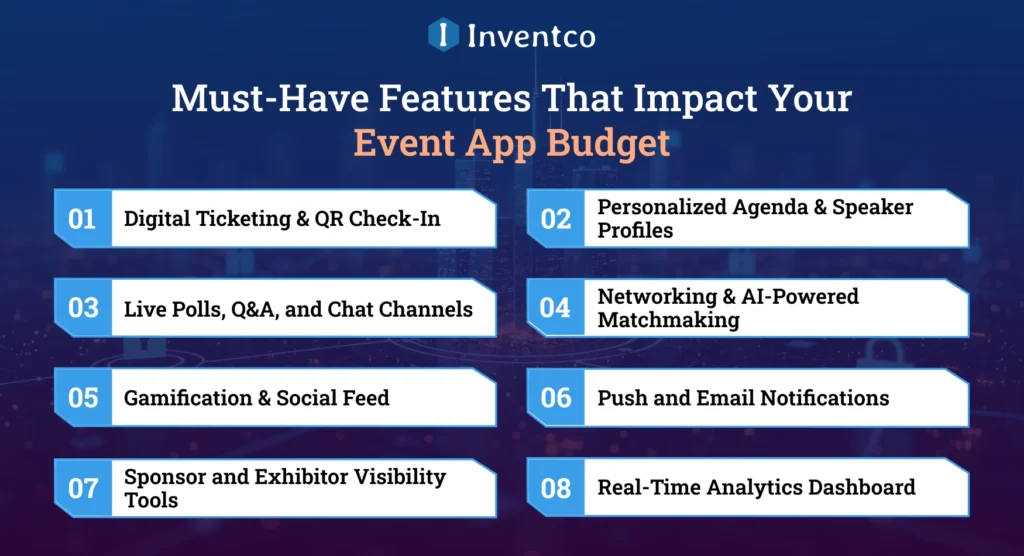
- Digital Ticketing & QR Check-In: Speeds up entry and reduces on-site staffing needs.
- Personalized Agenda & Speaker Profiles: Keeps attendees oriented across multi-track events.
- Live Polls, Q&A, and Chat Channels: Turn passive sessions into two-way conversations.
- Networking & AI-Powered Matchmaking: Connects attendees with relevant peers based on interests and goals.
- Gamification & Social Feed: Sustains engagement between sessions and encourages return visits.
- Push and Email Notifications: Keep attendees informed about schedule changes and speaker announcements.
- Sponsor and Exhibitor Visibility Tools: Create a measurable revenue channel for organizers.
- Real-Time Analytics Dashboard: Gives organizers attendance, engagement, and session-performance data as the event unfolds.
Not every event needs all eight of these mobile app features on day one. Conferences leaning heavily on sponsor revenue should prioritize sponsor visibility tools and analytics early, while community-driven events often get more traction from networking and gamification first. Sequencing features around your event’s actual revenue model, rather than building everything at once, is usually what keeps development cost inside the mid-tier range.
Event App Development Timeline
A mid-tier event app development process typically takes 3 to 5 months from discovery to launch, depending on scope and how many integrations are required.
| Phase | Estimated Duration |
| Discovery & Strategy | 1 – 2 weeks |
| UX/UI Design | 2 – 4 weeks |
| Backend & Frontend Development | 6 – 12 weeks |
| QA & Testing | 2 – 3 weeks |
| Deployment & App Store Submission | 1 – 2 weeks |
Hidden Costs Most Agencies Don’t Mention
A fixed event app development quote rarely covers the full lifecycle of an event app, and this is where many founders end up spending more than the original estimate suggested. Vendors are often reluctant to lead with these numbers because they make the headline cost look higher, but skipping them at the planning stage almost always costs more later. Founders evaluating vendors should budget for the following beyond the initial build:
- App store fees and compliance reviews for each submission cycle.
- Post-launch maintenance and bug fixes, typically 15–20% of development cost annually.
- Scalability and load testing ahead of high-attendance events or conference season.
- Third-party API costs for SMS, push notifications, and video streaming, which scale with usage.
- Backend hosting and data storage costs that grow with attendee volume and historical event data.
- Ongoing mobile app security patches and compliance updates as data protection regulations evolve.
- Vendor support and change requests once organizers start requesting event-specific customizations mid-cycle.
Evaluating vendors for your event app? Inventco’s team can scope your project and deliver a fixed-cost estimate within 48 hours.
Case Study: How Inventco Built CoHost, an Event-Based Application
Inventco developed CoHost, an event-based platform that combines conference-scale interaction into a single, attendee-first experience. From onboarding to checkout, users register, view event information, and buy digital tickets before getting a tailored calendar that includes speaker bios, session agendas, and venue maps. To make sessions engaging, Inventco’s team included live polls, Q&A, and chat channels, as well as gamification and a social feed to keep participants engaged between sessions.
The most notable addition was an AI-powered matchmaking and speed-networking module, which allowed attendees to connect with like-minded professionals and schedule meetings directly within the app, transforming a static conference schedule into a connected, revenue-generating experience for organizers and sponsors alike.
Discipline Breakdown
- Strategy: Mapped the attendee journey from registration to post-event follow-up, prioritizing features by commercial impact for sponsors and organizers.
- UX/UI: Designed an intuitive event guide and networking flow that stayed usable across multi-day, multi-track conferences.
- Backend: Built the architecture behind real-time chat, live polls, matchmaking logic, and analytics without compromising performance under peak attendee load.
- Frontend: Delivered a responsive, cross-platform interface so attendees get a consistent experience whether they’re on iOS, Android, or checking in from a lobby kiosk.
- Software Testing: Validated the app under simulated conference-day traffic, including simultaneous check-ins, live polling, and networking requests.
Why Choose Inventco for Event App Development?
Inventco is a leading mobile app development company that provides scalable, user-friendly solutions tailored to current event needs. Our team uses strategic planning, intuitive UX/UI design, strong development, and rigorous testing to build event apps that make registration, ticketing, networking, engagement, and event administration easier. We concentrate on creating solutions that benefit both organizers and attendees.
From MVPs to enterprise-grade systems, Inventco creates event mobile applications that include real-time alerts, live interaction tools, analytics, matching, sponsor management, and custom integrations. Our development strategy prioritizes performance, security, scalability, and seamless user experiences, assisting companies in developing dependable event systems that can change as their events and audiences expand.

Conclusion
The cost of developing an event app in 2026 is not a single figure, it is a range determined by the features you prioritize, the platforms you target, and how much of the attendee and organizer experience you want to automate from the start. Founders who start with a clearly defined MVP, confirm engagement with actual attendees, and prepare for post-launch expenditures early on tend to achieve higher ROI than those who overbuild before demonstrating demand.
If you’re considering suppliers or attempting to determine a realistic budget for your own event app, Inventco’s team can go over your specifications and deliver a scoped, fixed-cost estimate before you commit to a build. Getting that amount right from the start, rather than uncovering hidden expenses halfway through the project, might be the difference between an app that pays for itself in sponsor income and one that stealthily drains funding after launch.
FAQ’s
Q1. How much does it cost to develop an event management app in 2026?
Ans. Event app development cost in 2026 typically ranges from $10,000 for a basic MVP to $100,000 or more for an enterprise-grade app with AI matchmaking, analytics, and multi-event support. Most mid-tier apps with networking and live engagement features fall between $25,000 and $60,000.
Q2. What’s the cheapest way to build an event planner app?
Ans. The most cost-effective approach is starting with an MVP that covers registration, digital ticketing, agenda display, and push notifications, then adding networking and analytics features once you’ve validated attendee demand.
Q3. How long does it take to build an event app?
Ans. A mid-tier event app typically takes three to five months from discovery through app store deployment, depending on how many integrations and custom features are required.
Q4. Do I need native apps for iOS and Android, or is cross-platform enough?
Ans. Cross-platform frameworks like Flutter or React Native are usually sufficient for event apps and reduce cost by sharing one codebase across platforms. Native development is worth the added cost only if your app relies heavily on device-specific performance, such as AR venue navigation.
Q5. What ongoing costs should I budget for after launch?
Ans. Plan for 15–20% of your initial development cost annually in maintenance and bug fixes, plus hosting, third-party API usage, and periodic security updates as your attendee base grows.
Q6. How is Inventco different from other event app development companies?
Ans. Inventco combines end-to-end delivery, strategy, UX/UI, backend, and QA, with direct experience building conference-scale apps like CoHost, giving founders a single accountable team rather than multiple vendors to coordinate.

Ajay Bhal
He is an on-demand app solutions expert with 11+ years of experience in business consulting and building scalable, user-centric digital products. He specializes in robust on-demand platforms across industries, combining technical expertise with business-focused strategy to deliver efficient, top notch solutions that drive growth and enhance user experience. You can connect with him on LinkedIn to follow insights.


