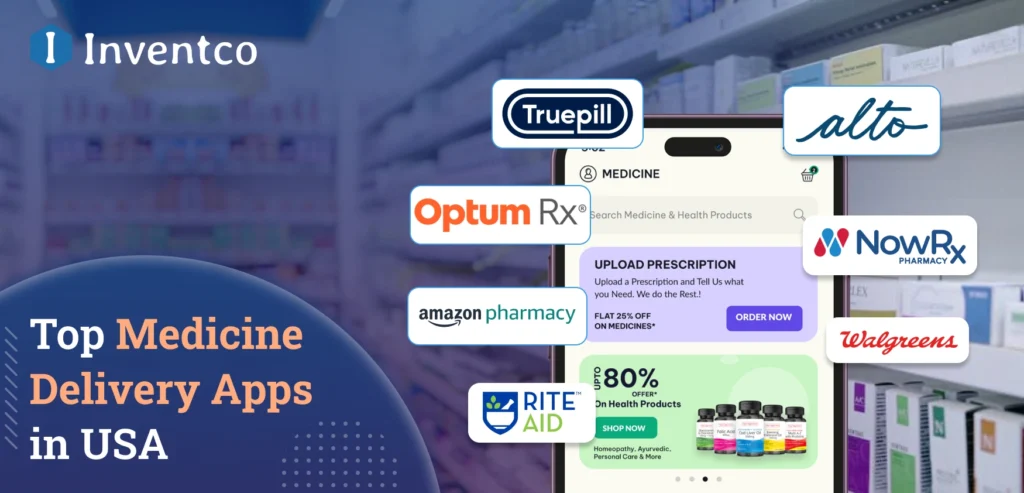
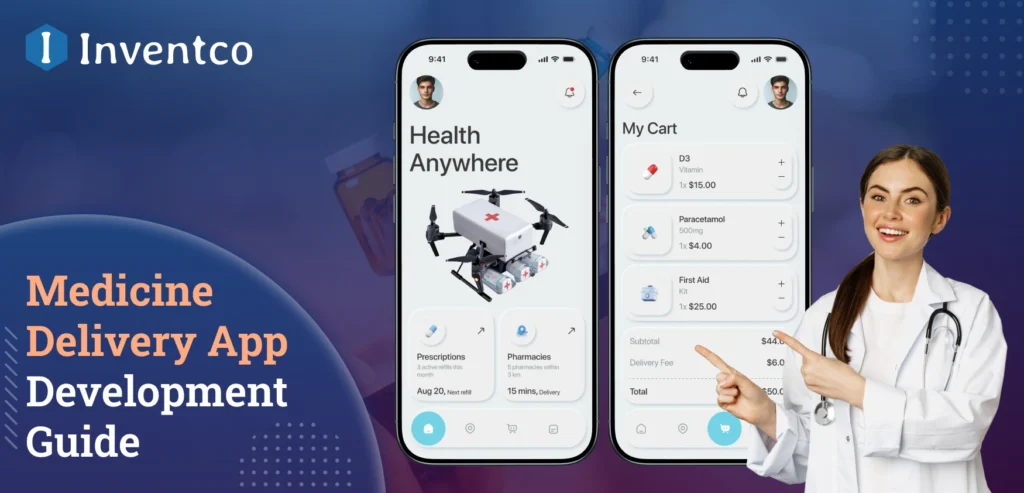
While the healthcare sector is going through digital transformation, how pharmacy services for the delivery of medications are integrated remains operationally siloed. For the end-user, this means operational delays, lack of transparency, inconsistent access, and most importantly, gaps in the continuum of care.
As expectations of users move towards more immediate and on-demand access to healthcare services, existing traditional pharmacy models will find themselves in the weeds. From a founders’ and investors’ perspective, this operational gap is a high-value white space to create & capture flexible and outcome-based access to improving technologies.
The global ePharmacy market is projected to surpass $200 billion by 2027, driven by chronic disease management, telehealth expansion, and mobile-first behavior. However, success in this space requires more than convenience, it demands compliance-first architecture, clinical accuracy, and trust-driven user experiences.
This comprehensive guide to pharmacy app development covers technology, regulation, compliance, cost, and monetization to save development time and focus on the areas of greatest return on your investment.
Key Takeaways
- Pharmacy app development has a promising future due to the rising global demand for digital healthcare services.
- To prioritize patient confidentiality and safety, architects should use a compliance-first approach when developing pharmacy applications.
- When deciding on a suitable business model, consider the impact on growth, business activities, and future income.
- A structured development process reduces risks and accelerates time-to-market for healthcare platforms effectively.
- Additional functionality and the use of artificial intelligence lead to the best financial results by increasing operational productivity and the number of users.
- Development expenses are influenced by the intricacy, demanded functionality, regulatory and future expandable needs of the software.
- It is possible to maintain a reliable and growing income in pharmacy applications when developed with effective business models and appropriate competitive market strategies.
Key Market Statistics for Pharmacy App Development
- The global digital health market was valued at ~$288.5 billion in 2024 and is projected to reach ~$946 billion by 2030, growing at a 22% CAGR.
- Another industry report estimates digital health could reach $2.19 trillion by 2034, driven by AI, remote monitoring, and mobile-first healthcare systems.
- The U.S. pharmacy market was valued at $732.44 billion in 2024 and is projected to reach $1.7 trillion by 2033, growing at a ~9.9% CAGR.
- The U.S. online pharmacy market was valued at $51.8 billion in 2020 and is expected to reach $145.8 billion by 2026, growing at a ~18.8% CAGR.
What Is a Pharmacy App and Why Is It Different From Other Delivery Apps?
A pharmacy app is a type of on-demand delivery service, but unlike all other on-demand delivery services, pharmacy apps are regulated digital healthcare services. These services allow users to order medications, provide and manage prescriptions, consult with pharmacists, and manage recurring refills within a controlled digital environment.
As with other on-demand pharmacy delivery services, there are a couple of unique features to pharmacy apps, such as the structure of the app itself, the regulatory oversight and responsibilities. These are features that exceed the operational requirements of a regular on-demand delivery app. These include:
- Prescription validation is mandatory, ensuring only authorized medications are dispensed
- Data privacy and security are non-negotiable, with strict standards for handling sensitive health information
- Drug authenticity and storage compliance must be maintained, protecting quality across the supply chain
- The app must ensure its customers are never left without the medications necessary in order to have their treatment plan continue.
From a business standpoint, it means you are not simply providing a delivery option, but rather a healthcare system that integrates all of the aforementioned factors and is user-friendly, compliant, and clinically dependable.
Types of Pharmacy Apps You Can Build
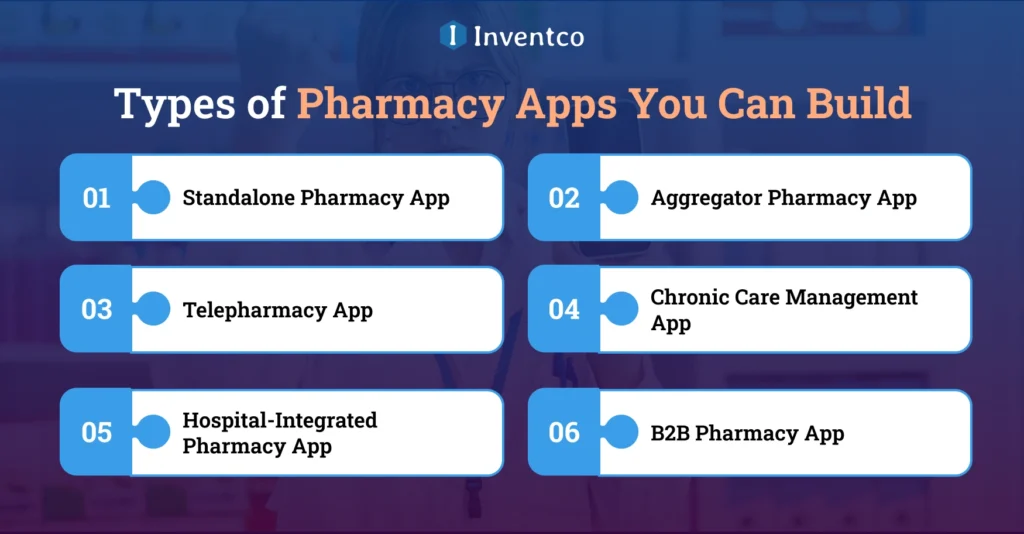
Choosing the right pharmacy app model is an important operational choice. It will define scalability, operational complexity, and total revenue projections. Each model fulfills a specific market demand and can be employed to achieve specific operational objectives.
1. Standalone Pharmacy App
This model is designed for a single pharmacy or retail chain to digitize its business. The pharmacy has full control and autonomy regarding the management of the inventory, pricing, and customer service experience on the app. This model is ideal for pharmacy brands that want to develop more direct business relationships with their consumers.
2. Aggregator Pharmacy App
This model allows for the comparison of multiple pharmacies and the selection of one pharmacy for the customer to facilitate the delivery of services. This model is more suited for startups and marketplaces that want to achieve rapid growth and scale without the hassle of inventory ownership.
3. Telepharmacy App
The telepharmacy app model allows for the integration of virtual consultations and corresponding prescription delivery services. It is best suited for digital healthcare providers who aim to deliver healthcare services digitally in remote areas and provide comprehensive digital care.
4. Chronic Care Management App
As the name suggests, this model is aimed at patients suffering from chronic diseases. Automated prescription refills and periodic deliveries of medication to patients can improve adherence to medication. This model is more suited to businesses that want a guaranteed and consistent revenue stream and long-term engagement with the patients.
5. Hospital-Integrated Pharmacy App
Pharmacy apps that are built to integrate with hospital systems and electronic health records (EHR) can directly receive prescriptions from doctors’ orders and dispense medicines to the patients. The operational efficiency of hospitals and clinics is improved, and patients receive continuous care.
6. B2B Pharmacy App
This model is aimed at bulk ordering. The app connects pharmacies, clinics, and healthcare provider distributors. It provides streamlined procurement and improved visibility of the supply chain, which is critical for managing and optimizing large-scale pharmaceutical operations.
From an investor’s viewpoint, choosing an appropriate model is more about market placement, operational management, and sustained scalability in the future rather than model features.
Note: With growing awareness of wellness, a developing women’s health-tracking app focuses on personalized features, data security, and a seamless user experience.
How to Build a Pharmacy App: Step-by-Step Process
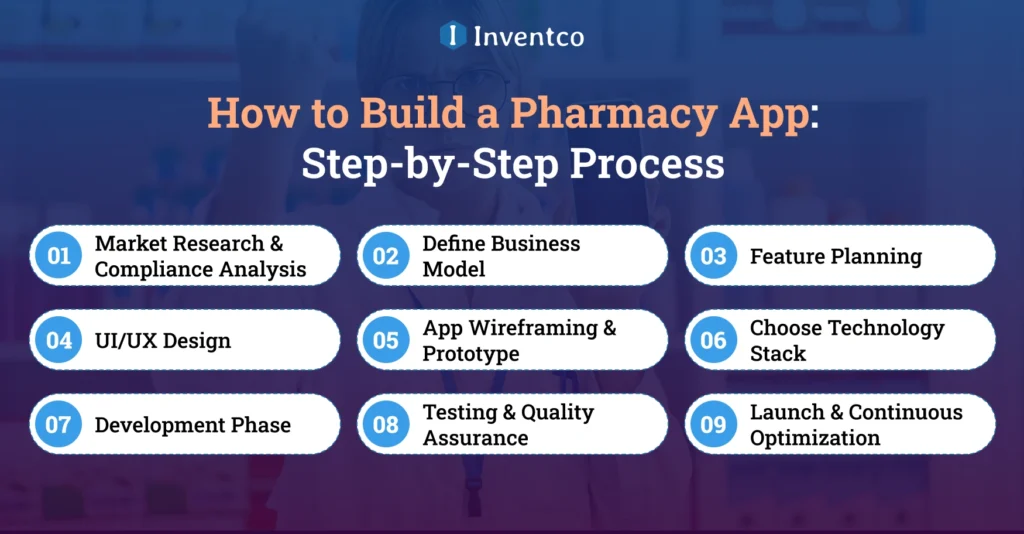
When developing a pharmacy app, a compliance-first, structured, and systematized approach must be utilized. At Inventco, we develop a system to align technologies with business goals to achieve scalability, security, and long-term ROI.
1. Market Research & Compliance Analysis
When it comes to the starting point of successful pharmacy app development, we must consider a regulatory and market analysis. This app development process includes analyzing the target user, gaps left by competitors, and the specific regulations governing the marketplace to be served.
Founders can also evaluate benchmarks from top medicine delivery apps to better understand user expectations and market positioning. Compliance must be addressed early to deliver the most cost-effective app. A well-researched strategy will yield a marketable, legally defensible pharmacy app.
2. Define Business Model
The pharmacy app must be constructed with a specific business model. For example, an aggregator model, an inventory-led model, or a hybrid model. These business models serve to provide the app with an elemental structure and set of operations, as well as a technology system. At this point, we will be looking to set the pharmacy app for market and monetization.
3. Feature Planning
The development of features should be guided by business goals and user expectations. We must first draft a description of an MVP mobile app, with the most essential features. Next, we will address the development of advanced features and later phases.
Insights from the best pill reminder apps can also guide feature prioritization to improve engagement and retention. The prioritization and development will optimize resource allocation. This will ultimately set the pharmacy app for success and ensure that the development and regulatory costs of the app will not be wasted.
4. UI/UX Design
In pharmacy apps, design isn’t merely an element of the business. It’s fundamental to instilling trust, clarity, and ensuring usability. UI/UX Design is used to ease some of the more complicated tasks, such as uploading prescriptions and selecting medications.
They also need to ensure that all demographics can access the application. Design that is effective elevates engagement and decreases errors, and trust is vital, especially in apps used within the Healthcare sector.
5. App Wireframing & Prototype
Before the actual development of the app can take place, the construction of app wireframes and prototyping of app functionality needs to be done to finalize the structural design of the app and the flow of the app in the User Experience.
This also enables the Stakeholders to finalize and approve the flow of the app so they can avoid having to pay for major adjustments and changes later in the development of the app. This is also how Stakeholders ensure that the functionality of the app aligns with their business goals.
6. Choose Technology Stack
For maximum scalability and security in a pharmacy app, an appropriate technology stack must be selected. This also entails cloud infrastructure, databases, mobile app development frameworks, and security protocols that deal with compliance and performance. An appropriate technology stack also allows for faster processing and other benefits because integrations can be done properly.
7. Development Phase
The Development Phase is where the Frontend and Backend of the app, as well as the primary Integration of APIs, such as payment processing, inventories, and Healthcare databases, are built and developed.
This phase requires that simple coordination be established among the development and Engineering teams so that performance and security, as well as compliance, are maintained. This phase should also ease modular development and its flexibility so that it can be done.
8. Testing & Quality Assurance
Thorough testing is vital for guaranteeing an app’s dependability, safety, and compliance with relevant laws and regulations. Mobile app testing for functionality, performance, and app security auditing all fall under this umbrella. Pre-launch problem discovery and resolution will increase user trust and minimize potential risks.
A solid QA process also ensures that your mobile app works properly across all systems and that it achieves all of the requirements for being a healthcare app.
9. Launch & Continuous Optimization
App launches are simply the start of the process. For the app to grow, it will need to be updated frequently after assessing user behavior, performance, and feedback. This encompasses all the aspects of an app’s service that are used to increase retention and the total user count.
A well-supported strategy to reduce space will help ensure that it adjusts to the user’s needs, particularly regarding the pharmacy app and the overall system.
Tech Stack for Pharmacy App Development
Choosing a pharmacy application development technology stack helps to address performance, legal, and future growth issues. Combining suitable technologies enables ease of use, data safety, and the required latitude for future growth.
| Layer | Technology Options |
| Frontend | Flutter, React Native |
| Backend | Node.js, Django |
| Database | PostgreSQL, MongoDB |
| Cloud | AWS, Google Cloud |
| APIs | Payment Gateway, Maps, EHR Integration |
| Security | OAuth 2.0, SSL Encryption |
| AI Integration | TensorFlow, OpenAI APIs |
Incorporating a strong mobile app technology stack is beneficial from a business perspective as it increases system dependability, regulatory compliance, and return on investment. Scalable architecture supports rapid expansion of app functionalities, integrations, and user demands.
Must-Have Features of a Pharmacy App
The functionality of app features is the least important in the development of pharmacy apps. Features impact trust, pharmacy app revenue, and pharmacy app regulatory compliance. Each feature is developed to align with business goals to ensure both instant and future extensibility of the platform.
Core Features
1. User Registration & Profiles
A secure onboarding process and user role-based profiles help to personalize the experience and also ensure compliance. This also aids in effective data management, user tracking, and the development of directed engagement initiatives.
2. Prescription Upload & Verification
This is a non-negotiable feature in any online pharmacy app development solution. The feature must have secure upload, automated validation, and pharmacist approval features to ensure that there is safe and compliant dispensing of medications.
3. Medicine Search & Smart Catalog
Medicine search is an area of great importance. Having a smart search aids in the discovery of medicines and improves user experience. This improves order conversion and reduces the friction involved in searching for medicines.
4. Order Placement & Real-Time Tracking
Transparent tracking, partnered with a seamless checkout process, provides the user with the greatest confidence. In matters concerning health, it is necessary to have the trust of the user for the service to be effective.
5. Secure Payment Integration
In terms of payments, the app must be compliant with health standards to ensure both safety and user data security. The app must also support encrypted transactions for different payment methods to ensure user choice.
6. Notifications & Reminders
Full adherence to medication schedules relies on reminders for medication. The reminder also improves engagement with the app and the process of order repetition.
Advanced Features
These features are critical when planning to build a medicine delivery app that is scalable and future-ready.
1. AI-Based Medicine Recommendations
AI-based medicine recommendations increase user engagement through personalization, increase user recommendations, and overall engagement.
2. Subscription-Based Refills
A subscription refill system for chronically ill patients increases revenue and also enhances patient care and retention.
3. Teleconsultation Integration
The integration of virtual consultations will transform the app into a complete digital health solution. This will enhance the app’s stickiness and value proposition. This can be further extended by integrating doctor appointment booking apps and medical billing software development solutions to create a complete healthcare ecosystem.
4. Smart Inventory Management
Companies will reduce stockout issues and better manage their supply chains and operational efficiency by using real-time inventory management and demand forecasting.
5. Voice Search & Accessibility
Voice search and an accessibility feature will include users who are elderly or have low digital literacy.
6. Multi-Language Support
The addition of several different languages will improve the ability to access the app and increase market opportunities.
These pharmacy app features will be the basis of competitive differentiation for 2026 from a strategic point of view. The emphasis is no longer only on features, but on creating a platform that is scalable, smart, and compliant so that it fosters user confidence and operational efficiency, as well as promotes enduring growth.
Cost to Build a Pharmacy App Development
There is a strategic investment for building a mobile app, especially for a pharmacy delivery app, in the range of $10,000 to $100,000+. This is primarily influenced by the product’s scope, potential for long-term compliance requirements, and the goals for long-term scalability. For investors and founders, the distribution of costs is essential to determining the ROI. This is better than making decisions based on short-term budgets.
1. Basic MVP (Minimum Viable Product) $10,000 – $30,000
An MVP focuses primarily on the core functionalities that will help to test the idea in the market. This offers user registration, prescription uploads, listing medicines, and placing orders with payment integration. It allows for demand testing and feedback, and for the startup to reduce its initial risk.
2. Mid-Level App $30,000 – $60,000
Apps built for mid-level functionality have a streamlined user experience, an improved backend for order tracking and notifications, and better integrations. For mid-level, supporting multiple roles is better. This is optimal for those looking to be operationally efficient and competitively market themselves.
3. Advanced AI-Powered App $60,000 – $1,00,000+
Apps at this level will incorporate advanced automation, smart inventory management, teleconsultation, and predictive analytics. They incorporate advanced compliance, scalability, and security. This is for those looking for operational differentiation and long-term target market dominance.
How Is AI Changing Pharmacy App Development?
Driven by evolving AI trends in healthcare, pharmacy app development is moving beyond basic delivery into intelligent, data-driven ecosystems. They are building new, intelligent, data-driven app ecosystems. They provide users with real-time information on how to manage risks or with flexible, adaptive apps. Instead of just offering users information on how to order medicine, pharmacy apps are becoming smarter.
At Inventco, we are focusing on integrating AI with user engagement, operational efficacy, and clinical precision.
Key AI Applications in Pharmacy Apps
- Predictive Medicine Refills: AI will study the engagement and prescription history of the user in order to improve adherence to medication and to decrease the number of doses that are missed.
- Drug Interaction Alerts: Clinical trust and safety are furthered by incorporating systems that identify and create alerts for potential interactions and contraindications.
- Personalized Recommendations: Suggestions of medicines, enhancements, and custom care plans are optimized via AI for the user to pursue based on the user’s profile & historical data.
- Demand Forecasting for Inventory: Predictive analysis is utilized by the pharmacy to create an optimally stocked inventory for the medication. This reduces waste and enhances optimized medication availability for high demand.
- AI Chatbots for 24/7 Support: The user experience is improved by allowing AI to resolve queries, support orders, and guide basic healthcare needs, thereby reducing operational needs.
AI technology in pharmacy apps provides predictable business value in user engagement, operational productivity, and improved business analytics. The development of pharmacy apps is now highly dependent on artificial intelligence, and as competition grows, the development of artificial intelligence systems is necessary.
Key Challenges in Pharmacy App Development and How to Solve Them
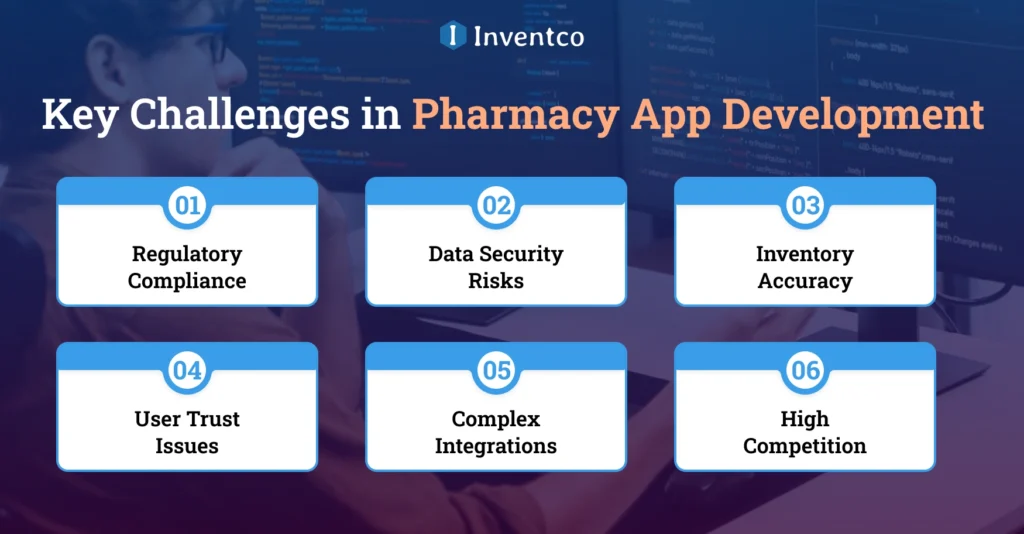
Pharmacy app development involves an intersection of complex digital environments, including technology, healthcare, and user expectations. Most startups overlook these challenges, and this leads to delays, compliance issues, or low user adoption. Defining these challenges early is necessary in order to develop a reliable and scalable product.
Regulatory Compliance
Challenge: Understanding healthcare regulations in different locations is time-consuming and increases the risk of facing legal issues.
Solution: Healthcare technology developers learn to integrate regulations into their designs from the start. They allow their clients to meet the requirements of HIPAA, GDPR, and country-specific laws for pharmacy products without compromising time and scalability.
Data Security Risks
Challenge: If pharmacy apps contain private customer data, they become targets of data breaches.
Solution: Maintain data integrity and sustain users’ confidence by using encryption and secure methods of authentication. This may include frequent checks and updates to prevent these breaches.
Inventory Accuracy
Challenge: Failure to meet customers’ expectations and to provide patients with their needs is derived from pharmacy apps’ problems with inventory.
Solution: With a pharmacy’s database and a fully integrated pharmacy app, order fulfillment may be easily achieved by providing the stock needed.
User Trust Issues
Challenge: For pharmacy apps to become widely used, they need to be credible.
Solution: If pharmacy customers are to use the app, pharmacy apps should provide verified pharmacies, simplified workflows for customers, and prescription reviews.
Complex Integrations
Challenge: Pharmacy apps become increasingly complicated and confusing as they need to integrate payment options, EHRs, logistics, and third-party APIs.
Solution: These complexities demand the use of modular design with integrated, scalable APIs, where pharmacy apps’ core functionalities can be altered without affecting the rest of the design.
High Competition
Challenge: With competition increasing in the ePharmacy sector, different strategies are needed in order to stand out.
Solution: Focus on User Experience, niche targeting, and value-added services (e.g. teleconsultation, AI-driven personalizations) to gain a competitive advantage.
These challenges represent mobile application development challenges in healthcare, where compliance, performance, and user-centered design are needed to achieve success. A clear and structured approach to problem-solving will make your platform functional, scalable, secure, and ready for the market.
Monetization Models for Your Pharmacy App
When developing your pharmacy app, keep monetization in mind as a scalable revenue framework instead of an afterthought. With your business goals and market positioning in mind, an ideal model would focus on profit, how much your customers can afford, and the value of your platform.
1. Commission on Orders
Get paid for every completed transaction on your pharmacy app. This model of revenue generation is ideal for pharmacy aggregation apps, as revenue can easily scale upwards as the number of orders increases.
2. Subscription Plans
Members can be offered priority service, free delivery, and medicine discounts among other benefits. This model creates a stream of revenue that can be counted on repeatedly and can also reduce customer churn.
3. Featured Pharmacy Listings
In the app, allow pharmacies to pay to appear higher in the rankings. This can especially be a good strategy in highly competitive markets, as good visibility can lead to more sales.
4. Delivery Charges
To help with sustaining delivery services, a convenience or logistics fee can be charged to customers. This monetization strategy should be done with operational delivery costs in mind.
5. Teleconsultation Fees
Charge customers for consultations with a doctor or pharmacist in order to increase revenue with a service that is a part of a healthcare platform.
6. In-App Advertising
Allow promotional ads for pharmacy or healthcare products and services. If done right, users will not be disrupted, and additional revenue can be generated.
A pharmacy app that is designed for effective app monetization strategies will have a sustainable revenue stream for the long haul and will have the potential for more growth in the future.
Businesses are also expanding into specialized solutions, such as developing a mental health app and creating more personalized and preventive healthcare experiences.
How Inventco Helps Build a Pharmacy App?
As a strategic technology partner, Inventco is a trusted medicine delivery app development company helping healthcare businesses build secure, scalable, and compliant digital platforms. We go beyond development by aligning product strategy, regulatory requirements, operational efficiency, and user experience with your business goals.
Our approach combines healthcare expertise with modern technology to create reliable medicine delivery applications that streamline operations, improve accessibility, enhance customer experiences, and deliver measurable long-term ROI.
An example is the AI-Driven Cancer Detection App, Check My Mole. Inventco built the entire backend, frontend, testing, strategy, and UX/UI. The platform is engineered to assist cancer detection by using AI to analyze and study medical images (X-rays and MRIs) to detect cancer at an early stage and with a high degree of accuracy. This is an example of Inventco’s ability to create AI healthcare solutions that are clinically driven, where accuracy and AWS are extremely important.
The application uses predictive analytics and pattern recognition to analyze and process medical images (scans) to detect cancer and other malignancies. The application has the ability to generate reports to assist healthcare professionals in making timely decisions. The model is designed to improve and enhance diagnosis on an ongoing basis and has the ability to scale.
Inventco covers the entire process from app wireframing to application deployment and mobile app maintenance, services designed to ensure pharmacy apps are built from the ground up with compliance, security, and high-performance standards. This knowledge allows founders and investors to create and build healthcare applications with confidence and sustainable growth.

Conclusion
Pharmacy app development has evolved from a convenience-driven solution into a strategic investment shaping the future of digital healthcare delivery. As patient expectations shift toward faster, safer, and more accessible services, businesses must adopt technology that ensures reliability, compliance, and scalability.
For founders and investors, the real opportunity lies in building platforms that go beyond transactions and deliver trust-driven healthcare experiences. This means integrating secure systems, intelligent automation, and seamless user journeys that improve both patient outcomes and operational efficiency.
With the right strategy, a robust technology stack, and an experienced development partner, you can build a pharmacy app that meets regulatory standards while driving long-term user engagement, sustainable revenue growth, and strong market positioning. For long-term success, it is essential to partner with the right technology provider, making it important to understand why you should choose Inventco for healthcare app development.
FAQ’s
Q1. How long does it take to build a pharmacy app?
Ans. Building a pharmacy app typically takes between 3 to 9 months, depending on features, compliance requirements, integrations, and scalability needs. MVP versions launch faster, while advanced platforms require extended development, testing, and regulatory approvals.
Q2. Is pharmacy app development regulated?
Ans. Yes, pharmacy app development is highly regulated. It must comply with laws like HIPAA, GDPR, and local healthcare regulations, ensuring secure data handling, prescription validation, and patient privacy protection across all transactions and platform interactions.
Q3. Can I start with an MVP?
Ans. Yes, starting with an MVP mobile app is a strategic approach. It allows you to validate your business idea, test core features, gather user feedback, and optimize the product before investing in full-scale development and expansion.
Q4. What platforms should I target first?
Ans. Most businesses target both Android and iOS to maximize market reach and user acquisition. However, starting with one platform based on audience insights, budget, and timeline can help optimize app development costs and accelerate initial launch.
Q5. How to develop an app like Life Pharmacy?
Ans. To develop an app like Life Pharmacy, focus on seamless user experience, regulatory compliance, real-time order tracking, secure payments, strong logistics integration, and a scalable backend infrastructure that supports future growth and expansion.
Q6. What is the biggest challenge in pharmacy app development?
Ans. The biggest challenge in pharmacy app development is balancing strict regulatory compliance with a seamless user experience. Ensuring data security, prescription validation, and system scalability while maintaining usability requires careful planning and technical expertise.

Ajay Bhal
He is an on-demand app solutions expert with 11+ years of experience in business consulting and building scalable, user-centric digital products. He specializes in robust on-demand platforms across industries, combining technical expertise with business-focused strategy to deliver efficient, top notch solutions that drive growth and enhance user experience. You can connect with him on LinkedIn to follow insights.