As the healthcare industry continues to evolve, it is becoming significantly more intelligent, precise, and outcome-driven. From early diagnosis to continuous patient monitoring and personalized treatment plans, every layer of care is being enhanced through advanced technologies. At the center of this transformation are emerging AI trends in healthcare in 2026, redefining how modern medicine operates at scale.
Artificial intelligence is no longer a supporting tool, it is becoming a core clinical and operational asset. The latest AI in healthcare trends show how providers are leveraging data to improve diagnostic accuracy, predict patient risks earlier, and deliver highly individualized treatment pathways. This shift toward data-driven care is enabling faster decision-making while reducing variability in outcomes.
From AI-powered diagnostic systems that identify diseases with greater precision to predictive analytics that forecast health risks before they escalate, the future of AI in healthcare centers on proactive, preventive care. These innovations are not only improving efficiency but also enhancing clinical confidence and patient safety.
More importantly, these AI trends in healthcare are redefining the practice of medicine itself. Healthcare providers are moving toward a model where decisions are continuously informed by real-time data, advanced algorithms, and intelligent automation. As a result, the next wave of AI in healthcare leadership trends in 2026 will focus on scalability, interoperability, and the delivery of deeply personalized care experiences, efficiently and consistently across the entire healthcare ecosystem.
Key Takeaways
- AI in healthcare is driving a shift toward proactive, preventive, and data-driven care models.
- Advanced technologies such as ML and NLP are improving diagnostic accuracy and accelerating clinical decision-making.
- Predictive analytics enables early disease detection, reducing risks, hospitalizations, and overall healthcare costs.
- AI-powered tools enhance patient engagement through virtual assistants, telemedicine, and remote monitoring solutions.
- Personalized treatment plans powered by AI improve patient outcomes and reduce inefficiencies in care delivery.
- Automating administrative tasks boosts operational efficiency and enables providers to focus on patient care.
- The future of AI in healthcare will prioritize scalability, interoperability, and consistent, high-quality care delivery.
Market Stats: AI in Healthcare
- The global AI in healthcare market is projected to reach $56 billion in 2026, growing rapidly from ~$39 billion in 2025.
- By 2034, the market is expected to surpass $1 trillion, reflecting explosive long-term growth potential.
- Another estimate suggests the market could hit $505 billion by 2033, driven by rising demand for efficiency and personalized care.
- In the U.S. alone, AI in healthcare is projected to grow from $14 billion (2025) to over $446 billion by 2035.
Current Landscape of AI in Healthcare
The current landscape of AI in healthcare is evolving rapidly, driven by advancements in machine learning (ML), natural language processing (NLP), and advanced analytics. Healthcare providers are increasingly integrating AI to streamline administrative workflows, enhance clinical decision-making, and deliver more personalized patient care at scale.
Today, AI is no longer limited to experimentation, it is actively transforming core healthcare functions. From predictive analytics that identify disease risks early to intelligent systems that support personalized treatment planning, AI is enabling a shift toward proactive and data-driven care models.
By processing vast volumes of structured and unstructured data, AI systems can uncover patterns, generate actionable insights, and support faster, more accurate clinical decisions. This makes AI a critical component of modern healthcare infrastructure rather than an optional innovation.
As adoption accelerates, AI is reshaping how healthcare is delivered, improving operational efficiency, reducing clinical variability, and driving better patient outcomes across the ecosystem.
Top AI Trends Powering Next-Gen Healthcare Solutions
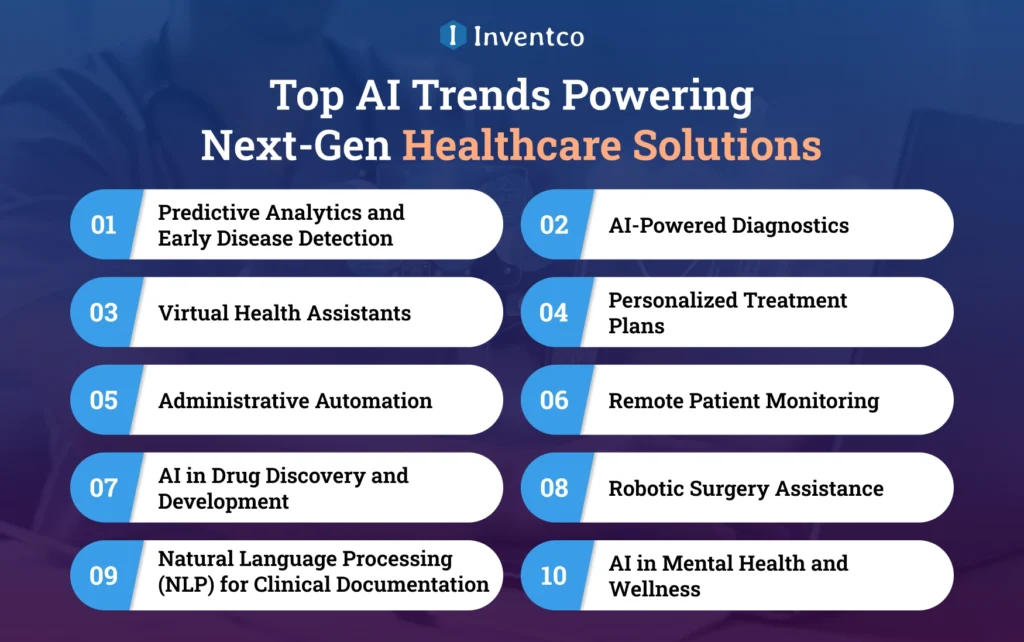
Artificial Intelligence is transforming the healthcare industry with smarter systems that provide more efficient patient care and reduce hospital operating costs.
Below are the top 10 AI trends in healthcare that will continue to fuel growth and innovation in 2026 and beyond:
1. Predictive Analytics and Early Disease Detection
AI algorithms learn from massive datasets to identify patterns and forecast possible health issues before they turn severe. This forward-looking approach enables preventive measures that benefit patients while reducing healthcare costs.
2. AI-Powered Diagnostics
ML models are trained to read medical images such as X-rays, MRIs, and CT scans with high accuracy, comparable to that of radiologists with decades of experience. This improves diagnostic accuracy, accelerates treatment decisions, and reduces human error.
3. Virtual Health Assistants
AI chatbots and virtual assistants enable patients to access medical information, schedule appointments, and receive medication reminders 24/7. This leads to enhanced patient engagement, satisfaction, and compliance with treatment schedules.
4. Personalized Treatment Plans
AI has the potential to sift through patient data, medical history, genetics, and lifestyle to make highly personalized treatment recommendations. This results in more efficient care and improved patient outcomes.
5. Administrative Automation
AI is increasingly automating repeatable administrative duties, from medical billing and coding to scheduling and inventory management. This relieves hospital staff of the workload and enables them to concentrate on patient care.
6. Remote Patient Monitoring
With AI-powered wearable devices, you can track vital signs and send alerts to clinicians when certain parameters are abnormal. This allows preventive interventions and ongoing care, such as for patients with chronic diseases.
7. AI in Drug Discovery and Development
AI accelerates drug discovery by forecasting how molecules will behave and simulating outcomes, thereby cutting development time, reducing costs, and getting effective new drugs into patients’ hands more rapidly.
8. Robotic Surgery Assistance
AI-driven surgical robots enhance surgeons’ accuracy and control during procedures, reduce errors, and shorten patient recovery times, contributing to safer, faster surgeries.
9. Natural Language Processing (NLP) for Clinical Documentation
AI-powered NLP tools analyze unstructured medical records, identifying key nuggets of information that can help streamline documentation and reduce errors, enabling clinicians to make better, well-informed decisions supported by data for optimal patient care and operational efficiency.
10. AI in Mental Health and Wellness
AI-powered mental health app solutions are transforming diagnoses and treatment by analyzing patient mindset, speech patterns, data, and behavior to deliver personalized therapy recommendations and virtual counseling.
These trends further emphasize that healthcare app ideas are not a far-off idea, but rather a reality today that’s changing patient care, operational efficiency, and shifting how doctors practice.
How Healthcare Providers are Adopting AI?
AI is gaining popularity in the healthcare industry and is being applied to individual applications, thereby changing how patients are treated and how treatment resources are managed.
- Clinical Decision Support: AI systems help physicians by processing large volumes of medical data and suggesting evidence-based treatment options. This enables medical professionals to make better decisions, resulting in more precise diagnoses and therapies.
- Operational Efficiency: AI also enhances hospital operations, including supply chain management, staff scheduling, and patient flow optimization. AI also makes operations run more smoothly at healthcare facilities by automating repetitive tasks and forecasting resource requirements.
- Patient Monitoring: Wearable devices use AI to monitor patients’ vital signs in real time and send alerts to healthcare providers if any anomalies are detected. This early preventive care helps prevent complications, especially for those suffering from ongoing conditions.
- Telemedicine: Remote consultation services are revolutionized by AI, enabling virtual consultations, facilitating remote patient monitoring, and supporting personalized treatment recommendations, all to make healthcare more accessible, efficient, and customer-oriented.
Benefits of Leveraging AI in Healthcare
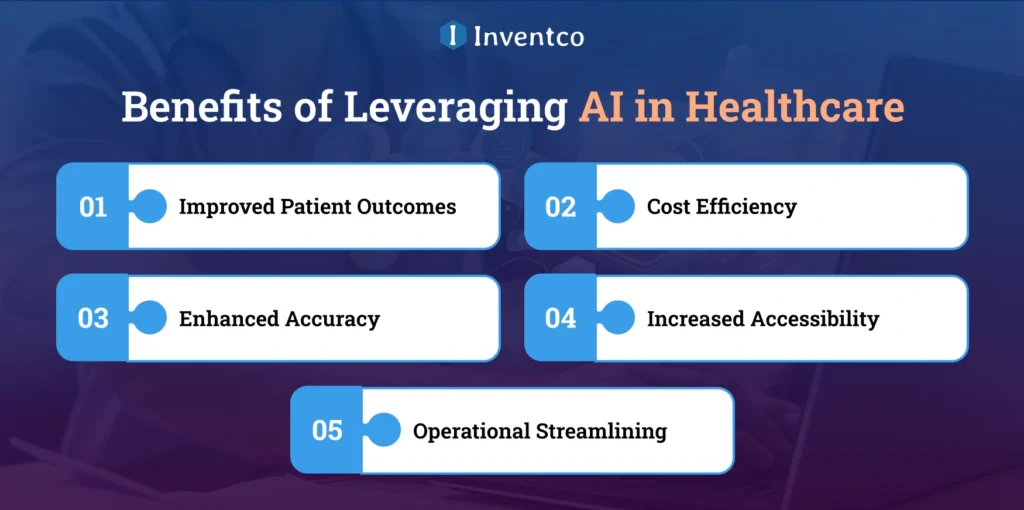
AI is revolutionizing healthcare through a variety of applications that enhance patient care and streamline operations.
- Improved Patient Outcomes: AI can help detect diseases early and provide personalized treatment plans suited to an individual’s unique health conditions. This preventative management plan improves recovery rates and other health outcomes.
- Cost Efficiency: As AI in healthcare comes to take care of administrative processes like billing, scheduling, and record-keeping on its own, AI also reduces operational costs and allows healthcare facilities to allocate resources more effectively.
- Enhanced Accuracy: With advanced machine learning, AI solutions can rapidly process massive datasets to identify clinical trends and generate insights that enhance diagnostic accuracy and support better treatment decisions.
- Increased Accessibility: AI-based solutions such as telemedicine and virtual health assistants are making healthcare services more accessible in resource-constrained or remote areas.
- Operational Streamlining: By reducing repetitive day-to-day tasks, care providers are better able to focus on direct patient engagement, resulting in greater efficiency and satisfaction for both providers and patients.
Overall, these advancements clearly highlight the benefits of AI in Healthcare, making it a transformative force in modern medical systems.
Challenges and Limitations of AI in Healthcare
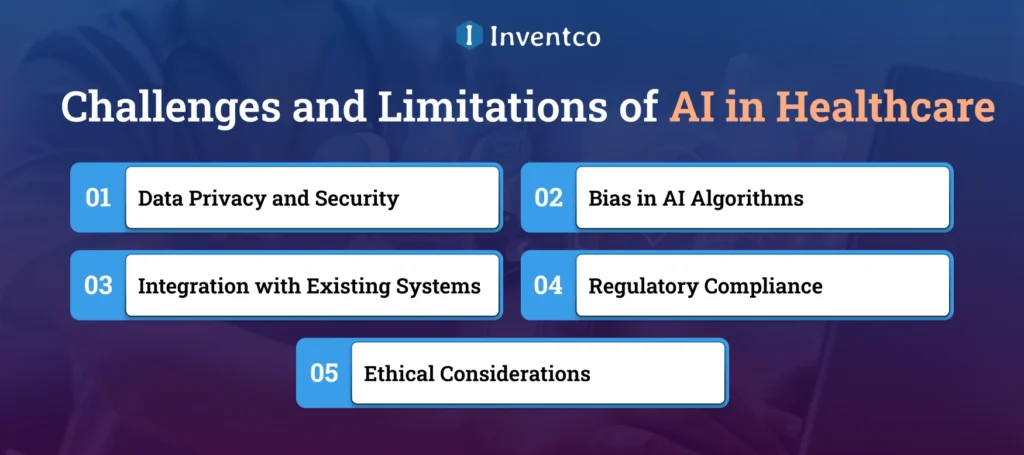
AI promises many advantages and also poses many challenges in its application in the healthcare domain.
- Data Privacy and Security: Safeguarding sensitive patient data is vital. AI platforms must meet stringent guidelines, such as HIPAA compliance, to protect data privacy and prevent breaches.
- Bias in AI Algorithms: Algorithms that are biased or trained on incomplete data can result in unfair healthcare distribution and disproportionately affect some users, consequently eroding trust in AI technologies as a whole.
- Integration with Existing Systems: Most healthcare setups use legacy systems. It can be challenging to integrate AI into these infrastructures: it’s a significant investment, requires careful evaluation, and must interoperate seamlessly.
- Regulatory Compliance: Adhering to regulations in an ever-evolving environment for AI utilization in healthcare is difficult, as providers must meet stringent safety and efficacy criteria.
- Ethical Considerations: Ensuring AI decisions are consistent with ethical principles, patient trust, and human oversight should underpin the responsible deployment of algorithms.
Future Outlook: Emerging AI Trends
Looking ahead, several AI trends are set to transform healthcare, making it smarter, faster, and more efficient.
- Generative AI: It is used to develop realistic synthetic medical data, enabling better-trained AI models and more accurate simulation of treatment outcomes, speeding research and improving predictive accuracy.
- AI-Driven Drug Discovery: AI algorithms are revolutionizing pharmaceutical development by predicting molecules, identifying potential treatments, and shortening the time-to-market for new medications. AI is now transforming pharmaceuticals.
- Robotic Process Automation (RPA): AI-driven RPA automates end-to-end complex administrative processes, minimizing errors and saving time across hospitals and clinics.
- AI in Mental Health: AI is helping diagnose mental health conditions, recommend personalized treatments, and provide virtual support for patients and their care teams.
- Edge Computing: AI processing at the edge enables real-time patient data analysis, supporting remote monitoring and faster clinical decision-making to improve care outcomes.
How Inventco Delivers AI-Driven Healthcare Solutions?
Inventco is a leading healthcare app development company that has built AI capabilities through actual healthcare expertise. Inventco wants to solve challenges in the healthcare industry, including delayed diagnosis, operational inefficiencies, and the redesign of personalized care through scalable, data-driven systems.
Inventco provides healthcare systems with AI across significant areas, including predictive analytics, intelligent automation, and personalized treatment planning. Inventco’s solutions improve clinical accuracy, enhance workflow efficiency, and improve the quality of patient outcomes.
Real-World Proof: AI Cancer Detection Application
A clear example of Inventco’s expertise is Check My Mole, an AI-powered cancer-detection application designed to support early diagnosis and clinical decision-making.
This application leverages advanced machine learning algorithms to analyze medical images such as X-rays, MRIs, and CT scans. By identifying patterns and abnormalities with high precision, it helps healthcare professionals detect cancer at an early stage, when treatment outcomes are significantly better.
The platform processes patient scan data in real time, compares it with large medical datasets, and generates risk assessments to support faster and more informed decisions. Its predictive capabilities also help assess potential disease progression and enable more personalized treatment strategies.
Beyond diagnostics, the solution seamlessly integrates with telemedicine ecosystems, enabling patients to connect with specialists remotely while giving clinicians access to AI-backed insights alongside traditional evaluation methods.
Driving Measurable Impact
By combining deep healthcare domain understanding with advanced AI capabilities, Inventco delivers solutions that:
- Diagnostics and early-stage disease detection
- Intelligent automation to decrease operational burdens
- Rapid clinical decision-making supported by data
- Scalable and personalized care models for patients
Inventco is a technology partner to the healthcare industry, offering pioneering artificial intelligence solutions that create value in the healthcare ecosystem without the guesswork.

Conclusion
Artificial intelligence is reshaping healthcare by enabling more precise diagnostics, proactive care, and streamlined operations. From predictive analytics to personalized treatment strategies, AI is helping providers move toward a more data-driven and patient-centric model. These advancements are not only improving clinical outcomes but also enhancing efficiency and reducing the overall cost of care.
As adoption continues to accelerate, the future of healthcare will be defined by intelligent systems that support faster decisions, early interventions, and scalable care delivery. Organizations that embrace AI-driven innovation will be better positioned to adapt to evolving patient needs and industry demands. Ultimately, the integration of AI is not just transforming processes, it is redefining how care is delivered, experienced, and optimized across the healthcare ecosystem.
FAQs
Q1. What are the primary benefits of AI in healthcare?
Ans. AI enhances patient outcomes through early detection, personalizes treatment plans, improves diagnostic accuracy, reduces healthcare costs, and streamlines administrative tasks.
Q2. How is AI being used in diagnostics?
Ans. AI algorithms analyze medical images and patient data to assist in diagnosing conditions with high accuracy, often identifying issues that may be missed by human clinicians.
Q3. What challenges does AI face in healthcare?
Ans. Challenges include data privacy concerns, algorithmic bias, integration with existing systems, regulatory hurdles, and ethical considerations.
Q4. What are some emerging AI trends in healthcare?
Ans. Emerging trends include generative AI, AI-driven drug discovery, robotic process automation, AI in mental health, and edge computing for real-time data analysis.
Q5. How can healthcare providers implement AI solutions?
Ans. Healthcare providers can implement AI by partnering with experienced technology providers, investing in training for staff, and ensuring compliance with regulatory standards.

Ajay Bhal
He is an on-demand app solutions expert with 11+ years of experience in business consulting and building scalable, user-centric digital products. He specializes in robust on-demand platforms across industries, combining technical expertise with business-focused strategy to deliver efficient, top notch solutions that drive growth and enhance user experience. You can connect with him on LinkedIn to follow insights.