The healthcare industry is one of the most important sectors in the modern economy. Today’s technology trends, such as AI, scalable computing, and networks beyond the internet, are driving foundational changes in healthcare. AI is becoming the core of the new technological infrastructure of the healthcare system. When Gen AI is integrated into the system, it allows the healthcare system to provide quicker, more precise, and outcome-based care to the masses.
AI is changing how clinical decisions are made. AI is penetrating every aspect of healthcare operations, including early detection of diseases, monitoring diseases, and providing real-time feedback. In the 2026 healthcare system, healthcare operations will no longer be conducted in the traditional clinical operational model. Rather, intelligent systems will be deployed to analyze patient and system data in real time, thereby improving the effectiveness of the healthcare app development system.
AI enables healthcare institutions to move from a completely reactive model to one that is predictive and proactive. AI technology is transforming healthcare from a reactive model to a fully predictive system. AI allows and empowers the medical staff to identify risks sooner.
Healthcare providers, startups, and institutions will be able to leverage AI technology beyond a technology spend to an integral component of their operations. This blog will highlight the key benefits of AI-driven healthcare and the trends shaping its future.
Key Takeaways
- AI simplifies diagnosis and speeds up the process by evaluating complex medical data at staggering speeds.
- Predictive analytics enable healthcare professionals to anticipate risks and implement strategies to prevent problems for patients.
- Custom treatment plans yield better results due to real-time health info, patient data, and genetics.
- AI technology streamlines systems and automates administrative tasks, improving overall productivity while allowing professionals to attend to patients.
- Proactive healthcare supports long-term patient engagement by enabling early detection and better outcomes through continuous monitoring.
- Optimized data management, coupled with advanced cybersecurity, enables healthcare professionals to securely, compliantly, and reliably manage sensitive data.
- AI technology enhances healthcare systems, making them more efficient and sustainable in delivering high-quality patient care worldwide.
AI in Healthcare Market Report: Growth Drivers, Size, and Future Trends
- The global AI in healthcare market is estimated at $50–56 billion in 2026, reflecting rapid enterprise adoption across care delivery systems.
- Some projections indicate the market could reach $61.2 billion by 2026, driven by growth in diagnostics and remote monitoring solutions.
- By 2030, the AI healthcare market is forecast to exceed $110 billion, driven by the adoption of clinical automation and predictive analytics.
- The generative AI healthcare segment alone is projected to reach $4.7 billion in 2026, expanding rapidly in clinical documentation and research.
How Is AI Revolutionizing the Healthcare Industry?
AI has changed how patients are treated and diagnosed. In a fraction of the time it would take a doctor, AI can do this with big data. It can sift through data, images, and lab results. It’s valuable for patient histories as well.
What are the main advantages of AI in the healthcare sector?
- Improved Decision Making: AI helps a medical professional choose a specific treatment plan. This is achieved by recognizing patterns in the disease data.
- Enhanced Operational Effectiveness: AI systems are being used by healthcare institutions to streamline administrative tasks, reduce errors, and improve workflow.
- Early Predictive Analytics: Predictive analytics can identify an individual or population’s risk and take preventive measures before the risk escalates.
All of these positive aspects of AI in the healthcare sector are verifiably true. AI enhances diagnosis and treatment planning, patient monitoring, and data management, which allows smarter, quicker, and more efficient healthcare systems.
Top Benefits of AI in Healthcare You Should Know
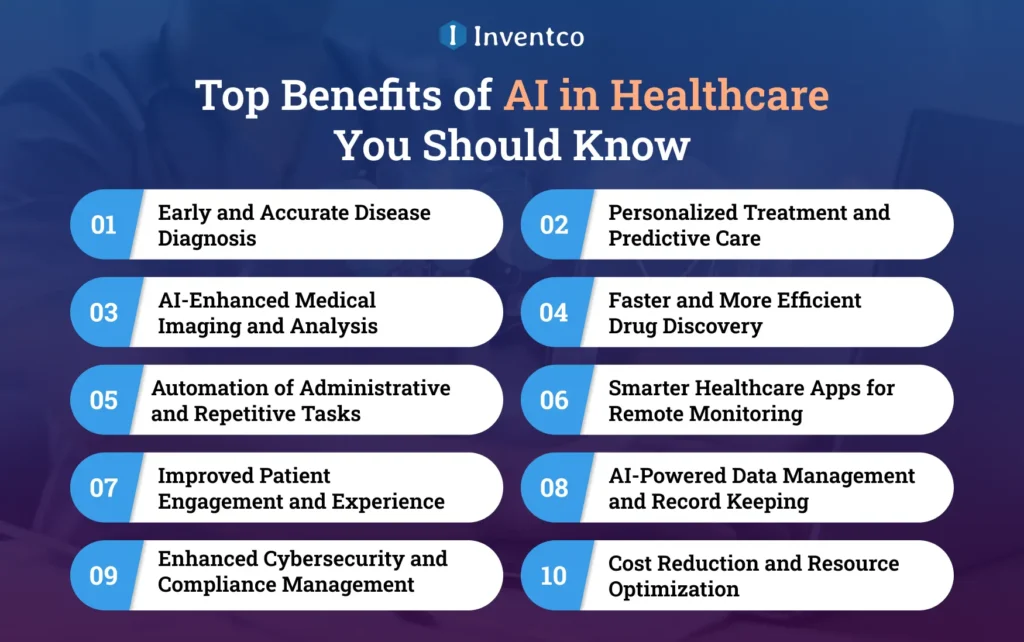
Healthcare systems, applications, and software use AI in multiple ways and here are some examples of the benefits:
1. Early and Accurate Disease Diagnosis
AI technology can identify and diagnose illnesses such as heart problems, neurological disorders, and certain types of cancer in their earliest stages. Improved survival rates and prompt treatment are due to extensive medical datasets and relatively quick AI analysis. This is what AI has to offer the healthcare industry.
2. Personalized Treatment and Predictive Care
AI and the subfield of machine learning can analyze a patient’s past history and current lifestyle to predict future treatment plans. The predictive models developed can identify an upcoming complication and adjust therapies to improve the outcome. Predictive models and personalized treatment plans are what AI offers the healthcare industry.
3. AI-Enhanced Medical Imaging and Analysis
Compared with humans, AI and other imaging technologies can evaluate an individual and analyze their X-ray, MRI, and CT scans much more quickly. In the middle stages of diagnosis, identifiable patterns are detected in diseases. This type of technology is advancing the healthcare industry.
4. Faster and More Efficient Drug Discovery
AI can predict how effective a drug will be and what potential side effects it may have. With these capabilities, AI can reduce the number of trial failures, and with many drugs yielding the same outcome, fewer alternatives can reduce time and costs in development. This is what technology has to offer the healthcare industry.
5. Automation of Administrative and Repetitive Tasks
Automation is used to schedule and bill patients, as well as generate medical documentation, reducing repetitive tasks and human error. Automation allows medical staff to spend more time attending to patients. When documentation is automated, clinician-patient time is improved because time spent documenting is reduced and spent more efficiently.
6. Smarter Healthcare Apps for Remote Monitoring
Mobile health applications and remote sensing devices use AI to monitor health status and identify changes in trends and values. These applications and devices are designed to monitor health and alert clinicians when intervention is needed. These applications and devices use Gen AI to monitor health status, facilitate proactive healthcare, and support long-term health status.
7. Improved Patient Engagement and Experience
AI Chatbots and other automated Virtual Health Assistants are now available to offer support and are programmed to provide reminders and guide patients through their healthcare journeys, delivering timely answers and updates. This automation boosts satisfaction and adherence to treatment. AI in health services offers greater access to care, faster care, and a greater focus on patients’ needs.
8. AI-Powered Data Management and Record Keeping
One of the benefits of AI in healthcare software development is its ability to manage large volumes of medical information. Efficient data management with AI improves data accuracy and accessibility. The depth of insights that result from well-organized data improves the quality of healthcare services.
9. Enhanced Cybersecurity and Compliance Management
AI can identify abnormal behavior in cloud-hosted applications to protect patient privacy and provide a layer of GDPR and HIPAA compliance for healthcare apps. By protecting health data in digital health applications and services, AI enhances operational trust and security, underscoring its importance in healthcare for managing secure, reliable medical data.
10. Cost Reduction and Resource Optimization
AI offers hospitals improvements in operational efficiency and resource allocation. With operational costs minimized, hospitals can utilize staff and equipment more effectively. The advances in AI use in healthcare demonstrate greater sustainability and higher-quality patient care, resulting in better patient outcomes.
AI in healthcare offers improved clinical precision, increased patient satisfaction, better turnaround time, and promotes sustainability and long-term improvements in healthcare.
Next-Gen Healthcare: AI Trends You Can’t Ignore
As technology evolves, the potential benefits of AI in healthcare are growing quickly, with upcoming AI trends in healthcare shaping patient care, medical research, and healthcare operations.
- Integration with Wearable Devices: AI-powered wearables monitor vital signs and chronic conditions in real time. They provide early alerts, enable proactive interventions, and support personalized care, improving outcomes and patient engagement across healthcare systems.
- Generative AI for Medical Research: It simulates molecular behavior, predicts drug interactions, and accelerates the design of new medications. By reducing research time and improving accuracy, it transforms pharmaceutical development and enhances the benefits of AI in healthcare.
- AI-Driven Virtual Health Assistants: Powered by AI, these virtual assistants offer personalized 24/7 support, answering patient questions, sending reminders, and guiding treatment. They increase accessibility, improve adherence, and enhance patient experience in modern healthcare systems.
- Predictive Healthcare Models: AI-driven predictive models forecast disease outbreaks, optimize hospital resources, and anticipate patient risks. These insights support preventive care, improve public health responses, and make healthcare systems more proactive and efficient.
- Ethical and Transparent AI: Healthcare AI must prioritize fairness, privacy, and accountability. Ethical frameworks ensure responsible decision-making, protect patient data, maintain trust, and maximize the benefits of AI in healthcare in a safe and responsible manner.
These advancements demonstrate that the benefits and challenges of AI in healthcare will continue to shape the way the industry operates, creating smarter, more efficient, and patient-centered healthcare solutions for the future.
Why Partner with Inventco for AI-Driven Healthcare Solutions?
At Inventco, AI is not treated as an add-on, it is engineered as a core capability that drives measurable clinical and operational outcomes. With deep expertise in healthcare systems, regulatory compliance, and scalable architecture, the team delivers tailored AI solutions that align with real-world clinical workflows, ensuring reliability, security, and long-term value.
Inventco designs and develops intelligent healthcare applications, predictive analytics platforms, and data-driven ecosystems that transform fragmented medical data into actionable insights. Each solution is built with a focus on accuracy, interoperability, and compliance, enabling hospitals, clinics, and digital health startups to enhance decision-making, optimize operations, and improve patient outcomes at scale.
A strong example is Check My Mole, an AI-powered cancer detection application developed by Inventco. The platform leverages advanced machine learning algorithms to analyze medical images, such as X-rays, MRIs, and CT scans, enabling high-precision early detection of abnormalities. Its real-time reporting and predictive capabilities support clinicians in making faster, data-backed diagnostic decisions.
By combining domain expertise, advanced AI engineering, and a proven delivery framework. Across strategy, UX/UI, backend, and testing, Inventco builds impact-driven solutions for predictive, personalized care.
Conclusion
Artificial Intelligence is rapidly redefining the healthcare landscape, enabling a shift from traditional, reactive care models to proactive and data-driven systems. From accelerating diagnosis to enhancing clinical accuracy and reducing operational costs, AI is driving measurable improvements across the entire care continuum, making it one of the most impactful technological advancements in modern medicine.
As AI capabilities continue to evolve, healthcare systems will become more connected, intelligent, and patient-centric. Advanced analytics, predictive insights, and real-time monitoring will empower providers to deliver more precise, personalized, and efficient care at scale, improving both patient outcomes and system performance.
For organizations looking to adopt future-ready healthcare solutions, embracing AI is no longer optional, it is a strategic necessity. Investing in secure, scalable, and compliant Gen AI technologies today will define the next generation of healthcare innovation and long-term success.
FAQ’s
Q1. What are the benefits of AI in healthcare?
Ans. AI enhances diagnostics, streamlines operations, personalizes treatment, and improves patient outcomes — all while reducing costs and errors.
Q2. What are the benefits of using AI in healthcare software?
Ans. It improves efficiency, automates workflows, enhances data management, and enables predictive healthcare through intelligent analytics.
Q3. How does AI impact healthcare apps?
Ans. AI powers virtual assistants, remote monitoring tools, and personalized wellness tracking — improving patient engagement and accessibility.
Q4. What are the benefits of generative AI in healthcare?
Ans. Generative AI accelerates medical research, drug discovery, and data analysis by generating accurate models and simulations faster than ever.
Q5. Why should healthcare companies partner with Inventco?
Ans. Inventco specializes in AI healthcare innovation, offering tailored solutions that combine data intelligence, compliance, and scalability for long-term success.

Ajay Bhal
He is an on-demand app solutions expert with 11+ years of experience in business consulting and building scalable, user-centric digital products. He specializes in robust on-demand platforms across industries, combining technical expertise with business-focused strategy to deliver efficient, top notch solutions that drive growth and enhance user experience. You can connect with him on LinkedIn to follow insights.