The global mobile app market is projected to reach $756 billion by 2027, driven by an accelerating shift toward digital-first consumer experiences. Yet one of the most persistent challenges businesses face when entering the mobile landscape is this: how do you deliver a fast, app-like experience without the time, cost, and distribution barriers of building a traditional native app?
This is where a progressive web app, or PWA, changes the equation entirely. Enterprises across retail, healthcare, logistics, and fintech are increasingly turning to PWA development as a cost-efficient, high-performance alternative to native mobile apps. PWA development costs typically range from $10,000 to $70,000, depending on complexity. It represents a significantly more accessible investment than native app development, which can run upward of $100,000 for a dual-platform build.
In this guide, we break down everything founders and investors need to know about what a progressive web app is, how it works, its key features and real-world examples, the business benefits it delivers, and how to determine whether a PWA is the right strategic move for your organization.
Key Takeaways
- PWAs combine the best of web and mobile app experiences for businesses.
- A progressive web app works offline, loads fast, and always feels native.
- PWA development cost is significantly lower than building native mobile apps.
- Major brands like Twitter, Starbucks, and Pinterest have successfully deployed PWAs.
- Service workers enable offline access and push notifications in PWAs.
- PWAs are indexed by Google, giving them a distinct SEO and discoverability edge.
- Choosing a PWA can significantly reduce your digital product’s time-to-market.
Global Market Stats for PWA
The numbers around Progressive Web Apps (PWAs) reveal why businesses across retail, SaaS, healthcare, fintech, and eCommerce are rapidly adopting this technology to improve mobile performance, engagement, and cost efficiency.
Here are some of the most credible and widely referenced PWA market statistics businesses should know before investing in development:
- The global Progressive Web Apps market was valued at approximately $2.08 billion in 2024 and is projected to reach $21.24 billion by 2033, growing at a CAGR of nearly 29.9%.
- The global market for Progressive Web Apps, estimated at US$1.9 billion in the year 2025, is expected to reach US$14.2 billion by 2032, growing at a CAGR of 33.0% over the analysis period 2025-2032.
- Pinterest reported a 60% increase in core engagement, a 40% increase in time spent, and a 44% rise in ad revenue after rebuilding its mobile experience as a Progressive Web App.
What Is a Progressive Web App (PWA)?
A progressive web app (PWA) is a type of web application built using standard web technologies, HTML, CSS, and JavaScript, that delivers a native app-like experience directly through the browser. Unlike traditional websites, PWAs can work offline, send push notifications, load in under two seconds, and even be added to a user’s home screen, all without requiring a download from an app store.
A progressive web app (PWA) is a type of web app built using standard web technologies, HTML, CSS, and JavaScript.
The concept was first introduced by Google engineers Alex Russell and Frances Berriman in 2015. The idea was simple but transformative: take the best features of native mobile apps, speed, reliability, and engagement, and deliver them through the open web.
At the technical core of every PWA are three foundational elements
- Service Workers: Background scripts that enable offline functionality, caching, and push notifications.
- Web App Manifest: A JSON configuration file that defines how the app appears on a user’s home screen, including name, icon, and display mode.
- HTTPS: PWAs require a secure connection to ensure data integrity and user trust.
Think of a PWA as a bridge between a website and a mobile app. It is discoverable like a website, installable like an app, and performant like a native product, making it an exceptionally efficient delivery vehicle for digital experiences.
Key Features of Progressive Web Apps
Understanding what makes a PWA different from a standard website or a native app requires looking at its defining feature set.
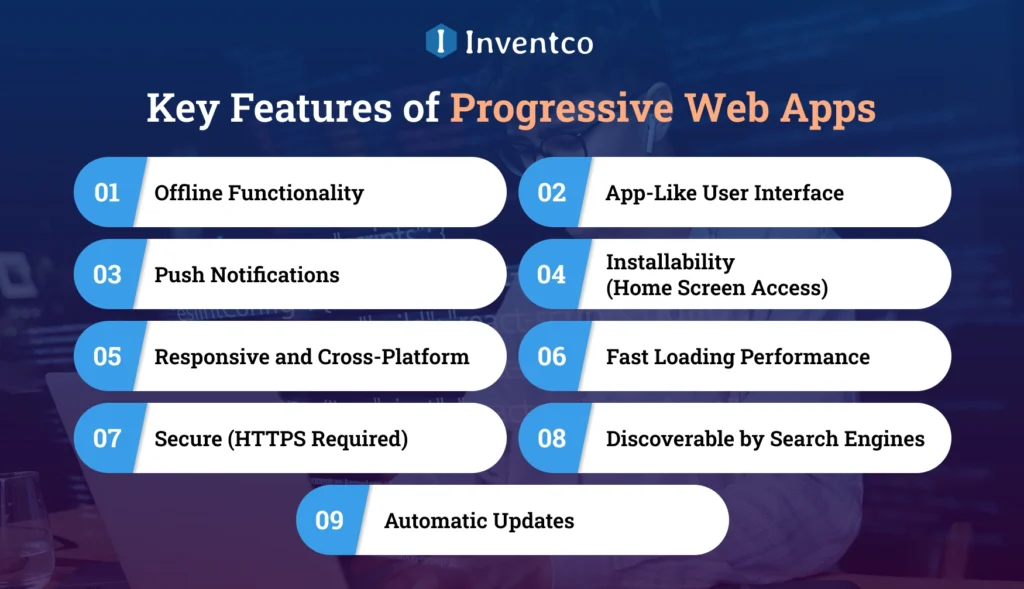
Here are the core progressive web app features that set this technology apart:
1. Offline Functionality
Service workers allow PWAs to cache critical assets and content, enabling the application to function even without an internet connection. For businesses in logistics, healthcare, or field operations, this capability alone can be a significant operational advantage.
2. App-Like User Interface
PWAs load in full-screen mode, eliminating browser chrome, and deliver a fluid, responsive interface that mirrors the look and feel of a native mobile app. Transitions, animations, and layouts are designed to match native UX conventions.
3. Push Notifications
One of the most commercially valuable features of a progressive web app is the ability to send push notifications to users, even when the app is not actively open. This enables re-engagement campaigns, real-time alerts, and personalized communication capabilities traditionally reserved for native apps.
4. Installability (Home Screen Access)
Users can add a PWA to their device’s home screen directly from the browser, bypassing app store friction entirely. This install-without-installing experience significantly reduces the barrier to adoption.
5. Responsive and Cross-Platform
PWAs are built to work seamlessly across all devices, desktop, tablet, and mobile, and all major browsers. A single codebase serves all platforms, reducing development overhead substantially.
6. Fast Loading Performance
PWAs use intelligent caching strategies via service workers to deliver near-instant load times. Google’s Core Web Vitals, which directly impact search rankings, are significantly easier to meet with a PWA architecture.
7. Secure (HTTPS Required)
All PWAs operate over HTTPS, ensuring encrypted data transmission. For industries like healthcare and fintech, this is a non-negotiable foundation for trust and compliance.
8. Discoverable by Search Engines
Unlike native apps locked inside app stores, PWAs live on the web and are fully indexable by search engines. This gives businesses a significant advantage in organic visibility, user acquisition, and long-term cost efficiency.
9. Automatic Updates
PWAs update silently in the background. Users always access the latest version without manual app store updates, removing a persistent friction point in the native app experience.
Examples of Progressive Web Apps
The best way to understand the commercial viability of a PWA is to look at how leading global brands have deployed them and the measurable results they achieved.
| Brand | Industry | PWA Result |
| X Corp. | Social Media | Achieved a 65% increase in pages per session, reduced bounce rates by 20%, and lowered data consumption by nearly 70% after launching its Progressive Web App experience. |
| Starbucks | Retail / F&B | Reported 2x growth in daily active users while delivering a web app experience significantly smaller than its native mobile application, improving accessibility for low-bandwidth users. |
| Social / E-Commerce | Generated a 60% increase in core user engagements and boosted mobile ad revenue by 44% after rebuilding its platform as a PWA. | |
| Uber Technologies | Mobility / Tech | Developed a lightweight Progressive Web App capable of loading the core booking interface in under 3 seconds, even on 2G networks, improving accessibility in emerging markets. |
| Forbes | Media / Publishing | Improved user engagement with 2x higher scroll depth and achieved nearly 6x better conversion rates compared to its previous mobile experience. |
| Alibaba Group | E-Commerc | Increased conversions for new users by 104% across all browsers, demonstrating the impact of faster mobile commerce experiences through PWA adoption. |
These progressive web app examples span industries and geographies, reinforcing that PWAs are not a niche technology; they are proven enterprise-grade solutions with documented ROI.
Benefits of Progressive Web Apps
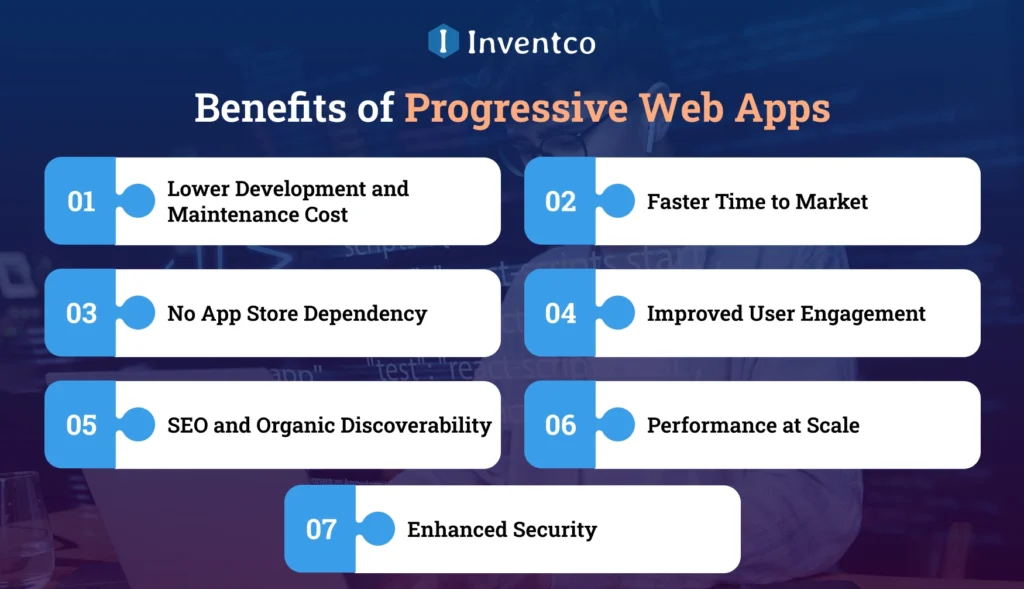
For founders and investors evaluating their digital product strategy, the advantages of progressive web apps are both technical and commercial.
1. Lower Development and Maintenance Cost
A single codebase replaces separate iOS, Android, and web builds. This directly translates into reduced engineering hours, fewer QA cycles, and significantly lower maintenance overhead over time.
2. Faster Time to Market
Without the constraints of app store approval processes, PWAs can be deployed and updated in real time, enabling businesses to launch faster, iterate efficiently, and respond to market feedback without delays.
3. No App Store Dependency
App store policies, review timelines, and 15–30% commission structures are eliminated. Businesses retain full control over distribution, updates, and app monetization.
4. Improved User Engagement
Push notifications, offline access, and home screen installability drive higher session frequency and deeper engagement, metrics that directly impact revenue and retention.
5. SEO and Organic Discoverability
PWAs are indexed by search engines, making them searchable and shareable in ways native apps are not. For growth-stage companies with limited marketing budgets, this is a meaningful acquisition channel.
6. Performance at Scale
Fast load times and a lightweight architecture improve the user experience in low-bandwidth environments, expanding a product’s addressable market to include emerging markets and underserved demographics.
7. Enhanced Security
Built-in HTTPS security and seamless background updates help minimize exposure to evolving cybersecurity threats while supporting regulatory compliance.
How to Build a Progressive Web App?
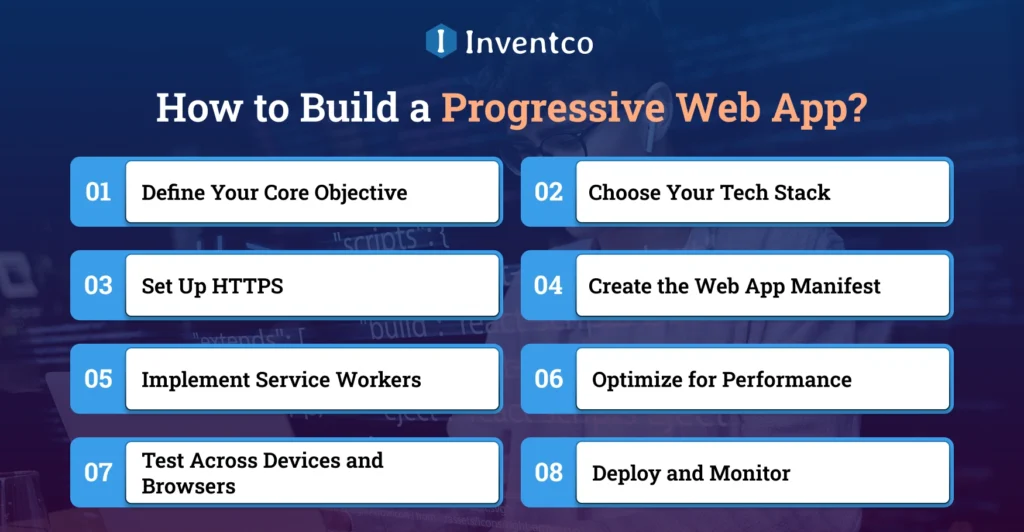
Building a PWA follows a structured development process. Here is a high-level overview of the steps involved:
1. Define Your Core Objective
Start by identifying the primary purpose of your Progressive Web App. Whether you are building an eCommerce storefront, SaaS dashboard, enterprise workflow platform, or customer engagement solution, your business objective directly influences architecture planning, feature prioritization, scalability requirements, user experience strategy, and long-term technology decisions throughout development.
2. Choose Your Tech Stack
Select a frontend framework and backend architecture that align with your performance goals, scalability expectations, and internal development expertise. Popular PWA frameworks include React, Angular, and Vue.js. The right technology stack improves maintainability, accelerates development timelines, supports responsive experiences, and ensures long-term flexibility for future upgrades.
3. Set Up HTTPS
Secure your Progressive Web App using HTTPS with a valid SSL/TLS certificate before implementing advanced PWA features. HTTPS is mandatory for service workers, secure data exchange, offline functionality, and browser trust. A secure environment also improves compliance readiness, strengthens cybersecurity, and builds user confidence across devices and platforms.
4. Create the Web App Manifest
Configure a web app manifest file that defines critical application metadata, including the app name, icons, theme colors, orientation, start URL, and display preferences. The manifest controls how the PWA appears when installed on mobile devices, enabling a seamless app-like experience for end users.
5. Implement Service Workers
Develop service workers to manage offline access, background synchronization, push notifications, and intelligent caching strategies within your Progressive Web App. Service workers operate independently from the browser, improving reliability and performance. Tools like Google Workbox simplify implementation while helping developers create scalable, responsive, and resilient PWA experiences efficiently.
6. Optimize for Performance
Enhance application performance and responsiveness with lazy loading, image optimization, code splitting, browser caching, and asset compression. High-performing PWAs improve search visibility, user retention, and engagement metrics. Use Lighthouse and Core Web Vitals auditing tools regularly to identify bottlenecks and consistently maintain enterprise-grade performance standards.
7. Test Across Devices and Browsers
Validate your Progressive Web App across multiple browsers, operating systems, and device types to ensure consistent functionality and user experience. Test compatibility across Chrome, Edge, Firefox, and Safari, including Android and iOS. Comprehensive app testing minimizes performance inconsistencies, installation issues, and cross-platform usability challenges before launch.
8. Deploy and Monitor
After deployment, continuously monitor your Progressive Web App’s performance, uptime, Core Web Vitals, engagement metrics, and crash reports using advanced analytics and monitoring platforms. Real-time performance insights help businesses identify opportunities for improvement, optimize user experiences, enhance reliability, and support continuous iteration based on actual customer behavior and usage trends.
What Is the Difference Between a PWA and a Native App?
The PWA versus native app decision is one of the most common strategic questions at the early stage of digital product development.
Here is a clear, concise comparison:
| Parameter | Progressive Web App (PWA) | Native App |
|---|---|---|
| Development Cost | Typically ranges from $10K to $100K, depending on complexity, integrations, and scalability requirements. | Generally costs $100K – $500K+ due to separate platform development and maintenance. |
| Time to Market | Faster deployment cycle with an average timeline of 4 – 12 weeks. | Longer development timeline, averaging 4 – 12 months for full deployment. |
| Platform Coverage | Uses a single codebase that works across web, Android, iOS, desktop, and tablets. | Requires separate applications for iOS and Android platforms. |
| App Store Required | No app store dependency; users can access directly through a browser. | Requires publishing through the Apple App Store and the Google Play Store. |
| Offline Access | Supports offline functionality using service workers and cached assets. | Provides built-in offline functionality through native device capabilities. |
| Push Notifications | Supports push notifications, though functionality remains slightly limited on iOS devices. | Offers complete push notification support across all supported platforms. |
| Device Hardware Access | Provides limited access to hardware features such as GPS, the camera, and sensors. | Full access to device hardware, APIs, and advanced system-level functionalities. |
| Discoverability | Indexed by search engines, improving visibility through organic search traffic. | Primarily discoverable through app marketplaces and app store search results. |
| Update Mechanism | Updates are deployed instantly without requiring manual user intervention. | Users often need to download or approve application updates manually. |
| Performance | Delivers near-native performance with fast loading and responsive interactions. | Offers the highest possible performance and platform-specific optimization. |
The key takeaway: if your product requires deep hardware integration (e.g., augmented reality, complex sensors, or real-time gaming), a native app may be the best choice. For the vast majority of business applications, commerce, SaaS, healthcare portals, content platforms, and internal tools, a PWA delivers comparable results at a fraction of the cost and timeline.
Is a PWA Right for Your Business?
Not every business needs a native app, and not every business is ready to invest in one. A progressive web app is the right strategic choice when specific business conditions are present.
Choose a PWA if:
- You are a startup or growth-stage company that needs to validate a product with real users before committing to a native app investment.
- Your primary acquisition channel is organic search or social sharing, where web discoverability matters.
- Your user base spans diverse devices, operating systems, and network conditions, including low-bandwidth environments.
- You want to minimize app store commission structures and maintain direct control over distribution and monetization.
- Your product roadmap prioritizes speed to market and iterative deployment over platform-specific feature depth.
- Budget constraints make dual-platform native development impractical at this stage of growth.
Consider Native App Development if:
- Your product requires direct access to device hardware, such as AR/VR, Bluetooth sensors, real-time camera processing, or complex GPS integrations.
- You are building a gaming platform where frame-rate performance and graphics rendering are central to the user experience.
- Your go-to-market strategy is built entirely around app store discovery and placement.
In many cases, the most pragmatic approach is to launch with a PWA, validate product-market fit, and then layer native functionality into the roadmap once revenue and user data justify the investment.
Why Leading Businesses Trust Inventco for PWA Development?
At Inventco, our web development services help founders, investors, and enterprise leaders turn digital ambitions into scalable, market-ready products. With years of experience, our engineers, architects, and product strategists have delivered high-performance web applications across retail, healthcare, SaaS, logistics, and fintech. Every solution is built around business objectives, user needs, scalability, and measurable outcomes, ensuring your website or web application delivers lasting value beyond technical functionality.
We do not approach PWA development as a commodity service. Every engagement begins with a thorough discovery process that includes understanding your business model, user base, competitive landscape, and growth objectives. From architecture design to deployment and post-launch optimization, our process is built around measurable results: faster load times, higher engagement rates, and accelerated time-to-market.
Whether you are evaluating your first digital product or scaling an existing platform, Inventco brings the technical depth and strategic perspective your project demands. Let us build a PWA that performs and converts.

Conclusion
The question is no longer whether progressive web apps work, the evidence from companies like Twitter, Starbucks, Pinterest, and Alibaba has settled that debate conclusively. The real question for founders and investors is whether a PWA aligns with your product goals, your go-to-market timeline, and your available capital.
For most businesses at the early to mid-growth stage, a well-architected PWA delivers the performance, engagement, and reach of a native app at a significantly lower development cost and faster deployment timeline. It eliminates app store dependency, opens organic discovery channels, and scales across devices and markets without the overhead of maintaining multiple codebases.
As digital transformation continues to accelerate across every industry, the businesses that win will be the ones that move fast, iterate intelligently, and deploy experiences that meet users where they are. A progressive web app is one of the most strategically sound tools available to do exactly that. If you are ready to explore what a PWA can do for your business, the next step is a conversation with a technology partner who understands both the technical and commercial dimensions of the decision.
FAQ’s
Q1. What is a PWA (Progressive Web App) in simple terms?
Ans. A progressive web app is a website that behaves like a mobile app. It can be installed on your device’s home screen, works offline, loads quickly, and sends push notifications, without requiring a download from the App Store or Google Play.
Q2. What is the difference between a PWA and a regular website?
Ans. A regular website requires a browser and an active internet connection to function fully. A progressive web app uses service workers to cache content, enabling offline functionality, near-instant load times, and installability, capabilities that standard websites do not offer.
Q3. What are some examples of progressive web apps?
Ans. Leading progressive web app examples include Twitter Lite, Starbucks, Pinterest, Uber, Forbes, Flipkart, and Alibaba’s AliExpress. Each of these companies reported significant improvements in engagement, conversion rates, and operational efficiency after deploying their PWAs.
Q4. What are the key features of a progressive web app?
Ans. The core progressive web app features include offline functionality, push notifications, installability (home screen access), responsive, cross-platform design, fast load times, automatic updates, HTTPS security, and full search engine discoverability.
Q5. What does PWA development cost?
Ans. Progressive web app development costs typically range from $10,000 to $100,000, depending on feature complexity, third-party integrations, backend infrastructure requirements, and the scope of ongoing support. This is significantly lower than building and maintaining separate iOS and Android native apps.
Q6. Can a PWA replace a native app?
Ans. For most business applications, including e-commerce, SaaS platforms, content portals, healthcare tools, and internal enterprise tools, a PWA can effectively replace a native app. For use cases requiring deep hardware integration or high-performance gaming, native development may still be preferable.
Q7. How long does it take to build a progressive web app?
Ans. A basic PWA can be built and deployed in four to eight weeks. Mid-complexity applications with multiple integrations typically take eight to sixteen weeks. Enterprise-grade PWAs with complex backend systems may take 6 months or more, depending on the scope and team size.

Sandeep Agrawal
Sandeep Agrawal is the visionary CTO at Inventco, bringing innovation to life through his technical expertise. With a passion for cutting-edge technologies, Sandeep leads the team in developing robust solutions. His dedication and continous efforts to pushing the boundaries of what’s possible defines his role as a transformative and innovative force in the tech industry. You can connect with him on LinkedIn to follow insights.