Thinking of starting a FinTech company in 2026? You are not the only one.
Fintech app development is no longer the same as creating a new mobile app for the app store. It is a matter of trust, regulation, speed, and creating valuable financial experiences.
From digital payments and lending to wealth management and embedded finance, fintech has been, and continues to be, the backbone of other modern economies.
Now we see the reality, and as you say, interest in Fintech is unprecedented. Many people, startups, banks, enterprises, and even brands outside Fintech all want a piece of the action, while Fintech continues to reward the prepared and punish the unprepared.
So, we created this guide. It is intended to serve as a practical and theoretical roadmap and is written from a product- and execution-oriented perspective of Fintech App development, emphasizing strategy over technology and compliance at all times.
This guide will cover why, in 2026, Fintech is a key business opportunity; step-by-step preparation, development, and launch strategies; the most common challenges; costs; timelines; and insights on scalability.
Let’s build Fintech the right way. Let’s dive in.
Key Takeaways
- Fintech app success depends on solving the real problems in the fintech industry with scalable, secure, and regulation-ready digital solutions.
- Choosing the right fintech mobile app business model directly impacts profitability, investor confidence, and long-term sustainable growth.
- Early compliance planning prevents costly legal issues, security gaps, and delayed fintech product launches later.
- For the best fintech app, it requires secure mobile app architecture, scalable infrastructure, seamless user experiences, and reliable real-time performance.
- The cost to build a FinTech startup is around $10,000 to $50,000, the final cost to develop a FinTech app depends on compliance requirements, integrations, scalability, and platform complexity levels.
- Building user trust through security, transparency, and smooth onboarding remains essential for fintech adoption success.
- Successful fintech companies prioritize compliance, execution strategy, scalability, and long-term operational sustainability over industry hype.
Understanding the FinTech Industry
Fintech stands for Financial Technology and refers to technology-driven strategies to enhance, streamline, or disrupt existing financial services entirely.
The year 2026 is almost here, and the same goes for fintech, which has integrated into the central digital infrastructure that supports financial systems in every sector.
The prominent sectors in fintech include digital payments and e-wallets that enable seamless transactions, leading BNPL platforms that ease access to credit, weather management, and AI-driven tools for automated investing, InsurTech, and automated compliance and risk management solutions.
The current fintech landscape is increasingly overlapping with digital banking, open banking, embedded finance, and fintechs that enable the frictionless integration of financial services and products into non-financial platforms.
The most successful fintech founders don’t start by asking which fintech app they should build. Instead, they begin by figuring out which financial friction they can eliminate at scale, because problem-solving is what real, sustainable fintech growth is made of.
FinTech Market Statistics and Industry Growth in 2026
The global fintech industry is rapidly expanding as AI-powered banking, digital payments, and embedded finance transform consumer and enterprise financial services worldwide.
- The global fintech market is projected to reach USD 460.76 billion in 2026, with forecasts estimating growth to USD 1.76 trillion by 2034 at an 18.2% CAGR.
- In 2025, the fintech industry generated approximately USD 650 billion in revenue, growing nearly 21% year-over-year, significantly outperforming the broader financial services sector.
- The total transaction value of digital payments is expected to surpass USD 26.89 trillion by the end of 2026, making digital payments one of fintech’s fastest-growing segments.
Fintech growth in 2026 demands compliance, scalability, trust, innovation, and customer-focused financial technology experiences for success.
Is Starting a FinTech Company a Good Business Idea?
When assessing a fintech startup’s profitability, several strategic variables must be analyzed, and profitability is defined as being highly profitable, defensible, and scalable. While a fintech startup’s profitability can be very high, it is also highly capital-sensitive, highly regulated, and defensible.
Key Factors That Determine FinTech Startup Profitability
- Business model selection: Transaction-Based Revenue vs. Subscription-Based model.
- Regulatory alignment: Compliance anchored from the first day.
- Speed to market: Fast execution with no gaps in security SOP.
- User trust and experience: Performance efficiency and trust in the subscribed user interface.
What Sets Successful FinTech Startups Apart?
Contemporary leaders in Fintech tend to integrate multiple elements, including AI in fintech startups that also incorporate payment systems, or regtech that focuses on efficient compliance solutions within financial services.
When done right, value retention in a market is sustainable: profit generation alone for a fintech is limited, but it also provides future, scalable, resource-driven platforms.
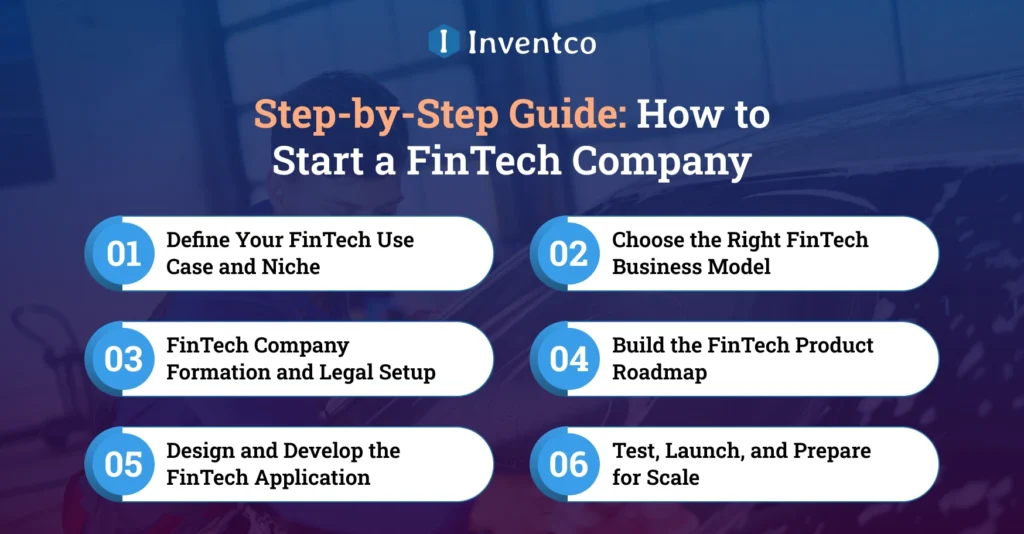
Step-by-Step Guide: How to Start a FinTech Company
Launching a fintech startup involves a myriad of steps far before any code is written or any investor is pitched to. Missing out on these steps can lead to being stuck in a regulatory mess, unscoped security obstacles, or costly modifications to functionality, if any, on your product line.
The purpose of this guide is to provide a step-by-step approach to building a fintech startup in a sustainable and responsible fashion, noting the appropriate groundwork to be laid.
► Step 1: Define Your FinTech Use Case and Niche
Before funding, development, or paperwork, clearly defining your fintech use case is critical for SEO-driven visibility and long-term success. A well-defined financial problem keeps your product aligned with real market demand and regulatory expectations.
Identify your target users, consumers, SMBs, or enterprises, determine which financial function you are improving or replacing, and clarify why users would switch from existing solutions.
For example, this could be a payment gateway business for cross-border SMEs, a neobank startup guide–based platform for freelancers, or a blockchain fintech startup enabling faster settlements. This clarity directly influences compliance strategy, technology selection, and scalable fintech growth.
► Step 2: Choose the Right FinTech Business Model
Your fintech business model must be sustainable and profitable in the long run. Monetization should not be an afterthought after the product is developed.
Transaction-based fees, subscriptions, interchange revenue, lending margins, and API or platform licensing are a few standard fintech revenue models.
Prioritizing feature development seems to be the cause of many founders’ failures, as they neglect to verify the revenue model.
Picking a model in line with real fintech business startup economics guarantees predictable growth, significantly better unit economics, and greater investor trust.
► Step 3: FinTech Company Formation and Legal Setup
Early legal and compliance planning is a significant necessity in an industry such as fintech, which is not a “build first, fix later” industry.
You should first register your company and select your jurisdiction, and then determine your licensing strategy: through banking partnerships or direct licenses. Along with KYC and AML frameworks, strong data protection and privacy policies should be implemented.
Getting to know fintech startup legal requirements and fintech startup compliance and regulations early will help you avoid problems with compliance that result in delays in regulatory approval, legal fees, and expensive redesign of a product later in the development lifecycle.
► Step 4: Build the FinTech Product Roadmap
An unambiguous product development roadmap assists your team in maintaining focus, as well as motivates your team to develop critical value-driven attributes first, in addition to facilitating compliance-related features and planning for scalability from MVP to the whole platform.
This point helps your startup fintech build the capacity to endure post-launch. Productive teams validate and iterate in a nimble manner and only expand after gaining sufficient product-market fit.
► Step 5: Design and Develop the FinTech Application
Execution starts with the development of the fintech application. Security, performance, and user trust architecture should all be included in the blueprint from the outset.
Secure and scalable architecture planning, along with real-time transaction performance optimization, trust-focused user experience design, and first-API integration for future growth, are all hallmarks of a robust fintech application development process.
Modular design aligned with Controlled app testing helps contain the core systems from unfurling excessive code and helps ensure the application is reliable when working with actual currency.
► Step 6: Test, Launch, and Prepare for Scale
Before going live on the App Stores, fintech products must undergo thorough mobile app testing to ensure security, performance, and regulatory compliance. Controlled launches assist in validating assumptions while minimizing operational risk.
End-to-end security and compliance validation, load and performance testing, user feedback, and infrastructure readiness for scale are the main areas of focus.
A measured launch strategy paves the way for long-term growth, sustained user trust, and expansion of the platform in competitive fintech markets.
How Much Does It Cost to Start a FinTech Company?
Let us look at the most pertinent question asked by people, which is: How much does it cost to start a fintech company? In 2026, the cost to found a fintech company ranges from $10,000 to $100,000+, depending on the product complexity, scope of compliance, and the technologies used.
Costs are broken down into discovery and compliance setup, UI/UX and design, security and infrastructure, and testing, launching, and refining. A minimal MVP with a limited feature set and third-party integration can be on the lower end of the range.
At the same time, a compliance-heavy platform will require a much more considerable investment. Knowing how much it costs to found a fintech company is a matter of aligning realistic expectations with the funds available rather than shooting in the dark.
A good number of founders fall into the trap of underestimating costs precisely because they forget to plan for scalability and updates in their software, which is directly related to the realistic mobile app development cost.
Technology Stack Required for a FinTech Startup
Performance, compliance, and scalability are the three attributes that your fintech technology stack must possess. Your fintech startup will appreciate your decision to choose flexible and secure technologies to avoid the costs that come with limited growth potential.
Typical Components of a Fintech Tech Stack include:
- Cloud infrastructure that allows for massive scalability and high availability.
- Secure backend frameworks that provide a protective layer for vulnerable financial information.
- Real-time databases that allow for instantaneous transactions and updates.
- Payment and banking APIs that will enable numerous financial integrations.
- Advanced analytics that provide insights, detect fraud, and support.
Many recent fintech trends combine Web3 elements with AI-driven automation, but only when there’s clear business value to be realized. The name of the game is flexibility: your tech stack for a fintech app should be able to shift along with your product, rather than tie you to inflexible systems.
How to Fund a FinTech Startup?
Funding a FinTech startup is not a one-dimensional strategy; it depends on the startup’s stage, compliance readiness, product maturity, and growth readiness. These factors dictate the funding stage and the capital strategy.
Standard Fintech Funding Options include:
- Bootstrapping for early-stage validation and proof of concept.
- Angel investors for MVPs that require significant compliance effort during development.
- Venture Capital for FinTech platforms that are ready for scaling and have good traction already.
- Strategic alliances with banks for additional capital funding and for licensing and credibility support.
As it stands, investors are not only concerned with the ideas; they also consider well-defined execution plans and compliance strategies, timelines aligned with the ideas, and scalability, while minimizing risk from regulatory complexities.
Common Challenges in Starting a FinTech Company and How to Overcome Them
Starting a fintech company comes with unique operational and regulatory challenges that can slow growth if not addressed early.
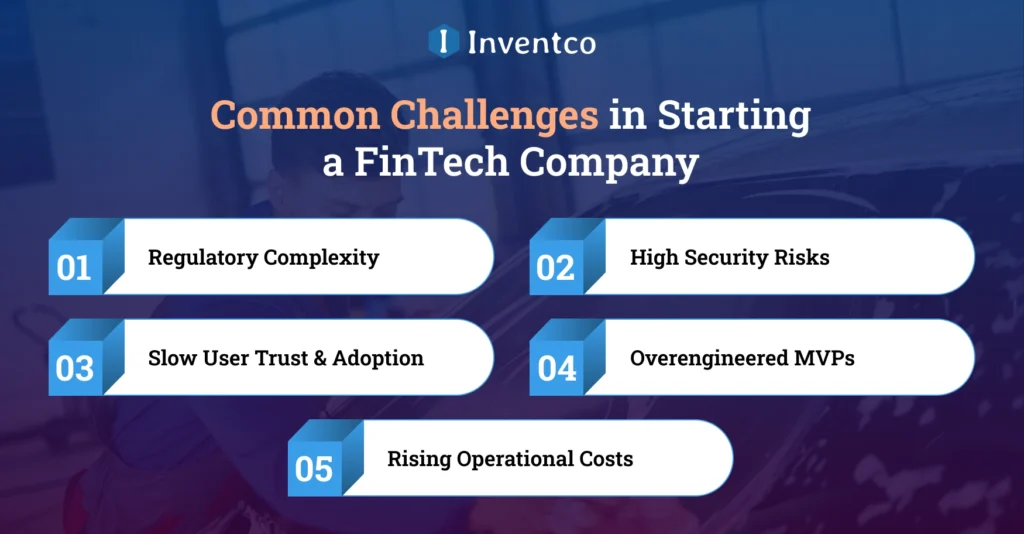
The biggest challenges in starting a fintech company include:
- Regulatory Complexity: Regulatory complexity remains a top challenge for the FinTech industry. In addition, licensing requirements, jurisdictional rules, and compliance approvals can delay product launches.
- High Security Risks: Fintech platforms are consistently targeted by cyberattacks. This is due to the sensitive financial data they process. In the absence of strong encryption and monitoring, data breaches can occur, eroding trust and triggering regulatory penalties and fines.
- Slow User Trust & Adoption: Unlike other software products, fintech applications must first establish trust. Complicated onboarding, unclear value propositions, and low-credibility signals are typical reasons user acceptance lags.
- Overengineered MVPs: Numerous startups spend too much time and money building a product. Failing to meet user demand on time due to too many features delays a release and increases costs.
- Rising Operational Costs: If scalability and automation are not straightforward, compliance, security, infrastructure, and continuous updates can significantly increase costs.
Moreover, common errors in fintech startups include failing to validate the market and miscalculating compliance costs. The answer is to build incrementally so validation remains continuous and to prioritize security compliance in line with mobile app security best practices.
How Long Does It Take to Build a FinTech Startup?
There are several stages to starting a fintech company, and each takes a different amount of time, depending on factors such as the company’s scope and the regulatory environment.
The Stages of Starting a Fintech Company include the following:
- MVP Development: Initially, MVP app development takes a few months to work on the core features and validate the product in the early stages of development.
- Compliance-Heavy Platforms: These products require longer development timelines due to the time needed to obtain licenses, complete reviews, and secure regulatory approvals.
- Full-Scale Fintech Systems: These platforms are phased in to ensure steady performance, no bugs, stability, and scalability.
When it comes to platform development, speed is crucial, but stability is more critical. In such a case, speed is not more relevant than development security.
Why Partner with Inventco for FinTech App Development?
At Inventco, fintech app development is approached with a deep understanding of security, compliance, scalability, and operational reliability. As a mobile app development company experienced in building regulated digital platforms, Inventco focuses on creating fintech ecosystems that are engineered for long-term business growth, user trust, and real-world financial operations.
Our expertise extends beyond application development. We help startups, enterprises, and financial service providers design secure architectures, implement compliance-ready systems, and build scalable platforms aligned with evolving industry standards. From digital payments and banking solutions to logistics-driven financial operations, every product is developed with performance, risk management, and operational transparency at its core.
One example is Bank Boss, a cash-in-transit management platform developed for the FinTech and banking logistics industry. The platform enables secure cash movement through biometric authentication, seal verification, automated job assignments, real-time GPS tracking, and centralized operational control across banks, branches, drivers, and administrators. Built using scalable technologies like Node.js, React.js, MongoDB, AWS infrastructure, and biometric integrations, the solution streamlined complex logistics workflows while improving operational visibility and fraud prevention.
Backed by experienced enterprise application specialists with 18+ years of expertise, Inventco combines technical excellence, fintech domain knowledge, and scalable engineering practices to help businesses launch secure, future-ready financial platforms confidently.

Conclusion
The opportunity to launch a fintech company in 2026 will be unlike any other, and entrepreneurs must be ready to take on the challenges ahead. We know that success in the industry will come from strong preparation, adherence to strict regulatory frameworks, and the execution of a meticulously developed plan, and not from industry hype or trends.
During the hype cycles, companies in the sector must constantly prioritize their products. In our industry, we are not just innovating; we are reminding the market that innovation, security, and governance must coexist.
Unfortunately, many of our competitors do not take fintech seriously; as a result, they are not building platforms that will last and sustain growing, active user bases. They will not achieve market dominance. Founders who move fintech to the centre of their strategic framework will have the last laugh.
FAQ’s
Q1. How to start up a fintech company with no banking license?
Ans. You can partner with licensed banks or financial institutions using BaaS models, enabling faster market entry, regulatory compliance, and reduced upfront licensing complexity for early-stage fintech startups.
Q2. Is fintech still a good business in 2026?
Ans. Yes, fintech remains highly attractive in 2026 due to digital payments growth, embedded finance adoption, AI-driven personalization, and rising demand for faster, more accessible financial services worldwide.
Q3. What is the biggest risk in fintech startups?
Ans. The most significant risk is underestimating compliance and security requirements, which can lead to regulatory penalties, user trust loss, delayed launches, and expensive re-engineering later in the product lifecycle.
Q4. Can fintech startups scale globally?
Ans. Fintech startups can scale globally by using modular architecture, region-specific compliance strategies, localized payment integrations, and strong data protection frameworks aligned with international financial regulations and standards.
Q5. Do fintech apps require ongoing maintenance?
Ans. Yes, fintech apps require continuous maintenance for security updates, compliance changes, performance optimization, API upgrades, and feature enhancements, directly impacting long-term operational stability and user trust.

Jitendra Jain
He is the CEO and Co-founder of Inventco, driving innovation in advanced computing and digital transformation. With deep expertise in modern IT ecosystems, he leads scalable, secure, future-ready solutions. His strategic leadership helps businesses accelerate growth, adopt innovation, and achieve success. You can connect with him on LinkedIn to follow his technology insights.