In a digital economy where customers live on their smartphones, building a mobile application is no longer a competitive edge, it’s a strategic move for survival. Mobile apps now drive engagement, streamline operations, unlock new revenue channels, and strengthen brand visibility in ways traditional channels simply can’t match. But here’s the real question: can you afford to get it wrong?
Transforming ideas into working mobile apps requires more than just creativity. It is a development journey that requires market research, technical how-tos, and planning. Your development journey will involve a number of tech and regulatory compliance planning, as well as performance and scalability planning. In this case, each mobile app development process has its own challenges.
The top obstacles are determining product and market fit, choosing the development approach, and post-launch maintenance. Mistakes in choosing a tech stack, prioritizing features, addressing security vulnerabilities, budget planning, and selecting the right development agency can negatively impact time, cost, and success.
This blog will identify the key challenges businesses will face when building mobile app platforms in 2026. More importantly, we will discuss actionable, detailed strategies to address these challenges, providing you with clarity, reduced risk, and stronger implementation to move forward.
If you plan to enter the digital ecosystem with a mobile application, it is crucial to be aware of these challenges up front. The primary focus will be the mobile app and its ecosystem, designed for continuous evolving success.
Key Takeaways
- Mobile applications are not a luxury, but rather a business imperative. By 2025, mobile applications will be a primary channel for customer interaction, a driver of business revenue, and an enabler of improved operational efficiency.
- This makes mobile app development an integral and structured component of a business’s development roadmap.
- The potential market size and competition are substantial. The global mobile app market is expected to be worth $391 billion in 2026 and $864 billion by 2031.
- This implies that the level of competition, combined with the quality of execution, will determine how long an app remains in the market and how successful it is.
- The mobile app development lifecycle stages facilitate the mobile app development process.
- The absence of a clear product-market fit, vague feature prioritization, a poorly designed architecture, and inaccurate budget estimates will be detrimental to your mobile app development and will frustrate your development team.
- Neither architecture nor design should be an afterthought in your mobile app’s development. Consistent user experience is the goal of cross-platform mobile app development.
- In-app delays and crashes are one of the leading causes of app uninstalls. Continuous optimization and performance monitoring are a mobile app development priority.
- Your mobile app’s development security features must be purpose-built. Throughout the development lifecycle stages, user data security must be considered through the development of APIs, encryption of user data, multi-factor authentication, and regular vulnerability monitoring.
- In the development process, anticipating growth in mobility apps helps ensure fraud-free, uninterrupted growth. A modular structure and a cloud-based framework will enable balanced, friction-free growth for a mobility app.
- Strict Apple and Google policies require proactive compliance checks, privacy transparency, and pre-submission validation.
- Integrations with third parties raise many complications. Developing stable APIs, fallback systems, and proper dependency management is essential for mitigating the risks of service disruptions.
- Long-term advantage means foresight in future-proofing. The next generation of application design will be defined by core AI, AR/VR, IoT, Blockchain, Generative AI, and mobile commerce (mCommerce), and as such will create a competitive advantage. Future-proofing will create long-term gains.
- Continuous updates, OS compatibility adjustments, performance enhancements, and security patches are critical for long-term sustainability.
- The right partner means more risk. If done correctly, the roadblocks will be development, and the integration will create greater value of artifacts to the overall ecosystem.
Market Stats of Mobile App Development
- Global mobile application market size and growth forecast: The global mobile application development market will generate more than $391.3 billion in revenue by 2026 and exceed $864.5 billion by 2031, reflecting the sector’s remarkable growth.
- Smartphone & app usage prevalence: Around 6.3 billion people globally used smartphones in 2025, representing about 78% of the world’s population, highlighting how deeply integrated mobile apps had become in everyday life.
- Mobile app usage and revenue: Reports suggest the mobile app market’s total revenue, including downloads, in-app purchases, subscriptions, and ads, amounts to hundreds of billions annually, with consumer spending in apps exceeding $150 billion in recent years.
Why Mobile Apps are Important for Businesses?
Consider mobile apps to be your brand’s digital handshake, they are always ready to connect and are available 24/7. Mobile apps are much more than digital tools, they are strong platforms that build brand presence and loyalty by connecting consumers directly on their smartphones. With the right mobile app, you can streamline operational processes, enhance the overall user experience, and establish regular revenue streams through in-app purchases, subscriptions, or service bookings.
Mobile phone users are at an all-time high, and companies without mobile applications in this competitive landscape are inviting competitors to exploit their business. That said, mobile app development can alleviate several business challenges, but it also introduces its own complex challenges. Let’s take a look at them next.
Top 10 Mobile App Development Challenges and Their Solution
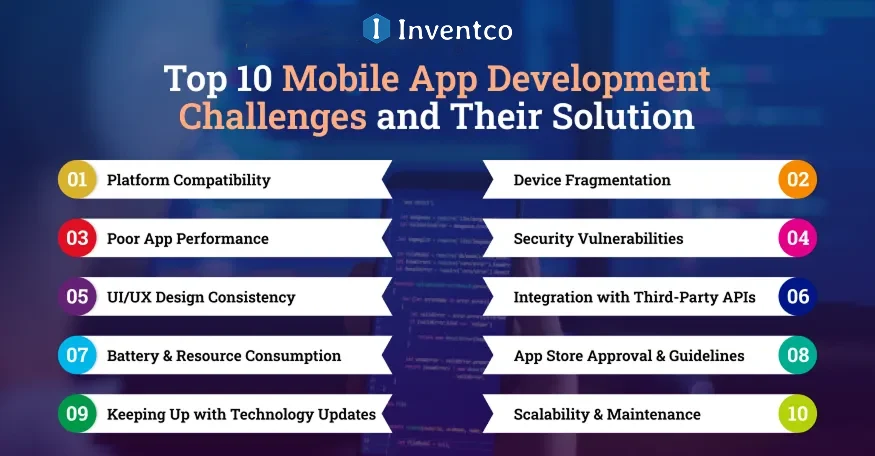
Creating a mobile app involves several steps, and challenges can arise that delay development, leading to time, resource, and money losses. Whether you want to develop a dream mobile application or you want to launch an application for your business or service.
Knowing the challenges ahead in mobile application development is pivotal to strengthening your preparation and making major obstacles easier to overcome as you work toward success, especially when planning the cost to build mobile app solutions efficiently and strategically.
Challenge #1. Platform Compatibility
The necessity for your application to be compatible with several platforms, including Web, iOS, and Android, is one of the most significant and widespread challenges in mobile application development. Each of these platforms operates on a distinct set of systems that define their own checklists, requirements, standards, and user expectations.
Without appropriate support, your business mobile app may crash, resulting in a negative user experience and ultimately losing potential customers and negative reviews.
Solution
With cross-platform development and cloud-based tools such as React Native and Flutter, you can create mobile apps that run seamlessly on both major platforms, iOS and Android.
When problems are detected early in development, additional mobile app testing can be conducted across multiple devices and operating system versions. Focus on customizing the user experience for each platform and operating system to meet user expectations while preserving the application’s core functionalities.
Challenge #2. Device Fragmentation
Device fragmentation refers to the variety of devices that are available within the operating system and the immediate hardware of the mobile device. It is one of the most prevalent challenges facing mobile device development today.
Device fragmentation can lead to multiple problems, such as user interface (UI) failures, a lack of functional UI elements, and a lack of complete user functionality. Each of these can ultimately lead to reduced user adoption and retention. This range of device hardware and software is especially problematic within the vast ecosystem of Android.
Solution
Implement responsive design strategies and UI components that adapt to varying screen sizes. Combine this with comprehensive testing on both physical devices and emulators across a broad spectrum of types. This will ensure uniform functionality and a polished appearance across all devices, improving user retention and satisfaction.
Challenge #3. Poor App Performance
Another issue encountered during app development is app performance. It is a major issue that undermines the user experience. Users may uninstall the app if it is slow to start, has a glitchy interface, or frequently crashes.
Poor coding, memory leaks, large media files, and too many idle processes can be the cause. Poor performance creates a negative user experience. Even the best ideas get harsh judgment from impatient users. App Store optimization is essential to your mobile app’s performance.
Solution
Write efficient code and minimize media files. Use performance monitoring tools to identify future issues and fix them. Reduce server and process delays. You should test your app regularly on a variety of devices to ensure it runs fast and smoothly. The result of your hard work will be happy and engaged users and better app reviews.
Challenge #4. Security Vulnerabilities
Security vulnerabilities are one of the most concerning challenges in app development. They pose a serious threat to your mobile app. They may leak, provide illegal access to, and enable hacks of sensitive user data. As hacking techniques become more advanced, one of the biggest challenges in mobile app development is protecting the app against potential risks.
A common breach in your mobile app may have serious legal implications, tarnish your app and brand, and lead to your company facing serious legal consequences.
Solution
Prioritize strong encryption for data, secure transit, and use safe APIs with identity and authorization checks. The use of multi-factor authentication provides the app with additional assurance of its security.
To enhance the app’s security, apply security patches regularly and conduct additional security audits. The more knowledgeable your team is, the better your app will withstand evolving online risks and keep your users and business safe.
Challenge #5. UI/UX Design Consistency
Consistent UI/UX design is crucial to the development of your mobile app. UI/UX design that is inconsistent or clashing can compromise user experience and retention. What’s worse is that mobile app development can also create a frustrating user experience that leads to app uninstallation.
The app development industry provides mobile app development services to maintain design consistency across several devices and screens. A poorly designed mobile app demonstrates a poorly designed UI. Poorly designed UI leads to reduced user retention and reduced brand value.
Solution
To solve this problem, app developers must focus on building clean, seamless mobile apps. Simplicity must be woven throughout the app to give users a sense of comfort and ease. The mobile app’s consistent feel and look must be coupled with consistent design to provide mobile users with a seamless experience. This process becomes more structured and effective when supported by app wireframing and validated through a mobile app prototype before full-scale development.
Upgrading your application involves pinpointing the challenges customers face and improving the app based on user feedback. The app’s accessibility and responsiveness across various operating systems and devices contribute to user retention.
Challenge #6. Integration with Third-Party APIs
Integrating with external APIs, such as payment services, maps, and analytics, increases your app’s usability. However, this poses challenges, including API rate limits, random downtime, and ambiguous location definitions, which can slow development and introduce frustrating bugs. Coordination with external services can compromise your mobile app security and user experience.
Solution
Use well-maintained, quality APIs. Monitor your API limits, and use alternative methods to minimize downtime. Ensure thorough testing and prepare your system to adapt. Maintain communication with your API providers to stay informed of service changes.
Challenge #7. Battery & Resource Consumption
If a mobile application uses too many of a user’s device resources, whether in battery or memory, most people will uninstall it. The device will burn out, run poorly, and the user will be dissatisfied because of how the application uses resources. One of the main challenges is creating an application that uses resources efficiently, allowing it to run with multiple processes and background applications without the user’s knowledge.
One of the main challenges is creating an application that uses resources efficiently, allowing it to run with multiple processes and background applications without the user’s knowledge.
Solution
Decrease the work done in the background. Use effective methods to minimize CPU and memory usage. Run power tests to find leaks. Design mobile app features that are adaptable based on the device’s current state. This guides the user in managing the device’s resources, and it will help improve battery life and overall quality of the application.
Challenge #8. App Store Approval & Guidelines
When developing an app, one of the biggest challenges is getting approval for Apple’s App Store. This is the same for Android devices and the Google Play Store, as they both have policy restrictions on content, data usage, and most importantly, privacy.
When an app developer violates the policy guidelines, they will face app removal and rejection. This is very frustrating, as it can lead to wasted time and resources. The policies are very complicated, and keeping up with the constant changes takes a lot of focus and a certain level of expertise on the developer’s part.
Solution
Once the app is complete, the developer has to conduct a thorough compliance review prior to submission. Before the app goes live, the developer is to conduct extensive testing to ensure it adheres to policies. It is recommended that app developers hire a consultant with policy expertise to ensure the app complies with all applicable policies.
If the app developer takes the time to prepare a detailed report, along with a clearly written privacy policy, they are more likely to have their app approved, which will significantly reduce the time required to get the app on the market and will reduce their financial losses due to delays.
Challenge #9. Keeping Up with Technology Updates
Rapid advancements in mobile technologies have introduced new operating systems, devices, and development tools. Changes in technology can cause an application to malfunction and abruptly impede its functionality, causing it to crash, or it can conflict with the mobile device.
This is the most challenging aspect of developing applications, and for good reason: users will change devices or software versions at different intervals, so the developer has to work across multiple technological/setting environments.
Solution
From the outset of developing an application, adopt a proactive approach of closely monitoring device and OS changes and developing a schedule for mobile app maintenance and updates to identify and remediate problems before technology changes cause them. Additionally, the application should be developed in a modular fashion, with a unique, customizable architecture to facilitate technological changes easily.
Engage with developers and collaborate with them so that they can remain functional and implement new technologies that will enable the application to be sufficiently safe and operational without issue on multiple devices.
Challenge #10. Scalability & Maintenance
Mobile application development requires building an application that can expand quickly and easily to accommodate changes in your business. A lack of scalability in the application can have adverse effects. It can prevent the app from supporting the growing number of users, and these negative factors can limit its functionality and cause it to crash.
Moreover, ongoing maintenance of the application is necessary, and bugs and performance fixes need to be made; even though this is an important activity, it is one that is also often neglected, thereby escalating the cost of prolonged user dissatisfaction of the users of the app and the longevity of the application’s functioning of the application.
Solution
Develop your app with an open, modular design to facilitate easier expansion. Also, plan and budget in advance to cover future updates, extensive testing, quick bug fixes, and long-term app maintenance costs. Utilize cloud technology to manage fluctuating customer loads. For your app to evolve in tandem with your business, prioritize technical manageability in your coding to minimize technical debt.
Key iOS App Development Challenges
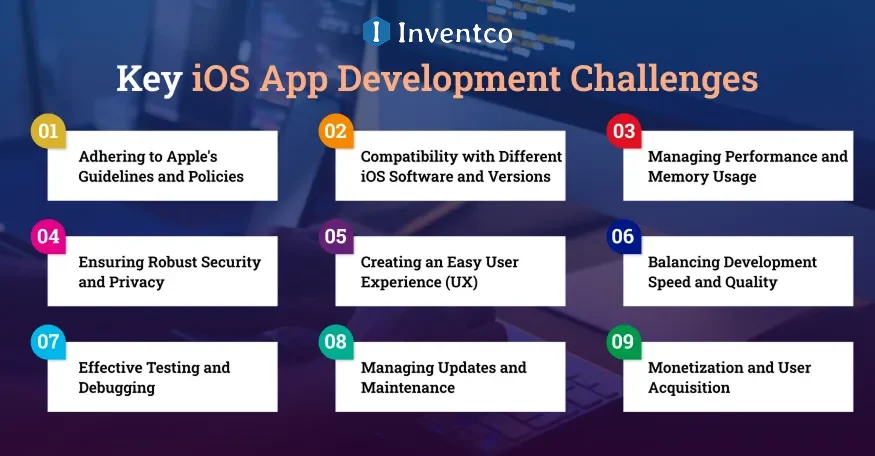
When it comes to iOS App Development Challenges, Apple sets a high bar. Here are the hurdles:
- Adhering to Apple’s Guidelines and Policies: Rejections can be brutal; follow their HIG (Human Interface Guidelines) closely.
- Compatibility with Different iOS Software and Versions: Test on different versions to avoid losing your user base.
- Managing Performance and Memory Usage: iOS users expect buttery-smooth experiences.
- Ensuring Robust Security and Privacy: Apple is strict on data keeping. Use safe files, rights, and encryption.
- Creating an Easy User Experience (UX): Intuitive design = happy people.
- Handling Network and Connectivity Issues: Offline help and proper warning messages matter.
- Balancing Development Speed and Quality: Use SwiftUI and frameworks, but don’t rush QA.
- Effective Testing and Debugging: Leverage TestFlight and unit testing.
- Managing Updates and Maintenance: Apple frequently updates its OS to stay current.
- Monetization and User Acquisition: In-app purchases, ads, or payments need careful planning and strategy for mobile app monetization.
Specific Android App Development Challenges
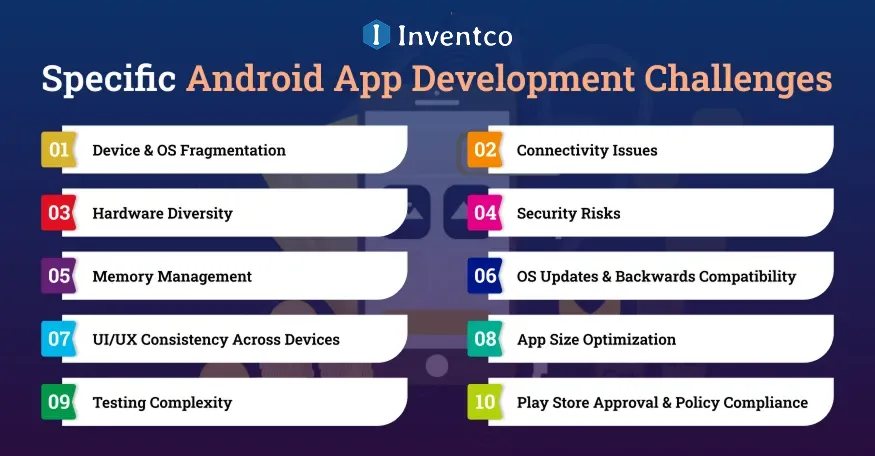
The challenges of Android app development bring their own set of problems, many stemming from the open environment.
- Device & OS Fragmentation: Hundreds of devices and OS versions to account for.
- Connectivity Issues: Not all users have strong networks; adjust for idle and low-data usage.
- Hardware Diversity: From cheap phones to high-end models, try a range of models.
- Security Risks: More open to malware and hacking; protect user data fiercely.
- Memory Management: Low-end devices need fast code.
- OS Updates & Backwards Compatibility: Your app must handle both the latest and older versions.
- UI/UX Consistency Across Devices: Design adaptively for different screen sizes and resolutions.
- App Size Optimization: Keep the download lightweight. Modularize features if needed.
- Testing Complexity: Use simulations and cloud-based real device testing.
- Play Store Approval & Policy Compliance: Follow all content, privacy, and data regulations to avoid being shut down.
The Next Set of Challenges: Future Trends Shaping App Development
As mobile technology advances, businesses must adapt quickly to changing user standards. Staying competitive means accepting future-focused solutions that improve both performance and engagement.
Here’s a look at the most influential app development trends changing the scene, and how top solutions like AI app development services or blockchain app development services can future-proof your product.
- AI and machine learning: Smart robots, predictive analytics, and UX that can be changed are becoming commonplace. If you use AI app development services, your app will be better, more natural, and a lot of fun.
- AR/VR Experiences: Augmented reality (AR) and virtual reality (VR) can help people become more interested in learning, product demonstrations, and engaging content.
- Blockchain and NFTs: In today’s digital world, security and access are necessities. You can add tamper-proof transactions, decentralized models, and NFT interfaces to blockchain app development services. These are great for games, finance, and souvenirs.
- Voice interfaces and conversational AI: They are becoming the standard, as voice-driven UX is no longer optional but expected. Incorporate smart tools and virtual assistants to enable next-generation interaction.
- IoT Integration: Connected groups are the way of the future. IoT app development services help ensure everything works well across all devices, from smart homes to gadgets.
- Generative AI: Unlock creative automation with apps that make content, ideas, or code in real time, great for work and design platforms.
- mCommerce: The mobile shopping wave isn’t slowing down. With mCommerce app development services, make lightning-fast, safe, and personalized shopping experiences.
- Progressive Web Apps (PWAs): Deliver app-like features with the speed and ease of the web, no downloads needed.
Overcome Mobile App Development Challenges with Inventco’s Structured Expertise
Mobile app development challenges extend beyond the technical aspects. Requirements include agile planning, architectural analysis, and criteria-based decision-making throughout the process. At Inventco, we treat development as a multi-faceted business exercise rather than merely a coding task.
We start the planning process with constructive discovery and technical analysis. Here, we evaluate the app’s market potential. We outline scalable app architecture, choose the ideal technology stack, and define app functionalities based on user and business growth. All features are supported by feasibility analysis, performance, and scalability for future growth. This means your app will be built with sustainability in mind, not just for launch.
We have adopted an open and collaborative governance model as a mobile app development company. This means that we will aid your decision-making process at every step. We explain the technical trade-offs, costs, required integrations, security, and growth potential.
Whether you are adjusting your business to include a new digital product, upgrading your existing systems, or preparing for enterprise-grade growth, your focus should be on minimizing potential risk, increasing user engagement, and driving future growth through measurable development.
Using our strategy-first development framework and engineering excellence, we help turn mobile app development complexities into organized, actionable steps. We provide mobile solutions that are flexible, safe, and developed with an enduring competitive advantage in mind for the customer.

Conclusion
Building a mobile app in today’s competitive digital landscape is both necessary and challenging. From platform compatibility and security concerns to integrating emerging technologies, the journey demands strategic planning, technical expertise, and ongoing maintenance. While challenges are inevitable, they’re also conquerable, with the right mindset, tools, and development approach.
Whether you’re a startup or an enterprise, understanding these hurdles helps you make smarter decisions and avoid costly mistakes. As mobile technology continues to evolve, staying informed and adaptable is key. So start strong, plan wisely, and turn your mobile app vision into a scalable, successful digital solution.
FAQ’s
Q1. What are the biggest challenges in mobile app development?
Ans. Some of the biggest challenges include platform compatibility, security risks, bad UI/UX, third-party interaction issues, and performance problems like power drain or memory hogging. Navigating app store rules and keeping up with tech trends also pose ongoing challenges.
Q2. How can I overcome security issues in app development?
Ans. Use strong encryption, safe APIs, and multi-factor authentication. Regular code checks and compliance with data protection rules (like GDPR) are key. Partnering with skilled developers helps reduce risks.
Q3. Why is UI/UX consistency such a big deal?
Ans. A confused or ugly design turns people away. A well-thought-out UI/UX design ensures smooth travel, boosts engagement, and improves user retention. Always favor simple design and user testing.
Q4. How do I handle API integration challenges?
Ans. Choose trusted third-party APIs with good documentation. Monitor for rate limits, handle failures appropriately, and ensure backup methods. Good planning and skilled devs go a long way here.
Q5. Why is mobile app development difficult?
Ans. Mobile app development isn’t just about writing code, it’s about handling design, performance, platform compatibility, security, scaling, and user standards. Add in ever-evolving tech changes and app store policies, and you’ve got a high-stakes balancing act. That’s why strategy, planning, and skilled execution are everything.
Q6. What is the failure rate of mobile apps?
Ans. Around 80-90% of mobile apps fail to gain popularity. The reasons? Poor UX, lack of market research, weak performance, and skipping proper QA. Building a great app isn’t just about launching; it’s about fixing real user problems regularly and effectively.
Q7. What is the key factor to consider when designing for mobile apps?
Ans. User experience (UX) is king. A mobile app must be simple, responsive, visually pleasing, and easy to explore. Design uniformity, simplicity, and usability across devices can make or break your app’s success.
Q8. Who can help me overcome mobile app development challenges?
Ans. Hiring the best mobile app development company, like Inventco, can be a total game-changer. From strategy and technology advice to design, development, and post-launch support, Inventco helps you handle every problem with confidence. With their knowledge, you avoid costly mistakes and build high-performance, future-ready apps that stand out in the market.
Q9. What is the biggest challenge in mobile app development?
Ans. Platform fragmentation tops the list. With different screen sizes, OS versions, and hardware specs, ensuring compatibility and performance across all devices can be a big task.
Q10. Why do developers prefer Android?
Ans. Android gives more freedom, open-source tools, and a wider global user base. It’s easier to publish apps on the Google Play Store, and the platform allows for deeper customization, making it a favorite playground for devs who like creative control.

Sandeep Agrawal
Sandeep Agrawal is the visionary CTO at Inventco, bringing innovation to life through his technical expertise. With a passion for cutting-edge technologies, Sandeep leads the team in developing robust solutions. His dedication and continous efforts to pushing the boundaries of what’s possible defines his role as a transformative and innovative force in the tech industry. You can connect with him on LinkedIn to follow insights.