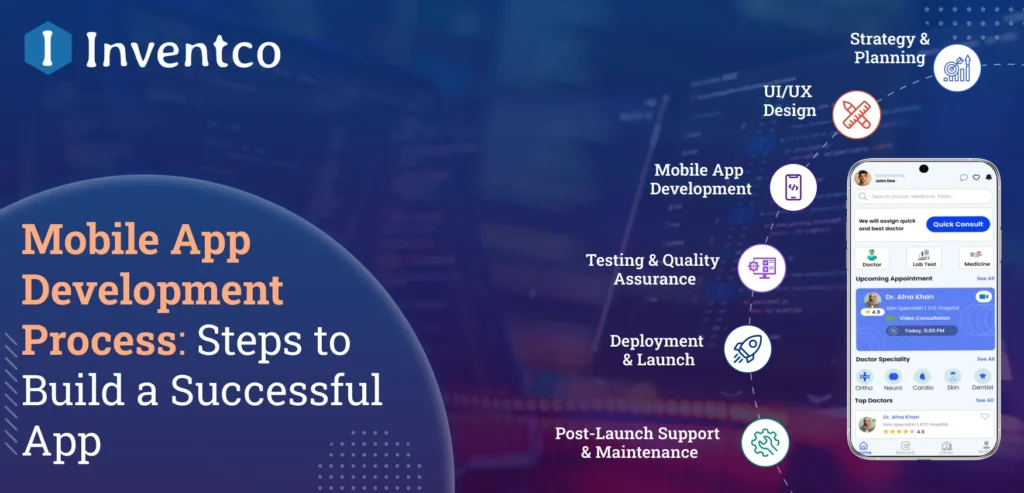
Developing mobile apps involves systematic planning and designing for connected devices such as mobile phones and tablets. In contrast to classic web development, which runs in a web browser, mobile app development focuses on platform-specific development for Android or iOS.
For a founder and investor evaluating a social media venture, understanding the mobile app development process goes beyond coding, as it determines scalability, monetization potential, and long-term product defensibility.
The potential is enormous. Investor gratification is further demonstrated by mobile-first digital ecosystems. According to Statista, the global mobile app market generated more than $522 billion in revenue in 2024, reflecting the growing dominance of mobile-first digital ecosystems.
The market for mobile apps is projected to reach $756 Billion by 2027, further confirmed by the increase in smartphones, digital advertising, and in-app purchases. Mobile Application Development is essential for developing the app to its fullest potential, ensuring sustainability, and achieving scalability.
This blog aims to provide a business-centric overview of the app development process, covering strategy and architecture, design and development, and testing and optimization. Founders and investors who take the time to understand the mobile app development lifecycle will be able to minimize risk, accelerate time-to-market, and build platforms that sustain growth and improve enterprise valuations.
Key Takeaways
- There are several stages in mobile app development through which an idea is transformed into a highly monetizable, scalable product.
- There are multiple opportunities and untapped revenue in the mobile app market, which is expected to grow exponentially until 2030.
- For a focused and effective strategic plan, mobile app founders and investors will need to define objectives, validate market demand, define user personas, and build monetization architecture to reduce execution risks.
- There is a correlation between a strong user interface and user experience design and increased retention, engagement, and the overall value of the app.
- Your technological decisions regarding app development will greatly affect the app’s initial performance and flexibility. This is also true of the mobile application’s future growth capacity.
- User trust will be lost, and your reputation is on the line during the launch of the mobile application. This is why testing, quality assurance, and security are a MUST during app development.
- A successful deployment strategy, along with readiness for compliance and App Store Optimization, boosts early traction and discoverability.
- Launch growth opportunities hinge on active feature improvement, constant monitoring, scalable infrastructure, and planned maintenance.
- To ensure long-term success, the key best practices are agile execution, a user-centric approach, and data-driven optimization.
- Investors and founders will be able to manage risks, forecast ROI more accurately, and build defensible digital assets through mastering the entire development lifecycle.
Mobile App Market Stats (2026 and Beyond)
Here’s the latest authoritative data you can use to set the stage for the mobile app development process and its massive market opportunity:
- The global mobile application market size is estimated to reach around $391.3 billion in 2026 and is forecast to grow at a strong CAGR of ~17.2% to reach about $864.5 billion by 2031, reflecting sustained demand across entertainment, utility, and social segments.
- According to Grand View Research, the global mobile application market, spanning gaming, social networking, productivity, e-commerce, and more, is projected to grow from its 2023 base and reach approximately $626.39 billion by 2030 at a CAGR of about 14.3% (2024-2030).
- Broader market projections estimate that the global mobile application market could expand from roughly $330.6 billion in 2025 to an impressive $1,230 billion by 2035, underlining strong secular growth driven by smartphone penetration and digital service monetization.
Key Stages of the Mobile App Development Process
The mobile application development process encompasses much more than simply writing code. Instead, it consists of multiple stages that develop a mobile app idea into an accessible digital product. When founders and investors look to develop a social platform, understanding the mobile application development process minimizes risks, improves spending efficiency, and speeds up market adoption.
Below is a refined, high-value breakdown of the mobile application development process, aligned with modern 2026 product and compliance standards.
1. Strategy & Planning
The mobile application development process starts with a foundation built on some strategic thinking. This stage identifies the components that will sustain the business in the long run, the technical framework, positioning relative to the competitors, and a vision for the growth the mobile application can achieve.
The absence of a thoughtful plan increases the chances of scope creep, wasteful spending, and misalignment with the market.
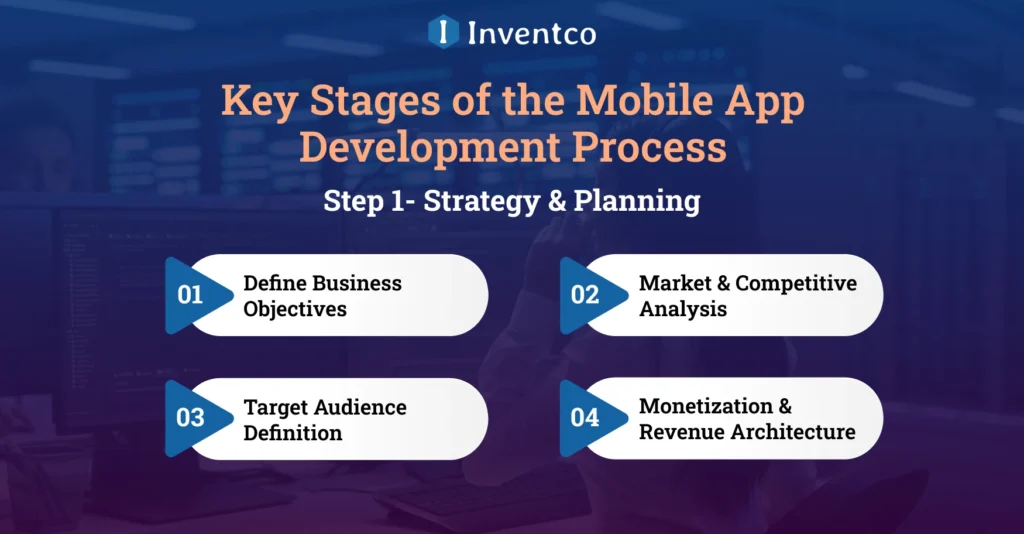
1. Define Business Objectives
Your set targets guide each decision made during the mobile application development process. This could include anything from increasing user engagement to a specific dollar value for advertising revenue, and then establishing KPIs guide feature prioritization and roadmap planning. The level of alignment to a strategy at this point determines how quickly the business can start making money and also the total value of the business.
2. Market & Competitive Analysis
Before any development can be done, the demand needs to be validated. This can be done by analyzing competitors, identifying market gaps, and understanding the behavioral patterns of the target segment. With the help of artificial intelligence, content personalization, and a growing demand for community-driven platforms, products can be positioned successfully in a changing digital economy.
3. Target Audience Definition
Creating precise user personas by collecting demographic, behavioral, and psychographic data is key to ensuring a product fits user needs. A social media platform for Gen Z will be very different from one for professionals or for niche communities. A clear audience will help inform UI, engagement loops, and retention strategies.
4. Monetization & Revenue Architecture
User experience and backend architecture can both be significantly impacted by choosing the right revenue model, whether that is subscription, freemium, advertising, or a combination of those. Monetization logic is easier to integrate and less expensive to change the earlier it is implemented in app development, which allows a platform to be built for sustainable financial performance.
2. UI/UX & Product Design
The design and development of the mobile app shapes the user’s first impression of the product and gives the company’s strategic vision a face. During this stage of design and development, the business goal is translated into a user experience through a user-friendly interface and a simple navigation structure, as well as through meaningful engagement funnels that guide users.
Good product design has a direct impact on retention, session length, and investor confidence, especially on social platforms where user interaction drives the company’s overall valuation.
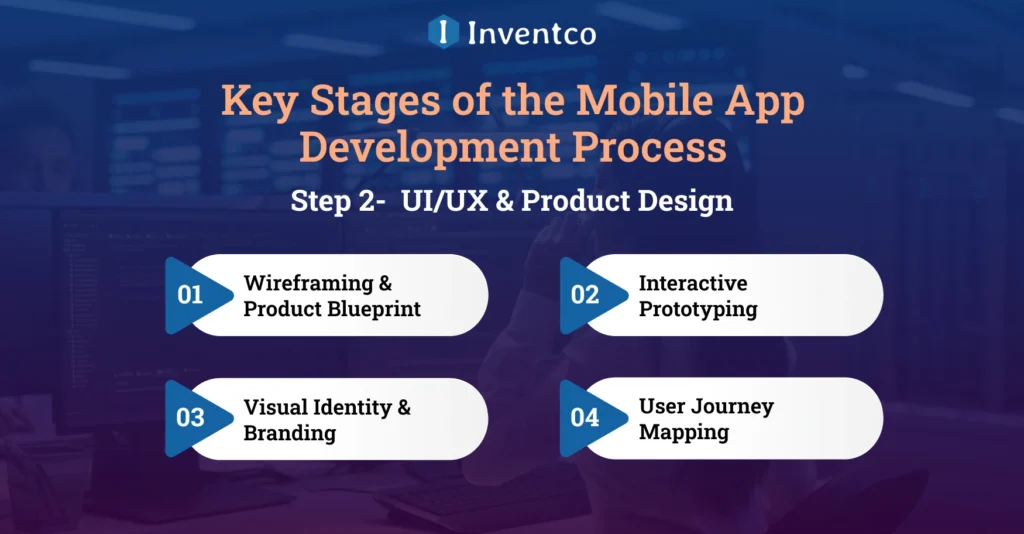
1. Wireframing & Product Blueprint
Mobile app wireframes are the app’s skeleton. They determine the screen layouts, navigation, and feature hierarchy before construction begins. Most product teams draft a diagram of the mobile app development process to outline user flow, content structure, and engagement loops. This structured diagram of the app development process keeps everyone on the same page and aligned.
2. Interactive Prototyping
Interactive app prototypes show the app as if it were fully developed, allowing investors and test users to see the product before it is built. Because navigation and user flow are tested and validated beforehand, teams experience less friction and costly modifications during the agile mobile app development process. Preemptive testing and validation greatly improve usability and reduce time-to-market.
3. Visual Identity & Branding
Visual design establishes trust and brand recognition. Elements such as color systems, typography, iconography, and layout consistency must reflect the platform’s positioning while remaining adaptable across devices and screen sizes. Strong branding reinforces credibility and enhances user loyalty within the broader mobile application development process.
4. User Journey Mapping
User path and journey mapping of onboarding, engagement, and monetization creates logical, smooth, and seamless user experiences. Good journey mapping is the most effective way to reduce user drop-off and increase user engagement. These factors are critical to the development of social applications, as the focus will primarily be on the user’s sustained activity.
This is the ideal stage to incorporate your accessibility and regulatory considerations to avoid future compliance app development challenges and development setbacks.
3. Development & Technical Execution
In this phase of mobile app development, we validated concepts and approved designs to become a tangible product. Effective technical execution means the application is built in a way that is scalable, secure, and able to withstand real-world usage.
To achieve the product conclusion, there needs to be close collaboration among frontend engineers, backend developers, DevOps, and stakeholders to ensure it is performant and aligned with the business objectives.
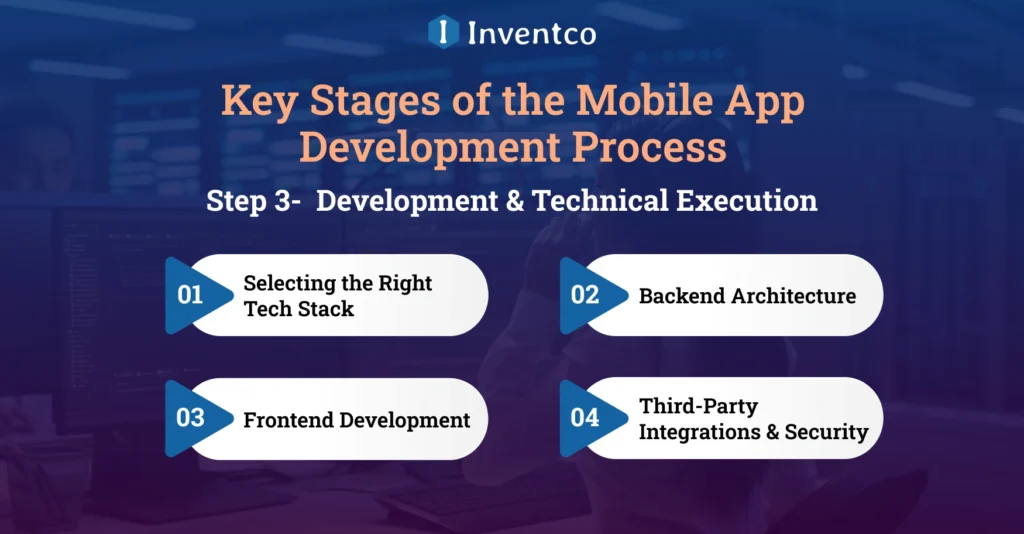
1. Selecting the Right Tech Stack
The right technology stack for mobile app development is crucial to development speed, product scalability, and future flexibility. For optimal performance and tighter integration with device features, native development with Kotlin, Java for Android, and Swift for iOS is preferred.
For faster MVP mobile app launches and lower development costs, cross-platform frameworks like React Native and Flutter are preferred. The target audience, geographic market, complexity, and expected growth are the factors that determine this decision.
2. Backend Architecture
The different components of real-time messaging, notifications, user authentication, database management, and API calls are all powered by a scalable backend. The cloud backend supports elastic scaling to maintain system stability and accommodate future traffic growth.
3. Frontend Development
The frontend team aims to create design systems and user interfaces that are flexible and adaptive. The goal is to ensure, through optimization, that user interaction is seamless, navigation is uninterrupted, and that the interfaces are fully compatible with all devices. This is to ensure the greatest degree of user satisfaction and retention.
4. Third-Party Integrations & Security
While the integration of payment systems, analytics, and communications services can facilitate development, the prioritization of data protection, user trust, and the costs associated with breach mitigation and strategic compliance frameworks means these services should be considered first in the development process.
4. Testing & Quality Assurance
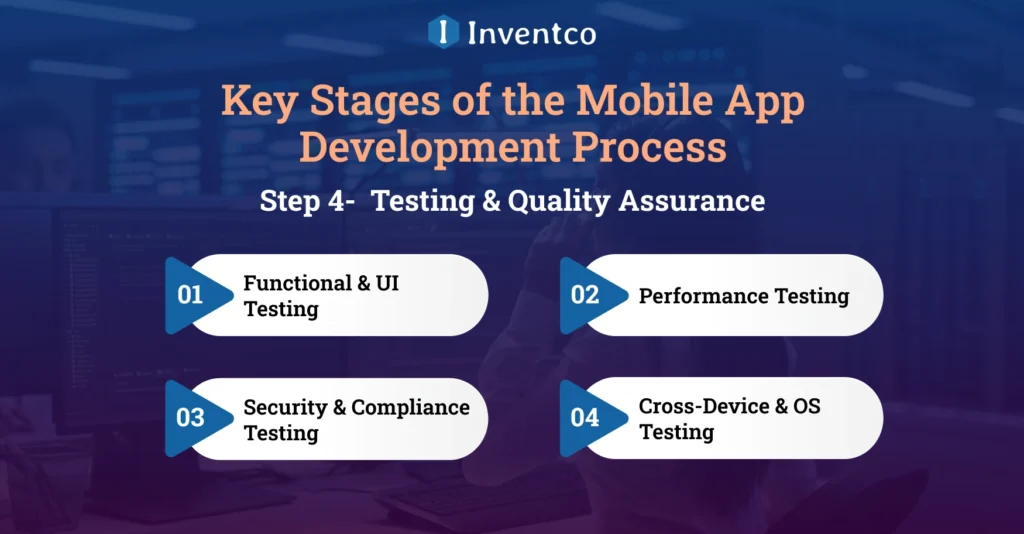
In addition to post-launch updates, the app will undergo numerous mobile app testing and validation processes to best configure it for end users and its intended use, expressed or implied. While tests are designed to technically address and solve open-ended issues, they shouldn’t provide solutions to create confidence that the UX will be highly dependable on the first-use experience.
1. Functional & UI Testing
Functional and User Interface Testing aims to review and confirm that each and every component and function of the system meets the system specification. Therefore, functional testing must verify every aspect of the User Interface, every step of the transaction process, and every component of the app’s content.
2. Performance Testing
Performance testing aims to inform the developer of the app’s optimal and acceptable operating parameters. Therefore, performance testing helps the developer establish the app’s optimal and acceptable operating parameters, even under high-bandwidth or high-performance processing conditions.
3. Security & Compliance Testing
The goal of mobile app security and compliance testing is to identify, address, or verify the application’s compliance with potential forms of liability, the developer’s data protection requirements, and the protection of the developer’s data.
4. Cross-Device & OS Testing
In compatibility testing, we ensure that app communication works across all device models and operating system versions, providing a consistent experience for all users.
Mobile app development is incomplete without quality assurance. It is essential for safeguarding the brand’s reputation and providing peace of mind during the launch.
5. Deployment & Launch
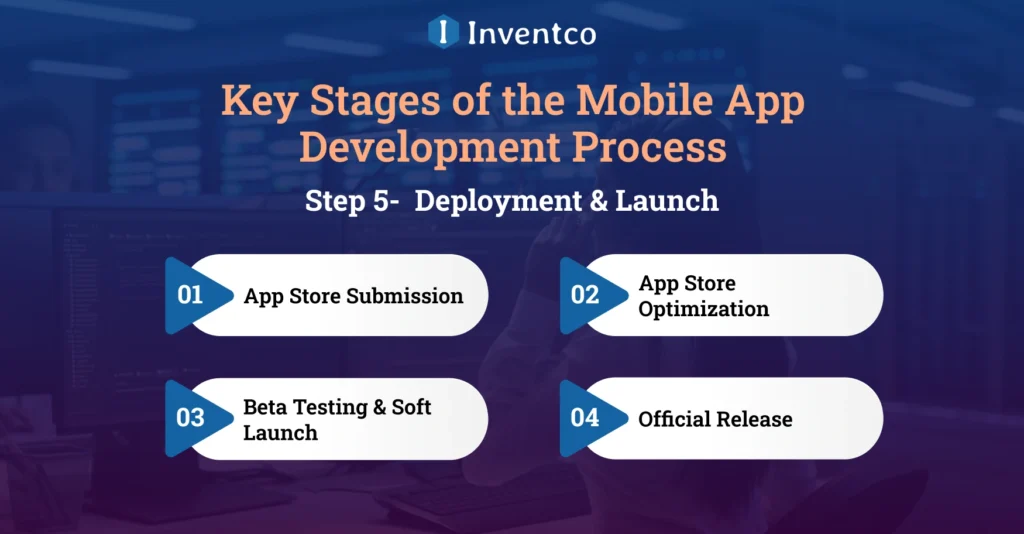
This point marks the end of product creation and initiates the product’s lifecycle as an offering that can be sold. In the mobile app development lifecycle, this phase focuses on app compliance, engineering, market positioning, and performance, ensuring the app is ready for large-scale user acquisition. Early user acquisition, user retention, and user growth, along with development trends, are influenced by launch planning.
1. App Store Submission
The mobile app submission process to app stores is highly compliance-heavy. Each mobile app submission entails a documented process for the app store, which may include guide reviews and testing to ensure the app meets all the store’s submission requirements.
For iOS submissions, this includes the signing of codes, new privacy, and new performance review compliance submission tests. Meeting compliance and testing deadlines allows the app to be submitted and the review completed by the due date.
2. App Store Optimization
After launch, the first point of competitive advantage is app store optimization. By optimizing the app store for visibility, organic app downloads increase, reducing the need to acquire customers through paid channels.
3. Beta Testing & Soft Launch
Before the app goes to full-scale launch, it is ideal to beta-test it. During a soft launch, product teams can examine how users interact with the app and the overall experience to enhance app usability. This approach aims to improve product-market fit while reducing early-stage app churn.
4. Official Release
The official launch will integrate all PR outreach, digital and influencer marketing, and targeted user acquisition strategies. We will be tracking engagement metrics to evaluate performance and inform marketing optimization. A strategic, measured soft launch will enable the app to be released into the market with sufficient visibility, credibility, and measurable traction.
6. Post-Launch Support & Growth
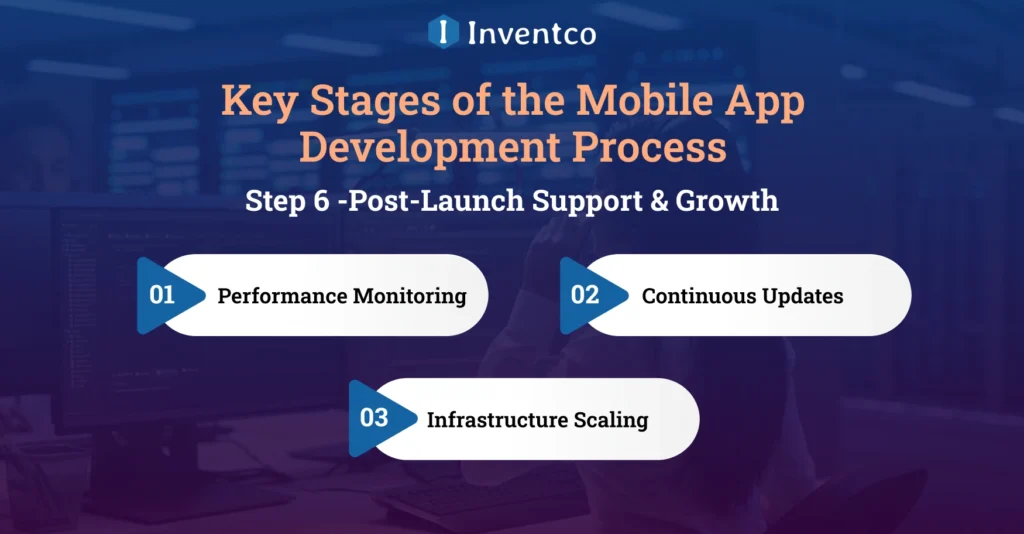
The cycle of mobile app development encompasses much more than simply app launch. The release signifies the start of an ongoing phase of optimization for app security, performance, and user experience. For investors and founders alike, sustainable growth results from effective management of what comes after the launch, not from the launch itself.
1. Performance Monitoring
Sophisticated analytical tools provide insights into retention, engagement, feature usage, and crashes. Monitoring is done in real time, enabling quicker issue identification and resolution and improving decision-making around the product. These metrics and analytics inform the optimization of user experience and engagement strategies.
2. Continuous Updates
Frequent updates will add new mobile app features, improve the user experience, fix bugs, and add or remove items as required by the regulations. This approach can act as an iterative strategy to keep the app relevant.
3. Infrastructure Scaling
The use of optimized cloud services and adaptable architecture allows the system to grow seamlessly without experiencing bottlenecks or downtime. Infrastructure that scales elastically will remain stable regardless of minor or significant increases in user traffic and will accommodate growth during spikes.
Regular mobile app maintenance is important for maintaining performance, improving security, and upholding your brand’s integrity. Mobile app maintenance costs should be factored into investors’ estimates of the overall cost to build a mobile app and into calculations of operational spending in the years to come.
Final Perspective for Founders & Investors
The journey to enterprise mobile app development is well-planned and comprises multiple phases that integrate strategically across design, technology, regulatory compliance, and business growth. Knowing how to navigate the entire app development journey helps founders mitigate risks and create defensible digital assets.
When developing a mobile app, to build strong investor confidence and sustain growth, it is important to integrate app development phases with defined metrics, compliance with security protocols, and an intentional approach to revenue generation.
Best Practices for a Successful Mobile App Development Process
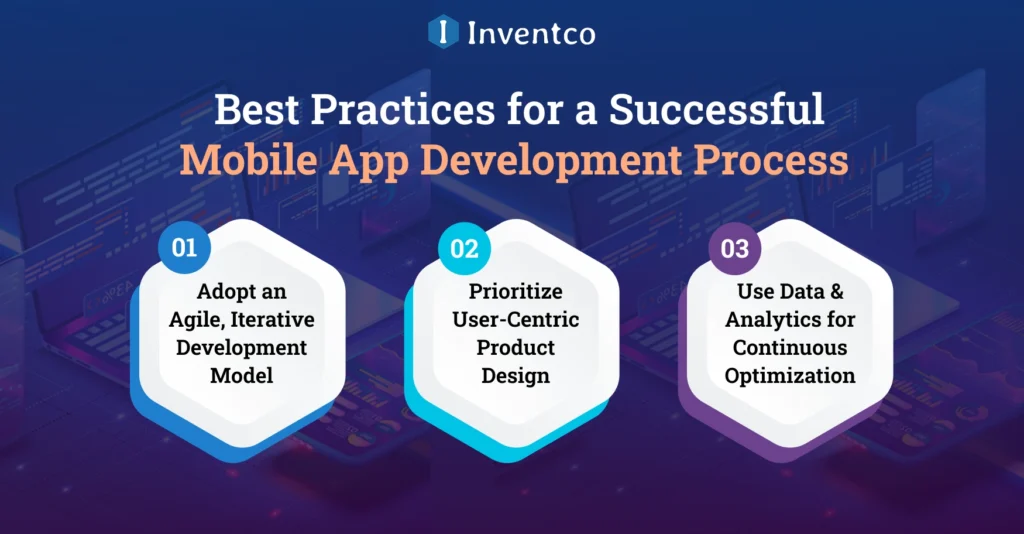
A well-defined mobile app development journey reduces the risks associated with numerous tasks and development quality, regardless of the app’s market potential. Effective development delineates the differences between scalable opportunities and the first step in launching successful mobile applications.
Below are three effective development strategies from the most current set of principles and the state of mobile application development.
1. Adopt an Agile, Iterative Development Model
An agile mobile app development process enables teams to build in short, focused sprints rather than long, rigid cycles. Frameworks like Scrum or Kanban allow continuous testing, stakeholder feedback, and rapid iteration.
The reduced time required to release complete functionality helps reduce the accumulation of technical debt. This also helps clarify and align the product and business goals and provides feedback with minimal additional cost. In the case of engagement apps, the quick feedback cycle helps the app adapt to actual customer needs.
The app’s development process, execution, and feedback also help clarify the continuity of the engagement, the number of app users, and the app’s development speed. In turn, this helps provide the working app to investors and developers.
2. Prioritize User-Centric Product Design
Mobile app design and development can only be successful when user behavior, user expectations, and friction points are analyzed. Empirical data should shape design, not assumptions. For instance, data can be used by founders working on a social media platform to design for user retention and active engagement.
User-centered design extends to conducting user research to create user personas and user flows, and to prototype before building a minimum viable product. Early app design should eliminate friction points around onboarding, navigation, and user engagement. Apps are better monetized, retain users better, and drive greater engagement when design is driven by behavioral data. In fact, design for usability, accessibility, and personalization is not a nice-to-have, it is a competitive necessity.
3. Use Data & Analytics for Continuous Optimization
Once an app goes live, the development cycle moves into an ongoing improvement cycle. Analyzing app metrics post-launch can reveal user engagement, churn, and conversions. These data will help the product team strategize, driven by fact, not by intuition.
Founders can identify potential growth areas and operational inefficiencies in the mobile application development process by tracking metrics such as retention rate, session duration, feature utilization, crash frequency, and revenue per user. Most modern analytical tools provide instant dashboards that enable faster decision-making.
This includes making suggestions when there is a need to optimize content algorithms, further develop app monetization strategies, or shift focus to updates that will create the greatest impact. Starting in 2026, sustainable growth will focus on disciplined iteration and data intelligence rather than guesswork
Strategic Takeaway
Successful mobile application development must be user centered, agile, and optimized. For investors and founders of rapidly growing platforms, these principles guide the development journey from a simple technical execution framework to a growth oriented blueprint.
Why Choose Inventco for Mobile App Development?
To successfully develop mobile apps, an excellent technical partner is needed. Suppliers and developers are not enough. Investors and founders require long-term thinking about scalability, compliance, performance optimization, and app evolution. Inventco aims to be a full-cycle development partner and is focused on business outcomes rather than development milestones.
Inventco has built an extensive mobile app development business, offering market validation and product strategy, UI/UX design and engineering, and post-launch optimization. Using the latest frameworks: Flutter, React Native, and Native iOS and Android, the development team provides clients with the ability to choose the appropriate architecture for their needs, be it performance, scalability, or cost. This balances the need for an MVP with the need for enterprise expansion.
Inventco agile development emphasizes structure for collaboration and a positive mobile app development journey through documented, repeatable milestones, continuous development and testing, and stakeholder input. With continuous design testing and compliance, thorough quality assurance and performance testing, and risk management for launch, planned App Store optimization drives user acquisition and retention after launch.
In addition to the technical components, Inventco also appreciates cooperation, effective communication, and the use of analytics to provide the best path to take. Active assistance, evaluation of results, and scheduled tactical advice provide flexibility to the various stages of the mobile application development process in response to changes in the target audience.
Inventco values development that sustains profitability in the long run and, as such, provides af structured, growth-focused mobile development service that enables clients to adopt scalable, economically valuable mobile business strategies.

Conclusion
There are initial steps to take, and completing a finished application in the mobile application development process is not straightforward. It commences with an estimate, then walks through the various steps to assemble a fully functional, revenue-generating digital product. It begins with appropriate, focused planning and market research, then moves through user-centered design and development, and concludes with comprehensive evaluation and app enhancements. Subsequently, all stages of mobile app development are necessary for an improved overall user experience, sustained profitability, and the growth of the application.
Companies can develop successful business applications that withstand market pressures by thoroughly understanding the development process and being adaptable to change. Businesses can streamline resource use and zero in on the parts of the application with a direct, quantifiable business impact by understanding the process and being patient with the development.
FAQs
Q1. What is the mobile app development life cycle?
Ans. The mobile app development life cycle comprises phases such as strategy and planning, UI/UX designing, development, testing, deployment, and post-launch maintenance. Each phase is planned so that the application best serves the user requirements and business needs.
Q2. How long does mobile app development take?
Ans. The timeline depends on the app’s size, features, and platform. A basic app will take 3-6 months. However, custom functionality apps require 9-12 months or more, which includes testing and deployment.
Q3. Do mobile apps have frontend and backend?
Ans. Yes, most mobile apps consist of a frontend (user interface) and a backend (server-side logic, databases). Frontend handles user input and backend handles data, authentication, and integrations.
Q4. What technology is used to develop mobile apps?
Ans. Technologies include native application development (Swift for iOS, Kotlin for Android), cross-platform frameworks (Flutter, React Native), and back-end platforms (AWS, Firebase). Selection is based on the target markets and budget preferences.

Jitendra Jain
He is the CEO and Co-founder of Inventco, driving innovation in advanced computing and digital transformation. With deep expertise in modern IT ecosystems, he leads scalable, secure, future-ready solutions. His strategic leadership helps businesses accelerate growth, adopt innovation, and achieve success. You can connect with him on LinkedIn to follow his technology insights.