The global sports tech economy is rapidly evolving. What was once an accompaniment to live sports, digital engagement has rapidly become the main way fans experience the sports they love. With smartphone usage on the rise, the availability of modern data streams, and a growing expectation of on-demand, real-time engagement, the casual pastime of many has become a multi-billion-dollar industry.
These changes are impossible to overlook for potential investors and founders. The global fantasy sports market size was estimated at USD 24,853.7 million in 2024 and is projected to reach USD 56,381.2 million by 2030, growing at a CAGR of 15.2% from 2025 to 2030.
North America and India are key players, with the latter boasting over 200 million registered users while the former adds tens of millions of players across various sports and games. Competing in this market will take more than designing an app that fulfills the same function as FanDuel or DraftKings. It will require knowledge of technology’s potential and careful planning and execution.
This guide will detail what fantasy sports apps really are, the increased demand for them, the top trends that will impact fantasy sports app development in 2026, challenges that founders will face, estimated development costs, and how Inventco, a tech partner, can help you take advantage of this opportunity.
Key Takeaways
- AI in fantasy sports apps has moved from a backend tool to a front-facing differentiator, powering team suggestions, lineup optimization, and predictive insights.
- The global fantasy sports market exceeds $30 billion in 2026 and is expanding at a 12% to 15% CAGR, making it one of the more investment-ready segments in mobile gaming.
- Real-time data, blockchain-backed transparency, and AR/VR draft experiences are redefining what users expect from a competitive platform.
- Fantasy sports app development trends are shifting toward shorter, modular contest formats, such as ten-minute micro-contests, rather than season-long commitments alone.
- A custom fantasy sports app typically costs between $10,000 and $100,000+, depending on feature depth, AI integration, and compliance requirements.
- Founders who treat scalability, security, and regulatory compliance as day-one priorities are best positioned to capture long-term market share.
What Are Fantasy Sports?
Fantasy sports let users build a virtual team composed of real athletes from an actual league or tournament, then earn points based on how those athletes perform in real matches. Participants draft, trade, and manage their roster across formats, season-long leagues, daily fantasy contests, or short micro-contests tied to a single game, competing against friends or the wider platform community on a live leaderboard.
Fantasy sports started as a hobby for some football and cricket fans. Now it is an advanced digital category. Examples of this are the live leaderboards and real-money fantasy contests on FanDuel and DraftKings, which all offer tailored content to millions of users at once. Though the mechanics may be simple, the technology required to support a complex, competitive game is advanced.
Fantasy sports rely on real-time sports data, scoring that occurs in real-time, and even secure, real-time transactions. This industry is rapidly changing and developing because users have higher expectations of the technology behind the app than the user interface. The apps with the most users don’t just have an advanced user interface, they also emphasize speed and reliability for the user.
Is Fantasy Sports App Development Still in Demand?
Fantasy sports app development remains a strong investment opportunity in 2026 as the global market continues to expand. Valued at over $30 billion, the industry is growing steadily due to increasing smartphone usage, better internet access, and rising interest in live sports.
Key markets are North America and India, while Europe and Latin America are new areas of opportunity. Fantasy platforms increase fan engagement with interactive real-time experiences. Today, the main focus of investors is to monetize the user experience, increase user retention, and be as innovative as possible, instead of the traditional focus of acquiring as many users as possible.
Mobile app features such as AI-powered recommendations, real-time analytics, secure payments, and regulatory compliance are essential for success in this competitive and rapidly evolving market.
Top Trends in Fantasy Sports App Development
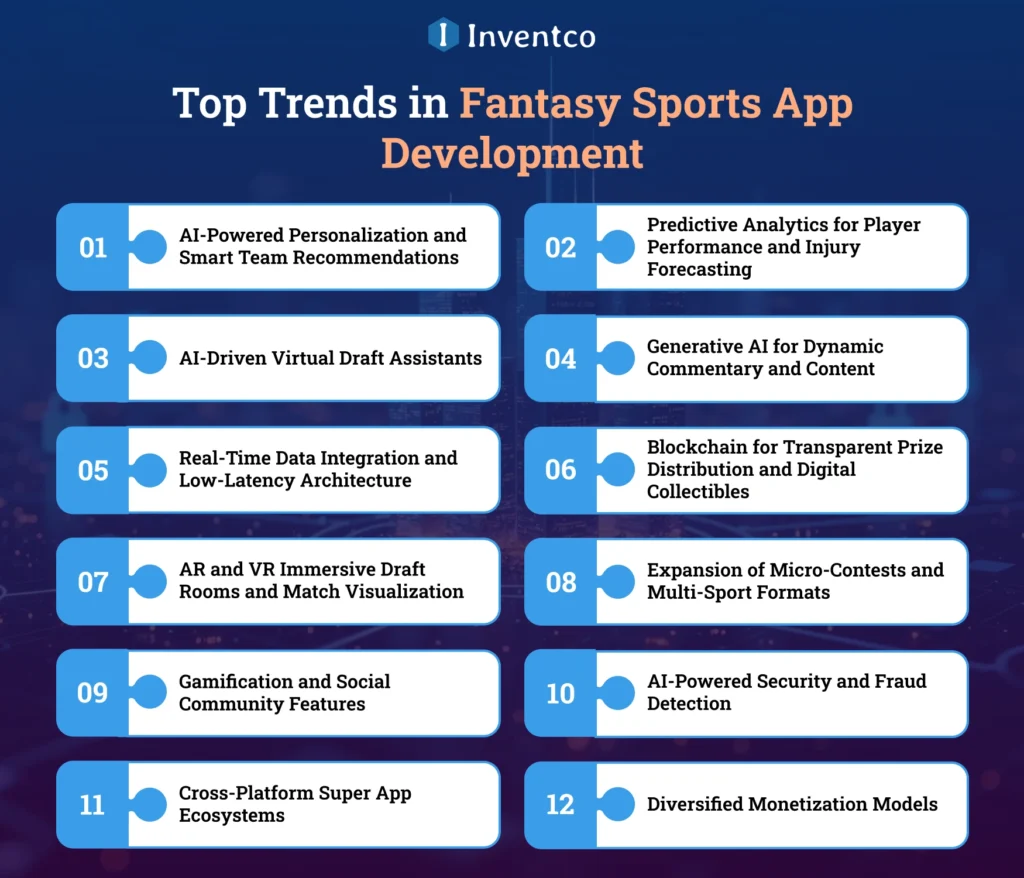
Technology used in fantasy sports has advanced far beyond simple score tracking. The next generation of fantasy sports is equipped with everything from artificial intelligence to blockchain to virtual reality and everything in between. Below are the top fantasy sports development trends all founders and product managers should know.
1. AI-Powered Personalization and Smart Team Recommendations
The inclusion of AI in fantasy sports apps begins the moment users launch the app. Machine learning is utilized to analyze users’ draft history, win-loss records, and behavioral patterns to suggest players, lineups, and contests appropriate to their skill and risk levels. Suggestions for beginner users, for example, may include a guided auto-draft that helps users build a strong draft-competitive team without spending numerous hours on research.
For advanced users, the app may provide insights on matchups, including player and team forms, strengths and weaknesses of the opposition team, and environment and weather conditions. Users who access suggestions and have appropriate personalization are significantly more inclined to engage in more contests and are likely to stay on the app for a longer period.
2. Predictive Analytics for Player Performance and Injury Forecasting
One of the most direct values of incorporating AI in fantasy sports has been the incorporation of Predictive Analytics. Advanced Machine Learning models, when built to include player and match data, injury history, and player in-game event data, have the ability to predict probable player performance and, increasingly, player injury events.
Users are able to make informed decisions and create fantasy strategies, while platforms see reduced injury events and increased trust in the scoring engine and lower contest disputes. Predictive Analytics should be considered a core offering.
3. AI-Driven Virtual Draft Assistants
Drafting has historically been the most daunting part of fantasy sports for a majority of participants. AI virtual assistants are helping to eliminate this. Having the ability to analyze an individual’s drafting needs, specific salary cap considerations, and scoring predictions to make better draft decisions leads to a better overall drafting experience.
Using a drafting aid lowers the complexity of draft tools for new or casual participants while leaving the flexibility and complexity of a manual draft for advanced participants. This provides a better balance of user experience for casual and advanced participants.
4. Generative AI for Dynamic Commentary and Content
One of the biggest pain points in retaining users in fantasy sports is keeping users engaged and interested between matchups. Generative AI has started to become the solution for that specific problem.
Instead of users getting the same news updates, users will get personalized previews of upcoming matches, analyses of matches that have concluded, and even post-game commentary that will provide specific and personalized insights for users based on their team and lineups.
This will keep users of the app engaged on the non-match days, and on the days when matches are not taking place. This solution is far more efficient than using editorial staff dedicated to one or multiple sports.
5. Real-Time Data Integration and Low-Latency Architecture
Users expect their leaderboard to move the instant a goal is scored, not a few seconds later. That expectation is pushing platforms toward edge computing and low-latency APIs that can process live sports data without the lag that used to be acceptable.
During particularly intense contests, the few seconds of delay in what is expected from a scoring engine will erode user trust. Constructing a low-latency infrastructure backbone will require significant investments in early stage computing infrastructure and resources, explaining why this concern ranks so highly on developers’ top fantasy sports app development trends for 2026.
6. Blockchain for Transparent Prize Distribution and Digital Collectibles
Blockchain in fantasy sports apps is moving past the hype phase into practical use cases: transparent, auditable prize distribution that users can verify themselves, and collect-and-play models where users own and trade digital player cards as NFTs.
For platforms holding real-money contests, blockchain technology provides a significant advantage by eliminating payout disputes, as users can view and verify the prize distribution. Digital player cards and collectibles provide a new revenue stream in addition to contest entry fees.
7. AR and VR Immersive Draft Rooms and Match Visualization
Besides creating a virtual draft room and projecting player stat overlays with augmented reality, what else can AR and VR do to bridge the gap between reality and fantasy? Well, augmented and virtual reality can enhance the fantasy game experience beyond a spreadsheet and a scoring system that tracks player stats.
Given the resource-intensive nature of AR and VR, draft rooms and stat overlays will be selectively implemented, especially for marquee events or featured product tiers. Selective implementation has made augmented and virtual reality a major differentiating factor for gaming platforms that rely on user experience in an increasingly competitive market.
8. Expansion of Micro-Contests and Multi-Sport Formats
The fastest-growing segment in fantasy sports is not hardcore season participants, but rather casual sports fans looking for a low commitment. This has caused a push for micro-contests, which are bite-sized contests that can even be tied to only one quarter or one half.
To accommodate users in these short contests, a modular app architecture is necessary, as contests need to be able to come and go without a full redeployment. Multi-sport paradigms are also in contention, as they can be regional, niche sports, or even esports to maximize profit, unlike a single-sport model.
9. Gamification and Social Community Features
Fantasy sports app gamification goes well beyond traditional leaderboards or badges. Newer iterations of these platforms now offer in-client leagues, group chats, head-to-head challenges, and loyalty tiers for users who play more frequently. As a result, entering a contest becomes far more social and is something users return to and do with their friends.
Community-oriented tools such as private leagues, chat threads, and bragging-rights rankings draw users back to the app and keep them engaged between sporting events. Compared to more complex gamification systems such as AI or blockchain, it is far more cost-effective to implement a social system early on, as the community-oriented features have a compounding retention effect.
10. AI-Powered Security and Fraud Detection
Fantasy apps that offer real-money stakes are especially susceptible to the negative impacts of a trust gap the moment fraud occurs on their app. Security concerns naturally cause regulatory scrutiny and damage to the reputation of a real-money fantasy sports platform.
AI-based systems also help detect and prevent payment fraud by learning to monitor deviations in abnormal user behavior in real time. For those founders building a platform for real-money contests, this should be part of the core infrastructure, not something to be considered after launch.
11. Cross-Platform Super App Ecosystems
Users want their fantasy sports apps to work on web, iOS, and Android, and not just work – they want the apps to offer more than just contests. Operators are now using the term Super App to describe fully integrated fantasy sports, live streaming, sports news, and sports merchandising apps.
Cross-platform development is an expectation, not a request. For founders, the decisions they make regarding the development framework, control structures, and API designs during the prototyping stage will greatly impact the ease with which a fantasy sports app can be expanded in the future.
12. Diversified Monetization Models
Creating a sustainable revenue model using only entry fees and advertisements is obsolete. In 2026, implementing subscriptions for premium analytics, token economies, loyalty rewards, and tiers for contest pricing will ensure a better balance of revenue streams and increase the overall user value for the platform, as well as decreasing the reliance on a single stream.
These users are more loyal contributors to the platform, making retention even easier. For investors, this more diversified model demonstrates a better level of sustainability beyond the next round of funding.
What Challenges You Need to Face to Build a Fantasy Sports App
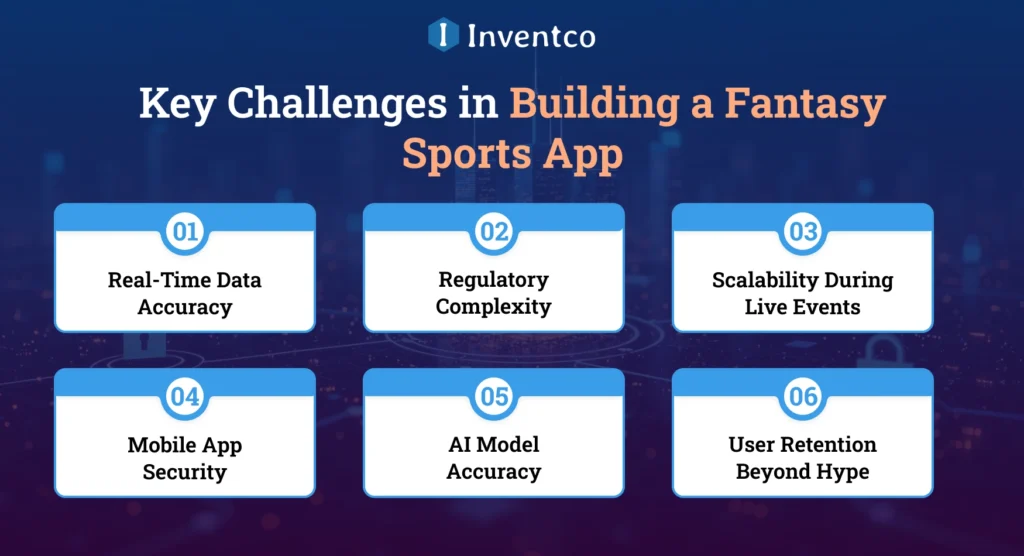
Building a competitive fantasy sports platform comes with a distinct set of Mobile App Development Challenges that go beyond typical app development hurdles, and founders are better served planning for them early rather than discovering them mid-build.
- Real-Time Data Accuracy: Sourcing reliable, low-latency sports data feeds and reconciling them with your scoring engine is technically demanding, and any inconsistency directly damages user trust in the leaderboard.
- Regulatory Complexity: Fantasy sports occupy a different legal category than betting in most jurisdictions, but the line varies by state and country. Real-money platforms need region-specific compliance built into the product, not bolted on after launch.
- Scalability During Live Events: Traffic spikes dramatically during marquee matches and tournament finals. A platform that crashes during the final minutes of a championship game loses user trust instantly, regardless of how strong its features are otherwise.
- Mobile App Security: Real-money transactions, user data, and payment information all need enterprise-grade Mobile App Security, since a single breach can end a platform’s credibility overnight.
- AI Model Accuracy: Predictive features are only as valuable as the data training them. Poorly calibrated AI recommendations can hurt user trust rather than build it, so model accuracy needs continuous monitoring post-launch.
- User Retention Beyond Hype: Many fantasy apps see strong downloads around a major tournament, then struggle to retain users once the event ends. Designing for sustained engagement, not just launch-week spikes, requires deliberate product planning from day one.
Each of these challenges is solvable, but they require an app development partner who has actually built and scaled platforms in this category, not a generic team applying standard app development logic to a use case with very specific real-time, regulatory, and trust requirements.
How Much Does It Cost to Develop a Fantasy Sports App?
The cost to develop a fantasy sports app falls between $10,000 and $100,000+, depending on the use complexity and required features and platforms. Budget-implicating features include AI-integrated recommendations, real-time scores and updates, and data and platform iterations.
Native apps are costlier than cross-platform apps. Budget implications for compliance, security, age and identity verification, and regional restrictions are also a factor. To ensure the app’s post-launch success, the app’s creator should consider restrictions and technology as a core building block and not an accessory.
Why Startups Must Consider Fantasy Sports App Development Trends
Startups need to keep in mind that knowledge of new developments in fantasy sports is an essential requirement for long-term success. Users of fantasy sports apps have come to expect personalization, secure payments, and the latest real-time data, recommendations, and notifications. The omission of any one of these features from an app can result in the loss of users to an app that is more innovative and has these features.
Investor expectations have also evolved, with greater focus on technology, scalability, compliance, and diversified app monetization strategies. Startups that can demonstrate strong data infrastructure and future-ready architecture often have a better chance of securing funding.
Most importantly, successful fantasy sports platforms treat technology as a core competitive advantage. By building scalability, security, and intelligent features from the start, startups can position themselves for sustainable growth and increased market share in a rapidly evolving industry.
How Inventco Helps You Build a Top Fantasy App That Rules the Market
Inventco collaborates with stakeholders to construct next-gen fantasy sports apps. Our services extend beyond the average app developer. We survey fantasy sports app markets, map out competitors, and create monetization strategies, all before we brainstorm app ideas. This guarantees that your digital product offers a sustainable value proposition and helps your app-related business grow.
We create the tech infrastructure that enables AI personalization, real-time sports data, sophisticated analytics, and seamless transactions. If you need a minimum viable product or an app that can support hundreds of thousands of simultaneous users, we have the right tech and the right approach to help you realize your business goals.
We also prioritize regulatory compliance and sustainable monetization. By implementing subscriptions, premium contests, loyalty programs, and other revenue models, we help businesses maximize user retention and lifetime value while creating fantasy sports platforms that are built to scale across markets and sports categories.

Final Thoughts
The evolution of fantasy sports is notable, we have advanced tremendously from casual bets with friends. Innovative technology is at the forefront of a multi-billion dollar industry. Platforms can succeed or fail after a single tournament cycle. Twelve trends have been analyzed, including AI personalization, blockchain technology, and monetization strategies.
Implementing every trend is neither feasible nor necessary. User trust and safety should always be prioritized. Future mobile app development trends can be layered on top, even some that are disruptive. If you are a founder or an investor looking into fantasy sports in 2026, there is an opportunity in this space. The rewards will be there for the builders who take the industry seriously and view fantasy sports as an actual technology category rather than a sports gaming app.
FAQs
Q1. How much does it cost to build a fantasy sports app?
Ans. A basic MVP typically starts around $10,000. At the same time, a feature-rich platform with AI personalization, real-time data, and blockchain integration can exceed $100,000+, depending on scope, compliance needs, and the app technology stack chosen.
Q2. How long does it take to develop a fantasy sports app?
Ans. A basic MVP can take 3 to 4 months, while a mid-tier or enterprise-grade platform with AI and real-time features typically takes 6 to 12 months, depending on feature complexity and compliance requirements.
Q3. Is fantasy sports app development legal?
Ans. Fantasy sports are legally distinct from sports betting in most jurisdictions, but rules vary significantly by country and, in some cases, by state. Founders should build region-specific compliance into the platform from day one rather than treating it as a post-launch fix.
Q4. What AI features are essential for a fantasy sports app in 2026?
Ans. At minimum, founders should plan for AI-powered team recommendations, predictive performance analytics, and AI-based fraud detection. Generative AI content and virtual draft assistants are increasingly expected but can be phased in after the core platform launches.
Q5. Should I build native apps or a cross-platform solution?
Ans. It depends on scale and budget. Cross-platform development is faster and more cost-effective for an MVP, while native development often performs better for data-heavy, real-time features once the platform reaches scale.
Q6. How does Inventco support fantasy sports startups specifically?
Ans. Inventco handles the full build, including market positioning, AI integration, real-time architecture, compliance, and monetization strategy, so founders get a platform engineered for both user trust and investor confidence, not just a functional app.

Ajay Bhal
He is an on-demand app solutions expert with 11+ years of experience in business consulting and building scalable, user-centric digital products. He specializes in robust on-demand platforms across industries, combining technical expertise with business-focused strategy to deliver efficient, top notch solutions that drive growth and enhance user experience. You can connect with him on LinkedIn to follow insights.