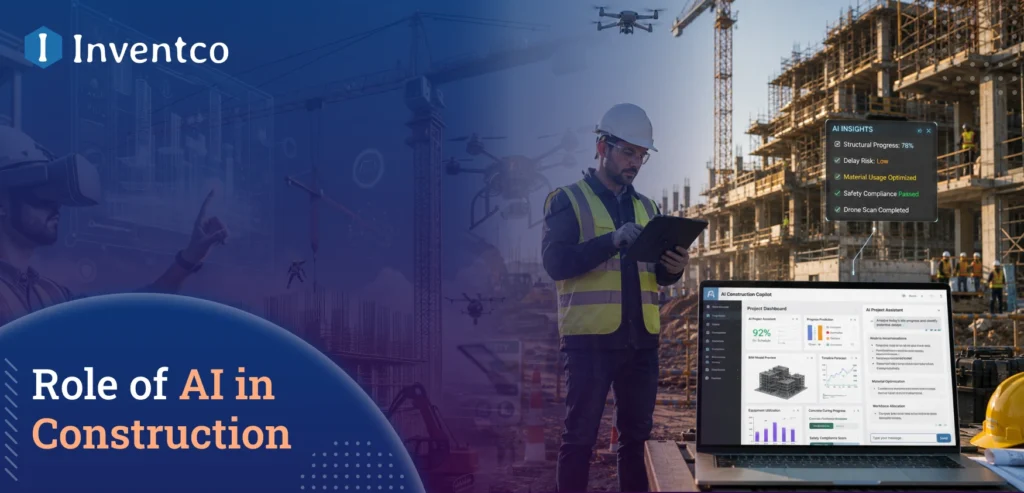
Going digital has been the priority for the construction industry for the last decade. Companies have moved from 2D paper blueprints to 3D building information models, and from radio communications to equipment fitted with IoT technology. 2026 marks a new era in construction. A perfect storm of a massive labor shortage of 500,000 workers in the U.S. alone, rising prices for construction materials, and increased data center and infrastructure construction competing for the same skilled workforce are all driving the same solution: the use of construction technology.
According to industry analysis from Fortune Business Insights, the global AI in construction market is projected to grow from roughly $6 billion in 2026 to more than $35 billion by 2034, a compound annual growth rate near 25% that few categories in the built environment can match.
For founders and investors, this is rapidly becoming a focus area for the deployment of their capital and design engineering resources. The labor shortage has made this a key focus area for the construction industry. The prevalence of contractors that have adopted AI for the purposes of cost estimation, scheduling, and bid management has increased from 17% in 2025 to 38% in 2026 according to the ServiceTitan’s 2026 Commercial Specialty Contractor Industry Report.
This guide breaks down how AI technologies used in construction are generating real value today, shows how technologies are used on jobsites and in back office operations, shows how much it costs to build a competitive product, and lays out the pathways on how to take an idea from MVP to enterprise-grade deployment.
What Is AI in Construction?
AI in construction refers to the application of machine learning, computer vision, natural language processing, and generative AI models to construction-specific problems: estimating costs, sequencing schedules, inspecting work quality, monitoring jobsite safety, predicting equipment failure, and, increasingly, generating design and structural options before a single brick is laid. Unlike general-purpose software, AI in construction management systems are trained on the variables unique to the industry, including weather exposure, multi-trade coordination, regulatory inspection cycles, and equipment that operates in harsh, unpredictable field conditions.
Project management systems and construction industry scheduling systems are the most investment-heavy construction industry systems to employ AI. This is because construction companies are using artificial intelligence to build systems that will streamline and enhance efficiency with time management, project scheduling, and, in turn, improve profit margins on projects. Of the systems that manage commercial construction projects, systems that manage trade partner and construction project risk are the systems that will have the greatest impact on profit margins.
North America currently leads global adoption, driven by venture capital availability, mature cloud infrastructure, and a wave of federally backed infrastructure and clean-energy construction. Europe is close behind, accelerated by new digital construction alliance regulations taking effect in 2026 that will require greater AI and digital tool adoption on public projects.
If you are a founder looking at this space, the conclusion is clear. AI in construction is no longer an experimental appendage to outdated systems. It is fast becoming the norm for general contractors and developers, as well as asset owners juggling complex and extensive multi-site portfolios.
Why 2026 Is the Inflection Point for AI Adoption
Three converging pressures are forcing the construction industry’s hand in 2026.
1. A Labor Shortage That Technology Can No Longer Ignore
The Associated General Contractors of America reports that 94% of construction firms are struggling to fill open positions, with the industry needing roughly 500,000 new workers in 2026 alone just to keep pace with current demand. Nearly three-quarters of construction leaders say skilled labor shortages are already disrupting business operations, and an estimated 41% of the existing workforce is expected to retire by 2031. Workers in the trades are not replacing those who have been lost, and the lack of new workers is a concern for 80% of construction executives, according to the BambooHR 2026 State of the Workforce report.
2. Competing Demand From Data Centers and Infrastructure
Skilled labor needed for the construction of data centers, semiconductor fabs, and clean-energy facilities, along with the construction of housing and commercial facilities, compete with one another. This has disrupted a number of construction projects and caused significant delays. Companies will need to focus on efficiency as opposed to simply workforce expansion if they hope to meet deadlines and complete the work.
3. Margin Pressure That Rewards Measurable ROI
Material costs continue to rise, and supply chain problems are persisting, which means contractors will not be able to absorb inefficiencies for much longer. In response to these issues, we will see a true transition to embedded, revenue-preserving AI tools, versus the isolated, experimental projects of the past. ServiceTitan’s 2026 survey reported that 24% of contracting firms are utilizing AI for cost estimation and budgeting, and 22% are using it for bid management, both of which directly deal with protecting contractors’ margins.
For investors, the combination of chronic labor shortages and strong, measurable ROI is the main reason AI in construction is miles ahead of the previous construction technology excitement. It is not an aspirational demand; it is a requirement, and demands of this type lead to a long-term use of a platform as opposed to temporary pilot projects.
How Is AI Used in Construction? Core Applications Reshaping the Industry
Understanding how AI actually changes construction practice is essential when deciding whether to invest capital in a construction product. Here are the primary areas where AI is being adopted right now.
1. AI in Project and Schedule Management
Scheduling is notoriously one of construction’s weakest points. Problems can escalate and become company-wide disruptions. Development of AI scheduling tools means that trade scheduling problems will be detected and resolved far in advance of the usual scheduling bottleneck, as planners will have more comprehensive and accurate forecasts to work with.
One tool even automatically identifies schedule rework and billing discrepancies by comparing 3D site scans to BIM models. As scheduling problems are arguably the most detrimental to project bottom lines, AI tools that help mitigate scheduling problems have the highest adoption rate and growth.
2. Generative AI in Construction Design
Generative AI in construction has reached a new phase of engineering viability. AI co-pilots are being integrated into structural design workflows by engineering firms to automatically generate upwards of dozens of design options within material, space, and cost constraints. Tools to generate design options have notably reduced time to design by orders of magnitude.
Engineering firms have also employed AI-assisted generative design in the construction of bridges to produce multiple models of a design to refine and iterate structural models to reduce design cycles. Tools for generative design in engineering offer extremely high value opportunities with little risk of commoditization.
3. AI in Construction Equipment Maintenance
Unscheduled equipment failure is one of the largest expenses during a construction project. It has been reported that the construction of projects in 2025 experienced an approximately 14% loss of operating time for the heavy equipment used due to breakdowns, resulting in repairs that delayed milestones and reduced profit. Construction equipment maintenance that uses AI and IoT devices can achieve real time monitoring of vibration, temperature, fuel burn, and hydraulic pressure.
AI can learn early indicators of mechanical stress, for example, bearing wear, pump cavitation, or injector problems, that would occur hours or days before equipment would be expected to fail. Companies that are the early users of these technologies may achieve a 45% reduction in equipment downtime. This significantly reduces the cost of maintenance.
4. AI-Powered Jobsite Safety
Computer vision is the most advanced AI technology available for construction site safety. Fatalities from falling, being struck by an object, or being caught in or between an object are major concerns in the construction industry, and manpower cannot be employed to monitor large and moving construction sites.
AI-based systems are being deployed to monitor construction sites and track violations in PPE, proximity, and behaviors, and alert safety personnel in real-time, as opposed to being notified after the fact, once an incident report is generated. Various case studies report a 20%-60% incident reduction during the first year of system deployment, and safety directors and insurance companies take these numbers seriously.
5. AI in Risk Management and Cost Estimation
Risk assessment and the associated costs have been the most rapidly growing applications of AI in construction. Predictive systems, as opposed to labor-intensive manual estimates, provide an integrated view of costs, risks, and multiple parameters. AI does not eliminate the manual component; rather, it allows the estimator to consider cost and schedule risks and unreliable vendors, which traditionally went unassessed.
6. AI in Supply Chain and Procurement
The construction industry is challenged by material price spikes and interruptions in the supply chain. Advanced AI procurement tools predict trends in the price of materials and identify risks in supplier reliability. These tools also optimize the timing of orders in order to minimize the costs of carrying materials, while also protecting against shortages that disrupt supply to the construction site.
There is a common theme throughout all these AI use cases in construction. They rely on data and tend to make processes that were previously reactive and manual, proactive and automated, which is why they are all so appealing from an investment standpoint.
Benefits of AI in Construction for Founders and Investors
Beyond the use cases themselves, the benefits of AI in construction compound across the entire project lifecycle, which is what makes the category attractive for both contractors adopting these tools and the founders building them.
| Benefit | Business Impact |
| Reduced Project Delays | Predictive scheduling identifies potential risks weeks in advance, helping construction firms maintain delivery timelines and avoid contractual penalties. |
| Lower Equipment Downtime | AI-powered predictive maintenance can reduce unplanned equipment downtime by up to 45%, improving productivity and asset utilization. |
| Improved Jobsite Safety | Computer vision and real-time monitoring systems have been shown to reduce workplace incidents by 20% to 60% within the first year of implementation. |
| Tighter Cost Control | AI-assisted cost estimation enhances bid accuracy, minimizes budgeting errors, and helps protect profit margins amid fluctuating material prices. |
| Faster Design Iteration | Generative AI accelerates design development, reducing design cycles from weeks to days while optimizing resource and material usage. |
| Stronger Investor and Lender Confidence | Data-driven project reporting increases transparency, enabling better communication with investors, lenders, insurers, and public-sector stakeholders. |
For founders specifically, the appeal extends beyond any single benefit. Construction is a famously fragmented, technology-underserved industry, and the segments seeing the fastest AI adoption, scheduling, safety, and maintenance, are also the segments where a well-built mobile platform can scale across thousands of contractors without requiring custom integration for each one. That combination of acute pain and software-addressable demand is rare, and it is why investors have continued backing construction AI through several broader technology funding pullbacks.
How Can AI Be Used in Construction? A Build Roadmap for Founders
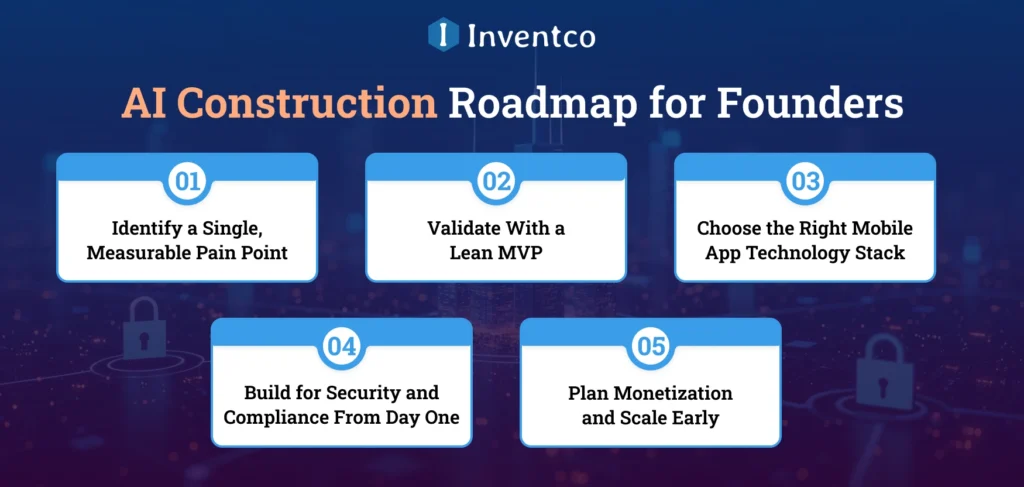
If you want to know how to use AI in construction while targeting a product market, rather than offering contractors a tool, you need a well-structured strategy. Here is what the most successful construction-tech founders have done.
Step 1: Identify a Single, Measurable Pain Point
The best AI-enabled construction products identify a problem that costs significant resources to resolve and provide a robust solution. Examples are construction downtime, safety violations, and schedule risks. Other products have tried to build an all-encompassing platform, but fail to implement necessary mobile features in the early days. This approach enables founders to build a highly focused, scoped, and capital-effective construction technology mobile app.
Step 2: Validate With a Lean MVP
Before spending lots of money on a complete AI model pipeline, a large percentage of construction founders focus on validating the need for their product with a lower version of the product, which is built on existing layers of AI APIs, rather than on a custom AI model. This is in the spirit of the mobile app refactoring that construction founders often reference, which talks about quickly defining must-have mobile app features. Doing this allows real user feedback to help prioritize the features to implement next.
Step 3: Choose the Right Mobile App Technology Stack
Unlike standard consumer apps, construction apps require a set of tools designed to accommodate inconsistent connectivity, tough equipment, and multiple personnel. Consideration of an array of tools, including offline-first architecture, edge AI, and the tools used to conduct field work, will be necessary when designing your mobile app tech stack. Different construction mobile apps will require different trade-offs when considering the use of complex technologies, like computer vision and sensor data. Consider trade-offs for high performance and native apps versus cross-platform speed and ease of rollout.
Step 4: Build for Security and Compliance From Day One
The sensitive nature of the data that construction AI platforms process makes the security of mobile apps especially important in this industry. User data can include sensitive biometric data, equipment telemetry, and bid data. Safety, security, and compliance must be built in from the start, especially with the increased number of requirements in public sector construction.
Step 5: Plan Monetization and Scale Early
Successful tools in this industry have all established mobile app monetization strategies before their first enterprise customer, as they are a hybrid of subscription and usage-based or per-project fees. The time between contracting the first enterprise customer and the first site-wide deployment will be used to field test the mobile tool in situations with low connectivity against multiple user roles. This is because a poorly designed safety app will crudely interrupt normal tool use on a construction site.
Following this guidance will allow you to establish the app development process at the cutting edge of AI, with field ready construction tools. The alternative is developing the AI retrofitting construction tools of an obsolete era.
Cost to Build a Mobile App Powered by AI in Construction
If you are evaluating what it actually costs to build a mobile app for this space, the honest answer is that it depends heavily on AI complexity, not just feature count. Pricing to build a mobile app with embedded AI in construction capabilities generally falls into three tiers.
| Project Tier | Scope | Estimated Development Cost |
| MVP / Single Use Case | Includes one core AI capability, such as predictive maintenance alerts or basic safety monitoring, built using existing AI APIs, along with a mobile application and a basic management dashboard. | $10,000 – $25,000 |
| Mid-Market Platform | Features multiple integrated AI modules, such as scheduling, risk assessment, and automated reporting, with light model customization, BIM/ERP integrations, and offline-first functionality. | $25,000 – $60,000 |
| Enterprise-Grade AI Platform | Supports custom-trained AI models, computer vision systems, predictive analytics, multi-site IoT integration, advanced reporting, enterprise security, and regulatory compliance requirements. | $60,000 – $100,000+ |
Several factors push projects toward the higher end of this range: training custom computer vision models for jobsite-specific hazard detection, integrating with legacy ERP and fleet telematics systems, building offline-first functionality for low-connectivity sites, and meeting the security and compliance bar required for enterprise and public-sector clients. Teams that start lean, providing value with a single AI-driven feature before expanding, consistently get a faster, less expensive path to product-market fit than those who try to build a multi-module platform on day one.
For founders comparing vendors or estimating their own roadmap, it is worth treating the decision to build a mobile app the same way contractors treat a construction bid: get clear on scope first, price second, and resist the temptation to over-build before real usage data justifies it.
Key Challenges in Adopting AI in Construction
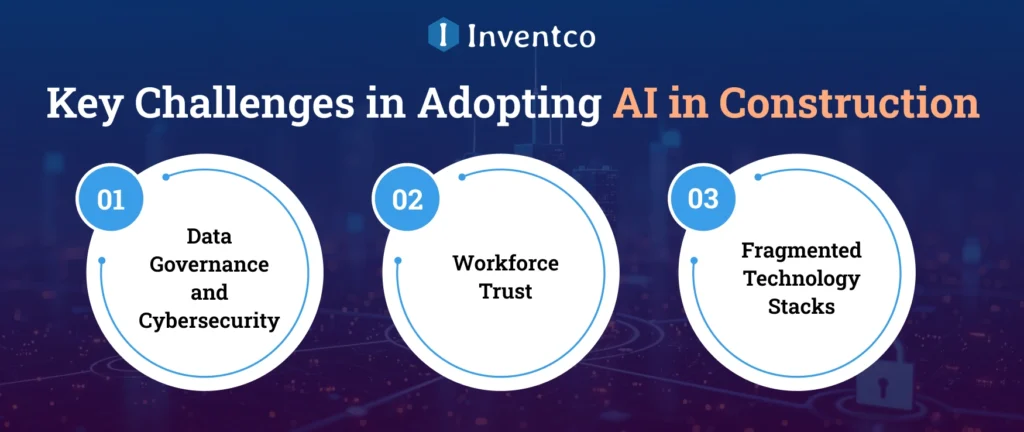
No category this fast-growing arrives without friction. Three challenges consistently come up for both contractors adopting AI tools and founders building them.
- Data Governance and Cybersecurity: Construction has historically underinvested in cybersecurity, yet AI in construction management tools depends on capturing sensitive data, including worker biometrics, equipment logs, and financial bid data. Secure-by-design architecture, encryption, and access controls are not optional.
- Workforce Trust: Despite rapid adoption, many field workers remain skeptical that AI tools will replace or threaten their roles. Products that position AI as a force multiplier for safety officers and supervisors, not a replacement, see far higher field adoption.
- Fragmented Technology Stacks: Nearly half of construction firms report zero AI implementation despite genuine interest, often due to high upfront costs, limited in-house technical expertise, and disconnected legacy software. Platforms that integrate cleanly with existing BIM, ERP, and fleet systems clear this hurdle far more easily than standalone tools requiring a full technology rip-and-replace.
Understanding these constraints upfront, rather than discovering them mid-build, is what separates AI in construction products that achieve real field adoption from those that stall in pilot purgatory.
How Inventco Can Help Build AI-Powered Construction Solutions
Bringing AI into construction isn’t as simple as applying smart features to a construction tech platform. Picking the right use case, building a flexible, scalable architecture, bridging gaps with industry systems, and delivering measurable ROI from the start become vital challenges. At Inventco, we turn operational roadblocks into AI-driven solutions for construction companies, startups, and enterprise contractors.
Our team specializes in developing custom construction technology solutions, including predictive maintenance platforms, AI-powered safety monitoring systems, intelligent scheduling tools, risk management applications, and generative design platforms. From MVP app development to enterprise-grade deployments, we handle every stage of the product lifecycle, including strategy, UI/UX design, AI integration, mobile app development, cloud infrastructure, security implementation, and ongoing support.
Use our construction tech industry focus and experience to turn your AI ideas into building construction tech fast. Use it to unify multiple construction tech sites and make it a flexible, scalable construction solution.

The Bottom Line
In 2026, the role of AI in Construction will be to defend very low profit margins due to rising construction material costs and the increasing difficulties in completing construction projects within established timeframes, as well as filling a 500,000-worker gap in the construction workforce that cannot be filled through hiring alone. The use of AI construction technology is now beyond the pilot phase and is being used for predictive equipment maintenance and real-time imaging for construction site safety and design.
It’s 2026, and because of the fusion of deep industry pain and real software scalability, opportunities for founders and investors are more apparent due to the rareness of the technology market as a whole.
Whether you are focused on a minimum viable product with a high-value singular use case, or a complex full-scale enterprise platform, the construction industry is more than willing to adopt AI tools that can significantly decrease risk, downtime, and cost. If you are pondering ways to construct a mobile application that integrates AI for the construction industry, the technical and financial resources mentioned previously are the right starting point.
FAQ’s
Q1. What is the role of AI in construction in 2026?
Ans. AI is helping construction firms close labor gaps, predict equipment failures, monitor jobsite safety in real time, and generate design options faster. In 2026, adoption has moved from experimentation to measurable, budgeted operational impact across scheduling, safety, and cost estimation.
Q2. How is AI used in the construction industry today?
Ans. The most common applications include predictive scheduling, generative design, equipment maintenance forecasting, computer vision safety monitoring, AI-assisted cost estimation, and supply chain forecasting. Project management and scheduling tools currently see the highest adoption.
Q3. What are the main benefits of AI in construction?
Ans. Key benefits include fewer project delays, lower equipment downtime, improved jobsite safety, tighter cost control, faster design iteration, and stronger reporting transparency for investors and lenders.
Q4. How much does it cost to build an AI-powered construction app?
Ans. Costs typically range from $10,000 for a single-feature MVP to $100,000+ for an enterprise-grade platform with custom-trained models, multi-site integrations, and full compliance hardening.
Q5. What is generative AI’s role in construction?
Ans. Generative AI helps engineering and design teams produce multiple structural or layout options against cost, material, and safety constraints simultaneously, compressing design cycles that once took weeks into a matter of days.
Q6. How can AI be used in construction equipment maintenance?
Ans. IoT sensors feed real-time vibration, temperature, and pressure data into AI models trained to detect early signs of mechanical stress, allowing maintenance teams to address issues before a breakdown halts the project.

Sandeep Agrawal
Sandeep Agrawal is the visionary CTO at Inventco, bringing innovation to life through his technical expertise. With a passion for cutting-edge technologies, Sandeep leads the team in developing robust solutions. His dedication and continous efforts to pushing the boundaries of what’s possible defines his role as a transformative and innovative force in the tech industry. You can connect with him on LinkedIn to follow insights.