Quick Answer
Most healthcare apps in 2026 run somewhere between $30,000 and $250,000, sometimes more. The exact figure depends on app type, how deep the feature set goes, and how much compliance work gets pulled in. A simple booking app and an AI diagnostic tool are worlds apart in price, and honestly, they should be.
Healthcare has turned into one of the busiest corners of the app world right now. Hospitals, clinics, and small startups are all trying to put some form of care into a patient’s pocket. Money is following that shift fast.
The mHealth apps market is projected to grow from $46.16 billion in 2026 to $92.69 billion by 2031, a compound annual growth rate near 15%. Zoom out further, and the broader mobile health market sits at $130.07 billion in 2026, on track to reach $403.02 billion by 2031.
That growth isn’t coming from wellness trackers anymore. Providers are pouring money into telemedicine, remote monitoring, and diagnostic tools built around artificial intelligence in healthcare, the same shift reshaping decisions clinicians used to make by hand.
Key Takeaways
- Basic healthcare apps start around $30,000. Complex, AI-integrated platforms can cross $500,000.
- HIPAA compliance alone can add 20% to 50% to your base development cost.
- App type changes the price more than most founders expect going in.
- Hidden costs like audits and hosting often add another 15% to 25% every year after launch.
- Planning compliance from the start avoids expensive rework later.
Average Healthcare App Development Cost in 2026
Most healthcare apps land in one of three tiers. Each tier reflects how much security work, integration, and custom logic the build actually needs.
| App Complexity | Features | Estimated Cost (2026) |
| Basic | Appointment booking, profile, notification | $30,000 – $80,000 |
| Mid-Level | Telemedicine, chat, payment, basic compliance | $80,000 – $200,000 |
| Advanced | AI diagnostics, EHR integration, wearable sync | $200,000 – $500,000+ |
These numbers track with what agencies are quoting right now. One 2026 industry breakdown puts costs between $25,000 for a lean, HIPAA-compliant MVP and over $500,000 for an enterprise platform with AI and EHR integration built in. Most of that price gap isn’t about skill but about project scope. Bring in a team that already lives and breathes healthcare app development, and you dodge the nasty surprise where compliance work gets bolted on halfway through, quietly doubling the budget.
Healthcare App Development Cost by App Type
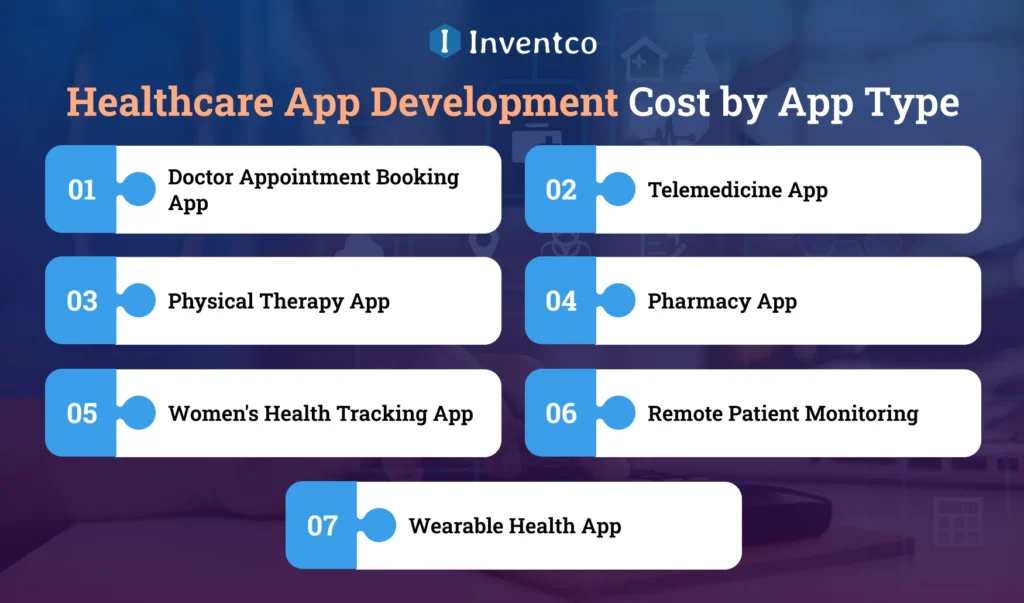
Cost shifts a lot depending on what the app is actually built to do. Here’s a realistic breakdown by category.
1. Doctor Appointment Booking App
These sit at the easiest entry point into healthcare tech, with a straightforward doctor appointment booking app usually landing between $40,000 and $90,000. Costs climb once you add calendar sync across providers, insurance verification, and support for multiple clinic locations.
2. Telemedicine App
Video consultations, e-prescriptions, and payment processing push this category to 90,000–220,000. HIPAA-grade video encryption isn’t optional here, so it needs pricing in from the start rather than bolted on later.
3. Physical Therapy App
These combine exercise libraries, progress tracking, and sometimes motion-sensor feedback for form correction, usually running $60,000 to $150,000. Building a physical therapy app well means the exercise content has to update easily, since clinics adjust programs constantly based on patient recovery.
4. Pharmacy App
A pharmacy app built around prescription uploads, inventory syncing, and delivery tracking across multiple locations typically falls between $70,000 and $180,000, depending on how many delivery partners it connects to.
5. Women’s Health Tracking App
A women’s health tracking app handling cycle data, fertility metrics, and symptom logs needs privacy handling that goes beyond the usual baseline, which is part of why costs sit around $60,000 to $140,000.
6. Remote Patient Monitoring
This is where budgets climb fast. Device integration, real-time alerts, and clinician-facing dashboards that plug into hospital record systems push costs to 150,000–400,000, depending on how many device types the platform has to support.
7. Wearable Health App
Syncing with Fitbit, Apple Watch, or custom sensors adds SDK licensing fees and a lot of app testing overhead. Wearable app development can become significantly more complex depending on how many device ecosystems the app needs to support, so budget $100,000 to $300,000.
Read More: How to develop a Mental Health App?
What Factors Affect Healthcare App Development Cost?
A handful of variables consistently swing the final number, sometimes by tens of thousands of dollars.
Platform choice is the first one. Native iOS and Android builds cost more than cross-platform frameworks, though native often performs better once you’re dealing with sensitive medical features that need tighter device access. Picking the wrong tech stack here is one of the more common budgeting mistakes, and it usually shows up mid-project rather than at the start. The choice can also affect the overall app development timeline, particularly when separate platforms require additional development and testing.
EHR and EMR integration is another major driver. Connecting a new app to a hospital’s existing records system is rarely simple, and the difference between the two systems matters more than most founders realize before comparing EHR vs EMR requirements against their own project scope.
AI features add cost differently. Symptom checkers, risk-scoring models, and image analysis tools are common examples of AI in app development, but they all require training data, testing, and ongoing tuning after launch. Anyone weighing this feature set against a simpler build should look closely at how AI development pricing actually breaks down before locking in a budget.
Team location shifts the number too, sometimes drastically. Offshore teams in India or Eastern Europe often deliver the same scope for 40% to 60% less than a US-based agency charges, though the savings only hold up if the offshore team already has healthcare compliance experience.
Compliance scope is the last major factor, and it’s the one people underestimate the most. HIPAA, GDPR, and sometimes HITRUST requirements all pile on legal review and engineering time. Feature depth matters here too. Apps built around richer concepts, like the ones covered in ideas for improving patient care, naturally take longer to build than a stripped-down MVP.
How Much Does HIPAA & GDPR Compliance Add to the Cost?
Compliance is where healthcare app budgets tend to go sideways. Teams that treat it as a later step almost always end up paying more for it than teams that plan for it from day one. Building compliance into the mobile app development process helps identify security and regulatory requirements before they become expensive rework.
Industry estimates place the added cost of HIPAA compliance somewhere between $15,000 and $25,000 on top of a standard build. For larger builds, the number moves differently. Custom development can add 20% to 30% to the base build cost for HIPAA infrastructure alone, and retrofitting compliance into an app that wasn’t built with it in mind can cost 40% to 80% of the original build.
The financial risk of skipping this step is steep. Following mobile app security best practices becomes especially important when patient data is involved, since healthcare applications need stronger protection against unauthorized access and data breaches. The average healthcare data breach reached $10.93 million in 2024, the highest cost of any industry tracked that year. That single figure explains why compliance budgets keep rising even when development costs elsewhere hold steady.
GDPR carries similar weight for any app serving users in the European Union, with its own consent and data-handling rules that run separately from HIPAA. If you’re not sure where your app stands on either front, don’t wait for a developer to flag the gap mid-build.
Hidden & Ongoing Costs to Budget For
The launch price is never the full price, and healthcare apps carry more ongoing costs than most other categories.
Cloud hosting and storage sit at the top of that list, since medical images and patient records need infrastructure that meets HIPAA-grade security standards, not a standard hosting plan. Annual audits come next. HITRUST or SOC 2 certification typically runs $10,000 to $25,000 for the first review, then $5,000 to $15,000 every year after that.
Security patching isn’t optional once patient data is involved, and it has to happen on a schedule, not whenever time allows. App store and operating system updates also demand attention year-round, since a single major iOS or Android release can quietly break compatibility with older builds. Someone on the team also needs to own user support and compliance documentation on an ongoing basis, which is a cost founders often forget to staff for.
Planning this part of the budget properly usually comes down to treating ongoing app maintenance as a fixed annual line item from the start, rather than a surprise bill that shows up six months after launch.
Case Study: Real Healthcare App Cost Breakdown
Check My Mole
This one is a build from our own portfolio, and it’s a good example of how AI features reshape a budget. Check My Mole is an AI-powered app that scans mole images and flags possible skin cancer risk, then tracks how those moles change over time and connects users to a dermatologist directory.
Delivering that required an AI image analysis engine, a detailed medical questionnaire system, encrypted storage for biopsy data, and an admin dashboard for managing users and content. Projects with this scope generally land between $40,000 and $80,000 for a first version, once you account for the AI integration, secure record-keeping, and the administrative layer sitting behind it. The build combined React Native, Python, and AutoDerm AI’s image analysis API to keep both diagnostic accuracy and patient privacy intact at the same time.
Read More: What is the Role of AI in Healthcare?
How to Reduce Healthcare App Development Cost Without Compromising Compliance?
Cutting corners on compliance is never the right lever to pull. But there are real ways to control cost without touching security or regulatory requirements.
Starting with an MVP is the biggest one. Launching the core features of a mobile app first and expanding later keeps early spending focused on what actually matters, and a properly scoped MVP avoids paying for features nobody uses in month one.
Building compliance from day one is the second lever, and arguably the most important one on this list. Retrofitting HIPAA later costs far more than planning for it upfront, as the earlier compliance numbers make clear. Using cross-platform frameworks, build-ups can be safe and also cut development time without weakening core functionality. Moreover, the app doesn’t depend on features that require deep native access.
Working with a team that already understands healthcare reduces expensive mistakes simply because they’ve made them once already on someone else’s project. Planning the layout properly before writing any code matters more than it sounds. Careful wireframing up front consistently avoids the kind of late-stage revisions that quietly double a timeline.
How Inventco Builds Cost-Effective, Compliant Healthcare Apps?
Inventco is the leading healthcare software development company in USA. We build healthcare apps with compliance treated as part of the architecture from the first sprint, not something added right before launch. Our team has shipped AI-diagnostic tools, mental wellness platforms, and accessibility-focused healthcare apps, each with different regulatory demands. Addressing the challenges in mobile app development early is especially important in healthcare, where security, compliance, integrations, and regulatory requirements can affect both timelines and costs.
Costs stay predictable because we scope MVPs realistically and flag compliance requirements before writing a single line of code. Founders comparing development partners for a healthcare project usually end up asking the same question: why teams choose Inventco for healthcare builds. However, the answer is simple. It always comes down to planning for compliance early instead of scrambling to patch it in later.
Conclusion
Healthcare app development cost in 2026 depends heavily on what you’re building and how seriously compliance gets treated from day one. A simple booking app and an AI diagnostic platform live in completely different budget categories, and pretending otherwise is how quotes end up off by hundreds of thousands of dollars. Planning for compliance early, scoping the right app type, and working with a team that has already solved these problems once protects your budget far more than chasing the cheapest quote on the table.
Frequently Asked Questions
Q1. What factors affect healthcare app development cost the most?
Ans. Factors affecting healthcare app development cost usually come down to five things. Compliance requirements, feature complexity, platform choice, team location, and integration needs. HIPAA work alone can shift a quote by tens of thousands of dollars, which is why scoping compliance early matters more than picking a framework.
Q2. How much does healthcare app development cost in the USA compared to hiring offshore?
Ans. Healthcare app development cost in the USA typically runs 40% to 60% higher than offshore rates for the same scope. A US agency might quote $150,000 for a build that a HIPAA-trained offshore team delivers closer to $70,000, with similar quality.
Q3. What is the average cost to develop a custom healthcare mobile app with unique features?
Ans. The average cost to develop a custom healthcare mobile app depends entirely on how far it strays from standard templates. Once you’re building custom workflows or proprietary algorithms, or wiring up niche integrations nobody’s built before, the price jumps past $200,000 quickly.
Q4. Can you break down healthcare app development cost by individual features?
Ans. A healthcare app development cost breakdown usually separates three buckets. Core features run $30,000 to $60,000. Compliance infrastructure adds $15,000 to $40,000. It also depends on how complex things get. If you are adding AI or EHR integration into the build-up, you should add $50,000 to $150,000 to your total development cost.
Q5. Is healthcare mobile app development more expensive than a normal consumer app?
Ans. Yes, and it’s not close. Building a healthcare mobile app almost always costs more than a regular consumer app, mainly because of the compliance layer, the security work, and the data handling requirements a shopping app or a game never has to deal with. Encryption, audit trails, and access controls add engineering hours a fitness or shopping app never needs, which is why quotes rarely match.
Q6. Is 2026 the best time to budget for healthcare app development, or should businesses wait?
Ans. The healthcare app development cost you’re weighing today sits inside a market that’s already blown past $117 billion, and it isn’t slowing down. Waiting rarely lowers your cost. Compliance rules keep tightening, and developer rates keep climbing, so building now on solid architecture tends to save money later.
Q7. What hidden expenses show up after the initial healthcare app development cost is paid?
Ans. Here’s the part most founders don’t budget for. The bills don’t stop once the app is live. You’re looking at cloud hosting fees, then annual HITRUST or SOC 2 audits if you’re handling patient data, plus ongoing security patching and the never-ending cycle of app store updates. Add it all up, and you’re usually paying 15 to 25 percent of the original healthcare app development cost every single year, just to keep the lights on.

Jitendra Jain
He is the CEO and Co-founder of Inventco, driving innovation in advanced computing and digital transformation. With deep expertise in modern IT ecosystems, he leads scalable, secure, future-ready solutions. His strategic leadership helps businesses accelerate growth, adopt innovation, and achieve success. You can connect with him on LinkedIn to follow his technology insights.