
Quick Answer
Healthcare app development is the work of planning, designing, building, and launching software for patients, doctors, or hospitals. Most projects take three to nine months and cost between $30,000 and $250,000. The biggest factors are your scope, your compliance needs, and the experience of your team.
Ten years ago, booking a doctor meant a phone call and a long wait. Today, people expect to do it from their couch, and clinics have had to keep up. Hospitals, small practices, and startups are all racing to put care inside a patient’s phone.
The money is flowing. The mHealth apps market is expected to grow from $46.16 billion in 2026 to $92.69 billion by 2031. The World Health Organization also sees digital tools as a real way to bring care to people who lack access.
Still, a medical app is a different job from a shopping app. Patient data is sensitive, laws are strict, and mistakes can affect someone’s health. This blog covers app types, features, process, technology, compliance, cost, and timelines, so you can plan with fewer surprises.
Key Takeaways
- Pick one problem and one user group before you design anything.
- Plan for HIPAA and other privacy laws from the very first week.
- Launch a small MVP so real users can test your idea.
- EHR and wearable integrations can make or break how useful the app feels.
- Hire a team that has shipped healthcare products before, since it saves you rework later.
What Is Healthcare App Development and Why Are Businesses Investing in Healthcare Apps?
Healthcare app development is the work of creating a mobile app or web software that supports medical care. The users can be patients, doctors, pharmacists, insurers, or hospital staff. Some apps only send appointment reminders. Others pull live data from medical devices and show it on a clinician’s dashboard.
So why are so many businesses putting money into this space? A few reasons come up again and again.
1. Patient Demand
Patients now expect to book visits, read reports, and message their doctor from a phone. Nobody wants to sit on hold anymore.
2. Lower Operating Costs
Apps take over routine jobs like scheduling, paper forms, and repeated data entry. That frees your staff to spend more time with patients.
3. Better Health Outcomes
A timely reminder can decide whether a patient finishes treatment or skips it. With remote monitoring, doctors also spot trouble sooner, and early treatment is usually simpler.
4. New Revenue Streams
Clinics and startups can add subscriptions, virtual visits, and wellness programs. That brings in income from people who may never walk through the door.
If you’re still hunting for a direction, these ideas for healthcare to improve patient care show where technology is already helping.
Types of Healthcare Apps You Can Develop
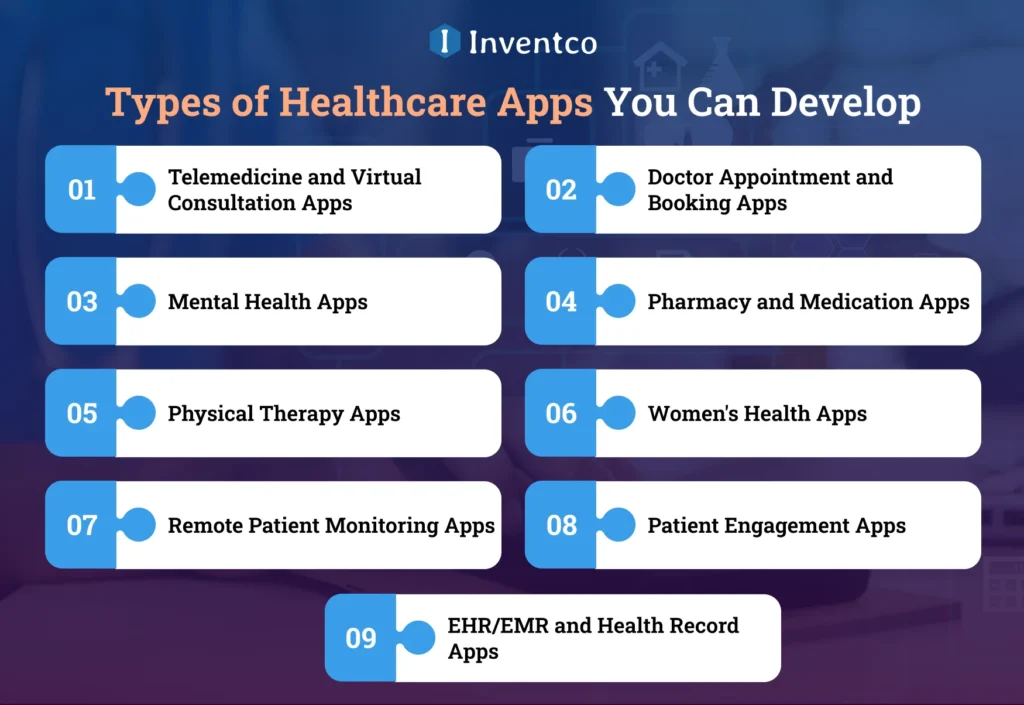
Every app type solves a different problem. Your pick affects the budget, the feature list, and the laws you’ll need to follow.
1. Telemedicine and Virtual Consultation Apps
These apps connect patients and doctors over video, voice, or chat. A typical build covers booking, digital prescriptions, and safe payment handling. They matter most in remote towns, where the nearest specialist may be hours away.
2. Doctor Appointment and Booking Apps
A doctor appointment booking app lets patients pick a time slot and get a reminder before the visit. Clinics see fewer no-shows, and front desk staff spend less time on the phone. For many clinics, this is the easiest place to start.
3. Mental Health Apps
This category covers therapy platforms, mood trackers, and meditation tools. Privacy matters even more here, because people share very personal thoughts, so you need to be very careful before developing a mental health app.
4. Pharmacy and Medication Apps
Customers can order medicines, upload a prescription, and get a nudge when a refill is due. Delivery tracking and a quick chat with the pharmacist make the experience much better. Drug rules change from country to country, so pharmacy app development needs some legal homework early on.
5. Physical Therapy Apps
These apps give patients exercise plans with video demos and progress tracking. A few even use the phone camera to check posture. If you want to create a physical therapy app, make content easy to update, because clinics change programs often.
6. Women’s Health Apps
Cycle tracking, pregnancy support, and fertility tools all sit here. Users see this data as deeply private, so your safeguards need to go beyond the basics. A good women’s health tracking app earns trust on every screen.
7. Remote Patient Monitoring Apps
These apps pull in readings like heart rate, glucose, and blood pressure from connected devices. Doctors follow the numbers on a dashboard and get an alert the moment a reading looks wrong. Costs climb fast here, mostly because every device type needs its own integration.
8. Patient Engagement Apps
These apps keep patients involved between visits with health tips, medication reminders, surveys, and secure messaging. Engaged patients tend to follow their plans more closely. That also helps providers avoid repeat hospital visits.
9. EHR/EMR and Health Record Apps
These apps store and share patient histories, lab results, and treatment notes. Many teams mix up the two record types at the start. Learning the difference between EHR vs EMR early can save weeks of confusion.
Essential Features of a Healthcare App
The right features depend on who is using the app. Most platforms end up with three separate experiences, one each for patients, providers, and administrators.
Patient-Side Features
- Easy sign-up with secure login and biometric options
- A profile with medical history and insurance details
- Appointment booking with automatic reminders
- Video or chat consultations
- Access to prescriptions and lab reports
- In-app payments and downloadable invoices
- Push notifications for medicines and follow-ups
- Wearable and health data sync
Provider-Side Features
- Provider profile and availability management
- Appointment and calendar management
- Patient records and medical history access
- Video and chat consultations
- Digital prescriptions and treatment plans
- Lab reports and test result access
- Patient progress and health data monitoring
- Secure messaging and follow-up reminders
- Notifications for upcoming appointments and patient updates
Admin-Side Features
- User and provider account management
- Appointment and consultation management
- Role-based access control
- Patient and provider data management
- Payment, billing, and transaction management
- Reports and analytics dashboard
- Content and notification management
- Integration management for EHR, payment, and other healthcare systems
- Audit logs and security monitoring
These are some of the key features of a healthcare app. Custom features can be added based on your specific requirements.
Process to Develop a Healthcare App
A clear app development process keeps cost and risk in check. Most successful teams follow a path like the one below.
Research and Discovery
Study your users, your competitors, and the rules in your target market. Write the problem in one sentence, then prototype the core user experience before you plan the full build. Talk to real doctors and patients before you move into development.
Planning and Scope
List every feature and rank each one by value. Decide what goes into version one and what can wait. Then pick your platforms by weighing the requirements of Android vs. iOS development, and set a budget range you can stick to.
Healthcare App Integrations You May Need
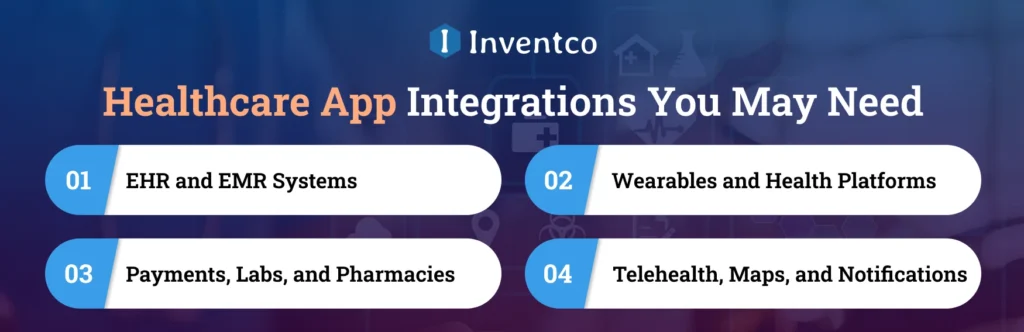
A standalone app helps only so much. Integrations connect it to the wider care system, and they affect both design and budget, so plan them early.
1. EHR and EMR Systems
Platforms like Epic and Cerner hold patient records. Most connect through HL7 FHIR, a standard that makes data sharing far easier.
2. Wearables and Health Platforms
Apple HealthKit and Android Health Connect let your app read steps, heart rate, and sleep data with the user’s permission.
3. Payments, Labs, and Pharmacies
Most teams plug in Stripe, Razorpay, or PayPal to take cards and digital wallets. Insurance billing usually needs a few extra connectors on top. Lab and pharmacy links let patients see test results and order medicines without ever leaving the app.
4. Telehealth, Maps, and Notifications
Video and chat rarely need to be built from scratch, because third-party SDKs already cover them well. Maps help people find nearby clinics, and push or SMS tools send reminders on time.
Every integration adds app testing work. So pick only the ones your first version really needs.
How to Build a HIPAA-Compliant AI Healthcare App?
AI can sharpen triage, image reading, chatbots, and risk scoring. It also raises the privacy stakes, since models often learn from sensitive patient data. Here’s a practical way to stay on the right side of the rules.
1. Know What Counts as Protected Data
The HHS HIPAA guidance defines protected health information. Names, dates, and record numbers all qualify.
2. Use Less Data
Collect only what each feature needs. Strip out identifiers before you train any model.
3. Sign Business Associate Agreements
Every vendor that touches patient data must sign one. That includes your cloud and AI providers.
4. Encrypt and Control Access
Encrypt data at rest and in transit. Give each role only the access it needs, and log every view or change.
5. Keep a Clinician in the Loop
Let the doctors make medical decisions. Track model accuracy and bias over time.
6. Check FDA Rules
Some AI tools count as medical devices. The FDA Digital Health Center of Excellence explains when that applies to you.
7. Audit Often
Run regular risk checks and penetration tests. Find the weak spots before an attacker does.
The technical safeguards are covered in more depth in this HIPAA compliance app development guide. Thinking about adding AI? Start with the benefits of AI in healthcare, then look at current AI trends in healthcare to see what works in real clinics today.
8. HITECH Act and Regional Laws
The HITECH Act backs up HIPAA with tougher enforcement. It also says organizations must tell patients when their data has been exposed in a breach. India, Canada, the UK, and Middle Eastern countries each have their own health data rules, so check them before launch.
A few habits help everywhere. Ask users for clear consent before you collect anything. Keep their data in approved regions, record who accesses it, and write a breach response plan before you need one. Following mobile app security best practices covers much of this. A data governance framework also keeps information organized across your company.
How Long Does It Take to Develop a Healthcare App?
| App Type | Typical Timeline | What It Includes |
| MVP | 3–4 months | Core features, one platform, basic security |
| Standard App | 5–8 months | Full feature set, both platforms, key integrations |
| Complex Platform | 9–14 months | AI modules, multiple user roles, deep EHR links |
MVP Development Timeline
An MVP tackles one problem for one user group. Discovery and design take about four weeks. Development runs eight to ten weeks, then testing and launch follow. The app development timeline can vary significantly depending on the feature set, integrations, and compliance requirements. It’s a good fit for startups that want to test an idea quickly.
Standard Healthcare App Timeline
A standard app adds more features, both mobile platforms, and more integrations. Design cycles run longer, and testing goes deeper. Compliance review also takes extra time, so build that into your schedule.
Complex Healthcare Platform Timeline
Large platforms serve hospitals or networks with many user roles. These platforms often rely on custom AI models and detailed analytics. Hospitals also expect audit trails that record every action taken inside the system. Teams usually work in phases, with a new release every few months.
Challenges in Healthcare App Development
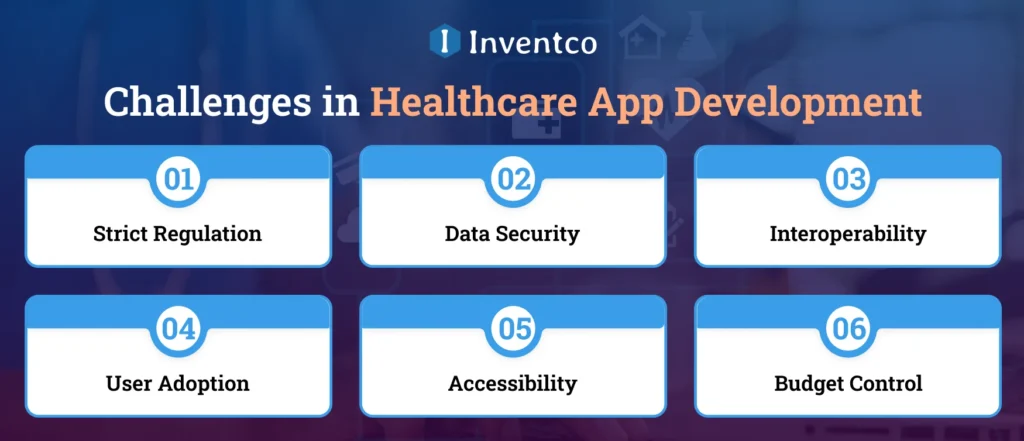
Healthcare projects run into problems that most apps never see. Knowing them early makes planning much easier.
1. Strict Regulation
Rules differ by country and keep changing. One missed requirement can push your launch back by months.
2. Data Security
Health records are a favorite target for attackers. A single breach damages trust and often brings heavy fines.
3. Interoperability
Hospital systems store data in different formats. Connecting them takes time, testing, and patience.
4. User Adoption
Doctors are busy. If your app adds work to their day, they’ll ignore it. Bring them into the design process early.
5. Accessibility
Many users are elderly or have poor eyesight. Keep the interface simple and easy to read.
6. Budget Control
Scope creep is common. Decide what version one includes and hold that line.
Some hurdles hit every product, so these general mobile app development challenges are worth a read too.
How to Choose a Healthcare App Development Company?
Your development partner shapes the whole project. Look closely at these points before you sign anything.
1. Healthcare Experience
Ask to see live apps in your niche, not just general work.
2. Compliance Knowledge
Pay attention to how a team talks about HIPAA and GDPR. If they can explain both in plain words, that’s a good sign. Then ask what they did about consent and data storage on their last healthcare project.
3. Security Practices
Ask what the team actually does to keep patient data safe. Good answers mention encryption, regular security testing, and clear limits on who can see which records.
4. Clear Pricing
Ask for a written estimate that breaks the work into milestones. That way you know what each stage costs before it starts. You pay as each stage is delivered, so there are fewer surprises on the final invoice.
5. Communication
Look for a team that shows working demos every week or two. Honest updates, including bad news, tell you more than polished promises ever will.
6. Post-Launch Support
Apps need fixes, updates, and monitoring long after release, so mobile app maintenance should be part of the post-launch plan. Ask what the support plan looks like.
7. References
Talk to past clients about what working with the team was really like. Founders often ask us why teams pick us for this work.
Case Study: How Inventco Helped Brands Build Healthcare Solutions
Real projects show how these ideas work in practice. Here are three healthcare builds from case studies.
Check My Mole
Check My Mole is an AI-powered app that scans mole images and flags possible skin cancer risk. A project with this scope generally costs between $60,000 and $90,000 for a first version. That range covers the AI integration, secure record-keeping, and the admin layer behind the app.
Expathy
Expathy is a mental wellness platform built around emotional support instead of diagnosis. You can find its full feature set and cost details on our healthcare app development page.
Best Practices for Healthcare App Development
These habits help you build something safe, useful, and easy to grow.
- Design for Privacy First: Collect only the data you need, and tell users exactly how you use it.
- Start with an MVP: Test with real users before you add advanced modules.
- Involve Clinicians Early: Doctors and nurses spot workflow problems faster than any designer.
- Keep the Interface Simple: Fewer taps and larger text help every kind of user.
- Use Standards: Build around FHIR and HL7 from the start. Hospitals already speak these formats, so future integrations take days instead of months.
- Test on Real Devices: Many patients still use older phones on weak networks. Run your tests on those devices, not only on the latest models.
- Encrypt and Monitor: Encryption protects data, but alerts tell you when something looks wrong. Turn on alerts for strange login activity and unusually large data exports.
- Plan for Growth: A good launch can bring in more patients than you expected. Pick a cloud setup that grows with your user base. That way, the app stays quick even on the busiest days.
- Collect Feedback: Ratings and user interviews should guide every new release.
- Budget for Upkeep: Check the numbers on mobile app maintenance costs before you lock in a final budget. If you plan to earn from the app, these mobile app monetization strategies can help. After launch, app store optimization makes it easier for the right users to find you.
Future Trends in Healthcare App Development
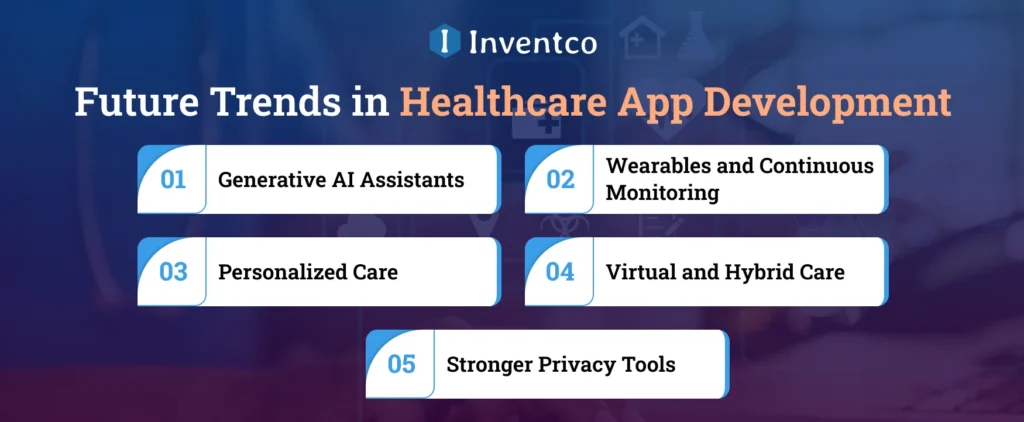
The field moves fast. These trends deserve your attention over the next few years.
1. Generative AI Assistants
Chat tools will summarize records, draft clinical notes, and answer patient questions. Human review will still matter. The wider impact of AI in mobile app development is already showing up across industries.
2. Wearables and Continuous Monitoring
Smartwatches and patches will send richer, more frequent data to care teams.
3. Personalized Care
Future apps will build care plans around each person. They may draw on daily habits, medical history, and in some cases genetic test results.
4. Virtual and Hybrid Care
Telehealth will blend with in-person visits instead of replacing them.
5. Stronger Privacy Tools
Methods like federated learning keep data on the device while models still improve.
It’s also smart to follow broader mobile app development trends, since many of them reach healthcare soon after.
Conclusion
A good healthcare app takes more than clean code. You need a clear problem, solid compliance, secure design, and steady feedback from real users. Begin with a small version and prove its value. Next, find a partner who knows code and clinical work equally well. Patients are safer with a team like that, and trust follows when the app works as promised.

Jitendra Jain
He is the CEO and Co-founder of Inventco, driving innovation in advanced computing and digital transformation. With deep expertise in modern IT ecosystems, he leads scalable, secure, future-ready solutions. His strategic leadership helps businesses accelerate growth, adopt innovation, and achieve success. You can connect with him on LinkedIn to follow his technology insights.


