Global retail is undergoing its biggest transformation since smartphones made online shopping mainstream. By the end of 2026, AI-assisted shopping is expected to influence a significant share of online purchase decisions. Industry analysts also estimate that agentic commerce could redirect $3 trillion to $5 trillion in global retail spending by 2030, making AI a major driver of future eCommerce growth.
For the founder and investors, these numbers highlight a clear opportunity. Personalized AI is shaping online customer journeys with conversion rates that many online businesses can depend on to generate consistent revenue. Companies that delay AI adoption risk losing visibility as AI assistants increasingly influence buying decisions.
AI is not just another feature to add to an online store, it has now become the foundation of modern eCommerce app development solutions. Customers now expect conversational shopping, personalized recommendations, and seamless experiences across websites and mobile apps. Developing an AI-powered eCommerce solution can typically cost between $10,000 to $100,000+, and it can vary based on the level of personalization, automation, and AI infrastructure.
In this guide, we focus on the top eCommerce AI trends of 2026. We have included specifics on functionality and significance, with some projected costs and detailed next steps to help you and your investors stay ahead of the market.
Key Takeaways
- Agentic commerce, AI agents that shop, compare, and check out on a customer’s behalf, is moving from pilot to production in 2026, with ChatGPT, Gemini, and Microsoft Copilot already completing live transactions.
- AI-driven discovery is displacing keyword search; investors should expect AI-referred traffic and machine-readable product data to become a primary growth channel.
- Real-time hyper-personalization now outperforms static segmentation, delivering meaningfully higher conversion than batch-based approaches.
- Multimodal shopping (visual, voice, conversational) is reducing discovery friction and lowering return rates through AR-assisted try-before-you-buy experiences.
- Predictive operations, AI-generated content, and clean, structured catalog data are now prerequisites for AI agent visibility, not optional upgrades.
- Businesses that delay AI-readiness investment risk becoming invisible to the AI agents now mediating a growing share of retail transactions.
Why Is AI No Longer Optional in eCommerce?
AI in eCommerce no longer means basic chatbots or product recommendation engines. AI is now embedded in eCommerce to the extent that it is used to redesign how customers find, compare, and purchase products. Founders building new eCommerce platforms must treat AI readiness as a core part of their mobile app development strategy instead of adding it later as an extra feature.
Potential buyers no longer need to visit eCommerce sites to do their product research, they are comfortable using AI to do it for them. Unlike traditional search keywords, customers find it more intuitive to list requirements for a product in a single sentence. The AI uses this information to provide better product recommendations and thereby make shopping more efficient and fulfilling.
This has created a desire for a new approach to customer acquisition and revenue generation. Real-time AI personalization, coupled with smart AI search and well-structured product data, has a dramatic effect on customer experience and conversion rates. At the same time, companies with API-ready product catalogs are more likely to be discovered and recommended by AI shopping assistants than competitors relying on outdated infrastructure.
For founders and investors, AI readiness has become a business necessity rather than a competitive advantage. Building scalable architecture, structured data, and AI-friendly mobile experiences ensures long-term visibility, supports future innovation, and positions eCommerce businesses to succeed as AI-powered shopping continues to become the industry standard.
Top AI Trends in eCommerce
Based on our work building and modernizing eCommerce platforms across categories, along with an analysis of how leading platforms and enterprises are deploying AI in 2026, here are the seven AI trends ecommerce leaders are prioritizing, and where the smart capital and the smart engineering effort are heading this year.
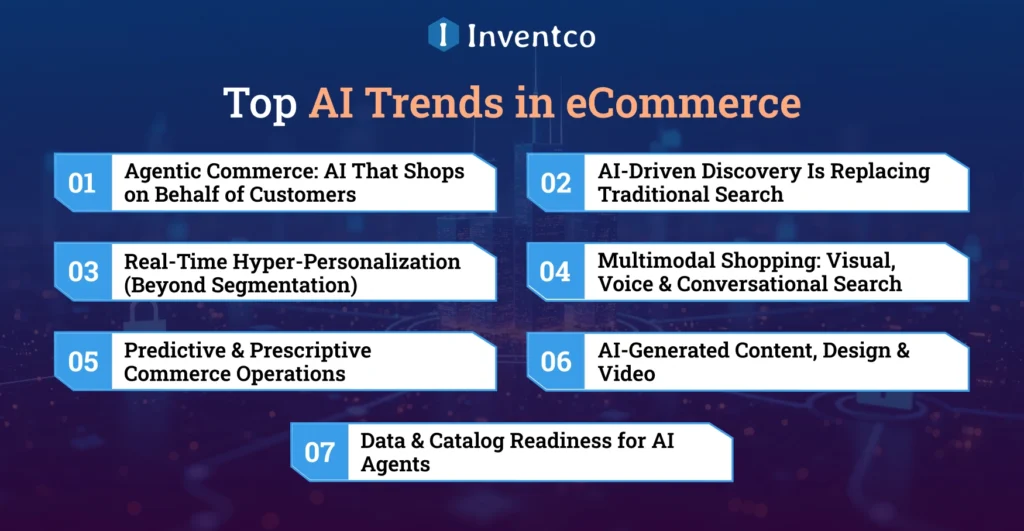
Trend 1: Agentic Commerce: AI That Shops on Behalf of Customers
Agentic commerce is one of the major eCommerce AI trends in 2026 and allows AI agents to opt out of advising users on purchases and do much more, like complete transactions on their behalf after comparing options and answering queries. AI chatbots like ChatGPT, Google Gemini, Microsoft Copilot, and Perplexity already offer AI-powered shopping experiences that simplify product discovery and decision-making.
AI shopping commerce ecosystems are booming with investment from many of the same retailers and technology companies. Google, OpenAI, Shopify, Stripe, Walmart, and Target are some of the companies announcing AI commerce ecosystems. The use of AI will create a substantial portion of the world’s online commerce in the upcoming years.
However, consumer trust remains an important factor. Many consumers appreciate AI product search and comparison. However, most are apprehensive about AI completing purchases without user confirmation. Because of this, instead of full AI shopping automation, AI shopping will most likely be implemented incrementally.
For founders, the priority should be building AI-ready platforms with structured product catalogs, API-first architecture, and accurate pricing and inventory data. A strong technical foundation ensures AI agents can understand, recommend, and transact with products efficiently as agentic commerce continues to evolve.
Trend 2: AI-Driven Discovery Is Replacing Traditional Search
Traditional SEO focused on helping businesses rank on search engines using keywords and backlinks. In 2026, product searches will no longer happen with the search bar but rather through assistants. Rather than being bombarded with search results and picking the least terrible answer, shoppers rely on AI to recommend products, which are curated based on price, features, and reviews, instantaneously.
This shift is rapidly changing the online shopping experience. AI-powered platforms are driving more referral traffic, and now, more than ever, product discovery is dominated by conversational search. For organizations, the presence of AI systems that are capable of understanding, analyzing, and making confident recommendations for their products will determine business visibility, regardless of keyword placement.
For investors and entrepreneurs, business visibility and product discoverability will depend on the investment supporting structured product data, descriptive accuracy, and data consistency across all sales channels. AI recommendation systems will choose among listed products based on quality, Price, Availability, and Fulfillment. Thus, inconsistent or incomplete data constrains business visibility, regardless of the quality of SEO.
Rethinking the digital strategy, businesses have to prepare for the future of shopping and create AI-friendly online and mobile interfaces. Quality and price-flexible shopping is enhanced using structured product data. This improves the discoverability of product listings.
Trend 3: Real-Time Hyper-Personalization (Beyond Segmentation)
Personalization has evolved far beyond basic customer segments and email campaigns. In 2026, AI analyzes real-time signals such as browsing behavior, product views, scrolling patterns, device type, and shopping intent to customize the customer experience instantly. Instead of relying on historical data alone, AI adapts recommendations and content while shoppers are actively exploring a store.
Compared to traditional personalization, AI with real-time analytics will outperform in business results. At the right time, an AI recommendation engine will drive conversions, deepen customer engagement, and create greater revenue by recommending the right products. This will drive even greater investments in AI with the goal of increasing the efficiency of a business’s personalization and the effectiveness of its marketing.
AI has removed the boundaries of the so-called ‘segment of one’ customer. Using preferences and shopping histories, as well as location, seasonality, and behavioral indicators, every visitor can have their product recommendations, offers, and even message customizations tailored through individually personalized homepages.
Modern eCommerce users are looking for brands to anticipate their needs to create and deliver appropriate experiences. This manifests itself through every customer interaction. For founders, personalization should go beyond the store and permeate search, email, customer support, and mobile. Integration of a customer data platform helps unify all of these touchpoints in a smart, seamless way.
Trend 4: Multimodal Shopping: Visual, Voice & Conversational Search
Finding products with just text search will be a thing of the past. In 2026, customers will be able to upload images, describe products with natural language, or use voice commands. With these new multimodal interfaces, AI will be able to interpret the user’s intent for a product, search for that product with greater speed and accuracy, and offer a more tailored search.
Online shopping will be forever changed with the advent of AR in Ecommerce apps. Customers will be able to visualize products in their space. Customers being able to try on glasses and clothing or place furniture in their homes means higher customer satisfaction and lower product returns.
Founders who want to cater to multimodal commerce must be able to support the technology. Visual search uses image recognition, voice search needs natural language processing, and AR requires 3D product images. Flexible mobile app frameworks and API architectures help support new technology.
Previously, multimodal commerce solutions were only enjoyed by larger corporations. This is frowned upon as systems are not as easily maintained and updated. If retail systems are based on modern AI tools, offer clear product descriptions, and have high-quality digital assets, these solutions are much more cost-effective.
Trend 5: Predictive & Prescriptive Commerce Operations
AI is helping business owners and customers. In 2026, predictive commerce will analyze user demand, proactively adjust inventory and pricing and prevent theft. AI commerce solutions will help retail systems run more efficiently and reduce the cost of doing business while improving customer service.
Dynamic pricing is one of the leading AI trends in mobile apps. AI analyzes demand, supply, competitor prices, and customer activities and changes the price. This, along with personalized offers and price alerts, changes pricing for each individual customer, which decreases cart abandonment, increases sales, and maintains profit margins.
AI has enhanced fraud detection as well. Current systems do not interfere with valued customers and detect risky behavior through analytics of behavior, fingerprinting devices, and transaction analysis. AI-bots for shopping are becoming more prevalent. Companies will need to use more advanced security to differentiate trusted automated purchases from fraudulent bots.
For founders and investors, predictive operations should not be an option, but it has become the main goal. AI-enabled pricing, inventory, and fraud protection are significantly easier to scale with trust from customers and will drive profit for the business as commerce driven by people and AI continues to grow.
Trend 6: AI-Generated Content, Design & Video
Traditionally, creating product copy, images, and videos for large catalogs required large amounts of time and other resources. By 2026, Generative AI will enable businesses to rapidly produce high-quality product copy, localized content, lifestyle images, and marketing collateral, thereby simplifying the process of launching and managing thousands of products across numerous sales channels.
AI-Generated Content is also critical for product discovery. When AI shopping assistants recommend products to customers, they depend on precise product descriptions and specifications. The ease of searching for and recommending products to shoppers via AI is greatly improved by accurate, high-quality content, while outdated and inconsistent product listings decrease discoverability.
Nonetheless, human oversight will always be necessary. Businesses using AI-generated content should review the content to validate the accuracy, ensure it aligns with the brand voice, and ensure the content meets legal requirements and industry standards.
The combination of integrating AI and editorial review will generate content that is reliable and trustworthy. This total content is expected to improve confidence and loyalty among customers, enhance brand equity, and promote sustained visibility and positioning over conventional search engines and AI-augmented eCommerce and shopping platforms.
Trend 7: Data & Catalog Readiness for AI Agents
Every major eCommerce AI trend depends on one essential factor: clean, structured, and accurate product data. Unlike human shoppers, AI agents evaluate products using specifications, pricing, inventory, shipping details, and other structured attributes. Inconsistent or incomplete information can prevent AI systems from recommending your products altogether.
This has driven the usage of an API-first architecture and machine-readable commerce. Companies expose their product catalog through structured APIs while keeping their data consistent across their websites, marketplaces, and mobile apps. This helps AI agents parse product offerings and execute a transaction.
Another app development challenge is the impact of AI on customer journey measurement. Since a lot of decisions happen during conversations with an AI, many of the traditional metrics (impressions and clicks) may not even represent the purchasing journey as a whole. Companies must adopt a new type of metric that identifies and measures AI traffic simultaneously with human traffic.
For founders, the most logical investment is also the most obvious: build the infrastructure for AI from the ground up. The future of commerce will be AI-powered. Consequently, the cost of building a mobile app will be less than building for standard commerce.
What This Means for Mid-Market & Smaller Retailers
It’s easy to see the agentic commerce headlines- Walmart, Target, Amazon, Shopify’s largest merchants- and assume the trends only impact large enterprises. While these trends impact large enterprises, we are also witnessing a growth in multimodal searches, real-time personalization, and AI content generation that large retailers are using APIs to implement.
These tools are available to smaller enterprises and do not require a large engineering team to implement. Almost 60% of small businesses used AI systems in some capacity in 2023. This is double the adoption rate of three years prior. Small and mid-sized businesses that embrace new technology report greater sales and profits than competitors that do not.
The technology is more sophisticated than it was, and the barriers to entry have decreased. However, the data readiness work of Trend 7 is an essential part of the business for the mid-market and smaller retailers.
Custom-built agentic checkout systems in 2026 won’t be a necessity, but systems will still need accurate fulfillment and clean product data. Online catalogs will need to be structured for both AI Search and a customer’s Shopping Agent.
The cost of this foundational work will be significantly less than the cost of the enterprise-scale agentic infrastructure. It will be the best way to keep a smaller retail business visible as discovery moves away from traditional search.
How to Prepare Your eCommerce Business for These Trends
The eCommerce AI trends of 2026 do not require a complete transformation of your business. Begin the process with a clear plan in incremental phases. Implement AI technology where you maintain operations and safeguard the most value by utilizing existing systems.
Start by auditing your entire product catalog and data. This includes ensuring that product information, as well as pricing and inventory, is accurate and consistent across all of your sales channels. This is the basic foundation for integrating AI.
After your data is finalized, use AI features to provide fast results with real-time personalization, smart product search, and recommendations. As your platform evolves, engage your customers through new modes like visual search, voice, and augmented reality by adding features to help them interact with your platform more fully.
Invest in an API-first structure, organized checkouts, and safe AI integrations to prepare for agentic commerce. This step-by-step strategy gives founders and investors the opportunity to create advanced, scalable, AI-based eCommerce platforms to provide support for future creativity and innovations without affecting business development.
Here’s how founders and investors typically budget for this roadmap, based on the scope of AI capability being implemented:
| Tier | What’s Included | Investment Range |
| Starter AI Integration | AI-powered search, basic recommendation engine, structured data optimization, AI chatbot support | $10,000 – $30,000+ |
| Growth-Stage AI Suite | Real-time hyper-personalization, dynamic pricing, multimodal (visual and voice) search, AI-powered content generation | $30,000 – $60,000+ |
| Enterprise Agentic Platform | Full agentic commerce readiness, predictive operations, API-first architecture, custom AI agent integrations | $60,000 – $100,000+ |
Actual investment depends on your existing tech stack, catalog size, and how much of your mobile app development process needs to be rebuilt versus extended. A phased approach, proving ROI at each tier before advancing to the next, is almost always the more capital-efficient path for founders operating under investor scrutiny.
How Inventco Can Help You in Your AI Journey for Your eCommerce Store
Inventco is a leading mobile app development company. We work with founders and investors who need more than a vendor; they need a technology partner who understands both the AI ecommerce future trends of 2026 and the practical realities of shipping production-grade commerce infrastructure on a timeline that satisfies a board or a cap table.
Our team designs and builds the full stack: structured, agent-ready product data architecture, real-time personalization engines, multimodal search, and secure, scalable checkout systems built on a mobile app technology stack chosen for where your business is headed, not just where it is today.
From Our Projects: A mid-market fashion retailer approached Inventco after watching AI-referred traffic climb while conversions stayed flat. Our team audited their catalog, discovered inconsistent sizing and fulfillment data across channels, and rebuilt their product feed on a structured, API-first architecture.
We layered in real-time personalization and visual search on top of the cleaned data foundation. Within one quarter of launch, the retailer saw meaningfully improved engagement from AI-referred sessions and a measurable lift in average order value, proof that AI readiness starts with data discipline, not flashy features.
Ready to build an eCommerce platform that’s ready for both human shoppers and AI agents? Talk to Inventco’s team about a tailored roadmap for your business, whether that starts with a focused MVP mobile app or a full agentic commerce build.

Conclusion
The eCommerce brands leading in 2026 are not always those with the largest AI budgets. Success comes from treating AI as a core part of business infrastructure rather than an add-on. Technologies like AI-powered search, real-time personalization, predictive analytics, multimodal shopping, and agentic commerce work best when supported by accurate, structured product data.
For founders, AI readiness starts with building scalable platforms and clean data architecture from the beginning. A strong foundation enables AI tools, automation, and intelligent shopping experiences to perform effectively while supporting future innovation.
For investors, evaluating AI maturity goes beyond customer growth metrics. Businesses with API-ready systems, reliable data, and a phased AI strategy are better positioned for long-term success as AI-driven commerce continues to reshape the eCommerce landscape.
FAQs
Q. What are the biggest eCommerce AI trends founders should prioritize in 2026?
Ans. Founders should prioritize AI-powered personalization, intelligent product discovery, AI search, and predictive analytics. Build a strong data foundation first, then adopt agentic commerce and autonomous AI capabilities as your business scales.
Q. How much does it cost to build an AI-powered eCommerce platform?
Ans. AI-powered eCommerce development typically costs $10,000 to $100,000+, depending on features. Basic AI search and chatbots cost less, while advanced personalization, AI agents, and predictive automation require a higher investment.
Q. Is agentic commerce actually generating revenue yet, or is it still experimental?
Ans. Agentic commerce is already generating revenue through AI-assisted shopping, recommendations, and automated purchasing. While fully autonomous shopping is still evolving, major platforms have begun deploying AI agents in real-world commerce.
Q. Do smaller or mid-market retailers need to worry about AI agents yet?
Ans. Yes. Smaller retailers should focus on clean product data, API integrations, and AI-ready infrastructure before investing in custom AI agents. This approach improves discoverability and prepares businesses for future AI-driven commerce.
Q. How does AI personalization differ from traditional recommendation engines?
Ans. Traditional recommendation engines rely on historical customer data. AI personalization analyzes real-time behavior, preferences, context, and intent to deliver dynamic shopping experiences that improve engagement, conversions, and customer satisfaction.
Q. What should investors look for when evaluating an eCommerce business’s AI readiness?
Ans. Investors should assess data quality, API-first architecture, AI integration capabilities, scalable infrastructure, and a clear AI adoption roadmap. Businesses with strong foundations can implement advanced AI faster and achieve better long-term returns.

Ajay Bhal
He is an on-demand app solutions expert with 11+ years of experience in business consulting and building scalable, user-centric digital products. He specializes in robust on-demand platforms across industries, combining technical expertise with business-focused strategy to deliver efficient, top notch solutions that drive growth and enhance user experience. You can connect with him on LinkedIn to follow insights.