Software budgets are changing at a speed exceeding product roadmaps. According to Gartner’s latest enterprise IT spending forecast, global spending on software will exceed $1.2 trillion by 2026. Most of that spending will be on products that will be completely re-released to the market within 18 months of their initial release, because the original product no longer meets market needs. For founders and investors of these builds, this is not a technology issue. This is a planning issue.
This is exactly the gap that adaptive software development (ASD) is designed to fill. ASD aims to provide development teams with the flexibility to respond to evolving market needs. ASD offers a framework for development teams to build software within changing market conditions, whereas traditional development models consider changing market conditions to be an exception that needs to be managed.
This guide breaks down what adaptive software development actually is, how its lifecycle differs from Agile and Scrum, where it delivers the strongest ROI, and how a technology partner puts the model to work on a real build.
Key Takeaways
- Adaptive software development (ASD) replaces fixed planning cycles with a Speculate-Collaborate-Learn loop built for volatile, high-uncertainty projects.
- ASD is a parent influence behind modern Agile practices, not a competitor to them; Scrum and Kanban borrow directly from its principles.
- It works best for founders building in markets where requirements are still forming, such as early-stage fintech, healthtech, and AI-driven products.
- Typical adaptive builds run $10,000 to $100,000+, with cost driven primarily by integration complexity and compliance requirements rather than team size alone.
- The model trades predictability of scope for predictability of learning, which reduces the risk of shipping the wrong product on schedule.
What Is Adaptive Software Development (ASD)?
ASD focuses on managing an engineering process via continuous learning. ASD was developed in the late 1990s by Jim Highsmith in response to a universal issue that most founders would recognize. Traditional software processes, which are motivated by a strict plan, assume that requirements can be fully described before any building is done. In rapidly evolving markets, the assumption that requirements can be fully known before the process begins is often incorrect.
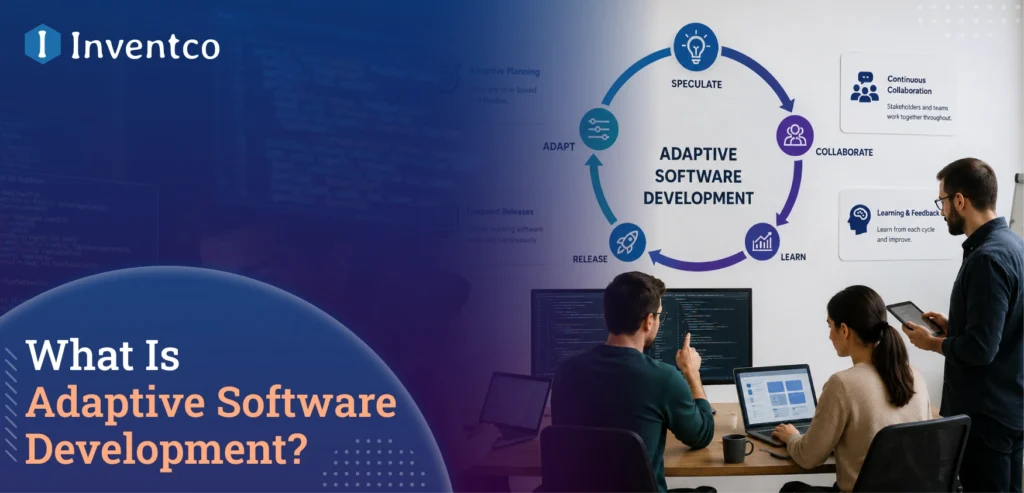
In contrast to a single, linear plan, ASD organizes the work to be done in a succession of short cycles of speculation, collaboration, and learning, each of which produces an incremental working piece of the product and incorporates the feedback to be learned. The purpose of ASD is not to eliminate the state of being uncertain. Rather, it is the construction of a process that becomes increasingly stronger as the environment in which the process is applied becomes increasingly uncertain.
The Evolution of Adaptive Software Development
In the 1990s, Jim Highsmith and Rapid Application Development (RAD) became the basis for Adaptive Software Development (ASD). The 1990s saw the development of large, funded software applications using the cascade method of planning, resulting in applications that had large and costly failures. The principles of RAD that focused on speed were developed by Highsmith and Sam Bayer, and the first version of the ASD model was published in 2000.
What is important for a founder today is the subsequent events. Adaptive Software Development (ASD) participated in the 2001 gathering that established the Agile Manifesto. Many techniques now deemed classic Agile, such as phased delivery, collaboration with customers over contract engagement, and a preference for changes over the plan, can be directly linked to the core logic of adaptive development. Thus, in that sense, ASD is not a marginal option to Agile. Rather, ASD is among the frameworks on which Agile was constructed.
Core Principles of Adaptive Software Development
Four principles separate adaptive development from a standard iterative process, and they are the reason it holds up in volatile markets:
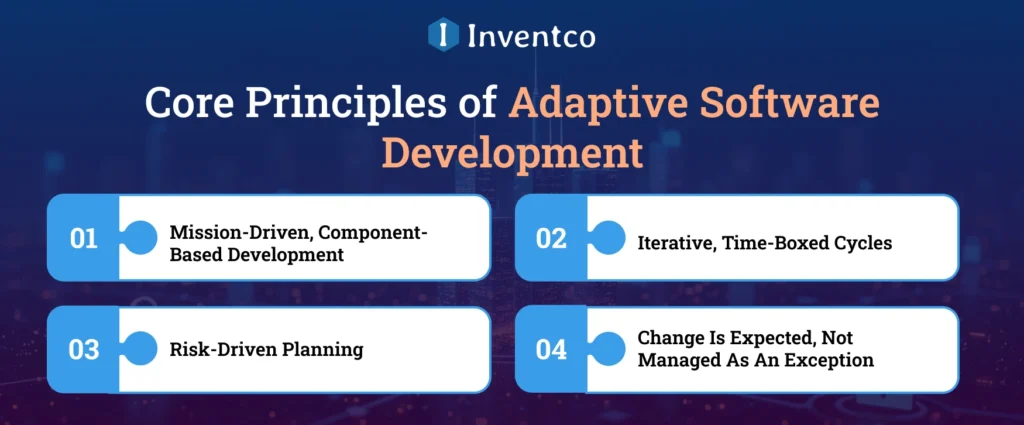
- Mission-Driven, Component-Based Development: Teams build around a clear product mission and deliver in functional components rather than a rigid feature checklist, so priorities can shift without derailing the whole build.
- Iterative, Time-Boxed Cycles: Work is planned in short cycles with a fixed end date, not a fixed scope, which keeps delivery predictable even when requirements move.
- Risk-Driven Planning: Each cycle is scoped around the biggest unknowns first, so the team learns what could break the product before it becomes expensive to fix.
- Change Is Expected, Not Managed As An Exception: The process assumes requirements will evolve and builds in the structure to absorb that evolution without a formal change-request cycle.
How Adaptive Software Development Works
In practice, adaptive software development replaces the question “what are we building?” with “what do we need to learn next, and what’s the fastest way to learn it?” A team comes up with a mission statement and a general plan for the components, not a full and detailed plan. The team conducts short and quick cycles. Each of these cycles ends with a review of the work, a piece of the product that is ready to be tested, and the work done by the team, all of which is done in a structured way.
The review is not a formality. It determines the priorities for the next cycle and helps teams choose the right mobile app framework while refining the product’s structure. For an investor who is looking at a project to assess the progress that has been made, this is what ensures the spending is in line with the learning that has been validated, as opposed to what was assumed in the first month of the project.
Adaptive Software Development Lifecycle
The adaptive software development lifecycle runs on three overlapping phases, repeated continuously rather than executed once from start to finish:
1. Speculate
This phase substitutes for the gathering of the requirements. Based on the best and most available information, and with an understanding that this information and the project will change, a team will write a mission statement, provide an initial structure for the components, and an outline for the project. The team will identify areas of risk to help determine the order of the cycles based on the most significant unknowns.
2. Collaborate
This phase encompasses the tight collaboration of designers, engineers, product owners, and even end users. Development is carried out in a fully integrated department. Building, testing, and adjusting occur within the same short cycle, continually validating decisions in the real world.
3. Learn
Every cycle ends with a structured review. Some call this a quality review. It is a way of collecting data to let us know what happened, good or bad, and identify what we should improve. Most methodologies skip this process, treat it as optional, or do not include it at all. In Adaptive Software Development, we make this mandatory. This is the main process that injects the correct information into the next phase, Speculate.
These three phases are continuously repeated for the entire life of that product. Because of this, Adaptive Software Development is described as a cycle, as opposed to a phased approach.
Key Benefits of Adaptive Software Development
For founders weighing ASD against a more traditional build process, the return shows up in a few concrete places:
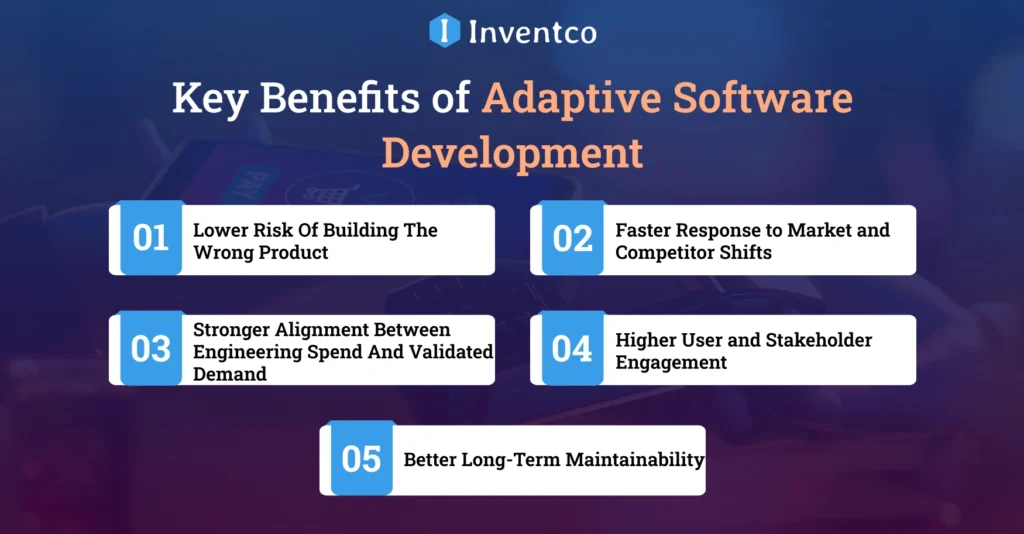
- Lower Risk of Building the Wrong Product: Continuous learning cycles catch a misaligned feature before it consumes a full release cycle’s budget.
- Faster Response to Market and Competitor Shifts: Component-based delivery means priorities can be reordered between cycles without a formal change-control process.
- Stronger Alignment Between Engineering Spend and Validated Demand: Budget flows toward components that are proven to matter, not ones assumed to matter at kickoff.
- Higher User and Stakeholder Engagement: Structured collaboration keeps founders, investors, and end users close to the build instead of waiting for a big-reveal launch.
- Better Long-Term Maintainability: Mission-driven component design tends to age better than feature lists built against a single point-in-time requirement set.
Challenges of Adaptive Software Development
ASD is not a fit for every build, and understanding app development challenges upfront matters. A technology partner should tell you that from the start rather than after the invoices begin to pile up.
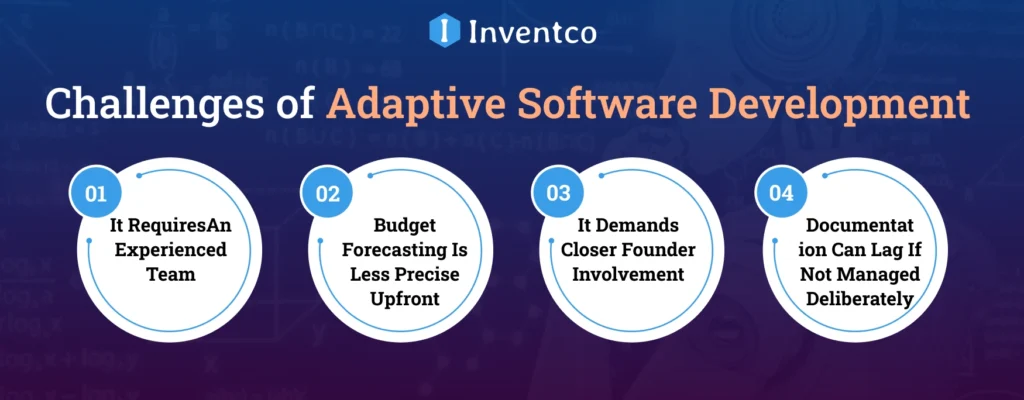
- It Requires an Experienced Team: Adaptive cycles depend on strong judgment calls under time pressure, which makes it a poor fit for junior-heavy teams.
- Budget Forecasting Is Less Precise Upfront: Because scope is expected to evolve, a founder needs comfort with a range-based estimate rather than a single fixed number at kickoff.
- It Demands Closer Founder Involvement: The collaborate and learn phases work best when decision-makers are genuinely available between cycles, not just at milestone reviews.
- Documentation Can Lag If Not Managed Deliberately: Fast-moving cycles need a disciplined partner to keep technical and compliance documentation current, particularly in regulated industries.
Adaptive Software Development vs Agile
Founders often use “Agile” and “adaptive” interchangeably, but the relationship between them is closer to parent and a family member than to two competing options.
| Dimension | Adaptive Software Development (ASD) | Agile Methodology |
| Origin | Introduced by Jim Highsmith in 2000 as an evolution of Rapid Application Development (RAD). | A broad software development philosophy established through the Agile Manifesto in 2001, encompassing frameworks like Scrum, Kanban, XP, and ASD. |
| Core Philosophy | Emphasizes continuous adaptation, learning, and collaboration in highly uncertain environments. | Focuses on delivering customer value through iterative development, collaboration, and responsiveness to change. |
| Development Structure | Follows the Speculate, Collaborate, and Learn cycle to encourage experimentation and rapid feedback. | Uses iterative development, but the workflow depends on the chosen framework, such as Scrum sprints or Kanban’s continuous flow. |
| Planning Approach | Risk-driven planning that prioritizes assumptions, uncertainties, and experimentation over fixed roadmaps. | Iterative planning with regular backlog refinement and sprint planning. Risk management varies by framework and team practices. |
| Requirement Handling | Assumes requirements will evolve significantly and encourages continuous discovery. | Welcomes changing requirements while maintaining a prioritized product backlog. |
| Decision-Making | Decentralized and team-driven, allowing quick adaptation based on new insights. | Collaborative decision-making involving developers, stakeholders, and product owners. |
| Best Fit | AI projects, innovative products, research-driven software, startups, and complex enterprise initiatives with unpredictable requirements. | Suitable for a wide variety of software projects, including web apps, mobile apps, SaaS platforms, enterprise systems, and product enhancements. |
| Primary Goal | Maximize learning and adaptability while reducing uncertainty throughout development. | Deliver working software frequently while continuously improving customer value. |
In short, every ASD build is Agile in spirit. Not every Agile build follows the specific speculate-collaborate-learn discipline that defines ASD.
Adaptive Software Development vs Scrum
Scrum is the most commonly implemented Agile framework, which makes the comparison with ASD especially relevant for founders scoping their first build.
| Dimension | Adaptive Software Development (ASD) | Scrum |
| Core Unit of Work | Core Unit of Work Uses a time-boxed Speculate, Collaborate, and Learn cycle centered on project goals and evolving components. | Organizes work into fixed-length Sprints (typically 1 to 4 weeks) based on a prioritized product backlog. |
| Team Roles | Flexible, self-organizing teams where responsibilities evolve based on project needs and collaboration. | Clearly defined roles including the Product Owner, Scrum Master, and Development Team. |
| Approach to Change | Expects continuous change, allowing architecture, scope, and priorities to evolve throughout development. | Accommodates change primarily through backlog refinement and prioritization between sprint cycles. |
| Review & Feedback | Ends each cycle with a dedicated Learn phase that captures insights and shapes the next development iteration. | Conducts Sprint Reviews to gather stakeholder feedback and Sprint Retrospectives to improve team performance. |
| Planning Style | Adaptive, risk-driven planning focused on learning, experimentation, and uncertainty reduction. | Sprint-based planning with defined goals and deliverables for each iteration. |
| Documentation | Lightweight documentation that evolves alongside the product and team learning. | Maintains essential documentation such as the product backlog, sprint backlog, and sprint goals. |
| Ideal Use Case | Best suited for AI solutions, R&D projects, innovative products, and software with rapidly changing or unclear requirements. | Ideal for SaaS products, web and mobile applications, enterprise software, and projects with a well-defined product roadmap and prioritized backlog. |
A useful way to frame it for a board deck: Scrum gives you a disciplined cadence for known work. ASD gives you a disciplined process for finding out what the work should be in the first place.
When Should You Choose Adaptive Software Development?
Adaptive software development obtains its complexity when the build meets two or more of the following five situations. These are still-forming markets or users, architectural or other considerable forms of tactical uncertainty are present in the product, substantial changes in requirements are highly probable after the initial feedback from users, or the cost of a build is more than the discovery.
If your product category is well-established and requirements do not deviate, and the goal is to optimize product delivery, a more traditional Scrum or Kanban will meet requirements with less overhead.
Industries Using Adaptive Software Development
In practice, adaptive development shows up most often in industries where the product itself is still being defined by the market:
- Fintech and embedded finance, where regulatory interpretation and user trust patterns shift quickly
- Healthtech and digital therapeutics, where clinical validation loops directly inform product architecture
- AI-driven and agentic software, where model capability and user expectations evolve between releases
- Enterprise SaaS entering new verticals, where buyer requirements differ meaningfully from the founding team’s original assumptions
- On-demand and marketplace platforms, where supply-and-demand dynamics change the product’s core mechanics post-launch
Best Practices for Successful Adaptive Software Development
Teams that get consistent value from ASD tend to share a few disciplined habits:
- Keep cycles genuinely short. Cycles stretched past a few weeks start to behave like mini-waterfalls and lose the learning advantage.
- Treat the Learn phase as non-negotiable. Skipping structured review is the single most common reason adaptive builds drift off course.
- Involve decision-makers directly in collaboration, not just in milestone sign-off. ASD’s value depends on fast, informed decisions between cycles.
- Document architecture decisions as you go. Fast iteration without a paper trail creates costly rework later, especially in regulated sectors.
- Pair ASD with strong DevOps practices. Continuous integration and deployment pipelines are what make short learning cycles operationally realistic.
Popular Tools for Adaptive Software Development
Adaptive development is a methodology, not a specific toolchain, but most teams running it lean on a consistent mobile app technology stack:
- Project and Cycle Management: Jira, Linear, or Azure DevOps for tracking speculate-collaborate-learn cycles
- Collaboration and Review: Miro or FigJam for shared planning sessions, Confluence or Notion for capturing Learn-phase outcomes
- CI/CD Pipelines: Jenkins, GitHub Actions, or GitLab CI to keep each cycle shippable
- Analytics And Feedback: Mixpanel, Amplitude, or PostHog to feed real usage data back into the next Speculate phase
- Architecture And Design Collaboration: tools that support rapid prototyping and version control together, so component-level changes don’t create integration debt
Typical Adaptive Software Development Cost Ranges (2026)
| Build Complexity | Estimated Development Cost | Typical ASD Cycle Count |
| Simple / MVP Adaptive Build | $10,000 – $25,000 | 4 to 6 cycles |
| Mid-Complexity, Multi-Component Build | $25,000 – $60,000 | 6 to 10 cycles |
| Enterprise-Grade, Compliance-Heavy Build | $60,000 – $100,000+ | 10 to 12+ cycles with continuous iterations |
How Inventcolabs Helps Businesses Build Adaptive Software Solutions
At Inventco, adaptive software development is not a theoretical framework we reference in a pitch deck. Instead, we apply adaptive software development for founders who have only a rough idea, recognizing that the mobile app development cost of building the wrong solution is far higher than investing in one more discovery cycle. Our engineers define the boundaries of the discovery cycles, focusing on the largest and most significant unknowns. Continuous structured collaboration with founders, done after each cycle, is treated as an important iteration and is done with the purpose of re-architecting the sprint.
From Our Projects
On a recent project, we were contacted after a different company spent four months developing software that was based on a fixed specification, which had become irrelevant in comparison to what clinicians needed at the point of care. We adapted the project and focused on developing the most critical and risk-based clinical workflows, instead of the entire mobile app feature set. During the first three cycles, feedback from clinicians was gathered to iterate on the design of two core modules, which, if developed in a previous cycle, would have been completely infrastructure- and resource-inefficient. The founder, in less than three months, with a significant amount of sunk cost, went from having an untested hypothesis to having a production-ready validated MVP mobile app.

Conclusion
Adaptive software development is not meant to supplant Agile, Scrum, or any other component of your product development. Think of it as the lens that sits beneath them, configured for scenarios when a founder is developing a product for a market that is still coalescing. If your building plans are based more on what you will discover in the upcoming 90 days rather than what you know today, ASD is the model that you should present to your technology partner ahead of the first sprint, rather than after the second iteration.
FAQ’s
Q. Is adaptive software development the same as Agile?
Ans. No. ASD is one of the frameworks that directly influenced the 2001 Agile Manifesto. Agile is the broader set of values and principles; ASD is a specific methodology built on a Speculate-Collaborate-Learn cycle.
Q. What is a real-world example of adaptive software development?
Ans. A common example is an early-stage health-tech or fintech platform where clinical or regulatory requirements are still being validated. Teams build core components in short cycles, test them against real user or clinician feedback, and restructure the next cycle based on what that feedback reveals.
Q. How does the adaptive software development life cycle differ from the waterfall?
Ans. Waterfall locks requirements before development starts and moves through fixed sequential phases. ASD assumes requirements will change and structures the entire lifecycle around learning and adjusting through repeated Speculate-Collaborate-Learn cycles.
Q. How much does an adaptive software development project cost?
Ans. Most mid-complexity adaptive builds fall between $10,000 and $1,00,000+, with enterprise-grade or heavily regulated builds running higher depending on integration depth, compliance scope, and team composition.
Q. When should a founder avoid adaptive software development?
Ans. If your requirements are already well-defined, your market is established, and speed to a known outcome matters more than discovery, a standard Scrum or Kanban process will typically deliver with less planning overhead.
Q. Does ASD work for regulated industries like healthcare and fintech?
Ans. Yes, provided documentation discipline is built into every cycle. ASD is used frequently in regulated sectors specifically because clinical and compliance requirements tend to evolve, but the Learn phase must be paired with rigorous, ongoing documentation to stay audit-ready.

Sandeep Agrawal
Sandeep Agrawal is the visionary CTO at Inventco, bringing innovation to life through his technical expertise. With a passion for cutting-edge technologies, Sandeep leads the team in developing robust solutions. His dedication and continous efforts to pushing the boundaries of what’s possible defines his role as a transformative and innovative force in the tech industry. You can connect with him on LinkedIn to follow insights.