There was a time when change in real estate moved slowly, measured in paperwork, site visits, and endless back-and-forth between buyers, sellers, and agents. That pace no longer fits a market shaped by digital ecosystems and real-time expectations.
In the modern world, companies and industries that do not evolve quickly fall behind, and real estate is no exception. The old traditional processes of real estate are being replaced with smarter, faster, and more transparent tech trends that put information and control in the hands of customers.
Technology is rapidly changing how buyers are discovering and evaluating properties. There are shifts towards modern AI automation, blockchain, and Web3 services being used to streamline the process.
All these changes make real estate app development crucial right now if we want to drive the industry forward. In the blog, we will be explaining the real estate technology trends we foresee for the year 2026.
Key Takeaways
- Real estate technology is rapidly replacing traditional processes with digital, automated, and user-centric platforms delivering faster, transparent property transactions.
- Market growth, rising AI adoption, and mobile-first behavior are driving demand for advanced real estate apps globally across industries.
- AI-powered insights enable personalized property recommendations, predictive analytics, and more efficient, smarter decision-making for buyers, sellers, and agents.
- Blockchain and Web3 technologies enhance transparency, security, and decentralized ownership, transforming how real estate transactions are executed globally today.
- Immersive technologies such as AR, VR, and digital twins deliver interactive property experiences, reducing physical visits and significantly improving buyer confidence.
- IoT-powered smart buildings enable automation, predictive maintenance, energy optimization, and enhanced security, creating efficient and intelligent real estate ecosystems.
- Future-ready apps require AI integration, strong security, localization, and continuous updates to stay competitive in the evolving global PropTech landscape.
What Is a Real Estate App?
A real estate app is a digital platform where users can buy, sell, rent, list, or manage their properties. It replaces the traditional real estate industry. Here, you can do everything from browsing properties to scheduling a property visit to making a deal in the app.
One key feature of real estate apps is their ability to streamline communication among buyers, sellers, agents, and developers, enabling faster, more informed property decisions.
The top real estate apps leverage features such as virtual tours, transaction tools, AI-based suggestions, and mortgage services to make real estate purchases even faster.
The end goal when you build a property portal, a Web3 real estate app, or a commercial investment tool is to provide every client with transparency, speed, and trust.
Market Statistics of Real Estate Apps
Recent advancements in data analytics and mobile technology have started to change the way buyers search for real estate, which is leading the industry to become primarily digital.
- Grand View predicted that the international real estate software industry would be worth around $21.77 billion by the year 2030, which would be a growth of 11.3% from 2024 to 2030.
- According to a recently published report by Fortune Business Insights, in 2024 the global PropTech market was estimated to be worth $36.55 billion. This market is expected to be $40.19 billion in 2025, and further increase to $88.37 billion by 2032. This shows growth of 11.9% year on year.
- According to Zillow’s Q1 2025 disclosures, the platform averaged 227 million unique users and received 2.4 billion visits.
- Over the period of 2024 to 2033, the growth of AI in the real estate market is expected to be 22.8% annually and is predicted to be $159.9 billion by 2033, compared to $20.5 billion in 2023.
- According to the National Association of Realtors, 58% of homebuyers want virtual tours on property listings, indicating strong demand for immersive digital experiences.
All of the data above shows that real estate companies that want to survive have to start incorporating AI technology and transforming their platforms to a mobile-first approach.
Top Tech Trends in Real Estate App Development
The rapid growth of real estate apps stems from customers in the industry expecting a smarter, faster, and more tech-driven property experience. Businesses can now develop real estate mobile apps that deliver speed, trust, and a rich experience through AI personalization, instant blockchain transparency, smart contracts, AR/VR for virtual tours, and digital twins.
Below are the top real estate tech trends:
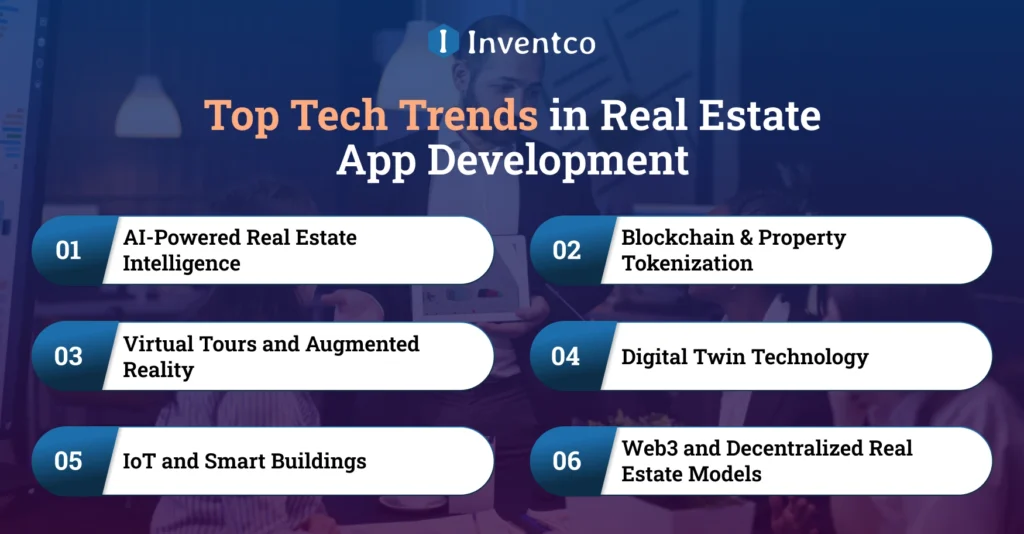
1. AI-Powered Real Estate Intelligence
Let’s be honest: AI is revolutionizing real estate more than any other technology, which makes it one of the most useful real estate tech trends.
In today’s real estate market, consumers want more than basic listings. They seek tailored insights into smart, data-driven properties. Such properties should align with buyers’ preferences, budget, lifestyle, and long-term goals.
Using AI and machine learning, today’s real estate apps offer buyers personalized insights by analyzing historical pricing, community data trends, buyer behavior, and market fluctuations.
AI enhances the experience through:
- Automated property valuations and assessments (AVMs) based on millions of data points.
- Tailored property suggestions based on the behavior of a particular user.
- More intelligent lead scoring on the part of agents and sellers.
- Forward-looking prediction analytics of market movement.
- Chatbots that quickly resolve questions and improve conversion.
The experience of buying a property is unique. The desire for a more personalized experience will drive the next generation of real estate mobile applications to be personalized.
2. Blockchain & Property Tokenization
If AI is the brain of real estate applications, then it’s safe to say that blockchain app development serves as the backbone of restructuring. It’s the technology that simplifies ownership and the way deals are closed.
The absence of paper transactions and the delays that often accompany them may be eliminated. The integration of emerging real estate technology trends in 2026 aims to leverage the benefits of blockchain for speed, transparency, and security.
The most significant potential shift is property tokenization. Users can now invest in real estate through fractional, liquid, and tradable global assets.
Blockchain provides:
- Smart contracts for automated rental and sale transactions.
- Indelible property records.
- Validated on-chain ownership.
- Safe peer-to-peer transactions.
With these characteristics, Blockchain is more than a real estate tech trend; it’s the backbone of next-generation Web3 real estate applications, empowering early users with unprecedented competitive advantages.
3. Virtual Tours and Augmented Reality
Immersive property experiences are among the most significant tech trends in real estate. Let’s face it; today’s buyers don’t want to visualize a home; they want to experience it from the inside.
This is where Virtual Tours and Augmented Reality (AR) come in. 360° VR tours let users travel through a property from anywhere, one room at a time. AR enhances the experience by enabling buyers to see and adjust real-time furniture, floor plans, lighting, and color combinations.
For businesses, this means:
- Increased engagement and extended time spent in the application.
- Lower site visits.
- Decisions made with confidence by distant buyers.
- Improved sales for high-value listings.
AR and VR are not merely a real estate tech trend; they have become a necessity for all real estate platforms of the future as immersive technology becomes increasingly compelling and lucrative.
4. Digital Twin Technology
The year 2026 is expected to showcase Digital Twin Technology as one of the most impressive innovations within real estate technologies, and rightly so; it is remarkable. This technology is changing the design and management of properties, as well as other interactions, in unprecedented ways.
Digital twins in real estate are interactive, real-time, and virtual reproductions of actual structures. They sample and digitally preserve every aspect of the building, such as its design, materials, energy use and consumption, occupancy, maintenance and upkeep, and environmental elements.
In real estate apps, digital twins offer:
- Targeted property monitoring in real-time.
- Detailed predictive maintenance based on IoT data.
- Efficient maintenance planning in intelligent and adaptive smart cities.
- Tailored models for real-time simulation of design and layout for renovation.
Digital twins enable end users to explore virtual properties in real time and allow developers to address the issues and concerns of future property owners quickly. Digital twins will allow the creation of intelligent building ecosystems that facilitate real-time, innovative, and economically viable building management and renovations.
5. IoT and Smart Buildings
The Internet of Things (IoT) is one of the most impressive tech trends to emerge in real estate. IoT in smart homes can transform ordinary buildings into innovative, living, and responsive structures. This is achieved through a level of automation and integration so seamless and invisible that most users do not even notice the technology has been deployed.
The seamless integration of IoT app development in the real estate industry connects building devices and systems. It provides intelligent features such as automated door locks, self-regulating air conditioning, adaptive lighting, and maintenance systems that use machine learning to send alerts before necessary repairs are needed.
For businesses, this means:
- Control of energy resources.
- Cost-effective maintenance.
- Enhanced security management systems.
- Operational supervision in real time.
Regarding users, this tech trend in real estate provides comfort, simplicity, and control like never before. The IoT in commercial real estate will give smart buildings and, more importantly, smart cities in the near future.
6. Web3 and Decentralized Real Estate Models
Web3 is among the significant tech trends in real estate for 2026. Unlike other technologies, Web3 is not about automation or mobile applications. It is about a complete overhaul of the fundamental principles of the real estate market, including ownership, trust, and transaction methods.
The Web3 real estate app advances the field by introducing a model of decentralized real estate where there is no need for intermediaries; ownership is stored on the blockchain, contracts self-execute, and transactions occur seamlessly.
Intermediaries slow the process, and now, with this model, users have transparent visibility into it; businesses can transact on a global scale with speed and increased efficiency while also gaining the level of security expected from Web3 protocols.
Key breakthroughs include:
- Decentralized Property Ownership.
- Fractionalized real estate investments.
- DAO-based property governance.
- On-chain KYC and identification.
- Web3 property marketplaces.
Imagine purchasing real estate as simply as you can a digital asset, now picture achieving ownership with verifiable proof in a matter of seconds, without weeks of drawn-out processes. Web3 technology is making this reality possible by driving innovation in next-gen property apps.
Popular Real Estate Apps for Inspiration
Before creating your next-gen real estate software, it is a good idea to research giants already dominating the real estate market. These platforms have set the standards for user experience, speed, data accuracy, and features, making them the ideal source of inspiration for top real estate app ideas.
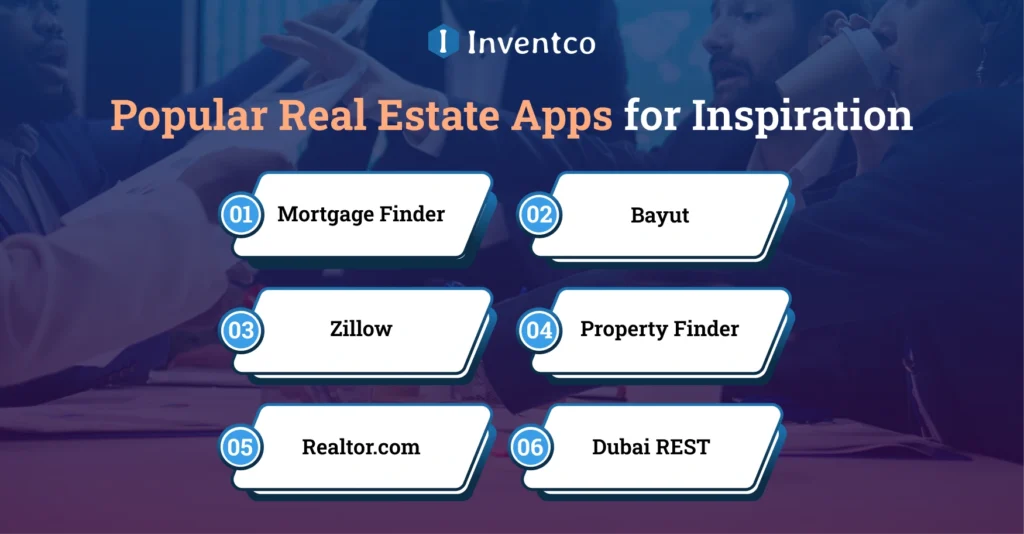
Here are the standout platforms buyers and renters trust worldwide:
1. Mortgage Finder
Mortgage Finder is one of the best real estate apps worldwide and is highly dominant in the UAE real estate market. The real estate app Mortgage Finder is a favorite in the UAE for home loans, eligibility checks, and instant mortgage pre-approvals. The platform’s strength lies in its simplified tools and transparent comparisons, and it is a model fintech company that real estate should strive to emulate.
2. Bayut
Bayut is one of the largest real estate mobile apps in the UAE and offers local listings, in-depth filtering, TruCheck-verified properties, and easy navigation. Their success is a testament to the clean UI and high accuracy of their underlying data.
3. Zillow
Zillow is the king of property search in the United States. It has a large inventory, various mortgage tools, and heat maps, and offers property valuations down to the exact estimate, making it one of the best real estate apps with the latest tech trends. Demonstrates how data and AI, along with a platform, can make a real estate company ubiquitous.
4. Property Finder
Real estate apps like Property Finder are giants worldwide, and especially in the UAE, they are known for their premium design and high trust among brands and listings. Their emphasis on user experience, especially in specific areas, is what made them most competitive in the Middle East.
5. Realtor.com
Realtor.com is one of the best real estate platforms worldwide, recognized for its range of deep market insights, real-time data, and excellent integrations with real estate agents. Realtor.com is a prime example of a platform that leverages the latest real estate trends, paired with strong data and insights.
6. Dubai REST
Dubai REST is one of the most trusted real estate platforms in Dubai, recognized for its official property records, transparent transaction data, and seamless integration with government real estate services. A real estate app like Dubai REST is a prime example of how regulatory-backed data, secure digital infrastructure, and user-focused design come together to deliver clarity, trust, and efficiency across Dubai’s property market.
These real estate softwares are leading innovators in the tech-driven real estate applications industry. These applications serve as templates for other tech real estate applications, as they are market-driven.
How Modern Technology Shaped the Brokerland Real Estate App?
Brokerland is an innovative real estate application designed to streamline property discovery, agent interaction, and transaction processes. Its primary aim is to become a scalable, robust, and competitive high-end real estate application, offering superior functionality and user experience, comparable to the best platforms globally.
Challenge
Brokerland’s unique value proposition is to offer a customized real estate experience. Some challenges are the fragmented datasets, lack of data-driven personalization, and inefficient lead funnelling, all of which have an impact on potential customer engagement. Furthermore, a scalable and future-ready technology stack is needed to address these challenges.
Solution by Inventco
Working alongside Brokerland, Inventco designed and developed real estate applications with cutting-edge technology and high-performance standards to create intelligent and user-centered platforms.
Brokerland employs a mobile-first approach and includes features such as smart and location-based search and real-time chat. For lead generation and agent responsiveness, the application is equipped with advanced analytics and data management tools. The cloud-based tools enhance the reliability and scalability of the application.
Tips to Make Your Real Estate App Future-Proof
Real estate applications will continue to evolve, and the most successful ones will embrace the latest industry trends. Future tech applications will be scalable, secure, and user-friendly.
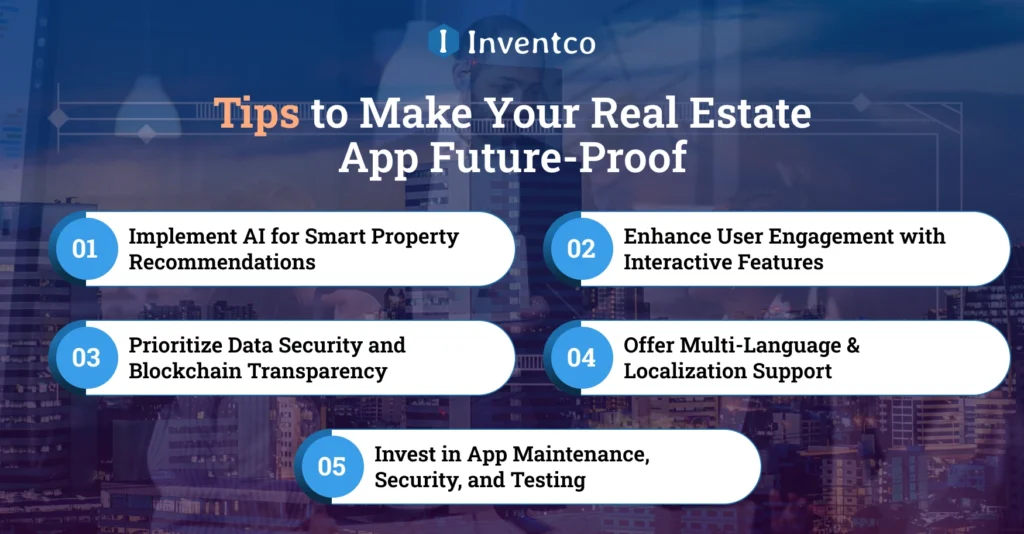
Here are the most essential strategies tech real estate applications can use to stay relevant and valuable.
1. Implement AI for Smart Property Recommendations
With the implementation of AI in real estate apps, the software is now able to provide instant, personalized, and accurate recommendations. With the power of generative AI in a real estate app, it will be able to monitor pricing in real time and analyze location, buyer behavior, and other factors to make recommendations.
2. Enhance User Engagement with Interactive Features
Real estate applications should include digital mortgage calculators, AR/ VR previews, and tools that help buyers understand the neighborhood. These applications should strive to make the property-buying experience enjoyable.
3. Prioritize Data Security and Blockchain Transparency
Records stored on the blockchain are unchangeable and cannot be replicated, thus preventing digital data forgery. Encrypted data can be modified through smart contracts.
4. Offer Multi-Language & Localization Support
Localization includes adjusting to customers’ regional languages, currencies, restrictions, and regulations. Multilingual support and geo-specific listings reassure customers that their preferred language is being catered to, which uplifts engagement across many market segments.
5. Invest in App Maintenance, Security, and Testing
Regular maintenance and security patches, along with mobile app testing, performance optimization, and bug fixing to stabilize and tune application performance, are necessary to keep the application domain reliable and scalable to meet user demands. This is necessary to keep the real estate application future-ready, as user demands shift over time.
Integrating these strategies is necessary to shift user expectations and engagement toward a premium experience, along with market changes, thereby establishing the application within a competitive digital landscape.
How Inventco Helps You Build Future-Ready Real Estate Apps?
Inventco, a trusted mobile app development company, partners with you to transform real estate app ideas into scalable, high-performance digital platforms that deliver measurable business outcomes. With deep PropTech expertise and experience across global markets, we develop mobile solutions aligned with real user behaviour, evolving market demands, and long-term growth strategies. Our business-focused approach helps real estate companies build engaging, reliable, and future-ready mobile applications that create lasting value.
Our approach goes beyond development, we focus on building intelligent ecosystems powered by AI-driven recommendations, secure architectures, and seamless user experiences. From advanced search capabilities to real-time data handling and automation, every component is engineered for performance, reliability, and conversion.
Our proven work with platforms like Brokerland Real Estate App and Naqera demonstrates our ability to solve real-world challenges, including fragmented listings, inefficient lead management, and poor user engagement. By implementing smart filters, real-time communication, and scalable backend systems, we’ve delivered platforms that improve decision-making and accelerate transactions.
With Inventco, you get a technology partner that prioritizes security, scalability, and continuous optimization. From strategy and UX/UI to development and post-launch support, we help you build real estate applications that not only meet market expectations but set new benchmarks.
Conclusion
Artificial intelligence, Web3, automation, virtual and augmented reality, and real-time intelligence technologies are revolutionizing proptech in the real estate sector. Modern real estate platforms require more than just a collection of listings. To meet users’ needs, service offerings require advanced features, ironclad system security, a seamless user experience, and a willingness to innovate. As real estate technology trends advance, the real estate sector will reward those who quickly embrace them.
2026 will be characterized by early adopters of new technologies in the sector, bringing digital experiences to real estate into the mainstream marketplace. The right tech stack and strategy will allow you to transform your digital presence, whether you are a Web3 real estate app developer or seeking to grow your current platform. Expert knowledge of real estate will help you make the sector’s future a reality.
FAQ’s
Q1. What is a Web3 real estate app?
Ans. A Web3 real estate app uses blockchain, smart contracts, tokenization, and decentralized systems to enable secure, transparent, and fast property transactions. It supports fractional ownership, on-chain verification, and automated agreements.
Q2. How does AI improve real estate apps?
Ans. AI enhances property search accuracy, automates valuations, predicts pricing trends, recommends listings, scores leads, and improves user engagement with personalized suggestions.
Q3. What is property tokenization?
Ans. Property tokenization converts real estate assets into digital tokens, allowing fractional ownership. This makes investing more accessible and increases liquidity in traditionally illiquid markets.
Q4. How much does it cost to build a Web3 real estate app?
Ans. Costs to build a real estate app vary depending on features such as blockchain, smart contracts, AR/VR tours, CRM, and FinTech integrations. On average, Web3 real estate app development ranges from $10,000 to $100,000+, depending on complexity.
Q5. Which technologies are best for real estate app development?
Ans. Top stacks include React Native, Flutter, Node.js, Python, Solidity (for smart contracts), AWS, Firebase, and third-party APIs, such as MLS, CRM tools, and mortgage engines.

Ajay Bhal
He is an on-demand app solutions expert with 11+ years of experience in business consulting and building scalable, user-centric digital products. He specializes in robust on-demand platforms across industries, combining technical expertise with business-focused strategy to deliver efficient, top notch solutions that drive growth and enhance user experience. You can connect with him on LinkedIn to follow insights.